FW


Close to 65,722 professional visitors attended at the recently concluded Chic 2017 Autumn edition in Shanghai. Special focus was placed on new and innovative collections as retailers look for high quality and debut luxury collections. In addition, China’s intensive endeavour for a clean planet plays an important role in the fashion business. A ‘Green Thread’ was prominent across the three-day event. Exhibitors presented technological, ecological and contemporary novelties at the fair. In his keynote address, Sun Ruizhe, President, China National Textile and Apparel Council, underlined the importance of sustainability in today´s economy and called it a ‘must’. The initiative ‘One belt, One Road’ also supports the fashion business on the stage of the global fashion industry. Talking about the positive response, Chen Dapeng, Head of Chic and Executive Vice President of CNGA said, “We are never subject to conventions and never stick to past achievements.”
Exhibiting innovations
Around 783 exhibitors from 16 countries and regions presented 815 fashion brands at Chic. Most of exhibitors were from China but many other nations including Denmark, France, Great Britain, India, Pakistan, South Korea, et al, benefitted from this fashion business platform. The event was structured into nine sectors: Urban View, New Look, Kids Paradise, Fashion Journey, Heritage, Impulses, Secret Stars, Superior factory, The Unit. Integrated as Shows-in-show: Chic Young Blood, Shanghai Bag Expo and Preview China from South Korea.
And Andrea Fessura, CEO, Fessura, said, “We are satisfied with our participation within the Italian pavilion. We had many contacts, which are certainly more selected then those we made joining the show outside the Italian pavilion in the past as individual exhibitor. We will definitely join the next show in spring again. Gionata Funari, Sales Manager, Giovanni Fabiani, said, “We never had as many contacts as this edition. Chic is one of the best platforms for us to position our brand successfully in the Chinese market.” Jin, Team leader, Kofoti, South Korea was satisfied with the participation. This time, they were focussed on designer brands. The visitor number at their pavilion was not as high as in March but the results were good. The got good orders.
Novelties on display
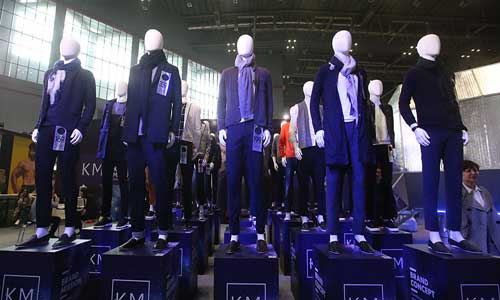
Among the innovative offerings, Shaoxing pavilion offered an emphasis to smart casualwear. Among the exhibitors were 13 formalwear enterprises, next to ‘bespoke’ exact measuring manufacturers presenting their collect ions. Bespoke menswear was one of the leading topics at Chic Autumn with Cezon, Aspop, Taizhou Goldjitai Garment, Long-Sailing and Jinyuanyang, being specialists in this field. The popularity of bespoke services is a direct reflection of the market´s need for individuality and customisation. Even jeanswear brand In Cell introduced its bespoke services at Chic.
Within Kids Paradise, school uniform brands Eton Kidd And Yuanlou displayed innovations such as garments with anti-bacteria, waterproof, anti-fouling and anti-allergic effects. Yuanlou presented its wearable position function that allows locating the child. Eton Kidd held a seminar on the importance of social responsibility in the field of school uniforms, realised by the use of environmental as well as health friendly materials.
Country pavilions
Elegant womenswear, menswear, shoes and fashion accessories were showcased at the Italian Pavilion as well as the French pavilion ‘Paris Forever’ in the international area Fashion Journey. The Korean participation, Preview in China, focussed on designer brands this time and received a lot of attention. Individual exhibitors from Canada, Denmark, and Greece showed their latest collections of cashmere womenswear, hats and jewellery.
Eco-emphasis
The Sustainability Zone, premiering at Chic and organised by the China National Textil and Apparel Council, wa attended by numerous visitors. Next to fashion manufacturers presenting their latest innovation on environmental friendly production methods and social responsibility initiatives, it hosted the China Fashion Forum, which was focussed on CSR. Environmental-friendly initiatives were launched by many companies, such as Fruit Dye from Foshan City, Guangdong Province, dying textiles 100 per cent without chemical additives, or the development of a coffee carbon fibre produced from coffee residues by Shanghai Different Chemical Fibre belonging to Shangtex Group Shanghai. This idea will be taken ahead in the upcoming event to be held in March with the introduction of the area Chic Green presenting eco-friendly fashion.
The next edition of Chic Shanghai March will take place from March 14 – 16, 2018. Its focus will be directed at the upgrading and evolution of creative, design-oriented fashion, at the same time, increasing intelligent service and support to meet all needs of the new retailing modes.
Global Sources Fashion is being held in Hong Kong from October 27 to 30. This is a fashion sourcing event and has 1,800 booths of apparel, fashion jewelry, underwear, swimwear, bags, luggage, scarves, footwear and fabrics. It has exhibitors from Greater China, South Korea, Bangladesh, India, Indonesia, Kenya, Vietnam and the Philippines.
Exhibitors include OEM, ODM and OBM suppliers, plus emerging designers and fashion technology practitioners. The show allows thousands of international buyers to discover a large variety of in-trend fashion items to drive sales for upcoming seasons.
Global Sources Fashion hosts the largest collections of bags and luggage, footwear, and sports fashion in Hong Kong. It also features 400 brand new exhibitors and more than 450 exhibitors who promote their own designs and brands. The app enables buyers to shortlist exhibitors, find booths, take pictures and then follow exhibitors after the show. A newsletter provides daily reports and live videos on the hottest products.
Models will showcase designs from rising designers and exhibitors. There will be forums on color trends for autumn/winter 2018-19 and women’s fashion and accessories forecasts for spring/summer 2018. Sourcing experts will cover new technologies along with sourcing tips. The Fashion Tech Zone will showcase smart, eco-friendly and innovative designs. There will be a display of unique products from emerging markets including Vietnam, Indonesia, India, the Philippines, Laos and Cambodia.
For the first quarter, Bangladesh’s footwear exports rose eight per cent over the same period last year. During the first three months of the current fiscal, Bangladesh’s earnings from footwear exports to the Netherlands alone registered a 35.57 per cent year-on-year growth. Export earnings from Spain grew by 47.06 per cent. Export earnings from Poland grew by 51.88 per cent and earnings from Canada showed a 15.39 per cent growth.
International buyers are expanding their sourcing markets to maintain their profit margins without increasing retail prices, which in turn has opened up opportunities for Bangladeshi footwear makers. Bangladeshi companies like Apex Footwear, Bay Footwear, Jennys Shoes, Bengal Shoe industries, Leatherex Footwear, and 30 other manufacturers are exporting footwear items across the world. Apex makes 15 per cent of Bangladesh’s total footwear exports.
The country’s footwear industry has experienced a meteoric rise in the past decade. Total footwear exports grew from $68 million in 2004 to $777 million in 2016-17. This year’s target for footwear exports has been fixed at $870 million. The target for footwear and leather exports is more than $2 billion by 2018 and $5 billion by 2021.
The quality of Bangladeshi footwear, lower production cost due to the comparatively cheap labor, and duty facilities for EU market are helping footwear makers boost their exports.
India has new duty drawback rates on garment exports from October 1, 2017. Duty drawback can be understood as the refund of the duty that was paid for the imported raw material used in the production of the exported products to the exporter.
Sustained export growth is essential to maintain and accelerate GDP growth, increase employment and reduce poverty. To encourage exports, duty drawbacks are offered to exporters, which will make their products more competitive in overseas markets.
For goods that have been imported in the country, on payment of duty, and then are being exported within a specified time period, the customs duty paid for the product import can be claimed as the duty drawback with certain cuts. The duty drawback scheme provides a rebate of the duty that is chargeable on the imported or excisable goods used in manufacturing of the exported product.
However, Indian garment exporters are already facing severe competition globally from countries like Bangladesh, Sri Lanka, Cambodia, and Vietnam. This rate cut is going to further elevate the costs of Indian garments, which will push Indian exports further back. Since 80 per cent of garment units in country belong to the small and medium category, this rate cut is expected to lead to huge job losses.
Lenzing has launched Refibra, a cellulosic fiber made from chemically recycled material that includes post-industrial cotton scraps and wood. Dubbed as the new generation of Tencel, Refibra is Recycled Claim Standard–certified and is made using a process that allows companies to identify the Refibra fiber in a finished garment. This guarantees transparency in the overall processing chain. For customers it is important to know whether the fiber made from recycled material is really in the textiles they have purchased.
At the October Kingpins Amsterdam, denim designer Adriano Goldschmied introduced a denim capsule collection made with Refibra. The capsule collection features 15 women’s and men’s styles.
Goldschmied has been designing denim since 1972, and he has been working with Tencel since the 1990s. He has long been an advocate for product development in the denim industry with less impact on the environment without compromising consumer demand for comfort and fashion.
Refibra fibers are made from pulp that contains cotton scraps left over from cutting operations and wood. The fibers are produced in the lyocell production process. Worldwide, Lenzing is the first manufacturer to offer cellulose fibers featuring recycled material on a commercial scale and is a pioneer with this technology. Reducing the need to extract additional raw materials from nature lowers the impact on natural resources. Thus Refibra fibers have initiated an important step towards circular economy for textiles.
Pakistan’s hosiery manufacturers and exporters say the delay in restoring zero rate regime is holding back textile makers from modernizing their industrial units. They want the zero rate regime for five export sectors. Industrial units face high power, gas and water rates.
A reduction in inputs costs is a long running demand of the country’s value-added textile exporters. They say this will help make Pakistan's exports competitive on world markets. Instead the soaring cost of inputs is hindering the country’s apparel textile growth. One point exporters make is the minimum wage in Pakistan is 111 per cent higher than in Bangladesh. A 20 per cent reduction would enable Pakistani exporters to compete with regional competitors. Similarly gas rates for the textile sector should also be reduced by 20 per cent.
A 0.25 per cent Export Development Surcharge is imposed on export proceeds. Exporters say the EDF should be placed on luxury imported goods like cars, soaps, shampoos, cosmetics and finished items and should be abolished from exports. Apparel textile makers want freedom to import yarn, fabric and other key raw materials. They say a four per cent incentive should be given on indirect exports of yarn/local sale on domestic markets.
In the second quarter of 2017, global yarn production rose by 11 per cent. It increased in Asia, Europe, and Brazil and slightly declined in the US. The growth drivers are: Asia and Brazil with their respective 12 per cent and 11 per cent increases. Yarn production decreased by 10 per cent in the US and by 18 per cent in Africa since the first quarter of 2017.
Global fabric production improved by almost nine per cent in the second quarter of 2017, with the most significant increase in Brazil, Asia, and Africa (10.4 per cent, 9.8 per cent and 9.2 per cent respectively). The output in the US and Europe remained stable. The situation has improved compared to the same period last year, with an increase of global fabric output of almost four per cent.
Global yarn stocks have also improved compared to the same quarter a year earlier. Global yarn orders have fallen in all regions in the second quarter of 2017. Worldwide fabric stocks increased a little, with the most significant change observed in Brazil for the second quarter in a row. Asian and European fabric orders remained stable and rose in Brazil and Africa. In comparison to the second quarter of last year, Asian and Brazilian fabric orders declined significantly, while they slightly increased in Europe and Africa.
Eastman has launched Naia, a sustainable fiber with easy-care attributes. The fiber is made from wood pulp from fast-growing pine and eucalyptus trees sourced from certified forests. Eastman does not use pulp that contains any endangered or ancient species. The trees are subject to an established certification process.
Eastman has been making cellulosic fiber for decades. Its acetate fibers were successful in the fashion market, but there were some drawbacks. Many of the fabrics had to be dry-cleaned to maintain color fastness and prevent shrinkage. The company saw an opportunity to reformulate and upgrade its acetate yarns as well as change the processes used to dye and finish the fibers and yarns. The result is Naia.
Although Eastman launched Naia for the intimate apparel market, the company sees applications for the fiber throughout the fashion apparel market. It has a wide versatility in terms of the substrate as well as the designs possible. Knits, wovens, velvets can be done. Texturized yarns can be done. Twisted materials can be done, giving a crepe-like appearance on the fabric.
The fiber and yarns take colors well, and Naia can be used alone or blended with other fibers. Naia is a thermoplastic material, which means mills can apply heat to the fabric to change its appearance and give the final fabric a leather look.
World Fashion Convention was held in Brazil from October 17 to 18. The concept and the theme of the convention was: Compliance and Technology – Key Drivers for Industry and Retail, were very much in line with International Apparel Federation’s mission to unite the industry to help improve it.
Among those attending were the chief purchasing officers of major apparel brands and retailers. In addition to excellent speakers, delegates were treated to a great display of Brazilian hospitality and zest for life. Brazil is a people oriented country. Speakers from Brazil and from abroad made clear that the solutions to the many challenges in the fashion industry hinge around the ability and the willingness of people to embrace far reaching changes.
One presentation set the stage highlighting the amount of investments the industry still has to make to actually digitise the supply chain by stating that 64 per cent of the firms questioned spend less than one per cent of their sourcing value on digitisation.
On compliance, both C&A and PVH stressed the importance of changes in buying behavior permeating throughout the organization so that the strategy set out by the corporate social responsibility and sustainability officers really affects the entire operation and that suppliers receive the same message from all buyers’ representatives.
Accord on Fire and Building safety, the legally binding initiative to ensure safe workplaces for readymade garment factory workers, will continue beyond its May 2018 deadline as the local regulatory body is not ready yet in Bangladesh. It would continue operations until the local regulatory body demonstrated 'full capacity to inspect factories, compel remedies, and protect workers'.
According to a statement, the government confirmed last week it would extend permission for accord to continue beyond May 2018 until a joint monitoring committee, comprised of accord brand signatories, accord trade union signatories, BGMEA, ILO and the government, agreed that the "stated conditions" for a handover are met. The readiness conditions include demonstrated proficiency in inspection capacity, remediation of hazards, and enforcement of the law against non-compliant factories, full transparency of governance and remediation progress, and investigation and fair resolution of workers’ safety complaints.
Jenny Holdcroft, IndustriALL Global Union Assistant General Secretary and Accord Board member, stated they have always aimed for the Accord functions to transition to a national regulatory body provided that the full capacity, transparency, and governance are in place and that it can be assured that the worker protections under the Accord continue to be safeguarded.
Accord wanted to continue operations for three more years and signed a new agreement in June this year. The High Court on Oct 16 halted the new accord between the fashion brands and trade unions, asking why it should not be cancelled for signing without permission from the government, owners and workers of the country.
Accord and Alliance for Workers Safety were formed after the deaths of over 1,100 workers in the 2013 Rana Plaza collapse raised concerns among the buyer countries over workplace safety in Bangladesh. As per the commerce minister the Alliance is winding up its operations by the May 2018 deadline.