

As we present this feature as part of our year-end series, 'Wrap Up 2025, Outlook 2026', the global textile and apparel industry is clearly moving beyond a simple calendar change. We are entering a period of "Radical Transparency" where the core of international trade is being rewritten. For decades, the primary hurdles in global trade were physical: quotas, shipping bottlenecks, and tariff brackets. However, as 2025 closes, a new barrier has emerged between manufacturing hubs like Dhaka and retail shelves in Paris. This wall is not made of brick or taxes, it is made of data.
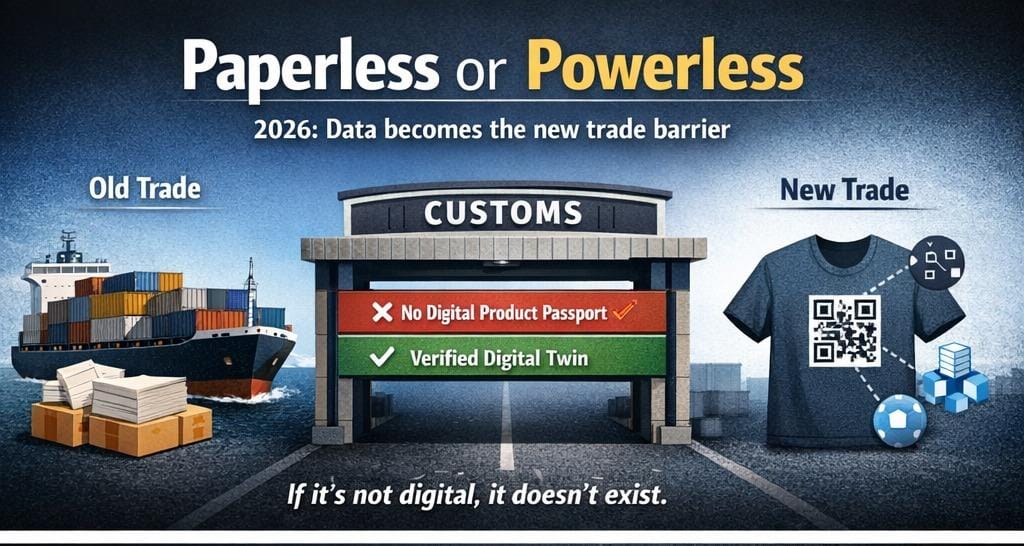
The European Union’s Digital Product Passport (DPP), the regulatory centerpiece of the Ecodesign for Sustainable Products Regulation (ESPR), has moved from a boardroom concept to a mandatory operational requirement. With the EU’s central digital registry scheduled to become operational by July 2026, the mandate for global exporters is absolute: if a garment lacks a "Digital Twin"—a blockchain-verified record of its journey from fiber to finish—it is effectively invisible to customs authorities. In the high-stakes trade environment of 2026, being paperless increasingly means being powerless.
The Great Decoupling: Why data infrastructure outweighs labor cost
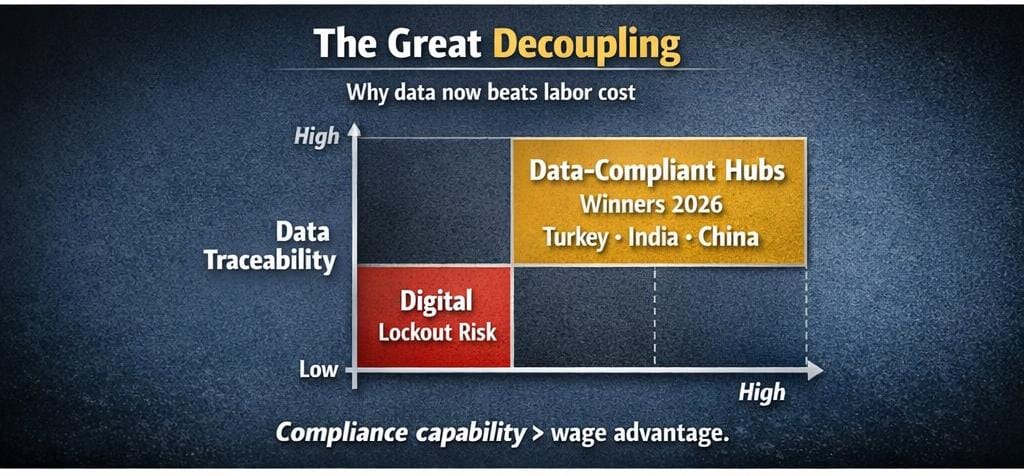
For thirty years, sourcing was a drive to minimize labor costs. In 2006, the industry moved toward speed; in 2016, toward quality. But as we map the 2026 trade landscape, a fundamental separation has occurred. Geography and proximity are being superseded by "Data-Traceability." Today’s C-Suite leaders recognize that a factory’s digital infrastructure; its ability to feed real-time, granular ESG metrics into a brand’s API, is now a more critical asset than its hourly wage rate. This has birthed the "Data-Compliant Hub." Countries like Turkey, with its integrated "Smart Mills," and India, leveraging its IT prowess to offer "DPP-as-a-Service," are emerging as the new victors. Conversely, regions that failed to digitize their Tier 2 and Tier 3 suppliers during the 2024-2025 transition are facing a "Digital Lockout."
The 2026 Macro-Indicator dashboard
The transition toward a data-centric trade model is reflected in the following market premiums and risk indicators observed as we enter the new year. These figures represent the emerging "Transparency Premium" that now dictates contract negotiations.
|
Indicator |
Market Impact (2025 Wrap Up) |
Forecasted Impact (2026 Outlook) |
|
Transparency Premium |
8-10% for verified organic cotton |
12-18% for full blockchain-traceable fiber |
|
Customs Rejection Risk |
<1% (Physical non-compliance) |
5-7% (Digital data discrepancies) |
|
Resale Value Multiplier |
15% for brand authentication |
35% for garments with full DPP history |
|
Non-Compliance Penalty |
Financial fines/Audit failures |
Total Market Exclusion / Port Impoundment |
Global Trade Scorecard: Winners, losers, and strategic outlook
The 2026 trade map is being redrawn based on a nation’s ability to prove its "Rules of Origin" through digital threads. Sourcing destinations are no longer judged solely on output volume but on the integrity of their data exports.
|
Country / Region |
2026 Trade Outlook |
Key Indicator: DPP Readiness |
Trade Policy & FTA Situation |
|
Turkey |
Winner |
High: Native blockchain integration in integrated mills. |
Near-shoring advantage; leveraging EU Customs Union for seamless data flow. |
|
India |
Rising |
Medium-High: PM MITRA parks and PLI 2.0 mandated for digital tracking. |
FTA with EU/UK hinges on digital verification of "Technical Textiles." |
|
Vietnam |
Vulnerable |
Medium: Automated at Tier 1; significant "Data Gaps" in raw material Tier 3. |
EVFTA benefits at risk if sustainability metrics cannot be digitally audited. |
|
Bangladesh |
Critical |
Low-Medium: High "Green Factory" count but lacks mid-stream data stacks. |
Transitioning from LDC status; urgent need for "Compliance-first" capex. |
|
China |
Pivot |
High: State-led green supply chains and proprietary "Trace-Tech." |
Moving from "World's Seamstress" to "World's Textile Tech Provider." |
The Regulatory Landscape: From voluntary to verified
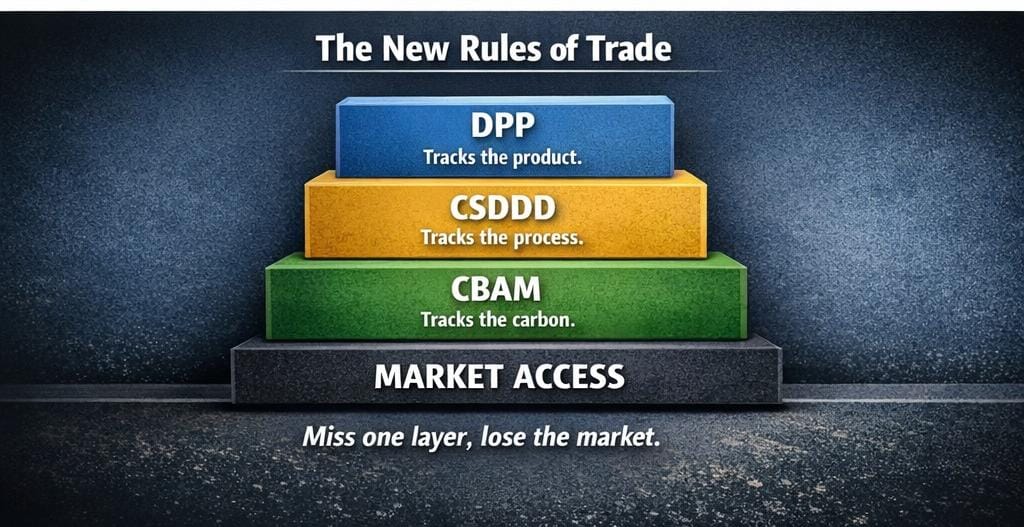
The transition into 2026 is marked by the hardening of voluntary standards into strict legal frameworks. Beyond the DPP, the industry is grappling with the Corporate Sustainability Due Diligence Directive (CSDDD), which now mandates that companies take legal responsibility for environmental and human rights violations within their entire value chain. This regulatory pressure is amplified by the EU’s Carbon Border Adjustment Mechanism (CBAM), which has begun its data-collection phase for high-impact textiles. These regulations work in tandem to create a "triple threat" of compliance: the DPP tracks the product, the CSDDD tracks the process, and CBAM tracks the carbon. For manufacturers, this necessitates a complete overhaul of internal auditing. Compliance is no longer a periodic check but a continuous stream of verified data points.
Strategic Leadership: The CCO as the new power broker
This regulatory shift has fundamentally altered the organizational chart of the modern apparel house. The Chief Compliance Officer (CCO), once a back-office administrator, has emerged as the most influential broker in the boardroom. In 2026, the CCO often holds veto power over the Procurement Director; if a supplier cannot meet the "Data Package" requirement, the contract is dead on arrival, regardless of the price.
Strategic leadership is now defined by "Active Governance." CEOs are no longer satisfied with annual audits. They are deploying AI-augmented GRC (Governance, Risk, and Compliance) systems—digital agents that monitor the "digital shadow" of the supply chain in real-time. These systems can detect a "red flag"—such as an unverified cotton shipment or a spike in carbon intensity at a dyeing house—long before the physical goods reach a port of entry.
The "DPP Gold Rush" and the Tech-Sourcing nexus
The 2026 deadline has birthed a multi-billion dollar "Traceability Tech Stack" industry. Startups like Fashion Data (France) have moved beyond simple tracking; they use predictive algorithms to align DPP data with inventory, slashing the "guesswork" that led to the overproduction of the early 2020s. Retailers are no longer just selling clothes; they are selling "Data Packages" attached to garments. Consumers now scan QR codes not just for a "Made in" label, but to access repair instructions, recycled content percentages, and carbon footprint scores. This transparency has turned compliance into a competitive advantage: brands that embraced DPP early are reporting 15-20% higher customer loyalty scores, as traceability becomes the new hallmark of luxury and trust.
Editor’s Conclusion: The dawn of the "Trust Currency"
As we wrap up 2025, the narrative of the textile industry has changed from volume to veracity. The Digital Product Passport is not merely a bureaucratic hurdle; it is the new "Trust Currency" of global trade. For the C-Suite, the mandate for 2026 is clear: the era of "don't ask, don't tell" sourcing is officially over. The leaders who will thrive are those who stop viewing compliance as a cost center and start viewing it as the ultimate business intelligence tool. In a world where every stitch is recorded and every fiber is followed, the most successful brands will be those whose digital stories are as seamless as their physical seams. The 2026 trade map is being redrawn, and the ink is made of data.










