By early 2026, the European textile and apparel sector finds itself at a crossroads that challenges traditional market logic. Unlike typical cyclical downturns, the industry is now confronting a crisis, the so-called Sovereign Fibre Trap where Western capital discipline collides with China’s state-integrated industrial strategy. European producers, bound by return-on-investment imperatives and cost transparency face competitors who operate under a radically different set of rules. China, through state-backed conglomerates and multi-year industrial planning, has effectively decoupled fibre production from conventional profit motives, transforming polymer and yarn manufacturing into a strategic lever for global market dominance.
The structural shock in fiber economics
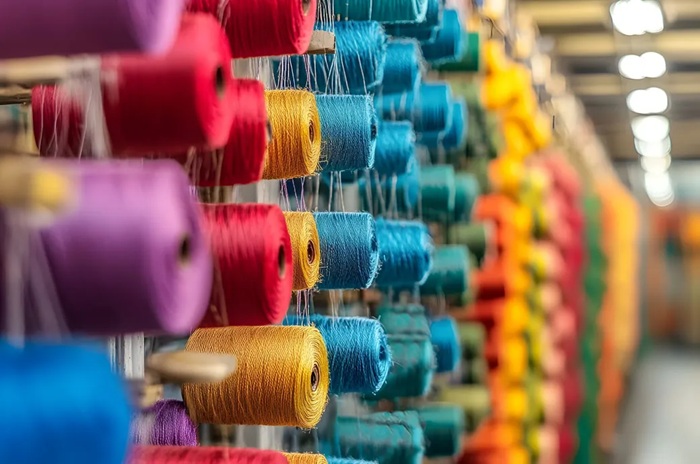
The crisis stems from a fundamental asymmetry in how midstream conversion is valued. In Europe, transforming petrochemicals into polymers and yarns is treated as a commodity business: margins dictate operational viability, and plants close if profitability disappears. In China, however, this stage is subsidized under the 15th Five-Year Plan (2026-30), allowing state-supported firms to absorb losses in polymerization and extrusion to secure downstream market dominance. The result is a surge of ultra-low-cost polyester and nylon flooding global markets.
What was once considered a theoretical risk, the Sovereign Fibre Spread has now become industrial reality. In the past year, numerous European polyester assets have been mothballed or repurposed for upstream chip production to avoid head-on competition with subsidized Chinese spinning. This marks an irreversible investment strike, where capital is permanently exiting the European textile midstream rather than waiting for a market rebound.
The price divide: Europe vs. China
The divergence in industrial strategy has created a striking price disparity that underlines Europe’s disadvantage. Recent market data from Q4 2025 illustrates the challenge: while European producers shoulder higher energy costs and stringent carbon compliance, Chinese pricing reflects the advantage of state-backed logistics and energy subsidies.
Table: Regional Recycled PET (rPET) Price Comparison (Q4 2025)
|
Region |
Price ($/metric ton) |
Market context |
|
Germany |
$1,351 |
High energy costs; stringent environmental certification. |
|
US |
$1,233 |
Softening demand; focus on strengthening domestic supply chains. |
|
China |
$755 |
Persistent oversupply; benefit of state-integrated industrial scale. |
|
India |
$770 |
Emerging production capacity; highly competitive regional supply. |
The table makes the gap starkly evident: European rPET costs nearly $600 more per ton than Chinese equivalents. For Western brands, sourcing locally has become economically irrational without intervention in tariffs, carbon pricing, or supply chain transparency.
Sustainability undermined by import deflation
Europe’s sustainability ambitions are also colliding with market realities in an ironic twist. Circular economy mandates, intended to give European companies a competitive edge in recycled fibers, are undermined by imported deflation. Massive Chinese overcapacity in virgin polyester has driven global prices so low that recycled PET in Europe trades at a premium.
As a result, European recycling facilities are under pressure: brands often find it cheaper to purchase subsidized virgin imports than invest in local rPET. Global recycled polyester’s market share slipped to 12.5 per cent in 2025, down from 13.6 per cent in 2022, even as virgin polyester production rose to 71 million tonnes, largely due to Chinese expansion. This green inversion highlights how environmental ambition without trade enforcement can inadvertently accelerate de-industrialization.
From fashion to strategic asset
The implications of this industrial retreat extend beyond consumer fashion into critical technical textiles used in defense, medical supplies, and automotive filtration. Industry advocates, led by EURATEX, are now pushing for a reclassification of synthetic fibers as strategic material, emphasizing their role as essential infrastructure rather than mere consumer products. At the February 2026 European Industry Summit, leaders called for a mindset shift, urging policymakers and industry stakeholders to treat textiles as a strategic sector, vital to national security and technological sovereignty.
The wave of industrial rationalization
The Sovereign Fibre Trap has already claimed substantial ground. Between late 2024 and 2025, multiple European assets were forced into permanent closure or restructuring due to compressed global margins:
• Oxxynova DMT (Germany) – Ceased production of DMT, a key polyester precursor.
• Artlant PTA (Portugal) – Declared insolvency under global price pressure.
• Plastiverd (Spain) – Halted PET production in November 2025.
• Indorama Ventures (Rotterdam) – Undertook significant restructuring of PTA/PET operations to mitigate losses.
Europe’s textile sector, valued at $274 billion, remains a global leader in high-end fashion and technical fabrics, employing 1.3 million people across 197,000 companies. Yet, as the global market swells to $660 billion, the EU segment faces an existential pivot. Historically reliant on decentralized efficiency, Europe now confronts the necessity of tech sovereignty, particularly as Chinese firms file 17 times more patents in textiles than the EU, consolidating their lead in both scale and innovation.
A path forward
Dealing the Sovereign Fibre Trap will require Europe to rethink both industrial policy and market strategy. Capital discipline alone is no longer sufficient when competitors operate under a different logic, integrating loss-leading operations as part of a broader state-backed plan. Europe’s challenge lies in balancing sustainability goals with competitive viability, incentivizing local production, and investing in technological innovation to regain control over synthetic fiber production.
Without decisive action the continent risks further de-industrialization, relinquishing both midstream control and the strategic capabilities underpinning its high-end textile and technical fabric sectors. The Sovereign Fibre Trap is not merely an economic challenge it is a test of Europe’s industrial resilience in the age of state-directed global competition.