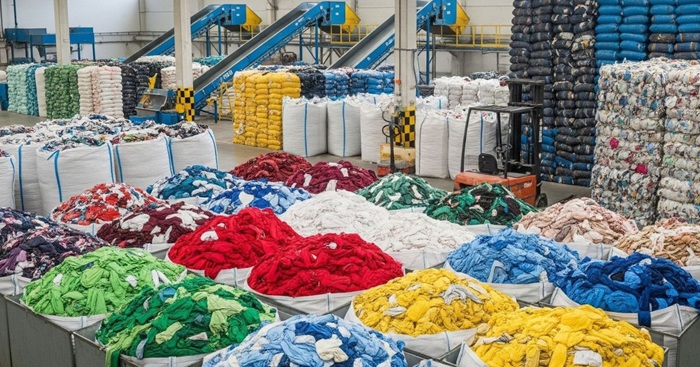
Europe’s apparel majors are no longer treating circularity as a branding layer. With Project FAE or Feedstock Activation Europe, the industry has entered a harder phase of capital formation: building the missing industrial infrastructure that turns textile waste into usable raw material. What makes this consortium, backed by adidas, Inditex, Bestseller and more than 40 ecosystem players, especially significant is not the sustainability rhetoric but the economic logic. The sector’s biggest bottleneck is no longer collection; it is conversion.
The European Union’s separate textile collection regime has increased waste capture, but that success has exposed the next systemic failure. Warehouses are now filled with non-rewearable garments that remain commercially unusable because recyclers cannot process contamination-heavy, blended, trim-laden post-consumer waste at industrial scale. In market terms, Europe is long on waste inventory but structurally short on recycler-grade feedstock. That mismatch is now emerging as a multibillion-dollar supply inefficiency.
Project FAE’s insight is simple but transformative: the highest-value intervention sits in pre-processing. Instead of treating discarded apparel as municipal waste, the consortium is repositioning it as an upstream commodity stream that requires standardization, grading and purification before entering the recycling value chain. In effect, Europe is building a textile equivalent of midstream refining.
The blend bottleneck
The hardest constraint remains the modern garment mix itself. Roughly four out of five garments sold globally are no longer mono-material products. Polyester-cotton blends dominate, frequently complicated by even marginal elastane inclusion. That seemingly small 1-5 per cent elastane ratio has an outsized industrial impact, destabilizing chemical depolymerization systems and degrading mechanical recycling outputs.
This is where Project FAE shifts from sustainability narrative to deep-tech operations. By deploying Near-Infrared spectroscopy, automated disassembly and polymer-sensitive sorting systems, the consortium is effectively building purity intelligence into the first mile of waste processing. The ability to isolate polyester from cotton without chain degradation could materially alter the cost curve of textile-to-textile recycling.
The market implications are substantial. Polyester is poised to become the fastest-scaling recycled textile segment precisely because depolymerization economics improve sharply once contamination rates fall. That makes feedstock quality, not collection volume, the real driver of enterprise value in Europe’s next circularity cycle.
Table: European textile recycling market dynamics
|
Material Segment |
2025 market share (Europe) |
Projected CAGR (2026-33) |
Primary challenge |
|
Cotton |
71.10% |
3.80% |
Fiber length degradation |
|
Polyester |
18.40% |
6.20% |
Chemical purity/Elastane |
|
Wool/Other |
10.50% |
2.50% |
Collection volume |
The table reveals the strategic asymmetry driving Project FAE. Cotton remains dominant by share, but its lower growth profile reflects physical degradation limits in repeated recycling cycles. Polyester, despite a smaller current base, is the growth engine because successful chemical purification unlocks near-virgin quality output. This explains why so much consortium attention is centered on blend separation and elastane extraction. The real prize is not waste diversion but polyester circularity at scale.
The rise of textile refineries
Perhaps the most investable dimension of Project FAE is its regional hub architecture. Europe’s circular chain has long suffered from fragmented collection geographies and prohibitively expensive manual sorting. The green premium attached to recycled fiber has therefore been less about technology failure and more about poor network design.
Regional pre-processing hubs fundamentally change this equation. By concentrating high-throughput automation in Northern Europe and Iberia, the consortium is introducing volume aggregation, logistics compression and standardized output protocols. These hubs are best understood as textile refineries industrial nodes that convert chaotic waste inputs into spec-compliant feedstock streams.
For recyclers such as Infinited Fiber Company and Circ, this pattern reduces inbound variability, improves plant utilization and lowers rejection risk. For brands, it creates the possibility of long-term recycled fiber procurement contracts that are closer to commodity purchasing than sustainability experimentation.
Data as the new sorting margin
The most commercially compelling pilot within the FAE framework lies in the convergence of Digital Product Passports and optical sorting belts. Historically, sorting economics have been undermined by information asymmetry. A batch visually categorized as cotton-rich could still be rejected downstream because of hidden nylon or elastane contamination.
By integrating DPP-linked composition data with optical systems capable of scanning multiple garments per second, partners such as Texaid and Boer Group are closing the quality gap at source. A projected 35 per cent reduction in recycler rejection rates has direct balance-sheet consequences: lower wasted logistics, better throughput efficiency and superior yield predictability.
In cases of Inditex for example, which has public 2030 preferred-fiber commitments, this is less an ESG milestone and more a procurement de-risking mechanism. Better data reduces volatility in recycled input sourcing and strengthens forward visibility on compliance-linked raw material costs.
Regulation turns circularity into margin defence
Thus Project FAE should be read as margin defence infrastructure. The EU’s eco-modulated Extended Producer Responsibility framework and the 2026 Circular Economy Act are converting poor recyclability into a direct profit and loss liability. Waste fees tied to garment design complexity effectively create a tax on bad product architecture. For large-volume retailers, a 2-4 per cent net margin drag is material enough to alter sourcing, product design and capital allocation strategies.
This is why Project FAE’s importance extends beyond waste management. It is becoming a strategic hedge against three pressures: rising EPR liabilities, virgin polyester price volatility linked to petrochemicals, and tightening disclosure rules under Digital Product Passport systems. In that sense, Europe’s fashion giants are not merely investing in recycling. They are building a new raw-material risk management layer.
The most important institutional evolution here may be Fashion for Good itself. Once seen primarily as an innovation accelerator, it is now functioning as a market architect, coordinating brands, recyclers, collectors and infrastructure providers into a system-level industrial thesis. Its ambition to lift Europe’s textile circularity rate to 24 per cent by 2030 is not simply an environmental target. It is a supply-chain redesign agenda that seeks to formalize textile waste as a secondary raw materials market.
The deeper market lesson is clear: circularity is moving from brand narrative to industrial asset class. The winners in this phase will not merely be the best recyclers, but the companies that control the feedstock gateways. And that is precisely why Project FAE may become Europe fashion’s most consequential midstream bet of the decade.