When Ingka Group committed €1.2 billion to broad price reductions across its European network, the move was seen as a tactical defence. In mature markets across the UK and Europe, persistent inflation had curbed consumer willingness to invest in home renovations, pushing customer sentiment toward three-year lows. By reducing shelf prices by up to 28 per cent on signature items like the Billy bookcase and the Kallax shelving unit, the world’s largest furniture retailer chose to accept lower operating margins simply to protect sales volumes and maintain store footfall.
Yet in India, price adjustments do not stem from consumer fatigue. Instead, pricing serves as a wedge into a market estimated at over $27 billion, where nearly 80 per cent of trade remains locked in fragmented, unorganized neighborhood workshops. Rather than treating India as another destination for standardized global merchandising, the retail giant dismantled its orthodox operational template to establish commercial relevance.
Table: IKEA’s European and India strategy an overview
|
Attribute |
European strategy |
Indian strategy |
|
Commercial Intent |
Defensive volume protection against high inflation |
Gain share from unorganised furniture trade |
|
Pricing Calibration |
Margin-diluting cuts across mature SKUs |
20% to 30% below Western baselines; 1,000+ items priced sub-Rs 200 |
|
Assembly Model |
Self-directed DIY (consumer absorbs assembly labor) |
Service-assisted ‘Do-It-For-Me’ (in-house teams + Urban Company) |
|
Procurement Base |
Established cross-border pan-European supply networks |
30% domestic sourcing baseline, moving towards 50% |
|
Format Deployment |
High-density suburban big-box stores + high-street boutiques |
Flagships, urban mini-centres and Lykli hubs |
Moving away from the DIY
The most visible operational difference was at assembly staheg. In Western markets, self-assembly is an implicit trade-off: the shopper gives the final mile of labor, and the merchant lowers the ticket size. In India, consumer expectations run entirely in the opposite fashion. Households operate within a deeply entrenched service freamework, relying on skilled neighborhood carpenters for home fitting. Unassisted flat-pack furniture initially generated issues, threatening conversion rates for first-time visitors.
To resolve this bottleneck, the retailer moved away from unassisted assembly, deploying an in-house installation squad of 150 carpenters while establishing an operating partnership with on-demand home-services platform Urban Company. The commercial terms were reworked for local conditions: 30-minute assembly visits were introduced at Rs 250, compared to comparable TaskRabbit bookings in the US that routinely start above $36.
Thus IKEA bridged the gap between flat-pack design and Indian lifestyle habits. This service-assisted focus reflects a wider reality across India's consumer and home goods sectors, where convenience and assisted delivery frequently outrank pure self-service across middle-class demographics.
Sourcing compliance turns beneficial
International lifestyle, apparel, and furnishing brands entering India under single-brand FDII rules have often viewed the mandatory 30 per cent domestic sourcing rule as a restriction. IKEA instead used the requirement to insulate its domestic cost structure.
Having sourced textiles and industrial goods from Indian vendors for global operations over decades, they established local supply sources covering mattresses, metals, plastics, and cotton. The domestic sourcing share has moved from 30 per cent mandate toward an operational target of 50 per cent. This has shielded the Indian business from international shipping hikes, import tariffs, and foreign exchange swings that have hit import-dependent consumer labels.
As the company works through a Rs 21,000 crore capital expenditure program targeting 30 mixed-format locations and an Rs 8,000 crore annual revenue goal by 2030, deep domestic procurement has become an operational safeguard. What began as an FDI compliance condition has evolved into a strategic buffer against input-cost volatility.
Smaller stores for dense urban core
The traditional blue-box flagships of over 400,000 sq. ft. with extensive parking real estate, faces geographic limitations in India's metros. High land acquisition costs, infrastructure congestion, and multi-hour commutes turn trips to suburban stores into infrequent, full-day excursions.
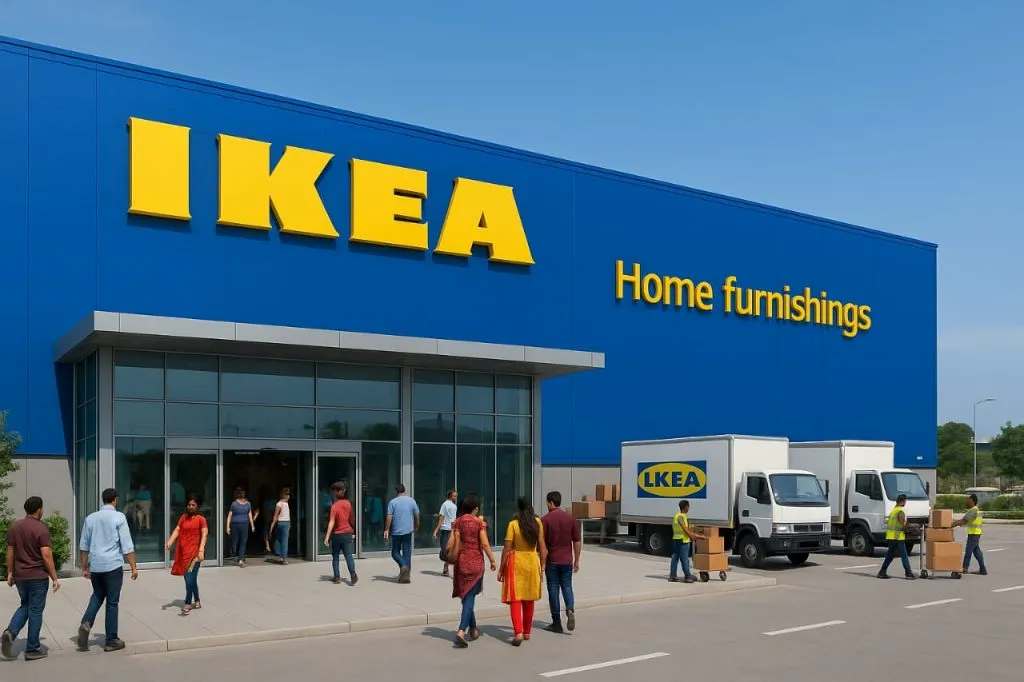
To capture weekly household spend and higher basket velocity, IKEA has shifted to an omnichannel format. With large flagship destination stores in Hyderabad, Navi Mumbai, and Bengaluru, they have introduced smaller city-centers and initiated large mixed-use shopping and commercial centers under the ‘Lykli’ brand in Noida and Gurugram.
This is paired with digital fulfillment networks covering over 80 cities, mirroring wider developments across India's retail sector. Department store operators and lifestyle retailers are moving away from sprawling single-format properties toward agile urban retail hubs supported by regional logistics backbones.
The 2018 opening of the 400,000 sq. ft, Hyderabad store is a clear look at this localization strategy. Field teams surveyed hundreds of Indian households before opening, identifying major differences in living habits compared to Western Europe: homes are cleaned with water rather than vacuum cleaners, needing moisture-resistant baseboards; living spaces are smaller, requiring multi-functional storage; and children routinely share bedrooms with their parents well into adolescence.
The retailer adjusted its merchandise accordingly, adding modular, elevated furniture pieces, changing fabric weights, and altering its dining selections. The Hyderabad store opened with a 1,000-seat cafeteria, the largest across the brand's global network swapping beef and pork meatballs for chicken and vegetarian alternatives and local dishes. Also, they placed over 1,000 lifestyle accessories priced under Rs 200 near high-traffic walkways. These low price points helped drive basket conversions among first-time visitors, while building shopper familiarity with the broader product line.
The contrast between defensive discounting in Europe and operational localization in India reflects an important shift across consumer markets. In Western economies, brands are trimming margins and testing recommerce models to manage saturated demand.
In India's growing retail economy, commercial growth remains strong, but unlocking it requires companies to set aside rigid global operational systems. Long-term performance in the domestic market does not depend on brand recognition alone. It belongs to operators that adapt to local assembly preferences, build localized manufacturing ties, and implement flexible retail formats suited to Indian urban infrastructure.