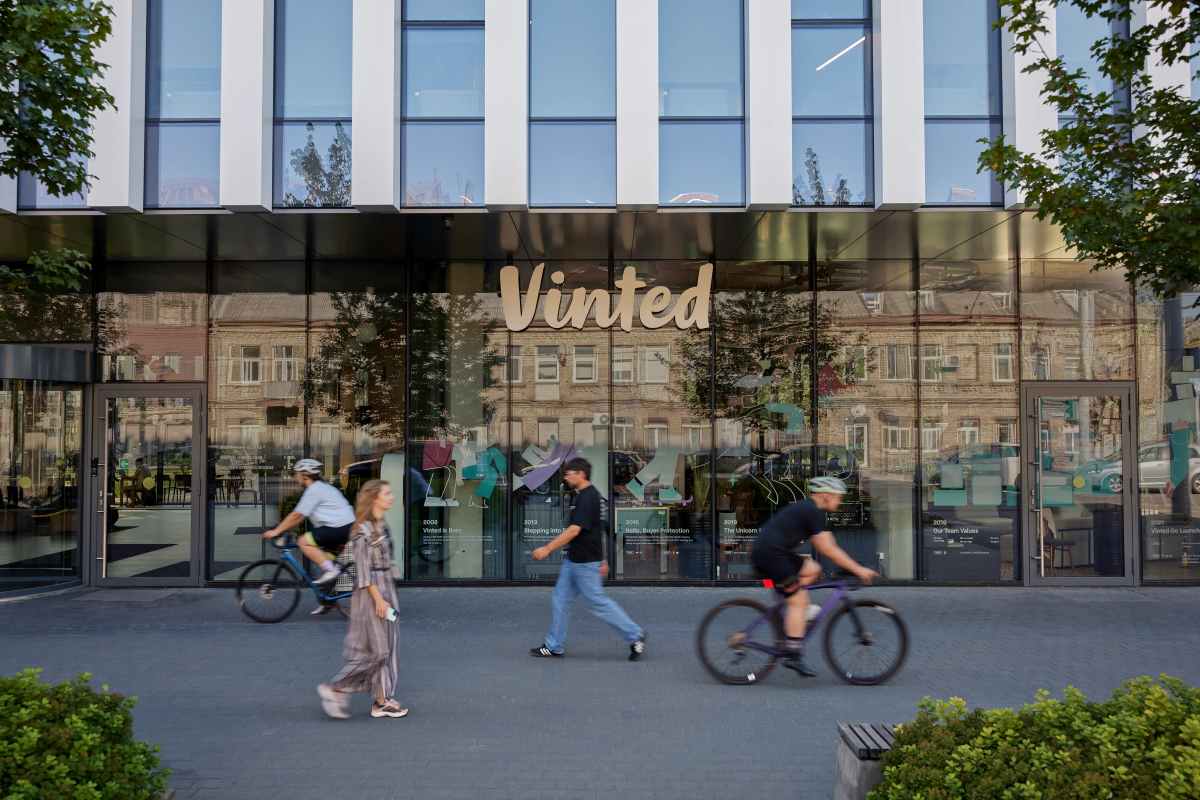
The French fashion market has reached a turning point. In a development that highlights the growing influence of circular commerce, Vinted has emerged as the leading fashion retailer in France in terms of volume of items sold, overtaking a roster of established apparel giants that have long dominated the market. Data compiled by the Institut Français de la Mode (IFM) places the Lithuania-founded peer-to-peer marketplace ahead of traditional retailers, confirming that secondhand commerce has evolved from a niche sustainability trend into a mainstream retail force.
The achievement marks more than a change in market rankings. It reflects a broader transformation in consumer purchasing behavior across Europe, where inflationary pressures, constrained household budgets, and rising environmental awareness are boosting demand for pre-owned fashion. Unlike conventional retailers, Vinted has built its position without manufacturing products, holding inventory, or operating stores. Instead, it has leveraged digital infrastructure, logistics integration, and network effects to become one of Europe’s most influential fashion platforms.
France’s new fashion leader
The latest IFM rankings reveal the scale of the disruption. Vinted now sits above value-fashion chains, global e-commerce platforms, and fast-fashion leaders in terms of items sold within the French market.
Table: Leading fashion retailers in France by items sold
|
Rank |
Market position |
Business model/subsSector |
|
#1 |
Vinted |
Peer-to-Peer Digital Marketplace |
|
#2 |
Kiabi |
Value-Driven Brick-and-Mortar / Digital |
|
#3 |
Amazon |
Multi-Category E-Commerce Platform |
|
#4 |
Decathlon |
Mass-Market Sports & Performance Apparel |
|
#5 |
Shein |
Direct-to-Consumer Ultra-Fast Fashion |
|
#6 |
H&M |
Global High-Street Fast Fashion |
|
#7 |
Intersport |
Multi-Brand Sporting Goods Retailer |
The ranking is particularly notable because it places a resale marketplace ahead of businesses built on large-scale production and inventory ownership. This shift suggests that consumers are prioritizing value, affordability, and access over ownership of newly manufactured apparel.
Growth through infrastructure
Vinted’s ascent has been driven by an operational model that differs sharply from conventional e-commerce. While most online marketplaces charge sellers listing or transaction fees, Vinted removed selling fees altogether. Instead, the platform derives revenue primarily from buyer protection charges and premium visibility services. This structure lowers barriers for participation and encourages a constant influx of inventory. The result is a marketplace with exceptional product depth and liquidity, where buyers can access millions of listings across price points.
Equally important has been the company’s investment in logistics and payments infrastructure. Through Vinted Go, the company has established a network of over 500,000 pick-up and drop-off points across Europe. Combined with the introduction of Vinted Pay and dedicated sorting facilities, these investments reduce dependency on third-party providers while lowering transaction costs.
The strategy enables profit trading even for low-value items, an area where many traditional retailers struggle due to shipping and handling expenses. By minimizing friction at every stage of the transaction, Vinted has transformed operational efficiency into a competitive advantage.
Financial momentum
The company’s financial performance shows how effectively this model is scaling. Recent figures show strong growth across merchandise volume, revenue, and cash generation, even as management continues investing heavily in expansion.
Table: Financial performance and core trading metrics
|
Category |
Performance indicator |
Baseline |
|
Gross Merchandise Value (GMV) |
€10.8 bn |
47% year-on-year growth |
|
Group Revenue |
€1.1 bn |
38% year-on-year growth |
|
Net Profit |
€62 mn |
Reduced by 19% due to reinvestment |
|
Free Cash Flow |
€137 mn |
Increased 36% year-on-year |
|
Average Transaction Value |
€13.81 |
Supported by 83% repeat-customer engagement |
These figures illustrate a business achieving scale while maintaining healthy liquidity. The combination of strong free cash flow and high customer retention indicates that Vinted’s growth is being driven not only by new users but also by increasing engagement among existing members. Chief Executive Officer Thomas Plantenga has repeatedly emphasized that the company’s objective is to make secondhand the default choice for consumers. The strategy hinges on reducing operational costs while increasing convenience, thereby reinforcing network effects that become stronger as participation grows.
Exporting the model
Having established France as its strongest market, Vinted is now attempting to replicate its success internationally. France alone has evolved into a multibillion-euro GMV engine, providing a blueprint for expansion into other European territories. The company has already strengthened its presence in Germany, broadened its category offerings beyond apparel into electronics and collectibles, and entered additional European markets including Latvia, Estonia, and Slovenia.
The most significant move, however, has been its entry into the US. The American market presents a vastly different operating environment. Europe’s dense geography allows efficient use of collection points and consolidated shipping networks. In contrast, the US faces higher logistics costs, greater geographic dispersion, and intense competition from established resale players such as Poshmark, ThredUp, and eBay. Whether Vinted can successfully adapt its low-cost European logistics model to North America may determine the company’s next phase of growth and future valuation.
The trust challenge
Despite its momentum, secondhand commerce still faces limitations. Unlike traditional retail, peer-to-peer marketplaces must overcome concerns around product quality, sizing accuracy, authenticity, and counterfeiting. These trust barriers remain one of the strongest defences available to premium fashion brands and established retailers. Many consumers continue to place a value on guaranteed quality, standardized returns, and the certainty associated with purchasing new products.
Recognizing this challenge, resale platforms are investing in authentication services, artificial intelligence-driven recommendations, and enhanced customer support. The goal is to narrow the trust gap between new and secondhand purchases. If platforms such as Vinted succeed in creating a resale experience that matches the reliability of traditional retail, the implications for the apparel industry could be profound. What began as an alternative channel for budget-conscious shoppers may evolve into a dominant distribution model capable of reshaping the economics of fashion retail across global markets.
For now, Vinted’s rise to the top of France’s fashion rankings offers a clear signal: the future growth battle in apparel may no longer be fought primarily through manufacturing scale or store networks, but through the ability to build efficient, trusted marketplaces that keep products circulating long after their first sale.