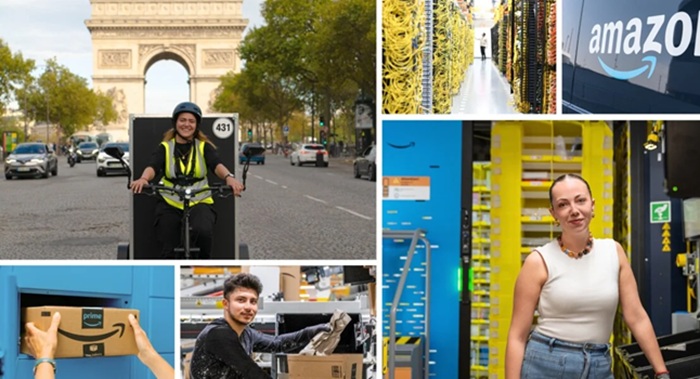
As Europe’s luxury sector enters a phase of austerity, a parallel transformation is unfolding in the continent’s retail foundations. What is leading this shift is Amazon, which has committed €15 billion to France over the 2026-28 period, its largest investment in the country to date. This is not simply a logistics expansion. It implies a reconfiguration of how retail value is created, distributed, and captured across Europe. While heritage brands recalibrate portfolios and reduce exposure to non-core assets, Amazon is deepening its role as the underlying infrastructure layer of commerce itself. The contrast is stark. On one side, luxury is tightening its focus on power brands. On the other, Amazon is building the physical and digital ‘pipes’ through which nearly every category of goods now flows.
Luxury pullback
The counter-movement is visible in the evolving strategy of LVMH. Facing volatility in aspirational consumption and asset valuations, the group has reportedly explored divestments of peripheral holdings such as Marc Jacobs and its stake in Fenty Beauty. This reflects a broader recalibration in luxury: a shift away from breadth and toward margin protection through brand concentration. Dior and Louis Vuitton remain central, while adjacent or non-core assets are seen as capital that can be redeployed more efficiently.
The difference with Amazon is structural rather than cyclical. Luxury is centring around identity and exclusivity. Amazon is expanding around access, speed, and logistics density.
France build-out map
Amazon’s €15 billion investment is heavily concentrated in last-mile compression, reducing time, distance, and friction between inventory and consumer demand. The strategy is built on regional hubs designed to decentralize inventory while increasing delivery velocity across France.
Table” Amazon’s France expansion blueprint (2026-28)
|
Project location |
Planned permanent jobs |
Functions |
|
Colombier-Saugnieu |
3,000 |
Regional hub for Southeastern France |
|
Ensisheim |
2,000 |
Gateway for cross-border EU trade (Est. 2027) |
|
Illiers-Combray |
1,000 |
Centralized distribution for Northern regions |
|
Beauvais |
1,000 |
High-velocity fulfillment for the Paris corridor |
This expansion pushes Amazon’s French employment footprint to over 25,000 permanent roles since 2010, supporting a wider ecosystem estimated at nearly 100,000 jobs. The model is explicitly proximity-based. By repositioning inventory closer to demand nodes, Amazon has already shown up to 25 per cent reductions in travel distance per package at select sites, alongside measurable emissions reductions per shipment.
Efficiency focus in apparel
The implications for apparel retail are particularly significant. Fast-moving fashion categories are increasingly defined by logistics performance rather than design alone. Retailers such as Lands' End have integrated into Amazon’s fulfillment ecosystem to compress delivery times and stabilize inventory positioning across demand clusters.
As Andrew McLean, CEO of Lands’ End, noted in industry commentary, leveraging Amazon’s logistics scale enables brands to operate with responsiveness previously reserved for local retailers. In effect, Amazon is turning national-scale brands into hyper-local fulfillment actors.
The French e-commerce apparel market, projected to reach $26.8 billion in 2026, is growing at a 13.4 per cent CAGR. In this environment, delivery speed is no longer operational efficiency it is competitive differentiation.
Predictive commerce engine
A growing portion of Amazon’s French investment is directed toward Amazon Web Services and generative AI systems embedded within retail operations. The shift is from reactive fulfillment to predictive stocking. AI models increasingly forecast demand at granular SKU levels, pre-positioning inventory in regional hubs before purchase intent fully materializes.
This creates a compounding flywheel: faster delivery improves conversion rates, which generates richer behavioral data, which further refines forecasting accuracy. The result is a self-reinforcing efficiency loop that reduces cost per unit while increasing system responsiveness. Retail is no longer just transactional. It is becoming anticipatory.
Retail power shift
The broader implication for Europe’s retail is a binary choice. Companies either operate inside Amazon’s infrastructure stack or compete against it using fragmented legacy systems. The €15 billion French expansion positions Amazon not merely as a marketplace operator but as a systemic utility for commerce. Its infrastructure scale, 200+ fulfillment centers and approximately 80,000 trailers globally creates a barrier that is increasingly difficult for regional logistics networks to match.
In parallel, European luxury’s consolidation strategy signals retreat into high-margin defensibility rather than infrastructure expansion. One side is optimizing exclusivity. The other is optimizing access.
Ownership of the ‘Pipes’
The emerging retail order in Europe is being defined less by brands and more by infrastructure ownership. Amazon’s French investment underscores a decisive shift: control of logistics networks now translates directly into control of commercial velocity. As luxury consolidates around iconic brand equity, Amazon is embedding itself deeper into the operational backbone of retail. The result is a re-architecture of commerce itself, one where the most valuable position is no longer the storefront, but the system that makes the storefront function.