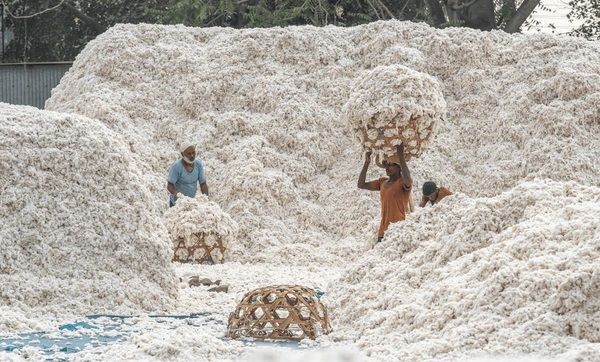
Farmers in Pakistan say the drop in cotton production is due to the supply of substandard seeds and some other factors. The country’s cotton production this year is about 10.4 million bales, while the estimated yield was about 14 million bales.
So it’s now anticipated that billions of dollars have to be spent to import cotton, while if agriculture-friendly policies had been followed and good quality cotton seeds had been supplied to farmers, the need for importing cotton would never have developed.
Pakistan’s future cotton policy envisages a number of strategies which include: germ-plasm improvements, development of hybrid cotton, improved farm and crop management, bringing additional area under cultivation, minimising post-harvest losses, increasing cotton production, improving yields per hectare, evolving disease resistant varieties, promoting Bt cotton cultivation and improving the overall quality of cotton.
The country’s cotton production in 2015-16 declined by 28 per cent due to reasons like climate change, competition with other crops, lower market prices and the outbreak of pink bollworm. In Pakistan, economic losses from contamination cost the cotton value chain, from raw cotton to garments, 1.4 billion dollars per year.
To meet the demand for extra-long staple cotton, about two million bales are imported annually. The country is also encouraging multinational and national technology providers to introduce the latest and most effective insect protection technology.
- 1
- 2
- 3
- 4
- 5
- 6
- 7
- 8
- 9
- 10
The Lyst Reset: Chanel and Dior rewrite luxury’s power index
The global luxury hierarchy has been quietly rewritten, and not by sales alone. In Q1 2026, Chanel rose to the... Read more
Inventory, not expansion, defines winners in global apparel
The 2025 fiscal year has crystallised that revenue growth and operational health are no longer moving in tandem. In an... Read more
From growth-at-all-costs to cash discipline, the new economics of DTC fashion
The global direct-to-consumer apparel market is entering a correction phase, as fashion brands across the US, Europe and the UK... Read more
Britain’s Forgotten Growth Engine: Why policy gaps are undermining fashion and t…
Britain’s fashion and textile industry, often framed through the lens of creativity and design, is emerging as a case study... Read more
Beyond price rallies structural reform can strengthen India’s cotton economy
India’s cotton economy is entering a decisive phase, where firmer prices and tighter arrivals in the 2026-27 season have given... Read more
Polyester volatility redraws India’s textile industry competitive map across Asi…
India’s synthetic textile industry has entered a phase of cost instability as polyester staple fibre (PSF) prices rise across domestic... Read more
The £7 Billion Question: Who pays for fashion’s ‘free rental’ habit?
The global fashion industry is facing an uncomfortable paradox: its most valuable customers may also be its most destructive. A... Read more
India, China Bangladesh face fresh headwinds as global apparel markets rebalance
Global apparel trade is entering a more uneven recovery phase, with demand growth persisting but losing uniform momentum across major... Read more
Global cotton enters a deficit year in 2026 as supply drop meets logistics risk
The global cotton economy has entered a fragile and sensitive phase. Early projections for the 2026-27 season suggest that world... Read more
India’s textile trade gets a Pacific push as New Zealand FTA removes tariff barr…
India and New Zealand have inked a ‘once-in-a-generation’ Free Trade Agreement (FTA), one that will have a profound impact on... Read more