The UK’s apparel sourcing has seen a realignment in recent years, as retailers increasingly diversify production away from traditional East Asian manufacturing bases toward South Asia and selected nearshore markets. The shift reflects geopolitical uncertainty, supply chain disruptions, cost pressures and evolving trade policies that are reshaping procurement strategies across the British high street.
Despite persistent logistical challenges caused by Red Sea shipping disruptions British apparel imports continued to grow during the first quarter of 2026. Data from HM Revenue and Customs (HMRC) and the Office for National Statistics (ONS) reveal, total clothing imports reached $4.89 billion during the period, up 3.8 per cent from $4.71 billion in the corresponding quarter of 2025. The increase suggests that underlying consumer demand remains resilient even as retailers contend with longer transit times and elevated freight costs.
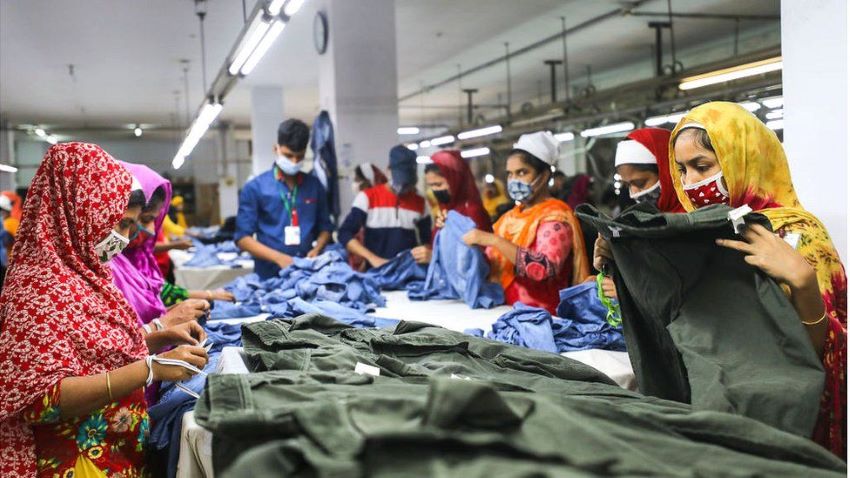
The most notable development was the emergence of Bangladesh as the UK’s largest apparel supplier by value, overtaking China for the first time in the period under review. The transition highlights a broader shift in sourcing priorities as retailers seek greater supply chain resilience and improved margin management.
Bangladesh leads supplier realignment
Bangladesh delivered the largest absolute gain among major sourcing destinations, with exports to the UK rising by $75.8 million to $1.11 billion, a growth of 7.3 per cent year on year. This enabled the country to surpass China, whose exports fell by $73.7 million to $1.09 billion, a decline of 6.3 per cent.
The contrasting data of the two sourcing giants underline changing procurement priorities. While China continues to offer scale and manufacturing sophistication, many British retailers are reducing dependence on single-country sourcing models amid geopolitical uncertainty, rising operating costs and ongoing logistical challenges. India and Vietnam emerged as major beneficiaries of this diversification trend. Indian apparel shipments increased 13.4 per cent to $362.8 million, while Vietnam recorded growth of 14.1 per cent, reaching $280.8 million. Both countries have strengthened their positions through investments in manufacturing capabilities, compliance standards and product specialization.
Turkey and Pakistan, meanwhile, faced competitive pressures. Turkey’s exports declined 3.0 per cent to $333.6 million as inflation and energy costs eroded cost competitiveness. Pakistan also saw a 3.6 per cent decline, reflecting growing competition from neighboring sourcing hubs.
Table 1: Major UK apparel sourcing hubs
|
Sourcing country |
Q1 2025 value ($ mn) |
Q1 2026 Value ($ mn) |
Absolute Change ($ mn) |
Year-on-year growth (%) |
Market share |
|
Bangladesh |
1,038.30 |
1,114.10 |
+75.8 |
+7.3% |
Expanding |
|
China |
1,166.90 |
1,093.20 |
-73.7 |
-6.30% |
Contracting |
|
India |
319.9 |
362.8 |
+42.9 |
+13.4% |
Expanding |
|
Turkey |
343.9 |
333.6 |
-10.3 |
-3.00% |
Contracting |
|
Vietnam |
246.1 |
280.8 |
+34.7 |
+14.1% |
Expanding |
|
Cambodia |
258.4 |
261.4 |
+3.0 |
+1.2% |
Stable |
|
Pakistan |
253.9 |
244.8 |
-9.1 |
-3.60% |
Contracting |
|
Italy |
214.5 |
233.3 |
+18.8 |
+8.8% |
Premium Growth |
|
Sri Lanka |
138.8 |
147 |
+8.2 |
+5.9% |
Niche Expansion |
|
Ireland |
50.4 |
118.4 |
+68.0 |
+134.7% |
Nearshore Surge |
|
Portugal |
80.1 |
89.6 |
+9.5 |
+12.0% |
Quick-Response |
|
Egypt |
26.1 |
41.5 |
+15.4 |
+58.8% |
Emerging Hub |
|
Thailand |
26.3 |
36 |
+9.7 |
+36.9% |
Niche Expansion |
The data also points to growing interest in alternative sourcing corridors. Ireland recorded a remarkable 134.7 per cent increase, supported by cross-border replenishment strategies and demand for rapid inventory turnaround. Egypt and Thailand likewise posted strong gains as retailers explored diversified production networks capable of supporting specific product categories.
Product categories drive procurement decisions
Changes in sourcing patterns are closely linked to shifts in product demand and manufacturing specialization. British retailers increased spending on women’s fashion and casualwear categories while reducing exposure to more seasonal and inventory-sensitive segments such as outerwear. Women’s suits and dresses emerged as the strongest-performing category, with imports rising 13.8 per cent to $808.1 million. Bangladesh and India captured a significant share of this growth through their strengths in woven garments, embellishment work and large-scale production.
Casual knitwear and T-shirts also expanded, benefiting Bangladesh’s vertically integrated textile ecosystem. At the same time, technical apparel and outerwear categories fell as retailers reduced forward commitments and focused on inventory optimization.
Table 2: Product category trends in UK apparel imports
|
Commodity category & HS code |
Sourcing hubs |
Q1 2025 ($ mn) |
Q1 2026 ($ mn) |
Shift ($ mn) |
Position dynamic & drivers |
|
Women’s Suits & Dresses(HS 6204) |
Bangladesh, India, China |
710.1 |
808.1 |
+98.0 (+13.8%) |
Bangladesh & India expand. Sourcing redirected away from China's mid-tier factories into Dhaka’s woven facilities and India's embellishment hubs. |
|
Casual Knits & T-Shirts(HS 6109) |
Bangladesh, Pakistan |
545.2 |
585 |
+39.8 (+7.3%) |
Bangladesh consolidates lead. Dhaka absorbed volume contracts from Pakistan and Turkey via integrated spinning cost efficiencies. |
|
Women’s Blouses & Shirts(HS 6206) |
India, Italy, Portugal |
139.4 |
162.4 |
+23.0 (+16.5%) |
India & Nearshorers advance. Quick-turn fashion orders split between India's premium design houses and European nearshore corridors. |
|
Brassieres & Corsetry(HS 6212) |
Vietnam, Sri Lanka, China |
99.1 |
120.3 |
+21.2 (+21.4%) |
Vietnam & Sri Lanka displace China. High-precision automated bonding lines draw technical lingerie contracts away from Chinese ports. |
|
Jerseys & Pullovers(HS 6110) |
Turkey, China, Bangladesh |
588.9 |
578.3 |
-10.6 (-1.8%) |
Turkey & China contract. Retailers thinned forward knitwear commitments to protect working capital against weather risk. |
|
Men’s Overcoats & Jackets(HS 6201) |
China, Turkey |
152.2 |
142 |
-10.2 (-6.7%) |
China drops rank. Severe pullbacks on high-ticket, weather-dependent outerwear to clear existing backlogs. |
|
Nonwoven Technical Apparel(HS 6210) |
China, Southeast Asia |
114.8 |
84.6 |
-30.2 (-26.3%) |
Global contraction. Severe drop due to complete normalization of medical/industrial protective equipment back stocks. |
|
Babies' Garments(HS 6111) |
India, Cambodia, China |
109.3 |
103.4 |
-5.9 (-5.4%) |
China drops; India holds steady. Shift away from mixed fabric items to high-compliance pure cotton infant ranges. |
Particularly noteworthy was the strong performance of lingerie and intimate apparel, where Vietnam and Sri Lanka gained market share through advanced technical manufacturing capabilities. Imports in this category rose 21.4 per cent year on year, reflecting growing retailer demand for specialized production expertise.
Trade policy a competitive lever
The sourcing move toward South Asia is expected to grow further following the implementation of the India-UK Free Trade Agreement on July 15, 2026. The agreement will remove duties of between 8 and 12 per cent on Indian textile and apparel exports, significantly improving India’s competitiveness in the British market. Industry leaders view the development as a transformative moment for sourcing strategies. By eliminating a longstanding tariff disadvantage, the agreement places Indian suppliers on a more equal footing with duty-free competitors and could substantially increase the country’s market share over the coming years.
For British retailers, the agreement offers an opportunity to build more balanced sourcing portfolios that combine Bangladesh’s scale, India’s product diversity and design capabilities, and selected nearshore suppliers’ speed-to-market advantages.
Diversification moves from strategy to necessity
The sourcing adjustments undertaken by major retailers show how rapidly procurement priorities are evolving. Companies are adopting multi-country sourcing frameworks to mitigate risks associated with logistics disruptions, geopolitical tensions and fluctuating costs. The experience of retailers such as Marks & Spencer reveals the benefits of this approach. By shifting portions of production from China to Bangladesh and India, the retailer reportedly reduced lead times and strengthened supply chain flexibility while preserving margins despite higher freight expenses.
As the UK apparel market, valued at approximately $18 billion annually, enters the second half of 2026, sourcing decisions are becoming less about finding the lowest-cost producer and more about building resilient, diversified supply networks. South Asia’s growing dominance, combined with emerging nearshore alternatives and supportive trade agreements, suggests that the restructuring of British fashion sourcing is only beginning.