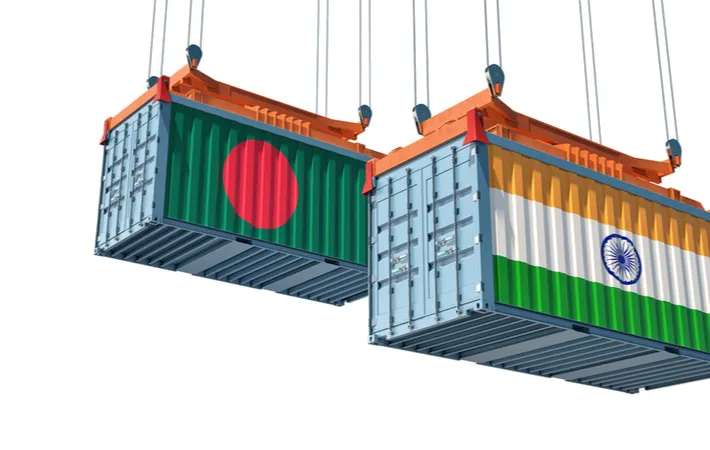
The Petrapole-Benapole corridor is evolving from a conventional trading route into an integrated production network, linking India’s upstream textile capacity with Bangladesh’s globally competitive garment manufacturing base. Trade data indicate that cross-border flows of intermediate textile inputs between the two countries reached about $2.42 billion in the first half of 2026. Indian mills are supplying cotton, yarn and woven fabrics, while Bangladeshi garment manufacturers convert those inputs into finished apparel for European and North American markets.
The significance of the corridor is increased by weakness in global apparel demand. Bangladesh’s RMG export receipts fell 4.85 per cent year-on-year to $21.84 billion during the first six months of 2026. Yet its requirement for imported textile intermediates remained substantial, with yarn and woven fabric imports reaching $4.85 billion.
Table: India-Bangladesh trade pattern
|
Trade component |
H1 2026 |
Bilateral share/operational dynamic |
|
Bangladesh Total RMG Export Receipts |
$21.84 bn |
Down 4.85% YoY amid consumer belt-tightening in EU & US |
|
Bangladesh Gross Intermediate Textile Imports |
$4.85 bn |
Foundational yarn and fabric intake for export assembly |
|
India Share of Bangladesh Imported Fabric |
31.2% ($842 mn) |
Core supplier of woven cotton, poplin, and bottom-weight twills |
|
India Share of Bangladesh Imported Yarn |
44.6% ($958 mn) |
Primary source for high-count combed cotton and carded ring-spun yarn |
|
Bilateral Intermediate Textile Input Flow |
$2.42 bn |
Combined intake across raw cotton, yarn, and mill-finished fabric |
|
Cross-Border Logistical Velocity |
48 to 72 hours |
Overland transit via Petrapole-Benapole vs. 18–25 days maritime sea route from East Asia |
Supply-chain dynamics
The relationship addresses a fundamental mismatch. Bangladesh has enormous cut-and-sew capacity but limited domestic cotton production and gaps in high-end woven textile manufacturing. It produces less than 3 per cent of its raw cotton requirements, leaving garment exporters dependent on imported fibre, yarn, polymers and fabrics.
India, in contrast, possesses extensive cotton-growing, spinning and weaving capacity across Gujarat, Maharashtra, Punjab and Tamil Nadu. This creates a complementary production pattern: India supplies the upstream inputs while Bangladesh provides downstream garmenting scale.
The competitive advantage is time rather than simply price. Shipments moving through the Petrapole-Benapole Integrated Check Post or the Gede-Darshana rail connection can reach manufacturing clusters such as Gazipur, Narayanganj and Chattogram within roughly 48-72 hours. East Asian maritime supply lines can take 18–25 days. For global brands managing shorter fashion cycles, that difference has direct financial value. Faster access to fabric enables Bangladeshi factories to compress cutting, stitching and finishing schedules, reduce inventory exposure and respond more rapidly to changes in retail demand.
Origin rules become strategic
The durability of this model, however, depends on trade architecture as much as logistics. Regional cumulation provisions under preferential arrangements can allow Bangladeshi exporters to use Indian cotton and yarn while meeting prescribed origin requirements for access to major Western markets. The UK's Developing Countries Trading Scheme similarly provides a framework for regional sourcing.
This becomes particularly important as Bangladesh moves ahead from its LDC status. Maintaining favourable rules of origin and securing deeper bilateral arrangements, including the proposed India-Bangladesh CEPA, could determine whether Indian inputs remain a competitive advantage or become constrained by origin requirements. For textile companies, therefore, trade agreements are no longer merely tariff instruments. They increasingly determine where each stage of production can economically take place.
Capital follows the supply chain
The integration is also beginning to extend beyond physical merchandise. Indian textile companies have developed sourcing and commercial operations in Bangladesh, while Bangladeshi manufacturers are strengthening procurement, warehousing and quality-control capabilities closer to Indian textile production centres.
The emerging model resembles a distributed manufacturing platform. Indian ginners and spinners secure fibre and yarn; weaving and processing units prepare fabrics to buyer specifications; cross-border logistics move intermediate goods into Bangladesh; and garment factories convert them into export-ready products. This arrangement gives manufacturers greater control over lead times and reduces their dependence on longer Asian maritime supply chains.
Beximco Apparels exemplifies the importance of such integration. The Bangladesh-based Beximco Group garment business operates large-scale manufacturing facilities in Gazipur and supplies international brands. Its production model requires consistent access to cotton yarn, denim and woven fabrics, making regional sourcing a critical component of manufacturing continuity.
The corridor still has issues
Trade is not without constraints. Petrapole-Benapole can face customs congestion, truck queues and demurrage, eroding the lead-time advantage. Bangladesh's energy costs, industrial gas shortages and fluctuations in Indian cotton prices can also complicate production planning.
Compliance is becoming another variable. European sustainability requirements, including supply-chain due diligence and digital product traceability, will increasingly require manufacturers to demonstrate the provenance of fibre, yarn, fabric and finished garments. That puts pressure on Indian and Bangladeshi companies to develop interoperable digital documentation, chemical-compliance systems and common social-audit frameworks.
From corridor to production system
The $2.42 billion intermediate trade flow therefore is more than bilateral commerce. It signals the emergence of a trans-Bengal production system in which competitive advantage is divided across borders. Bangladesh brings garment scale, labour-intensive manufacturing and established relationships with Western apparel buyers. India brings fibre availability, spinning capacity, textile engineering and a much deeper upstream manufacturing base.
As global apparel sourcing becomes more sensitive to lead times, inventory costs, tariff exposure and traceability, this complementarity could become more valuable. The challenge is to turn a fast land route into a dependable industrial corridor. If customs efficiency, trade rules, energy availability and digital traceability improve in tandem, Petrapole-Benapole could evolve from a bilateral trade gateway into one of South Asia's most important integrated textile and apparel supply chains.