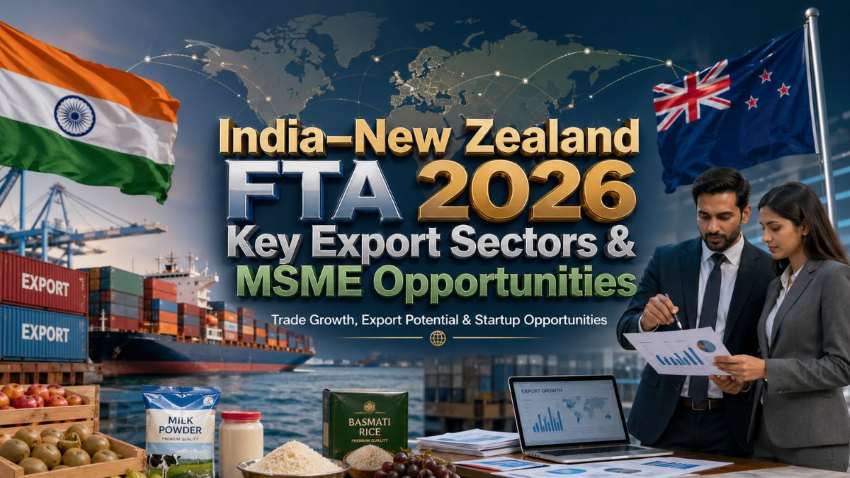
The India-New Zealand Free Trade Agreement (FTA), which comes into force on October 20, 2026, creates a new tariff-free corridor for Indian textile and apparel exporters. For a sector accustomed to competing against suppliers that enjoy preferential access to developed markets, the agreement removes a structural disadvantage rather than merely offering another export destination.
New Zealand has committed to duty-free access for 100 per cent of Indian tariff lines from the agreement’s entry into force. As per India’s Ministry of Commerce textile and apparel products faced tariffs of up to 10 per cent, while the broader textiles and clothing opportunity remains relatively underpenetrated: Indian textile exports to New Zealand are around $103 million against New Zealand textile imports of roughly $2.2 billion annually. That gap is important. The FTA is less about suddenly creating a large market than about changing the economics of supplying an existing one.
Removing the tariff handicap
For Indian manufacturers, the most immediate benefit is the elimination of duties on apparel, home textiles, carpets and other textile products. Indian government has specifically identified the sector as one where tariffs averaging 4.19 per cent and reaching 10 per cent had constrained competitiveness.
Table: India-NZ FTA tariff relief and supply-chain opportunity
|
Product segment |
Earlier NZ tariff exposure |
FTA position from Oct. 20, 2026 |
Indian clusters positioned to benefit |
|
Knitted apparel |
Up to 10% |
0% |
Tirupur, Ludhiana, Kolkata |
|
Woven garments |
Up to 10% |
0% |
Noida, Gurugram, Bengaluru |
|
Home textiles |
Up to 5% |
0% |
Panipat, Surat, Karur |
|
Carpets and floor coverings |
Up to 10% |
0% |
Bhadohi, Mirzapur, Jaipur |
|
Yarns and intermediate textiles |
Tariffs applied |
Duty-free access under FTA |
Coimbatore, Surat, Ahmedabad |
The significance goes beyond the headline rate. New Zealand's textile market is already deeply integrated with Asian sourcing networks. Removing a 5-10 per cent tariff handicap allows Indian exporters to compete more directly on product quality, lead time, design capability and compliance instead of carrying an embedded customs disadvantage. For Tirupur's knitwear exporters, Panipat's home textile manufacturers and Bhadohi's carpet makers, this changes the conversation with buyers from tariff negotiation to commercial execution.
The wool connection
The more strategic opportunity lies in the agreement's two-way supply-chain architecture. India has offered New Zealand market access on 70.03 per cent of tariff lines, covering about 95 per cent of bilateral trade value, while retaining exclusions for sensitive sectors. Importantly for textiles, 30 per cent of Indian tariff lines receive immediate duty elimination, including wool, wood and raw hides. That creates an unusual industrial linkage. New Zealand is a major source of high-grade wool, while India possesses established spinning, weaving, garmenting and carpet-making capabilities.
The opportunity, therefore, is not simply to export finished garments to New Zealand. Indian mills can potentially import premium raw material, undertake higher-value processing in India and export finished wool products back into the New Zealand market without the previous tariff friction. This matters for worsted spinning, premium suiting, carpets and wool-blend performance apparel. The FTA can thus reinforce the shift from commodity textile exports towards integrated fibre-to-fashion value chains.
Small market with a large signal
Bilateral merchandise trade remains modest. Official figures cited in the supplied data put 2025-26 two-way merchandise trade at about $1.15 billion, compared to $1.3 billion in 2024-25. The governments have nevertheless set a target of taking bilateral goods and services trade to Rs 35,000 crore, or about $4.2 billion, by 2030. New Zealand's ratification process was completed on September 21, after its Parliament passed the implementing legislation 93-29. The agreement consequently enters into force on October 20.
The scale of the ambition matters because textile trade is currently far below its potential. New Zealand imports around $2.2 billion of textiles annually, yet India's exports are only around $103 million. The arithmetic suggests that even a modest increase in India's share could materially expand the country's textile exports to the market.
Tariffs are only the first test
Zero duty, however, does not automatically translate into orders. New Zealand buyers operate in a market where sustainability, traceability, product safety and responsible sourcing increasingly influence procurement. Indian exporters will have to demonstrate compliance with rules of origin, product standards, environmental requirements and buyer-specific certification.
Table: India New Zealand bilateral merchandise trade
|
Category |
Value |
Context / Details |
|
FY 2024-25 Total Trade |
$1.30 bn |
Baseline trade volume |
|
FY 2025-26 Total Trade |
$1.15 bn |
-11.5% YoY growth |
|
India Exports to NZ |
$566.51 mn |
FY 2025-26 breakdown |
|
India Imports from NZ |
$589.10 mn |
FY 2025-26 breakdown |
|
2030 Bilateral Trade Target |
$4.20 bn |
Rs 35,000 cr target |
|
Long-Term Inward Investment Pact |
$20.00 bn |
Target span over 15 years |
This is particularly relevant for blended products. The commercial advantage of the FTA will depend on exporters being able to document where fibres originate, where transformation occurs and whether shipments satisfy the agreement's origin requirements.
The operational challenge is therefore to convert tariff preference into dependable supply. Delivery reliability, smaller minimum order quantities, design responsiveness, digital traceability and consistent quality could become as important as price.
From market access to scale
The agreement also gives a useful template for larger Indian textile companies. Welspun Living, for example, already operates an integrated home-textile model spanning bed, bath and flooring products, with a distribution footprint covering more than 50 countries. Its vertically integrated manufacturing capabilities and emphasis on traceability position such companies to use tariff-free access as part of a broader market-expansion strategy rather than as a standalone price advantage.
For smaller manufacturers, the opportunity is different. Exporters that have so far avoided New Zealand because the market was too small to justify the tariff and compliance costs may now find the economics more attractive. The larger implication is that India's textile competitiveness increasingly depends on the architecture surrounding the factory gate. Tariff access, cheaper raw materials, rules of origin, traceability and logistics must work together.
The India-New Zealand FTA delivers the first piece of that equation. The next task for Indian industry is to turn a tariff-free market into a durable supply-chain relationship and to use New Zealand not merely as an end market, but as another node in India's global textile manufacturing network.