
The most valuable takeaway at Intertextile Shanghai Apparel Fabrics this autumn was not just a single standout fabric, fancy yarn, or factory floor setup. It was speed; specifically, how fast raw material science can turn into a finished, store-ready roll of fabric.
Walking the halls at the National Exhibition and Convention Center, the shift was unmistakable. Global sourcing is moving away from the old, slow handoff where a brand talks to a spinner, waits weeks, visits a weaver, and then heads elsewhere to find a dyer. Instead, Intertextile Shanghai showed that the entire development chain can happen almost simultaneously at one platform, changing how products get built and how fast they reach store shelves.

The scale and role of Intertextile Shanghai
Organized alongside Yarn Expo Autumn, the 2026 edition of Intertextile Shanghai brought together more than 3,500 exhibitors from 30 countries across 240,000 square meters of exhibition space. Held each autumn in Shanghai, the fair stands as one of the world’s largest and most influential sourcing hubs for apparel fabrics and accessories. It draws tens of thousands of global fashion buyers, product developers, and mill owners looking for everything from everyday cottons and performance stretch knits to circular synthetic yarns and smart machinery.
But the more interesting story was how these categories increasingly overlapped. The fair was organised around four broad themes — Fashion Forward, Performance Textiles, Sustainability and Textile Future — while specialised zones such as Functional Lab, Econogy Hub and Innovation & Digital Solutions brought material science, sustainability and technology directly into the sourcing environment. The concurrent Yarn Expo added another upstream layer to that equation.
Where upstream meets the cutting table
The real strength of the event was the physical connection between Yarn Expo and Intertextile. At Yarn Expo, buyers could look at early-stage feedstocks, from plant-based alternatives and captured-carbon polymers to recycled synthetic chips. Just a short walk away inside the main Intertextile halls, those exact same materials were already turned into finished, commercial yardage, dyed and ready for production.
The connection was not theoretical. CCFGroup's floor analysis of Yarn Expo found recycled-polyester suppliers, virgin-fibre producers developing recycled businesses and companies working on textile-to-textile recycling all competing for buyer attention. T2T chemical recycling was among the most discussed areas, while companies such as Hengyi, Shenghong and Xinfengming were increasing investment across different recycling routes. At the fabric end, New Focus Textiles was showing woven developments combining recycled cotton and T2T recycled polyester with Haelixa's physical traceability technology.
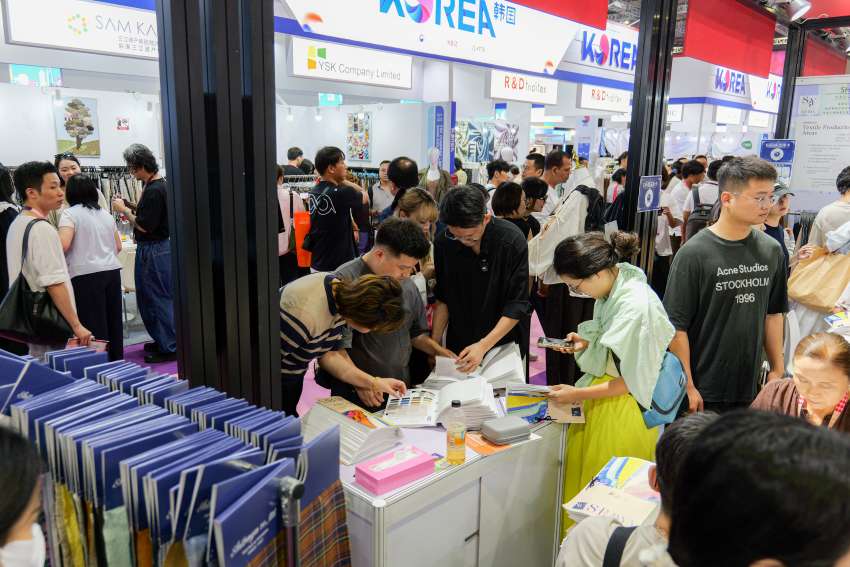
That setup closes a massive gap for product teams. In the past, a novel fiber could take years to make its way out of a laboratory and into a commercial garment. In Shanghai, upstream yarn producers and downstream fabric makers were talking to buyers side by side. Rather than picking an off-the-shelf fabric from a vendor's book, design and sourcing teams could sit down with fiber engineers to solve specific performance and price targets on the spot.
The LYCRA Company provided a useful illustration of this approach. Its expanded Shanghai presentation brought fibres, fabrics and garments from partners together inside a 356-square-metre “Lifestyle District”, within a larger 895-square-metre pavilion. The emphasis was less on displaying a fibre in isolation and more on showing how technologies from the LYCRA, COOLMAX and THERMOLITE platforms could translate through partners into finished textile applications.
Rethinking synthetics and everyday performance
A clear example of this shared problem-solving showed up in synthetics, which still make up the bulk of what the world wears. Instead of pretending polyester will vanish overnight, suppliers are re-engineering it from the ground up. In Intertextile’s Econogy Hub, the focus was not just on basic recycled plastics, but on building performance, natural dye acceptance, and future recyclability straight into the polymer itself.
The same direction was visible upstream at Yarn Expo. CCFGroup's review of polyester filament developments found the emphasis shifting towards greener, functional iterations rather than simply conventional filament-yarn products. Meanwhile, recycled-polyester participation was strong, although the market response was uneven and the transition to large-scale, stable chemical or enzymatic recycling remained a work in progress.
A more consumer-facing example came from the LYCRA Company, which presented a recycled polyester technology designed to combine moisture management with reduced visibility of sweat marks in woven apparel. The point was telling: sustainability was being attached to a specific performance problem, rather than presented as a standalone environmental claim.
Rather than treating green textiles like a niche marketing corner, the mills treated these updates as normal engineering standards. The goal was simple: give brands the technical durability, wash resistance, and stretch they need without creating a logistical headache down the road.
How digital tools keep the flow moving
Down the concourse in the digital solutions areas, the missing link between ideas and execution became obvious. Suppliers were showing off pattern-scanning tools, digital loom setups, and straightforward material tracking systems using simple markers embedded right in the thread.

This was also reflected in the programme itself. Intertextile's technology discussions brought together companies such as Haelixa, Coats Digital and OEKO-TEX around digital applications, traceability and the rebuilding of trust across China's textile supply chain. The fair's climate-adaptive textile programme similarly brought together fibre, fabric and verification perspectives around thermal regulation, comfort, sustainability and moisture management.
These setups cut out the endless rounds of mailing physical swatches back and forth across oceans. A designer can review a digital drape, the mill can calibrate its looms to match the specs, and compliance teams can check the origin data without stalling the order. The value is not in having fancy software for its own sake, but in cutting the dead time out of the sample process.
New Focus Textiles offered a particularly practical example of the direction. Its Shanghai developments combined recycled-content fabrics with Haelixa TraceDNA physical traceability, linking the material story to the actual fabric rather than leaving sustainability as a declaration somewhere in the supply-chain paperwork.
Why proximity still wins
This shift forces global retail brands to rethink what makes a good supplier. Chasing the lowest cut-and-sew labor rate often backfires when parts of the chain are scattered across three different countries, leading to testing failures, miscommunicated specs, and missed launch dates.
The Shanghai model showed another possibility: keep more of the problem-solving ecosystem physically and commercially close. Shantou, for example, used the fair to bring more than 30 local textile companies together under its regional nylon-spandex manufacturing identity, presenting more than 3,500 fabric types covering sports, outdoor, sun-protection, casual and business applications.
As fair organisers noted during the week, brands are no longer just looking for someone to run a machine; they need partners who can help them figure out what to make and how to get it done reliably. The enduring advantage on display in Shanghai is the sheer concentration of textile knowledge in one spot. Fiber makers influence spinning, spinners guide the weaving, and finishing specialists tune the final hand-feel, all within driving distance of each other.
The fabric on the table is what buyers take home, but the real product Shanghai is selling is the network that pulled it together.