FW

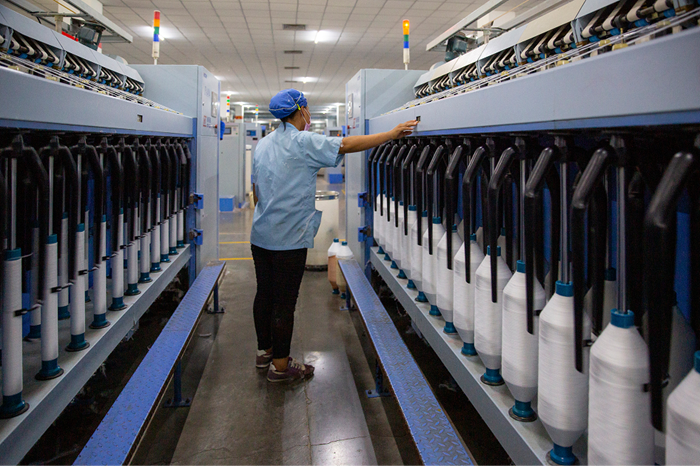
The inverted duty structure in India makes it easier for textile industry to import synthetic textiles rather than manufacture them domestically. Synthetic fiber is taxed at 18 per cent, yarn at 12 per cent and final output at five per cent, creating a tax structure where rate on inputs is higher than that on output.
The inverted duty structure has made imports 15 per cent to 20 per cent cheaper for the domestic industry. Also the absence of refund on input tax credit on the domestic sale of synthetic fabrics is said to have blocked the working capital of the textile industry. Refund of inverted duty is allowed but the industry feels it is complicated and leads to working capital blockage for months. GST on capital goods is not refunded.
Another grouse is that rules do not allow refund or adjustment of GST on services from output GST obligations, which has led to losses for small and medium enterprises using job working services and having an inverted duty structure. The industry wants the refund rule rectified and has sought refund for unused input tax credit that lapsed on July 31 last year and extension of the refund to those selling in the domestic market.
JC Penney will exit the major appliances category and shift gears to focus on soft textiles such as apparel and home furnishings, which are expected to represent higher margin opportunities.
The retailer is finalizing new layout options, including the reduction of store space previously dedicated to appliance and furniture showrooms to maximize efficiencies. It also wants to create an enhanced shopping experience that inspires repeat shopping trips. The assumption is that apparel is the answer to get consumers to return to the store on a regular basis.
The major appliance category will remain in the stores and online through February 28, while the furniture category will still be available online and at select stores. The major appliance category isn’t exactly high margin. Once consumers make a major purchase, they won’t need to make another replacement purchase for at least another five years.
JC Penney used to be the place where middle-income consumers went to for apparel and soft home goods but the retailer then threw out many of the private label brands that JC Penney customers relied on. They showed their displeasure by going elsewhere to do their shopping.
Exclusive private label brands in apparel for women’s, men’s and children’s were always a staple at JC Penney.
East Africa aims at developing a strong textile and leather sector. Priority is being given to the development of a competitive domestic textile and leather sector that can provide affordable clothes and leather products in the region.
Rwanda has already launched a multi-agency task force to embark on a training program targeting local factories and small and medium enterprises in leather processing. The country wants manufacturers to adopt cleaner production technologies.
Business within the East African Community is expected to grow with a reduction in the cost of power, transport, labor and interest rates. The aim is to improve the livelihoods of millions of people across East Africa. Countries in the region have agreed on a phase-out plan and an eventual ban on the imports of used clothes and leather products to support industrialisation and job creation. Textile industry players are being encouraged to start making garments that require basic level technology and skills. Regional sector players have been called in to put in place programs that will help stimulate a localised value chain.
Tanzania plans to boost cotton exports. Emphasis has been laid on the region’s cotton industry, which faces huge challenges including low yields, a low ginning out-turn ratio and inefficient value addition which is affecting its competitiveness.
Companies like Taylor Home & Fashion and Lenzing are working on reducing water use. Taylor Home & Fashion’s GiDelave line uses cellulosic fabrics and yarns such as cotton, linen, Tencel and modal. The company colors its yarns using 98 per cent less water than traditional dyeing methods and does not discharge harmful chemicals. A direct colorization method called Color Diffusion radically reduces water, chemical, infrastructure and energy consumption over traditional package dyeing.
For Lenzing, a breakthrough for water savings comes in the creation of Modal Black, a spin-dyed fiber that introduces color at the pre-extrusion level. The black color pigment is incorporated into the Modal fiber at the dope level. This coloring of the fiber, instead of dyeing it on the surface, not only creates greater penetration and longevity of the color, but creates a more sustainable product. This dope dyeing leads to 64 per cent less water use, 90 per cent less chemicals and 20 per cent energy savings.
The textile industry accounts for one-fifth of the world’s industrial water pollution, using as many as 20,000 chemicals, many of which are carcinogenic. Much of this water is used in the coloration and finishing of fabrics. Yarn dyeing and colorization are among the worst culprits in water use and discharge of hazardous chemicals.
"Growth in India’s knit T-shirt exports in Q2 FY 18-19 declined by 9.62 per cent over the previous quarter. Within the knitted T-shirts segment, cotton tees accounts for 73 per cent of the total share value at $414.54 million. The second topmost commodity in Q2 FY 18-19 under the knitted T-shirt segment included those made from other fibers. The export value of this commodity was $121.61 million in Q2. Exports of T-shirts made from synthetic fibres declined 45.30 per cent at S$ 31.33 million."
 Growth in India’s knit T-shirt exports in Q2 FY 18-19 declined by 9.62 per cent over the previous quarter. Within the knitted T-shirts segment, cotton tees accounts for 73 per cent of the total share value at $414.54 million. The second topmost commodity in Q2 FY 18-19 under the knitted T-shirt segment included those made from other fibers. The export value of this commodity was $121.61 million in Q2. Exports of T-shirts made from synthetic fibres declined 45.30 per cent at S$ 31.33 million. Growth of T-shirts made of both artificial fibre and wool declined. T-shirts made of artificial fibre declined by 48.76 per cent while those made of wool declined by 69.57 per cent.
Country break up
USA: Indian exports to the US in the second quarter of the financial year totaled $126.52 million. Of this, cotton T-shirts recorded an export value of $93.78 million. The second highest commodity exported included T-shirts made from other fibers which was worth $27.2 million in Q2 FY 18-19. This commodity witnessed a decline of 19.32 per cent over the previous quarter.
Nigeria: Nigeria recorded positive growth. The country’s total knit T-shirt imports from India was $23.27 million in Q2 a growth of 43.11 per cent over previous quarter. Import of cotton T-shirts was $17.31 million whereas T-shirts made from other fibers was $5.95 million.
U.A.E: India’s exports of knit t-shirts to UAE was worth $136.88 million in Q2 FY 17-18, a drastic fall of 40.76 per cent. Export of cotton tees was $43.69 million, declining 14.25 per cent over previous quarter. Export of t-shirts made of other fibers was $24.45 million with a negative growth of 4.49 per cent over the previous quarter.
Germany: T-shirt export to Germany was $53.51 million in Q2 FY 18-19 with negative growth of 3.5 per cent over previous quarter. Here too cotton knitted t-shirt ruled the basket with an export value of $37.99 million. T-shirts made of other fibres perceived a positive growth of 12.07 per cent to $13.18 million in Q2 FY 18-19.
UK: United Kingdom’s knitted T-shirt imports from India saw a fall of 12.22 per cent in Q2 FY 18-19 to $40.44 million. Export of cotton T-shirts dropped by 14.81 per cent to $31.13 million in Q2 FY 18-19. Cotton knitted T-shirt exports was worth $0.44 in Q2. Export of t-shirts made of other fibres was worth $7.45 million.
South Africa: India’s exports of knitted T-shirts to South Africa improved with a growth of 48.90 per cent recording an export value of $24.39 million. Cotton t-shirt exports totaled $19.61 million in Q2 FY 18-19, a growth of 87.30 per cent over the previous quarter.
Italy: India’s knitted t-shirt exports to Italy dropped in Q2 FY 18-19 by 12.85 per cent. Export valued at $11.26 million. Cotton T-shirt exports dropped 10.20 per cent while T-shirts made of other fibres dropped 25.79 per cent.
Vardhman Textiles has reported financial results for the period ended December 31, 2018. The company reported net sales of Rs1,789.86 crore during the period ended December 31, 2018 as compared to Rs1,727.17 crore during the period ended September 30, 2018. The company posted net profit of Rs 191.13 crores for the period ended December 31, 2018 as against Rs 195.60 crores for the period ended September 30, 2018.
On yearly basis, the company reported net sales of Rs 1789.86 crores during the period ended December 31, 2018 as compared to Rs 1685.54 crores during the period ended December 31, 2017. Net profit was Rs 191.13 crores for the period ended December 31, 2018 as against Rs 133.29 crores for the period ended December 31, 2017.
For the December quarter Sutlej Textiles’ net sales were Rs 657.35 crores as compared to Rs 693.73 crores during the September quarter. Net profit was Rs 17.29 crores for the December quarter as against Rs 24.85 crores for the September quarter. EPS was Rs 1.06 for the December quarter as compared to Rs 1.52 for the September quarter.
Net sales during the year were Rs 657.35 crores as compared to Rs 604.31 crores during the previous year. Net profit for the year was Rs 17.29 crores as against Rs 16.35 crores for the earlier year. EPS for the year was Rs 1.06 as compared to Rs 1 for the preceding year.
For the six month period net sales were Rs 1972.18 crores as compared to Rs 1877.06 crores during the same six month period the previous year. Net profit was Rs 50.77 crores as against Rs 103.35 crores for the same six month period the previous year. EPS was Rs 3.10 as compared to Rs 6.31 for the same six month period the previous year.
Sutlej is one of India’s largest integrated textile manufacturing companies. It specialises in synthetic, natural and blended yarns, all types of spun yarns and home textile furnishing.
A new report evaluated the financial viability of using post-consumer clothing and textiles as feedstock for chemical and mechanical fibre to fibre recycling operations in the UK. The study models the finances for both chemical and mechanical fibre to fibre recycling processes for recovering polycotton and cotton respectively. It highlights the pressure points, and potential returns, and outlines the barriers to developing post-consumer full fibre to fibre recycling.
The study, carried out by WRAP, suggests sorting done of clothing using near-infrared spectroscopy may be critical to the wider development of recycling. It also argues that chemical recycling processes are commercially farther off than mechanical but may offer higher economic potential in the long run.
The research was undertaken ahead of the anticipated global shortfall in virgin textiles. This predicts limitations in future cotton supplies, the UK’s most used fibre, with some projections suggesting a five-million-tonne global cotton deficit by 2020.
In 2018 Rieter’s orders were down 17 per cent compared to previous year while sales were up 11 per cent. Rieter achieved higher sales thanks to organic growth in the Business Group Machines and Systems. In addition, the acquisition of SSM Textile Machinery in the Business Group Components supported this positive development.
The Business Groups After Sales and Components were able to maintain the previous year’s levels of sales despite weaker market dynamics during the second semester of 2018.
In Asia, excluding China, India and Turkey, Rieter increased sales by 36 per cent. Sales in China fell by 19 per cent. With the phasing out of the subsidy program in the western province of Xinjiang, the demand for machinery declined. Sales in India fell by 16 per cent. In Turkey, Rieter achieved sales in a difficult market environment, thanks to the introduction of the new ring and compact spinning machines.
In Europe, Rieter increased sales by three per cent. Rieter is the world’s leading supplier of systems for short-staple fiber spinning. Based in Switzerland, the company develops and manufactures machinery, systems and components used to convert natural and manmade fibers and their blends into yarns. Rieter is the only supplier worldwide to cover spinning preparation processes as well as all for end spinning technologies.
Milan women’s fashion week to be held from February 19 to 25, 2019, will focus on new design talent, featured both on catwalk show calendar and in a number of other dedicated events and initiatives. The calendar will feature a wealth of new names, both from Italy and abroad. Young designers will be strongly supported. CNMI, the leading Italian industry association, traditionally makes it possible for a selection of emerging labels to show during the fashion week. The most promising Italian design talents will be supported via a mentorship program.
One label to debut on the fashion week’s catwalks with CNMI’s support is Marios, founded in 2002 by Cyprus-born designer Mayo Loizou and his Polish counterpart Leszek Chmielewski. This women’s wear label is currently being relaunched after the arrival of a new partner.
There are also other initiatives reserved for emerging talents through the Fashion Hub, which will run from February 20 to 24. The hub will host several shows, a series of conferences and the eighth edition of the Fashion Hub Market, which allows rookie labels to showcase their collections. For February, the roster includes 12 names. There will also be a focus on creativity coming from China and Hungary.