FW

Applications are open for the British Fashion Council/Vogue Designer Fashion Fund 2019. Established in 2008, the fund aims at discovering new talent and accelerating growth over a twelve-month period through mentoring and awarding a cash prize.
Applications are strongly encouraged from all over the UK. The application process encourages brands to think strategically about the fund’s core objective of business growth. All shortlisted designers will receive a full mentoring program through the BFC’s business support team, with access to funders and industry experts. The fund will award one winner and help bring new knowledge to designer businesses and the finance to put towards a full time or consultant team member but also to advise on areas such as accountancy, merchandising, business strategy, international growth, retail and e-commerce.
The fund provides a huge opportunity for both the shortlisted designers and the winner to gain invaluable knowledge and incredible monetary investment to grow and develop their brand on a global stage. Applicants need to be over three years in business, based in the UK, and their collection should consist of women’s wear and/or women’s wear accessories. Applicants should have both UK and international stockists and should be able to demonstrate support from media.
"The sub-Saharan African clothing and footwear market is worth $ 31 billion. The number of non-selected and African descent models has increased significantly, on global runways for fashion’s biggest brands. They are featured in leading fashion magazines and among most of the world’s land breaking advertising campaigns. In 2018, Amitoy Lagum of Uganda and Harith Paul of Tanzania will see the continual increase in African models of fashion."
 Cotton, textile and apparel manufacturers in 18 sub-Saharan African countries are backing a new initiative to boost confidence in Africa as a sourcing location and attract buyers and investors. These manufacturers also plan to resolve the issue of poor supply discipline, the lack of international partners and the challenges of inferior infrastructure promptly.
The sub-Saharan African clothing and footwear market is worth $ 31 billion. The number of non-selected and African descent models has increased significantly, on global runways for fashion’s biggest brands. They are featured in leading fashion magazines and among most of the world’s land breaking advertising campaigns. In 2018, Amitoy Lagum of Uganda and Harith Paul of Tanzania will see the continual increase in African models of fashion.
Raw materials, labor and expertise boost footwear industry
Although the African market for footwear industry is still young, the continent is heavily involved with raw materials, 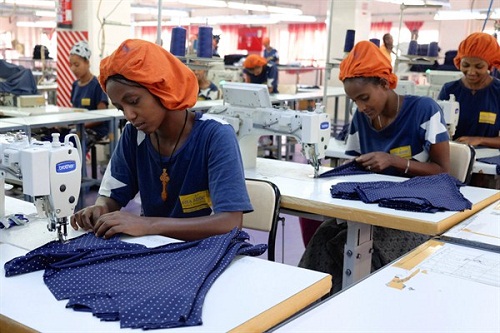 extraordinary talent and affordable labor, which is the perfect push to build an extraordinary footwear industry. Countries like Ethiopia, Ghana, Kenya, and Nigeria lead the revolutionary footprint of the continent. In 2015, Ethiopia earned more than $30 million from shoe exports, and achieved ninth place in leather products industry worldwide. And this is just the beginning. In 2018, one can expect to see further growth in Ethiopia and other African countries, as the African footwear industry is likely to touch $1 billion in the next decade.
Increasing acceptance, changing perception of fashion
Even though very few universities across the continent offer a degree in fashion, perception across the continent is improving with African fashion being increasingly accepted and adopted globally. According to Trade and Industry Minister, Rob Davies, South Africa is developing a master plan for the growth of apparel, textile, footwear, and leather retail value chain, targeted at creating 60,000 jobs. The plan may be announced early next year. Thanks to the upward trend of Africa’s clothing exports, especially thanks to the Bangladeshi investors, there has been a threat to the second position in the world’s clothing business. Under the African Growth and Scope Act (AGOA), the United States enjoys duty-free and quota-free access for certain goods with clothing.
Abuses are rife in the wool industry though there are companies that claim their materials are responsibly and ethically sourced. Though farming wool does not require killing animals in the same way that farming fur does, there is no really humane way to shear sheep for wool.
Though the vast majority of farms around the world raise sheep in a happy and protected environment, respecting the welfare of the animals and the health of the land, the shearing process can be harmful to sheep. Animals are beaten, kicked, punched and mutilated in front of each other in gruesome ways.
There are no synthetic equivalents available today that provide the same feel and technical capabilities of wool, and as a natural fiber, wool offers many environmental benefits over oil-based fibers. Wool is one of the most environmentally low-impact fibers there are. With plant-based fibers, the land has to be plowed up and a lot of soil carbon is lost. Also, synthetic materials contribute to fast fashion's overproduction problem while wool last longer and is recycled more often.
But a counter-argument to stopping the use of wool posits that choosing synthetic materials over animal products may be better for animals, but those same synthetic materials are harmful to the environment.
This year Vietnam’s garment and textile export turnover is expected to be up 10.8 per cent from last year. To this end, Vietnam is focusing on products with a high competitiveness in the world market, and improving its garment and textile supply chain. Investments are pouring into the Vietnamese weaving, dyeing, material and accessory segments. Vietnam’s export earnings in 2018 were up more than 16 per cent from 2017.
Its main export markets include: Asean, Japan, South Korea, the European Union and the United States. However, the country has had to spend heavily on importing cotton, yarn, fabrics, materials and accessories for production of garments, textiles and footwear. Vietnam is the world’s third biggest garment and textile exporter.
With the results achieved in 2018, Vietnamese textile firms have witnessed positive signals for orders in 2019. Many businesses have already received orders for the first six months of 2019 and some for the whole year. The upcoming enforcement of new generation free trade agreements is a positive factor supporting production and business activities of the sector in 2019.
In 2019, the Comprehensive and Progressive Agreement for Trans-Pacific Partnership is expected to boost many industries of Vietnam, including the textile and garment sector. In addition, the textile and garment sector is also waiting for more orders to be shifted from China due to the US-China trade war.
The Turkish textile sector has a strong image in the global market. The sector stands out with its state-of-the-art technology, flexible production ability, capability of producing special products and high-quality workforce. It is the biggest textile manufacturer in Europe. It continues to make significant breakthroughs not only in design and fashion but also in technical textiles. In 2018 Turkey’s textile exports increased seven per cent compared to the previous year.
There are approximately a million people employed in textiles and readymade clothing sectors. This number reaches two million if sectors such as retail and merchandising are included. The Turkish textile sector has a very high potential especially in terms of value added production.
The Turkish textile and readymade clothing sector as a whole has the highest foreign trade surplus. The sector ranks first in the country in terms of share in the gross domestic product and in terms of parameters such as domestic input use.
Turkey is the seventh biggest cotton producer in the world. It has the biggest machinery park in the world. The biggest factory manufacturing quilt covers is in Turkey. The country is one of the top three towel suppliers in the world. The share of Turkey in global textiles exports stands at three per cent, at 4.5 per cent in home and interior textiles and 1.5 per cent in technical textiles.
For the third quarter Trident has had a 53 per cent rise in net profit. The company’s revenue jumped 18 per cent. Operating profit or ebitda was also up 18 per cent. During the quarter, the existing promoters raised their stake to 70 per cent. Their shareholding in the textile firm was at 68 per cent at the end of September 2018.
The strong results coupled with increased control by the promoters is expected to further boost sales of the company in future. Trident is looking to expand its retail presence in the country by doubling its point of sales and expects to be a Rs 1000 crore brand by 2020.
Trident currently has around 400 points of sales across the country with manufacturing facilities in Punjab and Madhya Pradesh. Incorporated in 1990, and based in Ludhiana, the company has evolved from being a solitary yarn and paper manufacturer to one of the largest, state-of-the-art and integrated home textile manufacturers globally.
Trident’s spinning division produces cotton, compact and blended yarns. It has the largest spinning installation at a single campus in India. Presently, Trident has an installed capacity of 5.5 lakh spindles and 6,464 rotors with a capacity to produce 90,000 tons a year of cotton, compact and blended yarn.
Trade tensions between China and the US are expected to reap benefits for Southeast Asia. Tariffs would inevitably mean that manufacturers, already accustomed to selling goods on the international market, will likely move to greener pastures like Cambodia, Myanmar, Laos, Bhutan and Bangladesh, among others.
As a result, these countries will finally be able to diversify trade, improve the quality of life of their citizens, introduce new skills to the labor force and eventually move beyond just being the rice fields and bread baskets of the rest of the region.
Chinese bicycle manufacturers are shifting their plants to Vietnam, where improved bilateral relations with the US have resulted in a free-trade agreement between the two nations. Similarly, garment manufacturers like Gap, Levi’s and Zara have set up contingency plans which would allow them to move manufacturing to Bangladesh in the event their products are targeted by stricter trade regulations.
Malaysia, which hosts over 800 auto component manufacturers on its shores, will also certainly benefit from the Chinese and American firms’ demands for such products.
Asia’s GDP is expected to grow by 5.4 per cent this year, while North America and Western Europe’s GDP will grow by only 2.2 per cent and 1.7 per cent respectively.
Redress is the world’s largest sustainable fashion design competition. With a focus on emerging designers the search is now on to find the next big talent who has the ability to impress the judges and the commercial flair to inspire a new wave of conscious consumers. With support from two new headline sponsors the competition will also accept applications from menswear designers for the first time since its launch in 2011.
Emerging designers worldwide with less than three years’ industry experience are eligible to apply until the closing date on March 14, 2019. The winning designer will create a sustainable collection for retail.
Redress’ mission is to promote sustainable fashion and catalyse positive change in China’s powerful fashion industry. This is the ninth cycle of the Redress Design Award. The current fashion system is incredibly wasteful. Less than one per cent of the material used to produce clothing is recycled into new clothing. Fashion is currently the fourth largest emitter of carbon dioxide. Fashion’s direct link to waste, pollution and climate change is undisputed.
The 2018 cycle of the Redress Design Award attracted entries from 55 countries, and with 110 university partners worldwide the competition continues to blaze a trail for sustainable fashion.
Hopes of reviving the industry in Malaysia – and other Southeast Asian suppliers of home-textiles and other textile products – were visible at Frankfurt’s just-concluded four-day Heimtextil Trade Fair, the world’s largest event for home textiles and accessories. Fernex Sdn Bhd’s received many solid business enquiries from both existing and potential new buyers from around the world, including the US.
Nature World Manufacturing Sdn Bhd, which manufactures home textile products, also received numerous enquiries.The buyers showed a keen interest in its bio-active Energy-based products.
Organised by Messe Frankfurt, the Heimtextil show from January 7 to 10 boasted of 3,025 exhibitors from 65 countries. The textile exhibition saw participation from Asean exhibitors, including eight exhibitors from Indonesia, three from Malaysia, three from Thailand and eight from Vietnam. China and India had 559 and 394 exhibitors respectively, surpassing the host country Germany at 301.
According to the Malaysian trade commissioner in Frankfurt, Malaysia’s total exports of textiles, apparel and footwear amounted RM13.69 billion in the January-November 2018 period. The US is the biggest market for such products, accounting for RM 1.78 billion (13 per cent) of total exports.
Myanmar officials and businesses have requested the EU to reconsider its decision of potential withdrawal of its generalised scheme of preferences (GSP) from the country due to the fear of negative impacts on the nation’s growth and the grass root population over.
Aung Naing Oo, Director General at the Directorate of Investment and Company Administration says, EU’s decision could have a big impact on Myanmar’s reforms and growth momentum, as thousands of workers would lose their jobs if factories close and foreign businesses leave. The official requested the bloc to reconsider its planned punishment on Myanmar for alleged human right violations in three of the nation’s states where ethnic people reside.
EU Commissioner for Trade Cecilia Malmstrom announced a plan to consider a temporary GSP withdrawal, due to the findings. Zaw Min Win, President of the Union of Myanmar Federation of Chamber of Commerce and Industry, reiterated the importance of trade preference to local businesses to export their goods to European countries.
Khine Khine Nwe, Joint Secretary General of UMFCCI and General Secretary of Myanmar Garments Manufacturers Association, went to the EU office in Brussels recently to request the bloc maintain its trade privileges for Myanmar. She held discussions with EU authorities, including director generals for trade and employment.
Maung Maung, President of the Confederation of Trade Unions Myanmar, said more than one million workers from garment and fishery industries could be affected if the EU decides to revoke the trade preference.