FW

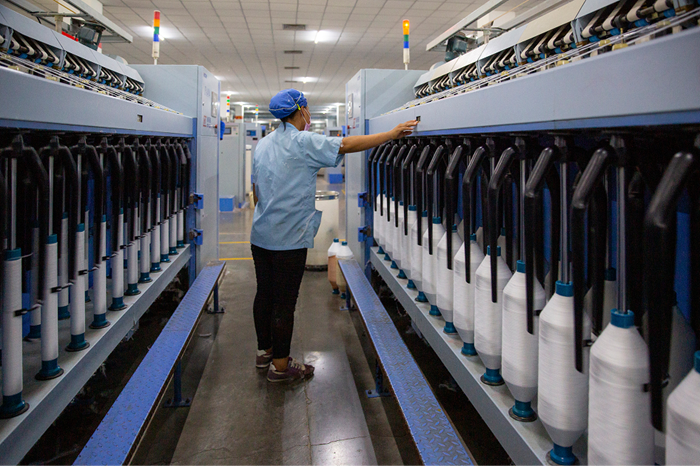
Pakistan Textile Exporters Association (PTEA) has demanded immediate release of funds for payment of outstanding Duty Drawback of Taxes claims to achieve sustainable growth through enhanced exports. The textile industry has a capacity to add further $5 billion in textile exports and generate 500,000 new jobs in two years.
Commenting on the prevailing situation, chairman PTEA Khurram Mukhtar said cash flow crunch has squeezed the financial streams and textile exporters are facing hardship to fulfill their export commitments. Rs16 billion was approved by the previous government for payment of DDT claims but this could not be released and the outstanding amount in this regard has accumulated to Rs35 billion, he said.
Moreover, huge amount of custom rebate claims amounting to Rs 10 billion has also been stuck. Textile industry contributes 8 percent of national GDP remained a low priority area for the policy makers and the sector has not been given deserving importance. Resultantly, a meager growth of 0.41 percent has been witnessed in textile exports in July to October 2018-19 as compared to previous year which reflects non-seriousness of the Government towards the largest manufacturing industry.
Heidi O’Neill is the new president of Nike Direct which handles the digital initiatives. In her new role, O’Neill will be responsible for all Nike digital products, services and member experiences, as well as lead Nike Direct through the next transformative and digitally-led era.
O’Neill, a 20-year Nike veteran, has held senior management roles across the company, including her current role. She has also held positions of increasing responsibility, including VP of US apparel; VP, general manager of Nike’s women’s category, and VP, general manager of Nike stores globally.
She began her career at Nike as a marketing director in apparel. Prior to joining Nike, O’Neill held roles at Levi Strauss. She is a founding board member of the Nike School Innovation Fund.
Adam Sussman, previously Nike’s chief digital officer, will assume an expanded role to become VP, general manager, Nike Direct digital and geographies. Sussman will continue to oversee Nike digital and the consumer vision for digital products, experiences, services and capabilities across the marketplace, while taking on management responsibility of the four key Nike direct geographies. Sussman will report to O’Neill.
Nike, based in the US, is the world’s leading designer, marketer and distributor of authentic athletic footwear, apparel, equipment and accessories for a wide variety of sports and fitness activities.
Apparel Summit of the Americas was held in Honduras from November 27 to 29, 2018. The who’s who of US active wear brands had assembled -- 250 executives from 125 organizations. Business was closed, joint ventures were initiated and mergers were negotiated during the event.
Honduras is the number one country of origin for US imports of cotton T-shirts and sweatshirts. The new strategic textile investments in Honduras are focused on manmade knits, adding to the region’s importance in the growing active wear category.
Honduras is attracting lots of foreign investments, creating thousands of new jobs, improving infrastructure and ports, enhancing education, building safe, affordable housing, generating stable renewable energy and above all else increasing the capacity for apparel production in the Americas.
The existing textile and apparel industry infrastructure in Honduras has outstanding conditions for investment and expansion opportunities. There are 18 industrial parks that together have a construction area of more than 1.8 million sq. mt., and advantages like availability of airports, ports, highways, telephones, water and electrical supply, customs paperwork, low working costs, machinery and logistics. The textile and apparel industry has the capacity of biomass production as well as wastewater management technologies allowing high productivity in a sustainable manner.
A meeting of the International Cotton Advisory Committee (ICAC) is being held from December 2 to 6, 2018, Côte d'Ivoire. The theme is: ‘Cotton Challenges: Smart and Sustainable Solutions.’ The event is focused on technologies being developed to assist small-scale farmers, particularly in Africa. Examples of innovative new technologies are being featured, including self-driving harvesters and artificial intelligence, as well as a live display of a flying drone.
The key message from the event is doubtless robots and artificial intelligence are eliminating jobs and putting people out of work in many of the world’s industries. In some less developed countries, however, high-tech solutions are being created to perform agricultural tasks for which human labor is either too expensive or simply not available. Cutting-edge technologies are focusing on new ways to enhance cotton cultivation throughout the growth cycle.
Formed in 1939, the ICAC is an association of cotton producing, consuming and trading countries. It acts as a catalyst for change by helping member countries maintain a healthy world cotton economy; provides transparency to the world cotton market by serving as a clearinghouse for technical information on cotton production; and serves as a forum for discussing cotton issues of international significance.
UKFT is working on the new £5.4m Future Fashion Factory project to develop advanced digital and textile technologies that will increase competitiveness and productivity in the design and production of luxury fashion, led by the University of Leeds alongside project partners including Burberry, Royal College of Arts, Wools of New Zealand, Wooltex UK and the British Fashion Council (BFC). The industry-led collaborative research project links the textile design and manufacturing centres within the Leeds City Region with the creative design and retail centre of London.
It brings together expertise from ten core industry partners, with many more forming a wider network spanning design, manufacturing and retail in the UK. The project involves collaboration with the Universities of Leeds, Huddersfield and the Royal College of Art as well as the Centre for Textile Excellence in Yorkshire.
Adam Mansell, CEO, UKFT will lead the project, spearheading the drive to increase productivity, shrink design process lead times, lower costs, and importantly, reduce waste.
By 2019 China will overtake the US as the world’s largest fashion market. Many luxury labels already depend heavily on Chinese customers, who have for some time been the world’s biggest buyers of luxury goods. The wealth of China’s nearly 1.4 billion people is rapidly multiplying, creating legions of new consumers with disposable income to spend on things such as sports, entertainment, and of course, clothes and shoes.
It’s shaping the way the fashion industry operates. Italian label Ermenegildo Zegna, for example, now looks to China, not the US, as the place where it tests new products before deciding whether to roll them out around the world. Sports brands such as Nike and Adidas are investing heavily in their Chinese businesses, as the growing middle class has more leisure time and money to devote to exercise and fitness.
Under a moderate scenario of growth, China is expected to add a number of consumers and spending power roughly equivalent to Germany’s current economy by 2025. China is poised to reach a milestone that signals how the rebalancing of economic power in the world is reshaping industries with it. There is an ascendance of young shoppers and policies are encouraging shopping.
Lectra’s Fashion On Demand is fashion’s first end-to-end personalization solution. This is a breakthrough solution enables fashion companies to personalize at ready-to-wear production speed. It automates the entire personalization process from product development to the final cutting stages.
Fashion On Demand is available in the form of two packages, one dedicated to made to measure, and the other to customization. This turnkey solution automates on-demand production right from order reception to production development stages and the cutting room. Companies can define the product customization criteria and range for each item depending on the package (such as altering product characteristics for customization and pattern adjustments for made to measure) and launch production processes right from the get-go, without interfering with their standard workflows.
The digital revolution has prompted consumers to demand personalized products and experiences. This is an advantageous business model for fashion companies as it allows them to accurately match supply with demand and solve a host of problems that regular business models usually face. By simply knowing ahead of time what and how much their consumers want, companies can produce in precise quantities and avoid overstocking and markdowns. In addition, as consumers pay upfront for their orders it improves cash flow for businesses. Fashion companies can use personalization as a way to outshine their competitors and earn consumer loyalty, by offering one-of-a-kind products that make their customers feel exclusive.
Chanel has banned the use of exotic animal pelts in its collections. The brand removed Python skin bags from its website recently although secondhand bags were still on sale from online resale sites. Its handbags made from them reportedly sell for up to $10,300. Animal rights groups welcomed the move, with People for the Ethical Treatment of Animals (PETA) hailing Chanel as giving a lead to other luxury brands.
Although top fashion brands have been under heavy pressure to renounce fur, with Gucci, Armani, Versace and John Galliano all deciding to go fur free, Chanel's decision to stop using exotic skins came as a big surprise. Animal rights campaigns against the use of crocodile and snake skin products have not got the same traction with the public as similar crusades against fur, with some luxury brands even investing in reptile farms so they can guarantee that skins are sourced ethically.
Apparel exporters in Bangladesh are opening factories in rural areas. The apparel sector in the country is gradually spreading to rural regions from a handful of industrial belts in urban areas. Triple Seven Apparels has a factory on 21 bighas of land in a remote place. The 2,40,000 sq ft floor of the factory is centrally airconditioned. The production line opened in December 2016 with four swing lines, which has now extended to 16 swing lines. The plan is to add ten more swing lines next year. About 1,500 people are currently working in the factory. The capacity is around four lakh units of woven products a month.
Approximately 150 export-oriented apparel factories have already been established in rural areas. Labor is easily available and employment gets generated. So the rural economy gets a boost. Factories in rural areas help garment workers live in close proximity to their own village areas, where the living cost is much lower than in the city. In addition they get training and experience in garmenting.
A factory established in a rural area adds value to other economic activities like small businesses, house rent services, bank and insurance facilities and hospital facilities.
Taipei IN Style (TIS), held from November 8 to 11, 2018, emphasised the ‘Sustainable Fashion and Functional Innovation’ in Taiwan’s high quality textile and apparel industry. This was illustrated by four themes: ‘Sustainable Fashion and Functional Innovation- the Power of Taiwanese Brands,’ ‘International Exposure Projects – Presenting Asia’s Fashion Talents’, ‘Expanding Fashion Industry with Smart Tech’ and ‘Asia’s Fashion Apparels Brands gathered at Taipei IN Style.’
Taipei IN Style 2018 featured over 120 apparel brands from Japan, Hong Kong, China, Taiwan, etc. It hosted a total of 13 house shows and an international competition, 5 seminars about fashion trends and international market potentials, as well as one brand event, attracting buyers from Europe, Japan, China, Southeast Asia and around the world.
The fair gathered top designer brands and fashion institutes from around the world, including Gioia Pan who won the 18th Golden Top Award in China, Yenline Hsu known for her exquisite techniques, ‘Madammay’ and ‘Hong Chubby' designed by May Hsu, which focus on detail cuttings and achieve fashion and high quality at the same time.