FW

Leading Swiss textile technology brand and a producer of functional polymer chips, yarn and textile technologies, Litrax, displayed its latest technology innovations that could change the future of functional garments, at ISPO Beijing last month.
The company showcased L2 Thermo, a fibre integrated warming technology that permits instant warming and insulation of +13°C infrared heat within 10 minutes, produced by the human body itself collected by L2.
This technology received Top 5 and Top 10 innovations awards at earlier ISPO shows, through fabric suppliers LMA and Sampaio Portugal and is in current use by several brands in body wear, insulation and winter and ski wear.
L2 Thermo is available in dark (grey), light (silver) and off-white fibre and filament versions with marginal temperature difference. Off-white still offers a +60 per cent higher temperature as against virgin polyester. This is best for e-vehicles interior (ceiling, carpet, seats), as it will reduce heating battery consumption by 30 per cent.
It claims their technology can warm up even with thinnest socks, and produces a +13°C temperature difference between virgin polyester and L2 Thermo polyester. The company also presented its solution with L14 Conductivity yarns: polymer filaments with finest Swiss made plasma coating of inert Ag/Ti (silver/titanium). The yarns are said to exhibit excellent conductivity properties, are washable and offer total textile flexibility.
“Under normal conditions the comparison between L14 textile electrodes and conventional gel electrodes show no difference of signal strength making it suitable for finest currents in medical, signalling, sensing and lighting applications,” the company added. Litrax presented another novel technology, showing halogen-free L11 Flame Retardant technology for PA6 yarns in both off white and predyed versions with great LOI values.
The Indian textile industry has recently been seeing exponential growth along with textile and apparel export. India is the world's second largest exporter of textiles and clothing. With readymade garments remaining the largest contributor to total textile and apparel exports from India, textile and apparel exports are forecast to increase to $82 billion by 2021.
Key growth drivers are increased penetration of organised retail, favourable demographics and rising income levels. Key highlights of the textile industry's big success are:
Foreign Investments and FDI: The hike in FDI limit in multi-brand retail is a blessing for the textile industry which will not only bring in more players, but even provide more consumer options. It will bring greater investments along the entire value chain. With international brands gaining a domestic foothold, outsourcing will also rise exponentially.
Retail sector’s growth potential: With consumerism and disposable income on the rise, the retail sector has seen a quick growth in the last ten years with several international players like Marks & Spencer and Guess etc. having entered the Indian market. The organised apparel segment is expected to grow at a CAGR of over 13 per cent over a 10 year period.
Private sector participation: While government policies and initiatives are growth drivers for the textile industry, private players to are making hay whilst the sun shines. The Central Silk Board's targets for raw silk production is a key example and to achieve these targets, alliances with the private sector, especially major agro-based industries in pre-cocoon and post-cocoon segments has been encouraged.
International demand: Growing population has been a main aspect of textile growth in the country. Moreover, according to World Bank, urban population accounts for 32.7 per cent of the total population of India. This also works as demand driver due to changing taste and preferences in the urban India. This trend has been enhanced by a young population which is growing and is being exposed to changing trends and fashion resulting in the textile industry seeing high volume demand within the country and also in exports.
For 2017, H&M’s operational profit went down 14 per cent. The retailer’s assortment missed the mark last year, which resulted in low comp sales, ballooning inventory levels, and an increase in markdown activity. Stock in trade was 16.9 per cent of net sales. The target is to come back to levels before 2016, which is 12 to 14 per cent.
H&M is experimenting with new store formats that focus on a more shopping-friendly environment thanks to less merchandise, a warmer feeling and more of an emphasis on experience. H&M is also applying features to make the stores easier to shop in. The brand will also make easier its new in-store mode on its app. Shoppers will be able to search the store assortment for specific items, get recommendations based on products available in nearby locations and become alerted whenever a product which is their favorite is in a store they happen to be passing by.
The company is planning to advance the company’s content, and it’s investing in a new photo studio for that purpose. For the fourth quarter of 2017 H&M saw a 34 per cent fall in profits on a four per cent drop in sales.
Dutch denim maker G-Star Raw is launching the most sustainable denim ever. G-Star uses 100 per cent organic cotton, which doesn’t use pesticides that are unnatural, synthetic or chemical. Its organic crops are grown from non-genetically modified seeds and the majority of global production is rain-fed.
The company has developed a new indigo technology that uses 70 per cent less chemicals, no salts, and produces no-salt byproduct. Pre-reduced indigo is combined with a liquid based organic agent that replaces the conventional use of sodium hydrosulphite — a major problem in indigo dyeing.
The conventional technique for washing denim can use nearly 2,000 gallons of water to make one pair of jeans. With G-Star 98 per cent of the water used to wash the jeans gets recycled and reused, and the small percentage left evaporates.
Other measures include replacing rivets and zippers with eco-finished metal buttons to make each garment 98 per cent recyclable, enforcing a code of conduct with suppliers and working to trace all raw materials back to their origins. For the buttons, G-Star collaborated with YKK on metal that doesn’t require electroplating baths during production, which eliminates acid and toxic chemicals.
As much as possible, G-Star uses recycled cotton from post-consumer or post-industrial waste material for its apparel.
The fabric collection presented by Canepa SpA at the February 2018 edition of Première Vision, the French trade fair presenting international innovations and textile trends, was dedicated to environmental sustainability. The company showcased its patent SavetheWater Kitotex®, whose manufacturing process was tailored to minimise its impact on the environmental by reducing the use of toxic substances, energy and water consumption in all the production process.
The new pre-collection S/S 2019 Canepa textile is eco-friendly, ‘ECO comfort’, flexibly destined to man and woman, suitable to be used in any stylistic pattern, through an innovative ecological dyeing. Prints and jacquards of unlimited chromatic variety are harmoniously developed in precious and imaginative top of the range Made in Italy collections, with a creativity that Canepa have been developing since 1966.
The new Canepa collections include other textiles in cotton made as per Global Organic Textile Standards (GOTS) certification requirements. Flowery, geometrical and false uni fabrics dominate S/S 2019 Canepa collection, pastel shades mix up with more energetic and intense tones, designed for a woman who craves innovation and a romantic mood.
Optical solutions and black and white geometries open the Spring season with light matelassé and fil coupé textiles, taking inspiration from flowers, together with brocades in romantic shades of colours such as antique rose, London grey, pastel blue and light yellow. As summer comes, tones become more intense, in the development of collection storytelling. Patterns become more abstract and shapes more irregular, the vision turns from romanticism to a journey in the hyperspace, colours appear almost unreal, taken to the most extreme tones. The new pre-collection synthetises the suggestions of new style tendencies, translated into textiles connecting a new romantic classicism, a return to minimalism and a strong desire for future and technology.
A designer studio-cum-library for viscose staple fibre (VSF) products will be launched in Tirupur to provide training in the handling of viscose yarn and fabrics. Grasim Industries, in association with the Tirupur Exporters’ Association (TEA), is to set up the state-of-art-facility. TEA president Raja M Shanmugham disclosed it was important to enlarge the product range, while 65 per cent of global apparel segment belongs to man-made fibres, it would be difficult for the dollar city to survive if it only continued to bank on cotton fabric products, because many developing countries are picking up in the latter market.
With the Liva brand, Grasim Industries is the giant in VSF market and so when they approached TEA, they welcomed them with open arms. Garment manufacturers in Tirupur may be good at handling cotton yarn and fabrics, but not viscose.
Head of R&D, NIFT-TEA College of Knitwear Fashion, CP Senthil Kumar explained, viscose’s wet strength is lesser compared to cotton and the fabric may swell easily. Experience will be needed to handle issues including shrinkage control. Such know-how could be earned from the technical experts at the state-of-art designer studio where marketing solutions could also be met. To strengthen the supply chain, Grasim Industries will include yarn/fabric manufacturers and dyeing processors, who works on their knowledge under Liva accredited partner forum (LAPF).
In January, Indian cotton textiles exports fell by 16 per cent year-on-year. Apparel exports fell 14 per cent year-on-year. Manmade textiles fell seven per cent year-on-year.
Between April and January of last financial year and for the same period this fiscal, apparel exports dropped by five per cent. Usually orders are good between January and March. However, this year, exporters are cutting back orders because of the financial crunch. While the country’s exports are growing, decline in apparel and textile exports will bring down the share of the sector in the export basket. Annual textile and clothing exports this year might be the same as last year. However, yarn and garments are going to be lower.
Cotton yarn exports have declined by more than 26 per cent from 2013-14 to 2016-17 despite adding over three million spindles and 62,000 rotors of spinning capacity during this period.
There has also been a continuous rise in imports of textile products post GST. Imports of textile yarn, fabric and made-ups increased by 15 per cent from April 2016 to January 2017. Almost 55 per cent of garment exporters have not received the Rebate of State Levies since last July.
Exports for the first month of the calendar year 2018 recorded $24.38 billion. Data released by the commerce ministry can be interpreted in two ways. Year-on-year, there is a 9.07 per cent growth from $22.35 billion recorded during January, 2017, but as against previous month of December 2017 when exports touched $27.03 billion, this shows a drop of 9.80 per cent.
During October/November, exports had stood at $23.09 billion and $26.2 billion. Thus when viewed from this angle, growth is depressing. SME and labour intensive sectors such as garments, carpets, handicrafts and man-made textiles are not reporting growth. The drop in exports of cotton textile by 16 per cent y-o-y, apparel by around 14 per cent y-o-y and man-made textiles by 7 per cent y-o-y is again a sad state of affair.
It may be noted that exports of petroleum product contributed to around 6 per cent of the total January export figures. Trade deficit for January is again at an alarming level. It touched a near 56-month high of $16.3 billion in January, when compared to $9.90 billion in the same period last year. This increase is mainly due to a 26.1 per cent increase in imports to USD 40.68 billion largely due to enhanced import of crude oil.
During the first 10 months of the fiscal, the gap widened to $131 billion when compared to $88 billion during the same year ago period. If this trend continues, trade deficit in this fiscal may reach $ 150 billion. Exporters have been crying horse about delay in refund of input tax credits that are stifling growth of the sector. An exporter’s body has also urged the government to look into the refund issues and clear all cases by 31 March, 2018. The same body had noted that exports credit had recorded a fall of -2.5 per cent in 2016-2017 and a y-o-y decline of -8.7 per cent in 2017. Thus, one can clearly see that government intervention is the need of the day.
"Amidst all odds, Pakistan’s leading denim maker, Artistic Denim Mills, which operates as a one-stop shop turning cotton into jeans, plans to double its production and has already built a new factory in Pakistan’s financial hub. At a time when many textile companies have shut shop, this really comes as a surprise. Being bullish about the prospects, Faisal Ahmed, CEO, Artistic Denim, says he supplies to retailers such as Zara and Next Plc. Unlike most industrialists, Artistic Denim started by making garments about 25 years ago instead of just shipping spun yarn or fabric. Pakistan is among the top five growers globally. "

Amidst all odds, Pakistan’s leading denim maker, Artistic Denim Mills, which operates as a one-stop shop turning cotton into jeans, plans to double its production and has already built a new factory in Pakistan’s financial hub. At a time when many textile companies have shut shop, this really comes as a surprise. Being bullish about the prospects, Faisal Ahmed, CEO, Artistic Denim, says he supplies to retailers such as Zara and Next Plc. Unlike most industrialists, Artistic Denim started by making garments about 25 years ago instead of just shipping spun yarn or fabric. Pakistan is among the top five growers globally. Pakistan has been mostly converting cotton into thread and fabric that is shipped East to other Asian countries, which then manufactured into final garment.
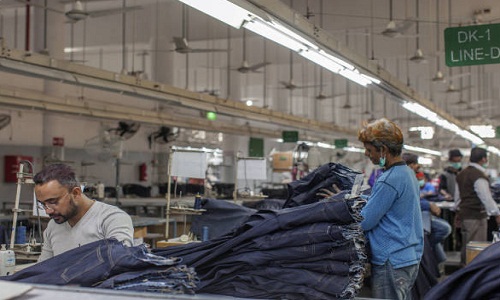
With upcoming elections in July, Pakistan government is under pressure to revive exports and would avoid any measure which would lead them to go to the International Monetary Fund for its 13th bailout since 1988. Accounting for half of overseas shipments, the textile industry remains the key for survival.
Pushing up market share
When new countries are emerging and growing their textile expanse, Pakistan’s performance has been deteriorating year after year, falling behind Bangladesh’s 276 per cent increase and 445 per cent in Vietnam, according to World Bank data. India is the second-largest apparel exporter in South Asia after Bangladesh. However, Pakistan has the advantage of homegrown cotton to capitalise on, unlike Bangladesh and Vietnam.
Pakistan is aiming for its first export jump this financial year after giving tax breaks to exporters, in a bid to reverse a three year slump with value added products like denim getting the biggest incentives, said Mohammad Younus Dagha, Secretary at the Commerce Ministry. Ahmed Lakhani, Analyst at Karachi-based JS Global Capital, points out Bangladesh and Vietnam governments are giving huge support to industries, unlike Pakistan. The tax breaks are a good step, but the government needs to decrease electricity tariffs and keep a check on wages. He is skeptical if government is in a position to do that and that’s where incompetency lies.
Majyd Aziz, President of MHG Group feels about 95 per cent of Pakistani exporters’ mentality is waiting for a customer rather than going out and finding them. In the global world, you need integration and economies of scale, if you do that, you make money. Artistic Denim is one of them. It has chased premium brands in Los Angeles that pay more for smaller deliveries to keep changing designs rather than bulk orders. The company said this will help revenues reach as much as eight billion rupees ($72 million) in year ending June with new garment production capacity increasing sales. According to Ahmed, Pakistan’s denim is on an upward trend, despite the larger textile industry being in trouble.
The Garment Technology Expo (GTE) 2018, held from January 19-22 at NSIC Complex, New Delhi, concluded on an optimistic note for both visitors and technology suppliers who displayed latest innovations. Subcontinent’s largest show for apparel technology had an unparalleled representation from all segments of the sector, with over 350 exhibitors representing over 800 companies and brands from over 22 countries and a big number of 21,736 visitors, made the 26th edition of the GTE a huge success. New country additions this time were Sweden and Switzerland as exhibitors.

Highlights
• Subcontinent’s largest show had over 350 exhibitors representing over 800 companies and brands from over 22 countries
• Sweden and Switzerland exhibited as the new countries in GTE
• A big number of 21,736 buyers visited the show, making the 26th edition of the GTE a huge success.
• Automation was the key theme
• ‘Apparel 4.0’ conference on Day 2, highlighted how Apparel 4.0 is shaping and transforming the global fashion and apparel business.
• GTE next events announced in Bangaluru on August 18-20, 2018, and next grand annual event GTE’ 2019 in New Delhi being held on Feb 22-25, 2019
Showcasing latest technologies and innovations
The key attraction at the fair was technology, the display of machine-to-machine communication systems powered by several tech companies like Juki, Jack, Hikari, Dürkopp Adler and Brother. “As the industry is still on oxygen, the only way to survive is to adopt automation as much as possible so that we can reduce workforce and minimise cost,” observed GS Madan who explored automation in all segments from cutting to stitching and finishing.
Digital printing was showcased by India-based ColorJet, which presented digital printer TXF at the fair. The printer offers speed of up to 24 sqm per hour and can achieve print resolutions of up to 1,440 DPI. The company has ambitious plans in place to expand in apparel manufacturing hubs like Bangladesh and Vietnam. And as Smarth Bansal, Brand Manager, Colorjet points explained, “India is already our stronghold and now we are looking to capitalise on the lucrative opportunities in other emerging countries. We are looking to collaborate with local partners, especially in Vietnam.”

Knowledge sharing at Apparel 4.0 seminar
The 26th Garment Technology Expo (GTE) 2018 presented a new set of opportunities to visitors and exhibitors on Day-2. The major highlight was the ‘Apparel 4.0’ conference. This was the first-ever conference that took place at the garment technology exhibition, held at NSIC Complex, New Delhi. The day-long conference organised by FashionatingWorld, aimed at educating the industry on how Apparel 4.0 is shaping and transforming the global fashion and apparel business. The discussions got a tremendous response and appreciation from industry stakeholders. Global experts and Indian stakeholders spoke about the growing importance of ‘Industry 4.0’ concept and the implementation challenges to Indian apparel industry. The list of speakers included stalwarts Mike Fralix, President & CEO, [TC]2; Dietrich Eickhoff, CEO & Chairman, Dürkopp Adler; Samath Fernando, CIO, Hirdaramani Group of Companies, Sri Lanka, Prabir Jana, NIFT Delhi and Dr Darlie Koshy DG, ATDC among others. The experts highlighted the role and perspectives of both technology providers and users from the point of view of ‘Industry 4.0’.
Also on the agenda was a panel discussion with industry leaders moderated by Rajesh Bheda of RBC and session chaired by Dr Darlie Koshy, DG ATDC. The panel included JD Giri of Shahi Exports, RC Kesar of OGTC; Gunish Jain of Royal Datamatics and Vinod Iyer of Fortuna Colours. Kesar pointed out, “Indian manufacturers appreciate technology but wait for the right time to implement it. If we keep on waiting for the ‘right time’, the time will never come when we are (actually) ready for Industry 4.0.”
Exhibitors satisfied with the response
Umesh Gaur, President (Asia), Tukatech observed, “The fair has been good overall. We are associated with GTE from the very beginning. The response was to the mark. It’s been a win-win situation for us.” Talking about India’s advantage, he said, “India holds the upper hand in many areas if explored well. Indian products are still considered the best in terms of quality, though we don’t produce in quantity like neighbouring countries. We are offering a verity of fabrics and handmade designs.”
Juki India displayed many advance machines this time. R Gopal Kukreti, GM, Juki India, said, “Many machines have been showcased for the first time in India. They are equipped with NTSC technology with direct drives and are connected with cloud. We have launched a machine, which can make 10-12 cuffs and collars in one go. We are mainly into non-apparel and knitwear industry.”
Speaking about changing customer profiles, Macpi India’s Mohanti Basanta Kumar, Director (sales), explains, “We have launched finishers for jackets, considering the demand is very high for casual jackets in the current market trends. The finisher deals with all kind of fabrics. The only condition is that the jackets should be casual. The market is good, not only for our company but the industry as a whole and this trend is here to stay for the next five years. A lot of business is coming in and we hope for the best in future. Personally, this is going to be 20th GTE for me. We have been seeing a change in the manner client deals with us in the fair. Earlier, they would come and strike deals in the exhibition for good amount of discounts, but now clients prefer to come directly to our office and deal with us in the hope that they would be able to make a better bargain over there.”
Overall GTE 2018, generated good business for both exhibitors and customers who came looking to upgrade their technology. GTE is looking forward to further adding successful chapters to their credits in Bangaluru on August 18-20 as well as their next grand annual event GTE’ 2019 in New Delhi being held on Feb 22-25, 2019