FW

A four-day exposition on yarn, fabric, denim, dyes and chemicals will open on January 31, in Dhaka’s International Convention City Bashundhara (ICCB). It is expected to create greater interaction among local and international stakeholders. Conference and Exhibitions Management Services (CEMS) Global CEMS Global in association with China Council for the Promotion of International Trade (CCPIT TEX) is organising the trade show called ’13th Dhaka International Yarn and Fabric Show (DIFS)-2018 – Winter Edition’.
Two other exhibitions the ‘2nd Dhaka Denim Show 2018 Winter Edition International Expo’ and the ’30th Dye+Chem Bangladesh 2018-Winter Edition’ will also take place simultaneously. President and Group MD of CEMS Global, USA and Asia Pacific Meherun N Islam said the readymade garment (RMG) industry is the key driving force of the country’s economy with over 80 per cent contribution to export income. Bangladesh is currently the second-largest apparel exporter, after China, she said adding that the country has the ability to overtake China for various reasons including reasonable production cost. “Chinese entrepreneurs are looking for joint venture scope in other countries including Bangladesh as production cost is getting higher there,” she noted.
DIFS-2018 is expected to help Bangladeshi entrepreneurs expand business opportunities, she averred. A total of 350 organisations from 21 countries including Bangladesh, China, Germany, Italy, Malaysia, India, Taiwan and Vietnam will participate in the trade shows. They will display various types of products and services including yarn, denim, knitted fabrics, fleece, artificial leather, buttons and zippers.
"Juki India which works mainly in the non-apparel and knitwear industry showcased for the first time at the recent GTE held in Delhi and made a mark with its advanced technology machines. “This time at GTE fair, we showcased many advanced technology machines displayed for the first time in India. The machines are equipped with NTSC technology with directs drives and are connected with cloud,” says R Gopal Kukreti, General Manager. Juki launched a machine that makes 10 to 12 cuffs and collar in one go."

Juki India which works mainly in the non-apparel and knitwear industry showcased for the first time at the recent GTE held in Delhi and made a mark with its advanced technology machines. “This time at GTE fair, we showcased many advanced technology machines displayed for the first time in India. The machines are equipped with NTSC technology with directs drives and are connected with cloud,” says R Gopal Kukreti, General Manager. Juki launched a machine that makes 10 to 12 cuffs and collar in one go.
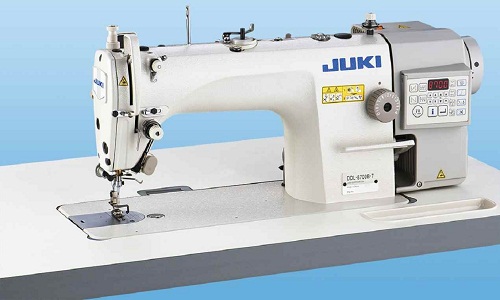
“At Juki, we are committed to customer satisfaction, and put all efforts to be close to customer needs,” says Kukreti. Juki India was established in 1995 as a representative office with a presence in New Delhi and Bangalore covering the Northern and Southern regions. Over the years, they have expanded operations significantly through nine branches at important apparel production clusters in the country and today have a full-fledged presence in with adequate sales and support.
Juki India has an extensive network of offices. This is further strengthened by the presence of agents and distributors who help in distributing their products. “We have continuously strengthened certain categories such as electronic assembly and apparel systems and equipment, with the technology of industrial sewing machines at its core,” says Kukreti.
Going forward, they are focusing on improved customer relations. The other division such Surface mount Technology (SMT) systems and household sewing machines also operate out of Juki India. “Our dedicated technical engineers and specialist team from Juki Corporation along with agents or distributors provide customer with machine knowledge, machine installation and maintenance services. Additionally, we conduct product seminars and training to all our valued customers and prospective buyers with the aim of providing technical and operational know-how of Juki industrial sewing machines,” he informs.
They also provide support to industrial customers in the form of services and software such as assisting apparel manufactures in improving productivity, developing highly efficient production systems and improving their work environment.
Kukreti sees strong competition in his segment and keeps ahead by providing good technical services to help client’s business grow, “We are associated with the industry for 22 years. We believe in quality and services. We are a Japan-based company and all manufacturing is done over there.” He feels “The future of garmenting is really bright,” and continues, “The domestic market is good and we need to exploit it properly. It will bring huge benefit to the economy. We are tapping markets in Chattisgarh and Jharkhand.”
"Tukatech is a solutions provider for textile product development. And as Umesh Gaur, President (Asia), Tukatech, says “We don’t just sell a product, we provide holistic solutions to our clients. A manufacturer/exporter looking at setting up a plant is not expected to be an expert in all areas of production and this is where we come into the picture by providing technical excellence and services.” Gaur says they have seven companies in their roster of clients — who were not tech savvy in some of areas of manufacturing. Tukatech helped them network with the right people and provided them support in-house."

Tukatech is a solutions provider for textile product development. And as Umesh Gaur, President (Asia), Tukatech, says “We don’t just sell a product, we provide holistic solutions to our clients. A manufacturer/exporter looking at setting up a plant is not expected to be an expert in all areas of production and this is where we come into the picture by providing technical excellence and services.” Gaur says they have seven companies in their roster of clients — who were not tech savvy in some of areas of manufacturing. Tukatech helped them network with the right people and provided them support in-house.
Offering time saving solutions

Explaining their working Gaur says, “Once a manufacturer gets a query on a product from an exporter or a domestic player, they first create a sample with all details like patterns, types and designs etc. We then use our software — which does not need a digitiser — to help the client create a product. This technology brings efficiency into the process along with faster pace and accuracy. The software minimises the chance of a product being rejected.”
Gaur informs they also provide solutions in warp knitting and grading. The major concern for a manufacturer is product development and approval. It takes time for a product to get approved, sometimes more than 30 to 40 days. “We help in reducing time cycle for approval by getting virtual sampling through the software. Then it is uploaded on cloud — which is another area of service we provide. This saves time, energy, labour and more. It’s all about productivity. So cloud solution and 3D are upcoming technology offerings. We also have cutting equipment and spreaders.” On India becoming a global garmenting hub, he says “India holds a trump card in many areas. Indian products are still considered best in quality, though we don’t produce in quantity like our neighbouring countries. We are blessed with a variety of fabrics and handmade designs. The kind of fabrics that are available here cannot be found anywhere else,” he expounds.
Gaur says they are looking to increasing market share, “We are happy with satisfied clients and well executed projects. Our bottom line is customer satisfaction. We are a US-based company and have significant expertise in our area of operation. There are more than 300 CAD companies worldwide. But we are doing exceptionally well everywhere. In India, we have clients like Future Group, KKCL, Gokuldas, Reliance etc. It is not that they are using these technologies first time but they chose us over competition because we provide them what others can’t.” Showcasing at the recent Garment and Textile Expo in Delhi, Gaur says they are associated with GTE from the very beginning. “The response in this edition of GTE was phenomenal. It’s been a win-win situation for us.”
The Clothing Manufacturers Association of India (CMAI) is organising the 66th National Garment Fair from January 29 to 30, 2018 at Hall I, Bombay Exhibition Centre, NSE Complex, Goregaon (E), Mumbai. This is the largest Spring/Summer Trade Fair ever organized by the Association. This B2B Fair will display more than 400 brands spread over 2,00,00 sq. ft. Approx 15,000 trade visitors are expected to visit the fair. The exhibits include men’s wear, women’s wear, kids wear, ethnic wear and accessories.
Apex Awards, the premier awards for Indian apparel industry, will be held on January 29 at Hall II. These awards acknowledge excellence in apparel manufacturing, marketing, supply chain management, exports, retail while recognising significant contributions to the industry from allied industries. This year, The Lifetime Achievement Award will be bestowed upon Sanjay Lalbhai, Chairman, Arvind Brands for his invaluable and outstanding contribution to the growth of the Indian apparel industry. Talking about bringing about policy changes, Rahul Mehta, President, CMAI says several amendments brought about by the GST Council were steps in the right direction and the textile and clothing industry has seen a fair amount of relief, especially in procedures. A lot more still needs to be done and CMAI is continuing its active interaction with the government and the GST Council to address these issues.
Teijin Aramid has announced plans to increase the production capacity for its Twaron super fiber by more than 25 per cent. This additional capacity will become available within the next five years. With this capacity expansion, the company will be able to meet future market demand and provide its customers with the material they need to excel in their markets. Demand for Teijin’s high-performance para-aramid fiber Twaron is growing steadily, and the outlook is positive. Expanding the aramid business is one of the Teijin Group’s key strategies, with an expected annual growth of 8 per cent. The company is determined to ensure that this growth will go hand in hand with an even better service for its customers.
As a market leader, Teijin Aramid aims to capture a substantial part of the global market growth, which should eventually lead to a future market share of more than 50 per cent. Substantial investments are planned to raise the production and adopt the latest technology.
By introducing lean methodology and internal optimization programs, Teijin Aramid has been able to increase its Twaron production capacity by 130 per cent since 1999. It is determined to keep up this best-practice way of working and keep investing in its factories, implement the latest technologies, and ensure economy of scale. This will enable the company to keep up with market demand and market competitiveness, while meeting its customers’ demand.
The total extra capacity is planned to be fully available in 2022. Teijin Aramid is currently implementing a new spinning technology at its Twaron facility in Emmen, the Netherlands, as was stated in July 2017. The extra capacity of that investment will become available as of May 2018.
United Towel Exporters is confident that exports to Europe will go up exponentially post the expansion of business following acquisition of a 70 per cent stake in the Netherlands-based Vespo Groep BV. The acquisition of majority stake in the home textile company would propel United Towel’s exports to $13.50 million in 2018, up 221 per cent from the current $4.2 million, the Finance Division told the Cabinet’s Economic Coordination Committee (ECC) in a meeting held late last month.
The projection while requesting the ECC to permit United Towel to remit $9.39 million to acquire 70 per cent equity in Vespo Groep BV. The State Bank of Pakistan (SBP) had forwarded the company’s request for remitting the money. Sponsors of United Towel have over 30 years of experience in value added textile manufacturing and exports of diverse products for the hospitality, healthcare, home fashion and work wear industries. Vespo Groep is a textile market leader in designing, producing and supplying products throughout Europe. The group’s expansion to Nordic countries is expected to enhance United Towel’s export prospects. The payback period of the proposed investment was expected to be about 13.5 years with the internal rate of return estimated at 26.72 per cent.
The proposed equity investment would be financed from export proceeds retained in special foreign currency accounts of the company. SBPs regulations permit textile exporters to keep 10 per cent of their export proceeds in foreign exchange. The Finance Division recalled that the ECC had decided in 2002 that the Central Bank should approve overseas investment proposals of up to $5 million, while investments valued at over $5 million should get the green signal from the ECC.
The SBP had evaluated the proposal and was seeking permission for remitting $9.39 million on the condition that the company would fund all future foreign remittances from the same account.
Gujarat Commercial Tax Commissioner, P D Vaghela has assured all stakeholders in Surat, the largest man-made fabric (MMF) sector to present the issues and demands related to GST before the Central government and the GST Council in order to find an amicable solution to these issues. Addressing a meeting of textile industry stakeholders at Southern Gujarat Chamber of Commerce and Industry (SGCCI), Vaghela promised, “I have heard the problems and issues faced by power loom weavers, traders, embroidery unit owners and women doing embroidery handwork. The issues are genuine and the state government will seriously take up the issues with the Central government and the GST Council.
He said most issues related to GST come under the purview of the GST Council, however, the issues like inter-state e-way bill provision etc will be sorted out by the State government. Last week, social media was abuzz when the CMO tweeted in favour of Surat’s diamond industry after the GST Council reduced the GST rate on polished diamonds from 3 per cent to 0.25 per cent. The CM was lambasted on social media when the textile industry raised questions whether the government did not consider Surat as the textile city.
Federation of Indian Art Silk Weaving Industry (FIASWI) Chairman, Bharat Gandhi said, “The industry is getting assurances since the day GST was rolled out. I think the visit of Vaghela in the textile and embroidery units indicates that the State Government is serious in taking a stand at the GST Council to see that the issues related to the textile sector are addressed amicably.” Gandhi announced they had put up three demands, including refund of input tax credit, credit on opening stock and implementation of central government notification on increasing basic customs duty (BCD) on imported fabrics from China. Leader of power loom weaving sector Ashish Gujarati asserts, a single demand of input tax credit will solve 10 other issues pertaining to GST. Vaghela is of the opinion that the state government will have to give a stiff fight at the GST Council to press for the refund demand of the textile sector.
Sara Textiles, (part of the diversified Sara Group) founded by D P Singh, a Noida-based home furnishing exporter with is growing at a 15 to 20 per cent every year and targeting a 35 per cent growth. S M Dwivedi, CEO, who started working as a QC Manager, explains his confidence about achieving his target. He believes the textile industry can be managed through professionals without the day-to-day involvement of promoters. Sara Textiles is almost a debt-free with 100 buyers and exporting to over 40 countries. Apart from a major share in Europe and a list of well known clients such as Lidl, Germany, the company is also associated with many dotcom companies in US and hotel industry in many countries.
Dwivedi says they never leave any of customer, big or small and no major customer has left them so far. Whenever they expand, they look at new markets and capacity dedicated to the existing customers remains untouched. Every difficult time that they have undergone has been a learning experience for the company and the entire team has managed the crisis successfully with the support of its vendors. This has ensured the smooth running of the organization so far, he notes.
“Whatever and whenever we have faced challenging times, due to recent policy changes or otherwise, we have evolved being more innovative in designing, costing and market developments and have enhanced our focus on the services. All this in a collaborative manner would deliver much better results in the coming years. We are managing our inventories quite precisely with thin manufacturing process and now we are into the peak season getting lot of orders from Europe and other countries also. We are even fully booked till the last quarter of this calendar year.”
The Pakistan government aims to enhance cotton production next season and is likely to announce a Rs 10 billion research development fund, as harvest for the natural fibre remained lacklustre for the last few years. This was announced at a high level meeting. The aim of creating a R&D was welcomed by representatives of major cotton-producing provinces, Punjab and Sindh which attended the meeting held at the Planning Commission. Officials disclosed it was a 10-year plan which would be sent to the federal cabinet for approval.
This plan may be formally announced in next fiscal year’s budget in May this year. Under the plan, the government will spend Rs 1 billion every year on R&D activities to find out ways of increasing the production of cotton, which keeps the home fires of the textile industry of Pakistan burning. The plan was announced after spinning mills went to court challenging the cotton cess of Rs 400 million that they had been paying every year for spending on R&D, however, for the past two years, they had refused to contribute and went into litigation with the federal government. It was decided at the meeting that the research fund would be disbursed in the form of competition grant to researchers. The absence of a support price has also pushed cotton farmers towards planting other crops such as wheat and sugarcane for which the government has been announcing support prices to ensure a fair return to growers. In recent years, cotton plantation area has shrunk post setting up of sugar mills in the cotton zone of south Punjab. Cotton farmers who have not been able to generate cost effective production have switched to sugarcane cultivation in areas where sugar mills have been set up.
The presence of mills in top cotton-growing areas and their increasing crushing capacity have resulted in a 26 per cent fall in cotton-sowing areas, especially in south Punjab including Rahim Yar Khan and Muzaffargarh. The Ministry of Textile Industry has also demanded provinces should stop granting permission to establish new sugar mills in the cotton-growing areas. Cotton production has been estimated at 11.1 million bales in the on-going season when compared to the target of 12.6 million bales. The harvest was even lower at 10.7 million bales last year.
Macpi India launched innovative finishers for denim which are selling out quickly. With casual jackets being in trend, they have also launched finishers for casual jackets, crafted with various fabrics. Mohanti Basanta Kumar, Director (Sales), sees high potential for his products and business is growing exponentially, not only for Macpi India but also the industry as a whole. And Mohanti expects the trend to continue for next five years.
Macpi was exhibiting at the recent Garment Technology Expo (GTE) held in Delhi. Speaking to Fashionatingworld Mohanti says, “We import machinery from Italy and China and have two manufacturing facilities in Italy and one in China. The company is based in Italy and this is our 14th year in India.” Mohanti avers this is the 20th GTE for the company. “We have seen a change in the manner with which clients deal with us at the fair. Earlier, they would come and strike deals to get discounts now they come to our office and expect significant discounts.” He points out GTE serves the purpose of meeting clients/potential clients in huge numbers at one niche platform. Hence, it saves efforts, time and energy. “We even meet clients from small towns who would not otherwise get a chance to review our range.” Mohanti says India is undergoing a transition which is good for the country. “We are optimistic about reforms as the market is constantly seeing improvement and that is a good sign for the economy.” Finishing industry undergoing change
Discussing the finishing sector he says, “There has been a marked improvement in garment finishes. We opened our office in 2004 and have a presence for over 30 years. Earlier people would ask only for vacuum and ironing tables but today, everybody is looking at automated dressing machines amongst others. This move towards automation indicates the Indian garment sector is gradually becoming more productive and quality-oriented. Earlier, with manual operations, quality was good but lacked productivity.”
Mohanti sees a promising domestic market with many opportunities, given the scale, size and population of the country. “If one looks at exports, countries like India and Bangladesh may hope for good growth in the garmenting sector, however, China is moving towards high engineered items.” The market is still not mature. “We lack discipline and that is our drawback. We need to resolve exporter’s issues and labour laws for the well-being of the industry.”
Mohanti feels competition is fierce but it helps us work harder, “Now, we are focusing mainly on finishing and fusing machines. Innovation and product development has been taken on a priority. The market is still nascent in India. Our strength lies in finishing and we are doing an exceptional job in that area,” he concludes.