FW

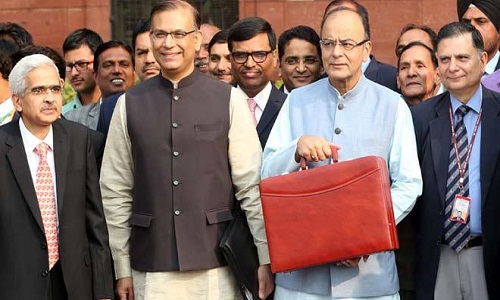
"In the Union Budget 2016-17, presented yesterday by the finance minister Arun Jaitley, he has proposed a reduction in basic customs duty on specified textiles, including fibers, yarns and fabrics. The minister proposed a cut in basic customs duty on specified fibers and yarns from the existing five per cent to 2.5 per cent. This will benefit both importers and exporters of these fibers and yarns."

In the Union Budget 2016-17, presented yesterday by the finance minister Arun Jaitley, he has proposed a reduction in basic customs duty on specified textiles, including fibers, yarns and fabrics. The minister proposed a cut in basic customs duty on specified fibers and yarns from the existing five per cent to 2.5 per cent. This will benefit both importers and exporters of these fibers and yarns.
Basic customs duty on import of specified fabrics (for manufacture of textile garments for export) of value equivalent to one per cent of FOB value of exports in the preceding financial year has been exempted subject to the specified conditions. The FM also proposed that tariff value for calculating excise/CVD on readymade garments and made up articles of textiles to be calculated at 60 per cent of retail sale price instead of the existing 30 per cent of retail sale price.
The Budget proposes to increase excise duty on branded readymade garments and made up articles of textiles of retail sale price of Rs 1,000 or more from nil to 2 per cent (without CENVAT credit) or from 6 per cent/12.5 per cent to 12.5 per cent (with CENVAT credit). Similarly, excise duty on PSF/PFY, manufactured from plastic scrap or plastic waste including waste PET bottles, is proposed to be hiked from 6 per cent to 12.5 per cent (with CENVAT credit), while keeping it unchanged at 2 per cent without CENVAT credit.
Meanwhile, TEA has welcome the Budget as President A Sakthivel has said the Budget has addressed the demands made by the Association. In his statement, the TEA chief also welcomed the nine pillars of the Union Budget: Agriculture and farmers' welfare, rural sector, social sector including healthcare, education, skills and job creation, infrastructure, financial sector reforms, ease of doing business, fiscal discipline, tax reforms to reduce compliance burden.
Sakthivel while describing the Union Budget as positive said that the focus of infrastructure and initiatives for ‘Ease of Doing Business’ will go a long way in improving the economy as well as reducing the transaction cost. However he expressed his concern on the proposal of excise duty on branded readymade garments and made up articles of textiles with the retail sale price of more than Rs 1,000. This will adversely affect the industry and will also be difficult to administer, he said.
The TEA president complimented the FM for allocating Rs 3,350 crores for Textile Industry which includes Rs 140 crores for amended TUF and Rs 300 crores for Development of Mega Cluster. Sakthivel welcomed the reduction of basic customs duty on specified fibers and yarn from 5 per cent to 2.5 per cent and also he said basic customs duty on import of specified fabrics (for manufacture of textile garments for export) of value equivalent to 1 per cent of FOB value of exports in the preceding financial year being exempted subject to the specified condition.
Panorama Berlin will be held from January 16 to 18, 2018. This is a service provider and an industry hub and will feature trends for fall/winter and more than 800 exhibitors. Last season, the show attracted nearly 50,000 visitors from 96 countries, and hosted more than 700 brands.
The upcoming edition will have a new hall structure, expanded lifestyle areas and new community areas. The layout makes it easier for buyers to navigate across the offering, with dedicated areas for men and women’s which blend seamlessly with each other from casual wear to formal wear, and from classic to progressive. Accessories, footwear, denim and street wear will also be presented.
There will be a new platform for sustainable fashion alongside a plus-size fashion area. The event will feature several lifestyle areas, which will bring a sense of being at a modern department store. Products and gadgets specially selected for the respective target groups will be presented in these lifestyle spaces.
Returning brands include Marc Cain, Oui, Vagabond, Fila, Chiemsee, Guess, Miss Sixty, Bench, Desigual and Jack & Jones. New exhibitors include Sandara, Codello, Adax, Norton, My Jewellery, Zoey, Chasin and Paddock’s Jeans. The exhibition space will cover 45,000 sq mt across 11 halls.
Leading textile player T.T. celebrated the completion of 25 years of public listing recently at the Bombay Stock Exchange.
During the occasion, the company’s management announced their plans to launch a premium innerwear brand in the near future as part of their new strategy to move towards the fashion side of the fiber to fashion spectrum. This move will help enhance margins and build the brand equity of the company. The company has enhanced their knitwear range to become a garment company from an innerwear company.
Dr R C Jain, Chairman and Founder of T. T Group explained the journey of the company and its evolution as a fiber to fashion company as it spread its wings not only across India but also across 65 countries. Brand T. T., under which all products are sold, has become a well known brand with registrations in India and many other nations. He paid special emphasis on the principles of the company and its employees who have been the two important pillars on which the Company laid its foundation and grew.
Sanjay Jain, managing director laid down the vision and roadmap of the Company with clarity and crispness. Incidentally, T. T. Group has to its credit many firsts in the industry, one of which is that it was the first garment company to get listed on a stock exchange in 1990.
Ginners in Pakistan want a ban on import of cotton and cotton yarn from India till the end of the cotton season and disposal of one million bales lying in ginneries as unsold stock. They want a bailout package. They also insist that regulatory duty, sales tax and customs duty on imports of cotton should not be waived and that these duties are essential for the survival of local farmers as well as ginners.
Their argument is that if duties are waived, that would be detrimental to local growers and ginners who have millions of bales lying in unsold stock. Ginners also want textile mills to clear their outstanding dues as early as possible. They want a national cotton policy to be formulated which would cover all aspects of the cotton trade, including fixing the support price and targets of production. The electricity tariff is another issue that bothers them.
Farmers in Pakistan say the textile sector is purchasing local cotton from them at throwaway rates but on the other hand importing cotton or yarn from countries like India at higher rates, which amounts to a great injustice. Pakistan has a target of reaching 20 million bales of cotton this season.
According to the International Cotton Association (ICA) leaders, in view of growing consumption of cotton in Bangladesh, the platform wants to provide a wide range of mediation and training support for trade associations and individual mills to ensure safe trading under ICA bylaws.
ICA officials say that the future of textile industry in Bangladesh is bright and the ICA is in Bangladesh to strengthen the bonds between the association and Bangladeshi spinning and textile sectors as the country is now the second largest cotton importer.
The ICA has training programs in Liverpool and they have visited Bangladesh several times and done training programs so that parties could know what are right and about the obligations. Rules are very important aspect here in Bangladesh because 100 per cent of cotton which is bought in Bangladesh is contracted under the ICA bylaws and rules, so the parties should better know under which rules and bylaws they buy a product.
ICA plays a vital role for Bangladesh textile sector and cotton worth over $2 billion is being imported to Bangladesh under ICA rules and bylaws. Bangladesh imports about four million bales of cotton per year.
Sources say, the Indian cloth industry reported a modest increase in revenues in the December 2015 quarter. Net sales of the industry grew by 2.4 per cent y-o-y during the period. The sluggish growth was attributed to a poor sales performance of a few large companies in the industry.
Out of the 54 company’s sample, 29 reported an increase in revenues. Net sales of 23 companies declined, while two companies failed to generate any sales. Aggregate net sales of the top 10 companies (accounting for three-fourth of the industry’s total sales) grew by 10.8 per cent. Raw material expenses of the industry dropped by 15.8 per cent in the December 2015 quarter.
Moreover, the industry liquidated inventory worth Rs.393.8 million during the quarter under review as compared to a pile-up of Rs.5.1 billion in the year-ago quarter. After adjusting for change-in-stock, operating expenses of the industry increased by 1.2 per cent. Nevertheless, this was still slower than the growth in sales. Consequently, operating profit of the industry increased by 12.3 per cent in the December 2015 quarter. Operating margin expanded by 110 basis points to 11.8 per cent.
On the post-operating front, interest expenses of the industry grew by 1.8 per cent and depreciation charges by 3.3 per cent, slower than the growth in operating profit. Resultantly, the industry reported a net profit worth to 0.2 per cent of the total income in the December 2015 quarter. The industry had reported losses equivalent to 0.1 per cent in the year-ago quarter.
According to the US Department of Agriculture (USDA) in its first formal forecasts for next season, Cotton demand in China, the top consumer of the fiber, will grow in 2016-17 by 1m bales to 33.0 million bales. This predicted increase would be the first since 2009-10, when it reached a record 50.0 million bales, before China's policy of providing guaranteed and elevated values for growers, in keeping domestic prices far above international ones, rendered its mills uncompetitive.
Consumption increase will be spurred by a willingness by China to accept lower bids for cotton stockpiled during its programme of guaranteed prices, after auctions last year failed to attract significant buying. The prospect of extra supplies hitting the market bode ill for prices, which will average 67 cents a pound next season, as measured by the Cotlook A index of physical values, 2 cents below the average price expected for 2015-16.
According to USDA, ‘weak’ world demand growth, and low prices of man-made fibers such as polyester, besides ‘the pressure of China's surplus disposal policies,’ are reasons for undermining cotton price prospects.
Velocity Apparelz is ramping up its presence in Africa by opening a plant in Ethiopia. Velocity is the manufacturing arm of Dubai’s Vogue International. It has factories in United Arab Emirates and Egypt. The company specialises in denim and sources material from China, India, Pakistan, Turkey and Italy. The Ethiopia plant, located on a campus measuring just under a square mile, will produce jeans and knit garments. The entire factory is fully automated, set up on conveyor systems, powered by wind and lit by LED bulbs, and has its own water treatment facilities on-site. Other sustainable practices include waterless washing, sublimation fabric printing and laser-blast technology. The factory is presented as one of the most advanced in the world.
The company sees Africa as the next manufacturing base of the world. It has developed a campus-based structure which houses all the workers and in time will have facilities like entertainment, schools and hospitals. Velocity hopes to ultimately provide jobs to around 10,000 people in Ethiopia.
The parent company Vogue opened in 1988 and since then has been committed to sustainable manufacturing. The Vogue group of companies is a fully integrated one-stop shop design and garment manufacturing facility offering design, production, logistics and its own retail brands.
www.voguevelocity.com/
Knitwear manufacturers in Tirupur feel the Northeast presents great opportunities. They plan to go through the e-commerce route. This will help knitwear manufacturers immensely as it drastically cuts the cost of marketing. Knowledge of English is high in the region and some of the states have English as the official language. People are internet savvy.
Markets in the Northeast demand apparels made of heavy GSM (grams per square meter) fabrics that can withstand the cool climates in states such as Meghalaya, Manipur, Tripura and Arunachal Pradesh. Fashion garments are popular among youngsters here.
The region is emerging as a magnet for upscale apparel and accessories labels. Makers of sports and fashion wear, branded jewelry chains and retailers are heading to the north-east to open their first stores or expand their presence. Rapid economic growth in recent years has increased the purchasing power of consumers in the region. This is a brand-conscious and fashion-forward market. Pockets of the north-east mirror the consumer behavior of high-income pockets of suburban Delhi and Mumbai.
The region’s traditional ethnic clothes represent the true spirit of India. However, supply chain and logistics-related issues loom as potential challenges and scaling up may be a challenge given the limited density of population of cities in the region.
Luxury lingerie brand Marie Jo has been chosen the top award at the first ever Belgian Fashion Awards. The label beat 23 premium brands to be voted ‘Fashion Brand of the Year’ by the Belgian public. Discussing the win, brand design Manger Lieve Vermeire said: “Being able to take this award home with us is recognition of our passion and proof that we can count on a host of loyal fans. Marie Jo women are certainly power women that make their voice heard.”
Van de Velde CEO Erwin van Laethem noted, “Resolutely choosing what consumers want, with a product that looks fantastic, but at the same time is also comfortable and fits perfectly is a proven recipe for success. I would like to give a big thanks to all Marie Jo fans for their support and I dedicate this award to them. We are grateful to have the opportunity to empower them with our lingerie day after day.”
Belgian lingerie manufacturer Van de Velde launched Marie Jo in 1981 to create a perfect-fit, fashion-forward lingerie which empowers women. The brand is known for its discreet luxury approach and attention to quality and craft. The Belgian Fashion Awards ceremony took place in Antwerp on November 16 as a part of Fashion Talks, an industry conference organised by the Flanders District of Creativity, a non-profit organisation established by the Flemish government.