FW

Nike will allow Worker Rights Consortium (WRC) to access its supplier factories. WRC will have formal access to Nike supplier factories that manufacture WRC-affiliated collegiate products, to investigate working conditions and strengthen coordination regarding any remediation efforts. The agreement also improves coordination between the consortium and the sportswear company when a violation is identified and change is required.
Nike also continues to work directly with the Fair Labor Association, a vital organisation dedicated to raising the standards for workers through its comprehensive supply chain program.
A report by the Worker Rights Consortium found that factory workers in Vietnam endured poor treatment, including not being allowed bathroom breaks and being padlocked in the factory. In the case of that facility, WRC identified a number of significant labor rights violations and has been working since then to try to get them corrected.
Worker Rights Consortium is an independent labor rights monitoring organisation, conducting investigations of working conditions in factories around the globe. Its purpose is to combat sweatshops and protect the rights of workers who make apparel and other products. Nike plans to focus on the hottest-selling sneakers, slash the number of styles it offers and sell more shoes directly to customers online as part of a restructuring in which it also will cut about 1,400 jobs.
Techtextil will be held in Mumbai from September 13 to 15, 2017. This is a trade fair for technical textiles and nonwovens. It attracts key buyers who are looking for solutions across multiple technical textile applications in agriculture, automotives, building, clothing and protective clothing, environmental protection, geo-technology, housing and home, medical science, packaging and sports. Top textile players including Reliance, Welspun, Garware Wall Ropes, Lenzing and Archroma will showcase their latest solutions for these key application areas.
More than 160 companies from nine countries including: Austria, Belarus, China, France, Germany, Italy, Korea, Spain and Switzerland will participate at this premium industry platform. A symposium will focus on prime business topics that cover the most demanding application areas to disruptive technical textiles that will drive innovation forward. The symposium will present a global outlook on technical textile trends, future forecast on sustainability, and digitalization.
The fair will also launch an exclusive pavilion of Texprocess, the leading international trade fair for processing textile and flexible materials. In this area, some of the largest machinery importers will have live demonstrations of their new technologies to buyers.
Telangana will promote textile policies and highlight investment prospects at this trade fair in a bid to attract buyers and investors to the state.
The upcoming Intertextile Shanghai Apparel Fabrics to be held from October 11 to 13, 2017 has added an extra accessories hall to strengthen its influence across entire apparel industry. In the entire process of creating a garment, the accessories used might be the smallest part and applied at the very end but they can have an outsized impact on the final look of the garment. These small pieces will also have a larger-than-life impact at the event. The extra accessories hall will accommodate more than 630 fashion and garment accessories exhibitors participating this year. High-end European accessories suppliers will also feature in Salon Europe. The increase in accessories exhibitors this edition adds to the 4,500-plus total suppliers taking part across all apparel fabrics and accessories sectors.
With so many suppliers under one roof, buyers are guaranteed a range of sourcing options to meet all needs. As with the rest of the fair’s product groups, among the offerings are a number of new product launches, products styled for the autumn/winter 2018/19 season, innovative products and eco-friendly options.
For the first time at Intertextile Shanghai, Hong Kong accessories suppliers will be represented in the Button & Garment Accessories Industry Chamber Pavilion. Also within Accessories Vision is the Shishi Pavilion from China, who will be joined by a number of China’s leading accessories suppliers. Accounting for the increased number of exhibitors this edition, the Accessories Vision halls will have a more defined grouping of exhibitors to maximise sourcing efficiency, including lining, interlining, tag, ribbon and lace and embroidery zones.
The number of Indians in China has been rising over the years. Unlike the IT sector, which is drawing an increasing number of educated Indians abroad, in the case of China, it is the textile trade.
For example, Keqiao, in eastern Zhejiang province, is called the Chinese textile city and it turned out to be the largest fabrics export center of China. With opportunities opening up and China's open policy, more than 5,000 Indian middleman traders have come to settle in the textile town. The first wave of Indian migrants to Keqiao in the early 2000s coincided with its exponential growth of fabric exports. With the moving in of Indian merchants, Keqiao transformed from a local Chinese textile market to an international textile export center.
Most Indians working as middlemen in the cloth trade are Sindhis. Immigration increased as they came to know it was easier to find a variety of fabrics at cheap rates in Keqiao compared to other places and shops are highly centralised. Unlike Pakistani merchants in the region, most Indian businessmen come with start-up capital to start the new ventures. Most of their employees are in the late 20s and early 30s but as they have left their home at an early age they have years of work experience.
While India was once the largest garment exporter in the world after China. It has now fallen to the sixth position, behind Cambodia, Vietnam, Bangladesh and Sri Lanka. Indian exporters now fear slipping to the ninth position in readymade garment exports, behind Myanmar and Ethiopia. They feel the proposal to slash export incentives including the cutting down of the duty draw back scheme from eleven to six per cent along with the appreciation of the rupee would affect them very badly.
Exporters in Tirupur say a cut in incentives will reduce price competitiveness, an important element in global competition. The threat of withdrawal of incentives has forced the exporters to go slow on orders. Competitors, Vietnam, Cambodia and Bangladesh, have free trade agreements with the European Union, a major destination for Indian exporters. India is currently looking for a higher volume of trade with the United States and non-traditional markets like Eastern Europe.
Tirupur accounted for 45 per cent of the country’s total exports of readymade garments during the last fiscal and exports touched Rs 25,000 crores. The target for the current financial year is Rs 35,000 crores.
Sri Lanka’s leading enterprise solution provider H One has launched a quality management solution tailormade to minimise defects in apparel manufacturing. RES.Q is a cloud-based IT solution that provides decision-makers with a 360 degree view of the factory floor. It uses data analytics to improve production quality, eliminate reporting time lags, enable faster and more accurate decision-making, and reduce waste. It can be used by anyone with minimal training, and easily adapted by apparel manufacturing businesses of any size - small, medium or large. It doesn’t require costly servers and can be set up in under a week. The platform is also 100 per cent paperless and functions via a device positioned with a supervisor at the end of each factory line.
The solution improves the overall cut-to-ship ratio faced by apparel manufacturers. The cut-to-ship ratio is a key performance indicator in any garment factory, and represents the losses incurred from the point a factory cuts pieces of a garment to fulfill an order to when it is shipped out to the customer. In Sri Lanka the average cut to ship ratio is 98 per cent.
With RES.Q manufacturers can cut back on this two per cent loss, for example, by reducing internal sewing line defects by 50 per cent and cutting the traditional ten per cent end of line defect rate by half.
The goals of Chinese textile manufacturers and leading fashion brands are converging. Both need to clean up and want to go circular. Since China is still a major supplier of fashion raw materials there is an opportunity to lay the foundations for a clean and circular business model. Manufacturers are largely on track, on going clean and tackling their water risks, as well as starting to move circular. About 98 per cent say they are taking actions to be green, 74 per cent are recycling water, 88 per cent have upgraded their wastewater equipment and 84 per cent upgraded equipment for chemicals. As for the circular economy, 72 per cent see business benefit in moving to it.
While manufacturers are clearly moving towards a clean and circular model, they still face significant regulatory, operational and reputational challenges as well as knowledge gaps. Costs are rising but prices offered by brands/sourcing agents are not reflecting this and so already thin profit margins are being squeezed further.
The dirty, thirsty and wasteful fashion industry poses water risks. Manufacturers have three overarching wishes to help them overcome their challenges. They are more training, more help with sourcing and more financial support. However, what’s common to all of these challenges and wishes is how to be compliant within the current low-price business model.
The Italian fashion industry is providing opportunities for the development of Caribbean fashion designers and manufacturers. Financial support is being provided to 10 Caribbean fashion designers in: apparel, jewelry, hats and other accessories.
Caribbean designers have been provided feedback and advice by Italian experts for furthering the development of their fashion lines. Arts promoters and buyers are meeting Caribbean artists and entrepreneurs to generate new business opportunities toward increasing the export of the region’s cultural goods and services.
Caribbean fashion is diverse and vivacious and is often seen through the renowned Caribbean cultural activity – Carnival – which is a medium to freely express oneself. The Caribbean has more of a contemporary form of fashion than traditional, more of a medium for self expression and culture than a reproduction of someone’s fashion sense. Caribbean fashion has come a far way and has been undoubtedly influenced by West African culture which is in fact traditional but with the larger influence of the Americas and Europe.
Caribbean inspired fashions have been gracing runways for years. Not only are there more local fashion shows in the Caribbean region, diaspora designers are infusing their culture in the aesthetics of their brands. For example, Haitian-Italian designer Stella Jean is one of those mainstream designers making a bold statement on the runway, always brilliant with a touch of Haiti in every collection.
"As per textile trade analysts and industry stalwarts, India’s apparel exports growth will remain flat or may see marginal rise this year, due to factors like GST, rupee appreciation against the dollar and sluggish global demand. As Rahul Mehta, President, Clothing Manufacturers' Association India (CMAI) points out, the rise in minimum wages and rupee appreciation have resulted in estimates of sluggish growth in apparel exports. The rupee has risen to 64.2 against the dollar from 66.5 last August. This is in contrast to six consecutive years of depreciation. India had posted $17 billion worth apparel exports in 2016-17."

As per textile trade analysts and industry stalwarts, India’s apparel exports growth will remain flat or may see marginal rise this year, due to factors like GST, rupee appreciation against the dollar and sluggish global demand. As Rahul Mehta, President, Clothing Manufacturers' Association India (CMAI) points out, the rise in minimum wages and rupee appreciation have resulted in estimates of sluggish growth in apparel exports. The rupee has risen to 64.2 against the dollar from 66.5 last August. This is in contrast to six consecutive years of depreciation. India had posted $17 billion worth apparel exports in 2016-17.

As per Apparel Exports Promotion Council (AEPC), India saw a marginal 5 per cent growth in apparel exports which was worth $6.9 billion for April-July 2017. In fact, the industry had expected 15 per cent growth, however, things are sluggish now. Apart from GST and rupee appreciation, what has also affected the industry is a rise in raw material prices and wages.
Apparel exports remain sluggish
There are no signs of revival for global apparel trade. This has resulted in sluggish demand in key importing countries. According to ICRA, this may result in India’s apparel exports continuing to remain volatile. According to Jayanta Roy, Senior VP and Group Head, corporate sector ratings, ICRA, although there have been brief phases of growth in the past 18 months, the trend has been unsustainable and failed to instill confidence. In such a scenario, sustained growth in India’s apparel exports remains challenging. The challenges have been further augmented by the appreciation of rupee in recent months, which has reduced competitiveness of Indian exporters vis-à-vis global counterparts.
According to the report, the apparel and fabric industry has been facing headwinds as a result of temporary disruptions caused by demonetisation and transition to the GST regime. The impact of these developments has been more direct on highly fragmented fabric segment, with fabric production declining 1 per cent in the first quarter of 2017-18 following flat production in 2015-16 and a 2 per cent decline in 2016-17.
Despite significantly higher raw material prices, revenues of fabric manufacturers that ICRA contacted grew a marginal 4 per cent in the first quarter of 2017-18 pointing towards a steeper de-growth in sales volumes vis-a-vis production volumes. De-growth in fabric sales volumes in the first quarter was higher than the aggregate nation-wide production de-growth of 1 per cent due to the clearance of channel inventory by intermediaries prior to GST implementation, Roy points out.
ICRA noted although profitability of export-oriented players have been protected to an extent by prudent hedging, sustained strength of the rupee might exert pressure on their pricing ability and hence demand and profitability. Notably, the likely pressures on profitability, debt levels are expected to decline with industry focussing on sweating the existing assets more and undertaking limited debt-funded capacity additions. In such a scenario, it is expected that the financial risk profiles of Indian exporters as well as domestic-focused apparel/fabric manufacturers will remain steady in the near term.
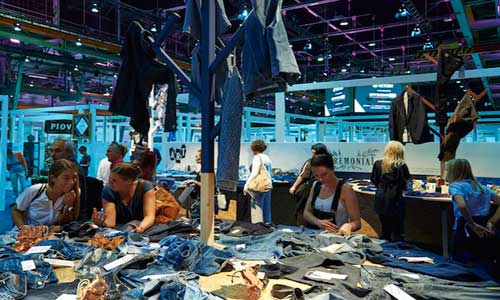
"Global denim mills will congregate at Munich Fabric Start’s Bluezone in Munich, September 5-7, 2017 to present their Autumn/Winter 18-19 collections. Their major target is making a mark in the German and Northern European markets. These mills bring forth innovations and new product lines, with focus on sustainability and performance. For instance, Artistic Fabric & Garment Industries (AFGI) is working on the possibilities of sustainably-produced and recycled denim. Henry Wong, Director-product development and marketing, North America at AFGI, said fashion and performance jeans are more eco-friendly than ever when cut from AFGI’s denim made from recycled jeans and plastic bottles."
Global denim mills will congregate at Munich Fabric Start’s Bluezone in Munich, September 5-7, 2017 to present their Autumn/Winter 18-19 collections. Their major target is making a mark in the German and Northern European markets. These mills bring forth innovations and new product lines, with focus on sustainability and performance. For instance, Artistic Fabric & Garment Industries (AFGI) is working on the possibilities of sustainably-produced and recycled denim. Henry Wong, Director-product development and marketing, North America at AFGI, said fashion and performance jeans are more eco-friendly than ever when cut from AFGI’s denim made from recycled jeans and plastic bottles.
The Pakistan-based mill uses its new, advanced indigo dyeing technology, which saves a minimum of 50 per cent water compared to current industry methods, to provide true sustainable denim products that do not sacrifice aesthetics, softness and performance. Wong points out, even mercerisation chemical is recycled via state-of-the-art machinery. Project R, initiated by Tejidos Royo, offers a 360-degree approach to sustainability. This is a concept that reduces water, contaminants, emissions and energy. Debutant Royo is slated to use post-consumer denim as a raw material resource, diverting it from landfill and incineration. The Denim Recycled Collection is offered in stretch and stretch colours, including black, blue, brown, khaki and dark gray.
Royo is also introducing the Nanami Collection, a development based on the Japanese concept that creates an irregular effect and open construction in the fabric. Nanami denim uses the color 413, which gives the fabric a vintage appearance. The Nanami collection is based on Royo’s ‘Save Water, Fill Seas’ mission to minimise water consumption. The process utilises zero waste water in the dye process and reduces energy by 80 per cent.
Spotting trends
This platform will be highlighting major trends that the industry is set to bring in the next season. For example, Artistic Milliners is providing solutions to better suit new comfier cuts and nostalgic designs. The mill will present Sunday Jeans, a concept that uses smart fibres like Tencel and Modal to create supple blends and drapey constructions. Ebru Ozaydin, Artistic Milliners director of sales and marketing, said that the fabrics are engineered with the right amount of stretch to help designers create great looking fits with a soft hand feel. Bleisure by Royo is a collection of fabric with three-dimensional elasticity in length, width and depth. The versatile fabrics blur the line between business and leisure, resulting in styles with elegant, utilitarian and soft tailoring.
For brands wanting to bring in ’90s nostalgia, Artistic Milliners has created a collection of specific fabrics with the right aesthetics to create modernised ’90s fits. Ozaydin said that its 90210 fabrics take back to original Levi’s look of the era, revive and refresh a traditional palette for timeworn vintage appeal. The incorporation of stretch technologies provides a hidden comfort for the wearer paying tribute to iconic marble look and open twill.
Brazil-based Vicunha, a Brazilian brand, infuses vintage and authenticity with plain open weaves and ring effects for men and women. Retro shades of blue and darker, deeper dyes create a multitude of wash effects suitable for looser silhouettes and throwback styling. According to Vicunha, heavier weights, traditionally for the men’s market, are picking up momentum in women’s fashion. Atlantic Mills has a warp-only stretch selvedge, offering comfort from stretch but has the ’80s look of selvedge as it used to be worn. The mill uses 90 per cent BCI cotton and 10 per cent organic cotton in its range, including in its retro selvedge story.
Indian brand shining through
India’s top denim maker Arvind will be present with a story rich in indigo heritage. It will highlight Azurite, a collection of fabrics touted as ‘denim bluer than blues’. Made with indigo saturated fabric, with indigo in the warp and weft, Arvind develops deep blue hues targeted toward brands and designers with a pure love for indigo denim.
Performance Preferred
With growing eco-awareness, most companies are offering sustainable solutions in clothing. Artistic Milliners has recently launched Urban Commuter concept, which will focus on combining performance, sustainability and ‘climate control fabrics’ using natural eco-friendly fibres from Invista, Cordura and Lenzing.
Royo is bringing its new collection, ‘Atmosphere’. Aimed at outdoor activities that require maximum comfort and protection, the performance fabric provides thermal insulation and protects against rain, wind and cold temperatures. The fabric is made with high temperature resistant fibres and disperses body perspiration through ultrathin breathable hydrophilic lamination.
Vicunha will bring in its first temperature control denim with an expanded line that uses high-tech yarns from fibre producer Nilit. The mill introduces Body Fresh, a denim with antibacterial properties; Aquarius, a fabrication that wick moisture away from the body; and Breeze, a denim fabrication that maintains constant body temperature after physical activities or in warm climates.