FW

Polyester producing companies have cut production by 40 per cent in the last three months due to the acute shortage of key raw material PTA (purified terephthalic acid) supplied by oil refining companies. Oil refineries have cut production in some of their units for various reasons. Reliance Industries, the largest producer of PTA, cut production between March and May for two weeks each and is allocating only 50 per cent of its supply.
Polyester manufacturers require 5.3 million tons of PTA per annum. The anti-dumping duty of 15 per cent levied in December has made import of PTA unviable for the polyester industry. Unlike other PTA users, polyester companies cannot afford imports after the anti-dumping duty as they are operating at a wafer-thin EBITDA margin of six to seven per cent.
A steady supply of PTA is key to operating a polyester plant as it is a continuous process and cannot be shut and restarted at will. So the industry wants the anti-dumping duty revoked. Of the annual installed polyester production capacity of 8.4 million tons, companies have produced only 5.8 million tons due to the raw material shortage.
While import of PTA attracts a duty of 15 to 20 per cent, imports of paraxyle, which is the raw material for producing PTA, are allowed duty free.
Kitex Garments aims to achieve 20 per cent growth in financial year 2016-’17 by expanding its customer base and increasing business share with existing customers. To achieve this goal the company is in the process of increasing its manufacturing capacity. Kitex is planning to invest about Rs 10 crores this year to upgrade its manufacturing and information technology wing.
Established in 1992, Kitex Garments is into 100 per cent exports of cotton garments, especially infant wear to the US and European markets. The vertically integrated manufacturing plant makes infant wear as well as fabrics.
The company intends at driving its next level of organic growth by expanding markets and online and offline marketing channels, backed by capacity expansion and enhanced technological capabilities. Kitex further plans to upgrade its automation of sewing production in 2016-17 in order to increase productivity and output capacity without increasing the manpower.
With regular capex for improvement of technology and infrastructure it aims to upgrade its current facilities so as to expand its capacity from 0.55 million units to 1.1 million units per day. It is a vertical set-up with knitting and processing of fabrics, until finished garments are done in-house.
The facility is 240 meters long and 70 meters wide and covers an area of six lakh sq. ft. The process line is equipped with a digital dispenser system for error-free, automatic and computer-controlled preparation of color guidelines, high quality knitting machines, and modern dyeing, printing and finishing systems that use cutting-edge technology.
From product certification in accordance with the OEKO-TEX Standard 100, which was first introduced in 1992, the International OEKO-TEX Association has now, through continuous development and expansion of portfolio, established itself as a full-service provider for independent certifications and services for greater sustainability along the textile value-creation chain.
The association is now taking into account this strategic change from niche provider for human-ecological product safety to a global system solution for brands, retailers and manufacturers with new brand architecture. The focus is on the OEKO-TEX logo and the claim “Confidence in Textiles”, which over the past almost 25 years has been known across the industry as synonym for effective consumer protection, responsible handling of chemicals and use of environmentally friendly production technologies and compliance with fair working conditions.
OEKO-TEX has already presented the new brand design during the market launch of MySTeP database, the MADE IN GREEN product label and the ECO PASSPORT certification for textile chemicals. Beginning Autumn 2016, the modernised appearance will also be used with most well-known OEKO-TEX brand, the STANDARD 100, and the STeP certification. At that point, the new STANDARD 100 product label and the refreshed STeP logo for B2B communication will also be available to more than 10,000 partner companies around the world.
Grasim has bagged Frost & Sullivan's Sustainability 4.0 awards at the 2016 edition of the India Sustainability Summit held in Mumbai. Grasim's unit at Harihar in Karnataka, which houses a facility for manufacturing both viscose staple fiber and rayon grade pulp, was awarded the Frost & Sullivan's Sustainability 4.0 Award in Challengers Category – Large Business.
The VSF plant at Kharach in Gujarat, which employs the most modern technology giving it a competitive edge in the export market, received the Certificate of Merit - Challengers Category – Large this year.
The awards were given away after the summit which was held with a mission to assist the adoption of sustainable practices across Indian companies. At the event eminent persons from various businesses spoke about the different initiatives taken by their companies with respect to sustainability.
The awards were received by Rajeev Gopal, Global Chief Marketing Officer of Grasim’s Pulp & Fiber business, and Ajay Sardana, VP and Head-Sustainability of Grasim’s pulp and fiber business.
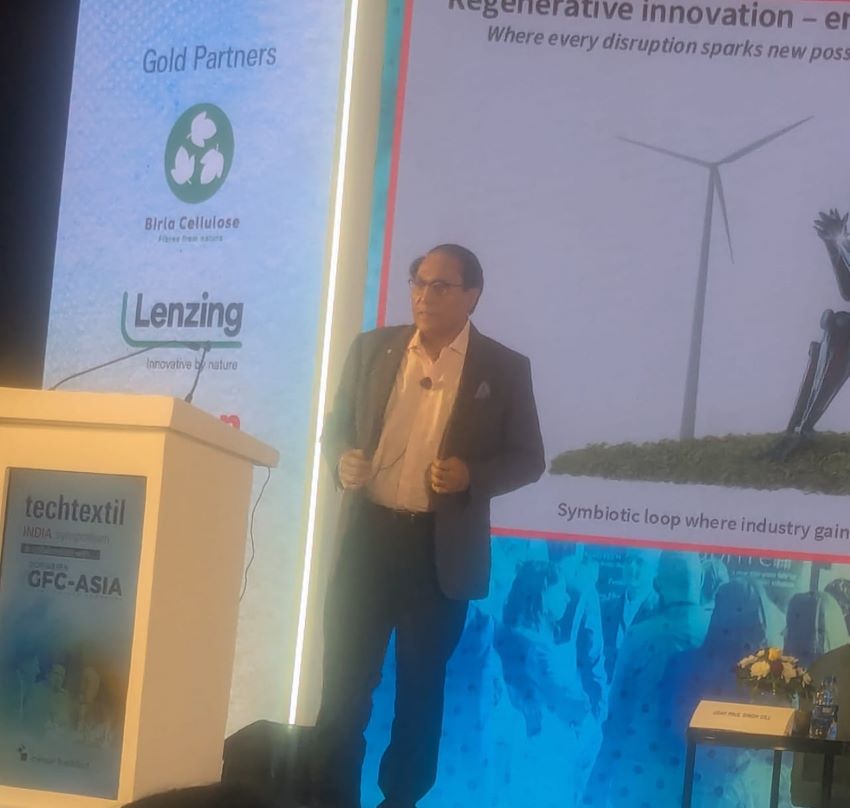
Sardana gave a presentation on product life cycle management and spoke about Birla Cellulose’s initiatives regarding its commitment towards a sustainable company. He explained the efforts at Birla Cellulose right from seeding to pulping to processing and manufacturing.
Federal Trade Fair for Apparel & Textile, Moscow is scheduled from September 20- 23, 2016. It is an important textile fair in Russia, which attracts a large number of buyers of textile products from Russia including entire CIS region and other major textile importing countries across the world. The fair is regularly visited by textile/clothing manufacturers, large scale retailers, wholesalers, chain stores, departmental stores, buying houses, leading agents including Fashion Designers.
The exhibition will be visited by leading Russian and other CIS countries textile buyers/importers/agents. Participation in this Exhibition will provide member-companies an excellent opportunity to establish trade-contacts with prospective Russian customers, and enhance their Exports to this market and entire CIS region.
Organised at the All-Russian Exhibition Center (V.V.C) Moscow, the fair will cover all types of yarn, fabrics, made-ups, home textiles, and garments.
"Consumers are tempted to buy trendy clothes the moment they are on shelves. But they don’t realise the stark reality, the pain with which the clothes are being manufactured. Fast fashion retailers in order to beat one another bring out newer collections frequently and this has been hampering not just the ecological system but also human labour adversely. Recently while shopping at Zara, customers from Istanbul found something unusual in the garments, which were tagged with messages from the factory workers saying, ‘I made this item you are going to buy, but I didn’t get paid for it.’ This is just one of instances showcasing their plight."

Consumers are tempted to buy trendy clothes the moment they are on shelves. But they don’t realise the stark reality, the pain with which the clothes are being manufactured. Fast fashion retailers in order to beat one another bring out newer collections frequently and this has been hampering not just the ecological system but also human labour adversely. Recently while shopping at Zara, customers from Istanbul found something unusual in the garments, which were tagged with messages from the factory workers saying, ‘I made this item you are going to buy, but I didn’t get paid for it.’ This is just one of instances showcasing their plight.
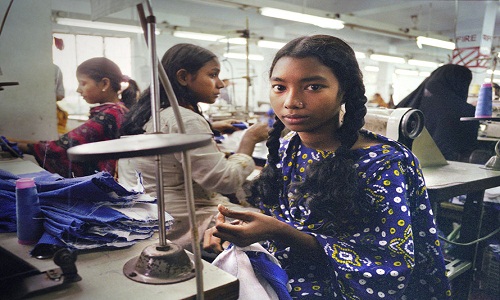
At most fast-fashion retailers’ workshops, employees work long days without a break to create hundreds of garments. These factories are also claimed to be anti-feminist. They exploit their largely female workforce while making a profit selling clothing with feminist messages. For example, 75 million people make clothes for brands across the world, and 80 per cent are women. These women encounter sexual assault, corporal punishment and verbal abuse while making little to no wages.
Can such incidents be ignored?
After the Zara incident, company officials were quick to respond stating that they are working on a proposal for a hardship fund for the employees affected by the situation. This instance should teach other brands that workers will take a stand against unethical practices.
A similar incident happened in Bangladesh when Rana Plaza collapsed, killing 1,134 and injuring more than 2,500 others. As a result, 17 companies including Nike, Patagonia and H&M, agreed to follow the transparency pledge. The pledge is aimed at providing ethically sourced products by encouraging brands to identify and provide other information about the clothing manufacture processes, according to the Human Rights Watch. However, still many brands are not publishing their information, including Urban Inc., Forever 21 and American Eagle Outfitters. Transparency is necessary to prove they are sourcing their garments ethically.
Women workers face the brunt
Women are making little to nothing for a garment and in return are sexually harassed, assaulted or worse. Designers and consumers alike need to face this problem by finding a balance between fairly priced garments and workers’ basic human rights. Most college students can’t afford expensive brands but still want to be conscious of how their clothing is manufactured. In order to drive the change, we need to acknowledge the problem and keep the discussion going. If this happens, then ultimately brands will have no choice, but to listen to its customers and source its products ethically.
The Chiripal Group plans to set up a Rs 500 crores terry towel facility in Ahmedabad with 80 airjet looms. About 95 per cent of the production will be exported. The company expects to achieve a turnover of Rs 400 crores from this plant in the first year of operations. The company has a total turnover of Rs 850 crores.
The unit will have a spinning capacity of 24,408 spindles and 960 rotors which will help Chirpal increase turnover to Rs 1,100 crores by the end of fiscal 2016-17. Commercial production will start from December this year.
Chiripal is a vertically integrated group of textile manufacturing companies based in Gujarat. With its eyes set on overseas market, the company has chalked out a strategy to market terry towels in the US, Germany, UK, Italy, France, Romania, Australia, New Zealand and Canada.
To meet its in-house requirements of textile verticals, Chiripal is also setting up 48,960 spindles for manufacturing cotton yarn with an investment of Rs 306 crores. The new facility will come up at Dholi Integrated Spinning Park near Ahmedabad for which the company has acquired 30 acres.
The towel manufacturing unit Nandan Terry will soon be brought under the denim unit of the group named Nandan Denim, thereby making it a diversified textile company.
Kids on China will now have access to safer apparels. The country has issued the first mandatory national textile standards for children’s clothing. The standards created after nationwide textile product inspections last year revealed that more than 10 per cent of products designed for children, including apparel, failed in safety regulations.
The standards are expected to guide manufacturers to improve the safety and quality of children’s clothing to ensure infants’ and children’s health and safety. Textiles are divided into two types under the new standards: materials for infants 36 months or younger and children from the ages of 3 to 14.
Six plasticisers and two heavy metals (cadmium and lead) have been banned in children’s apparel. Cords, stipulations and combustibility are also altered under the standard’s requirements for mechanical safety. Cords are banned from the neck area of clothing for kids under seven and sharp stipulations are also eliminated from all children’s apparel.
The new standard also breaks children’s apparel into three safety regulation groups: Category A includes all infant textile products and is very rigid in terms of appropriate materials; Category B involves any products created for direct skin contact and they must meet or go above the standard’s guidelines at this level; and Category C is the least rigid and involves children’s clothing not designed for direct skin contact.
Techtextil North America will be held in Chicago, Illinois from June 20 to 22, 2017. This is an international trade fair for technical textiles and nonwovens. Chicago’s four million strong private sector workforce puts a dynamic and thriving business community within steps of the exhibition’s location. Home to more than 2,70,000 businesses, more than 400 major corporate headquarters, and more than 300 corporate R&D facilities, Chicago is an economic powerhouse of thriving industries.
The show will present a B2B regional platform so that exhibitors and visitors can reconnect or establish new business relationships. Techtextil North America assembles all vertical aspects of the technical textile industry. From research and development, through raw materials and production processes to finally ending in conversion, further treatment and recycling. The Techtextil North America Symposium will address market developments, technological information, new technical processes and products as well as international industry trends.
Techtextil North America is the only trade show in the Americas dedicated to technical textiles and nonwovens. Exhibitors from around the world will showcase their latest innovations and visitors can discover new products, exciting technology, ground-breaking materials and advancements.
The 2017 event will be co-located with JEC Americas composites exhibition and conference, with an expected attendance of more than 3,000 visitors.
‘British business is better than ever.’ This was the message loud and clear at this year’s ‘Meet the Manufacturer’ event organised by ‘Make it British,’ the campaign for the return of UK manufacturing, which took place on May 25 and 26 at the Truman Brewery, London. The event saw a high-calibre of participants, including the British Fashion Council, Harrods, Marks & Spencer, the National Gallery and ASOS.
A poll carried out by Meet the Manufacturer in the run up to the event echoed these welcome signs of life for the British textiles and fashion industry, showing that 60 per cent of manufacturers say ‘business is better than five years ago’ and 65 per cent say ‘stay in the EU.’
According to Kate Hills, Founder and CEO of ‘Make it British,’ the campaign for the return of UK manufacturing that they have been delighted by the overwhelming support for this year’s event, borne out by the fact that we had more people attend this time on the first day than attended overall last year. Their workshops, which were new for this year, were phenomenally successful with around 900 people attending them over the two days. Meet the Manufacturer is a platform for leading industry figures to come together to drive UK manufacturing and for buyers and designers to find textile and garment production in the UK. There’s an air of confidence in the industry at the moment and Make it British is definitely back in fashion.