FW

The RMG industry in Bangladesh is again facing tough times with second COVID-19 wave that has hit Europe and the US. As Rubana Huq, President, BGMEA informs, buyers are postponing new orders which might affect export volumes. Apparel exports in Bangladesh recorded a steep fall in October even though the export volume of the clothing items rose in August and September. Buyers also placed fewer work orders for November and December compared to the corresponding period of 2019.
Let-down by this fall in garment exports, some garment makers decided against exporting woven clothing items during the first quarter of 2020–21. From March-June 2020, apparel sector incurred losses as garment exports nosedived due to widespread shutdown enforced to slow the spread of the Coronavirus.
To mitigate the effects of economic slowdown, the government introduced a stimulus package. Earlier, the government provided Tk 75 billion to the owners in loans at a 4 percent interest rate enabling them to pay the workers’ wages. It later gave Tk 30 billion in response to owners’ demand. The factories’ owners drew almost half the offered funds.
Prof Selim Raihan, Executive Director, Sanem said, the loan had a positive impact during the crisis. He advised the government to set up an independent authority to evaluate the initiative to help them make decisions in the future.
 Though India began unlocking its economy from June, normal textile production restarted much later which resulted in loss of many export orders. Ministry of Commerce and Industry stats reveal, India’s textile and apparel exports shrank almost 87.5 per cent year-on-year in April 2020. Since then, the decline has narrowed month by month with exports increasing for the first time by 10 per cent year-on-year in September this year.
From April to September 2020, India’s textile and apparel exports decreased 31 per cent year-on-year to $10.97 billion. Of this, apparel exports accounted for 43.6 per cent of the total industry exports and it declined by 39.3 per cent to $4.78 billion from April to September. India’s export of chemical fiber textiles also declined 38.7 per cent to account for 13.2 per cent of the total textile and apparel exports during the period. The decline in exports of cotton textiles and carpets remained relatively low at 19.5 per cent and 14.4 per cent year-on-year respectively.
Pandemic prevents resumption of production
Not just exports, work censure and production cuts led to textile industry’s production falling sharply during the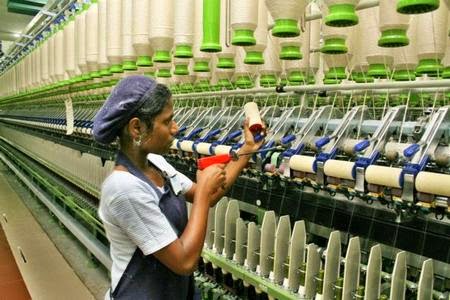 period. As data from the Ministry of Statistics and Planning and Implementation of India shows, in April 2020, India’s textile and apparel production fell 90.8 per cent and 94.1 per cent. Production has not resumed growth as the severity of the pandemic has not yet alleviated. The outlook for the Indian textile industry also remains pessimistic as India’s daily increase in the number of confirmed cases has exceeded 70,000 since September. This resulted in textile factories reducing their production capacities drastically.
US and the European Union are the most important export markets for Indian textile industry. Consumption of textile and apparel products in these markets has gradually begun to recover since May. Retail sales have recovered to about 85 per cent of the same period in 2019. Arrival of peak consumption seasons such as Christmas and Black Friday has spurred consumption prompting brands to place orders.
Export revenues to fall
However, India has been unable to fully grasp these orders due to the aggravation of the pandemic. Rating agency ICRA opines, in mid-October sales revenue of Indian apparel exporters may fall by 25 per cent in FY2020-21 while the revenue of manufacturers focusing on domestic market may fall by around 40 per cent. To bag more orders from the textile and apparel value chain, India needs to upgrade its product quality and customer services besides maintaining good reputation. It also needs to upgrade labor productivity.
Hurt by a 38.5 per cent decline in sales due to the COVID-19 pandemic, Italian luxury brand Salvatore Ferragamo recorded a net loss of €96 million ($113.15 million) during the first nine months of 2020. The brand’s turnover during the first nine months of the year totaled €611 million.
This drop in sales, which was much more marked during the first half of the year, was caused by the containment measures taken across the world due to the coronavirus pandemic, which led to store closures and a shutdown of international trade and tourism.
Given the uncertainty surrounding the pandemic, the brand has not made any forecasts for the year. The brand has, however, shared that sales in China have witnessed further acceleration in October compared to in the third quarter and online sales growth is also continuing.
The Asia-Pacific region remains Ferragamo’s largest market, comprising 42.3 per cent of total sales (excluding Japan). Though the brand;s sales during the first nine months fell by 30.6 per cent in the region, but sales in its stores in China rose by 38.3 per cent at constant currencies during the third quarter.
Its sales in Europe, Middle East, and Africa market decreased by 45 per cent, North America sales dropped by 45.1 per cent, Japan by 30.9 per cent, and South and Central America by 47.5 per cent.
Ferragamo, which had been suffering from a problem of its brand positioning, experienced two difficult years in 2017 and 2018 before beginning to recover last year. However, the pandemic has put a damper on this recovery.
According to T Rajkumar, Chairman, Confederation of Indian Textile Industry (CITI), Union finance minister Nirmala Sitharaman’s decision to launch focused production -linked investment (PLI) scheme to attract investment and growth in the manmade fibre (MMF) and technical textile segment will boost India's share in the global textiles market in both the segments.
T Rajkumar, Chairman, CITI believes, PLI scheme is extended for 10 key specific sectors, of which textile is one of the sectors and has been allocated Rs 10,683 crore of the total estimated outlay of Rs. 1.46 lakh crore, mainly for MMF and technical textile segment.
The objective of the scheme is to promote building of new facilities and attract investment in the MMF sector under greenfield and brownfield investments
Rajkumar cited that about 40 HS lines in MMF garments and 10 HS lines in technical textiles account for nearly US$ 180 billion global trade in which India has a very limited share.
CITI chairman observed that with the proposed scheme, the textile industry will get major boost to make investment in these sectors which will not only help India in increasing its global share but will also generate huge investment opportunities in textile sector which is already employing about 10 crore people.
The Pakistan Readymade Garments Manufacturers and Exporters Association (PRGMEA) revealed the country has achieved to secure more than $200 million business in one year’s span since 35th IAF Fashion Convention held last year in November in Lahore by the PRGMEA.
This was stated by Sohail A. Sheikh, Central Chairnan, PRGMEA while addressing a ceremony to mark the first anniversary of global summit held last year where he cut the cake along with Chief Coordinator Ijaz Khokhar and PRGMEA executive committee members.
Sheikh also mentioned the recent greeting message of the PM Adviser on Commerce Abdul Razak Dawood who had hailed the efforts of PRGMEA when the Germany’s fashion brand Hugo Boss placed its first order of sportswear to Pakistan. Sohail A Sheikh observed that the world class event highlighted the real and soft image of Pakistan, besides updating the foreign buyers about what Pakistan produced, and ensure interaction among Pakistani exporters and international textile chains.
Children’s wear brand Greendigo has gone carbon neutral and taken a number of steps to make its production process and supply chain eco-friendly and sustainable. Every carbon neutral product can be identified by a ‘carbon neutral’ visual on the product page. By clicking on the visual, they can see the exact amount of carbon offset for that product and explore the projects that the company invests in.
Customers will also now receive a purchase confirmation email with a ‘Carbon Neutral’ button that they can click to learn more about their carbon neutral order as well as the communities they have supported through the offset projects. These include a degraded land reforestation project in Orissa and Chattisgarh, a solar power project in Rajasthan, and a biogas plant that converts chicken litter into renewable energy sources.
Other steps the children’s wear brand has taken to increase sustainability include using plastic-free packaging and using GOTS certified organic cotton for its garments. “Our aim will always be to produce consciously and not leave behind a sizeable carbon footprint.
The Government has removed the antidumping duty (ADD) on acrylic fiber (AF) originating in or exported from Thailand and imported into India. This is going to be beneficial for Indian sweater and shawl manufacturers as now they will get AF on competitive price.
The industry has welcomed the decision. Sanjay Garg, President, Northern India Textile Mills’ Association (NITMA), said that this was long overdue and will be a game changer for the Indian AF sector and it will go a long way in boosting the growth of the MMF Industry.
This move will act as an impetus to this labor-intensive sector with generation of additional employment and hiking the competitiveness of entire value chain of the Indian acrylic fibre sector, which is going to be a big fillip to value addition.
It is pertinent to mention here that NITMA has been pursuing relentlessly with the Government and has made several representations to the ministers and top bureaucrats.
Dior has launched a new menswear collection, Modern Tailoring which is a surprising blend of chic and sartorial. The collection was launched through a video campaign that captures the mix-and-match mood of Modern Tailoring; much of which is made in dry wool takes in the signature shade of Monsieur Dior, pewter grey.
Shot photographer by Brett Lloyd, Jones’ tailoring troupe stars Kailand Morris, the son of Stevie Wonder and fashion designer Kai Millard Morris, who interned at Dior last summer. Kailand dons new variations of Jones' inventive new crossover double-breasted suit with matching shoulder ribbon, which he has developed over the past few seasons.
French actors Arnaud Valois and Jérémie Laheurte also appear, as does Younes Bendjima, a former boxer and model, carefully being fitted in the collection, which features artful detailing - mini logo buttons; breast pockets with flaps and buttons and jogging pants finished with zippered ankles.
His new crew, which also includes models Babacar N'doye, Issa Naciri and Ludwig Wilsdorff, nearly all of whom wear T-shirts, accessorize their looks with the Dior B27 sneaker with jacquard print.
According to The Confederation of All India Traders (CAIT), sales of its members during the one-month festive season increased to more than Rs 720 billion. The members of the confederation include retailers who sell everything from electrical items to furniture and footwear. The trade body said it gathered sales data from 20 cities.
Despite the upbeat report, India's economy, which grew at the slowest pace in over a decade during the year to the end of March, is likely to enter a technical recession for the first time since independence in 1947.
The Reserve Bank of India (RBI) has forecast a contraction of 8.6 per cent in the July-September quarter, on the back of a 23.9 per cent contraction in the April-June quarter.
However, India could return to growth in the ongoing quarter ending December 2020 if the "momentum" gained in September and October is sustained, the RBI said
The central bank said there was optimism that the revival of economic activity is stronger than the mere satiation of pent-up demand.
According to the US Department of Agriculture (USDA), recent apparel trade data (chapters 61 and 62 of HS code) shows, China's recovery of apparel sales has been faster than in any other countries. However, the speed of recovery in consumer demand is uncertain, and the impact of working remotely is not known. Global apparel imports dropped dramatically in April and May, with US imports for May down 55 per cent from the previous year. EU and UK imports were down over 40 per cent, while Japan fell 30 per cent in the same period.
The decline in textile and garment exports was felt in all major markets, but not equally. Exports from Bangladesh and India fell by 85 and 90 per cent respectively, while shipments from Pakistan, Turkey, and the European Union witnessed 60-per cent declines. Vietnam textile and garment exports fell roughly 30 per cent, the USDA report said.
The impacts of COVID-19 hit both demand and supply at the same time. Lockdown restrictions slowed consumer spending while also halting cotton-related processing. Spinning mills’ operating rates in India, Pakistan, and the United States fell over 90 per cent, while declines were slightly lower in China. Similar to the export data, Vietnam’s operating rate declined by only 30 per cent.
Recovery in the spinning sector has also been uneven – COVID-19 first impacted China and coincided with the Chinese New Year holiday. China’s recovery is faster than in many other countries, with operating rates returning to near pre-COVID-19 levels in 3 to 4 months. However, the speed of recovery in consumer demand is uncertain, since recent apparel imports include deferred demand as consumers made purchases that were initially delayed.