FW

Jeanologia is presenting its latest collection at the Bangladesh Denim Expo. The collection will be based on the new production model which is technological, sustainable, and respectful of workers’ health. The expo is being held on May 9 and 10, 2018, in Dhaka.
The collection will reveal the key factors showing how it is contributing to the transformation of the Bangladeshi industry, moving towards a complete digitalisation with Jeanologia as the expert technology partner. The capsule collection, created using the combination of Jeanologia technologies, shows two completely identical garments that have used two different production processes: the analogue and the digital.
The combination of Jeanologia’s laser, ozone and eflow technology, together with the correct choice of fabric made by the Light Sensitive Fabric tool, manages to save 80 per cent in water and 50 per cent in chemical use in this collection, reducing the production time 30 per cent.
The collection has been fully created in Bangladesh, from the fabric to the garment finishing, meaning that all the players involved in the Bangladeshi textile industry are taking part in the company’s mission to create an ethical industry, eco-efficient and sustainable.
Jeanologia, leader in the development of sustainable technology for the textile industry, has been present in Bangladesh for 10 years.
H&M was a rare high street name with a powerful presence on the red carpet at the Met Gala. The company got maximum value out of the creations it made for the night, marketing an exclusive capsule of four red carpet looks “inspired by celestial glamour”.
Actress Lili Reinhart wore a silver dress inspired by armour, described by the retailer as “a cloud-like drape of silver lame organza held by a silver corset, creating a dramatic contrast between control and flow.
Actress and model Olivia Munn wore a sleeveless chainmail dress designed to “drape on the body like liquid, while model and activist Alek Wek wore a draped dress that took inspiration from mosaics. It had a long train of silver and jewel tones created from a pattern of beading and sequins.
Actress Kiersey Clemons wore a beaded dress like a net of gold and pearl, while model and actress Jasmine Sanders wore a voluminous gown of gold metal lame tapping into another of the evening’s major trends, a high slit.
On the other hand model Luka Sabbat wore an extravagant robe hand-embroidered with sequins with tuxedo trousers made from sustainable organic silk, tencel and wool.
Daniel Link has recently became the new Chief Executive Officer of Loepfe Brothers. The current CEO Maurizio Wermelinger, will retire but will remain as a consultant for a limited time to ensure a smooth transition. Daniel Link is an experienced man in the textile industry. He holds a Master in Engineering from EPFL Lausanne and an MBA in General Management from the University of St. Gallen. Daniel Link held various management positions in R & D and product management at OC Oerlikon, before moving to Rieter Management AG in 2007 as Senior Project Manager for Corporate Planning and Development. In the last 8 years he was successful CEO of Bracker AG.
Maurizio Wermelinger has guided Loepfe successfully over the past ten years, particularly during periods of difficult economic situations in the textile industry. As former production manager he focused strongly on Swiss quality in manufacturing an approach, which has been proven to be a big success. Under his aegis several new instruments and services have been successfully developed and integrated into the portfolio.
"After the aftermath of series of deadly fire and building accidents in Pakistan and Bangladesh the image underscored a woefully inadequate apparel brands’ approach to worker rights.Brand-label information matters not just for fire and building safety. The $2.4 trillion apparel industry, which predominantly employs women as garment workers, witnesses a host of labor abuses. These range from poor wages to factory owners and managers denying paid maternity benefits or even firing pregnant workers to harassment of union leaders to forced overtime work to workplace sexual harassment."
 After the aftermath of series of deadly fire and building accidents in Pakistan and Bangladesh the image underscored a woefully inadequate apparel brands’ approach to worker rights.
Brand-label information matters not just for fire and building safety. The $2.4 trillion apparel industry, which predominantly employs women as garment workers, witnesses a host of labor abuses. These range from poor wages to factory owners and managers denying paid maternity benefits or even firing pregnant workers to harassment of union leaders to forced overtime work to workplace sexual harassment.
The governments of producing countries worldwide are primarily responsible for working conditions and labor law compliance. But under international standards, global apparel and footwear companies also have a responsibility to ensure that the rights of workers are respected throughout their supply chain.
At present, a number of leading companies have disclosed at least the names and addresses of their supplier factories.
On the other hand a vast majority of the industryhave still do not openly disclose which factories produce their branded clothes.
When an apparel company publicly discloses its production sites, it allows monitoring where it is most needed. Workers need this information, as do those who may advocate on their behalf, including union representatives, local and international nongovernmental organizations, lawyers, journalists, and academics.
Transparency not only provides workers and advocates critical information about where to turn with problems. It builds confidence among consumers who care about the ethical business practices and allows workers to hope that brands profiting from their labor will hear of their struggles and intervene.
Some brands that reject transparency invoke the oft-repeated trope of competitive disadvantage. But leading companies that already disclose factory information have not said they suffer any financial harm as a result. And publishing supplier factory information would allow brands sourcing from the same factory to potentially collaborate to prevent labor abuses or dangerous conditions.
Some brands say their membership in initiatives like the Bangladesh Accord on Fire and Building Safety, a binding agreement between brands and global unions forged after the Rana Plaza collapse, proves their commitment to transparency.
Governments must compel transparency and other mandatory human rights processes in an apparel company’s supply chain. Only governments can impose penalties and set enforceable standards.
However, there are increasing attempts by some governments to legislate on company responsibilities.
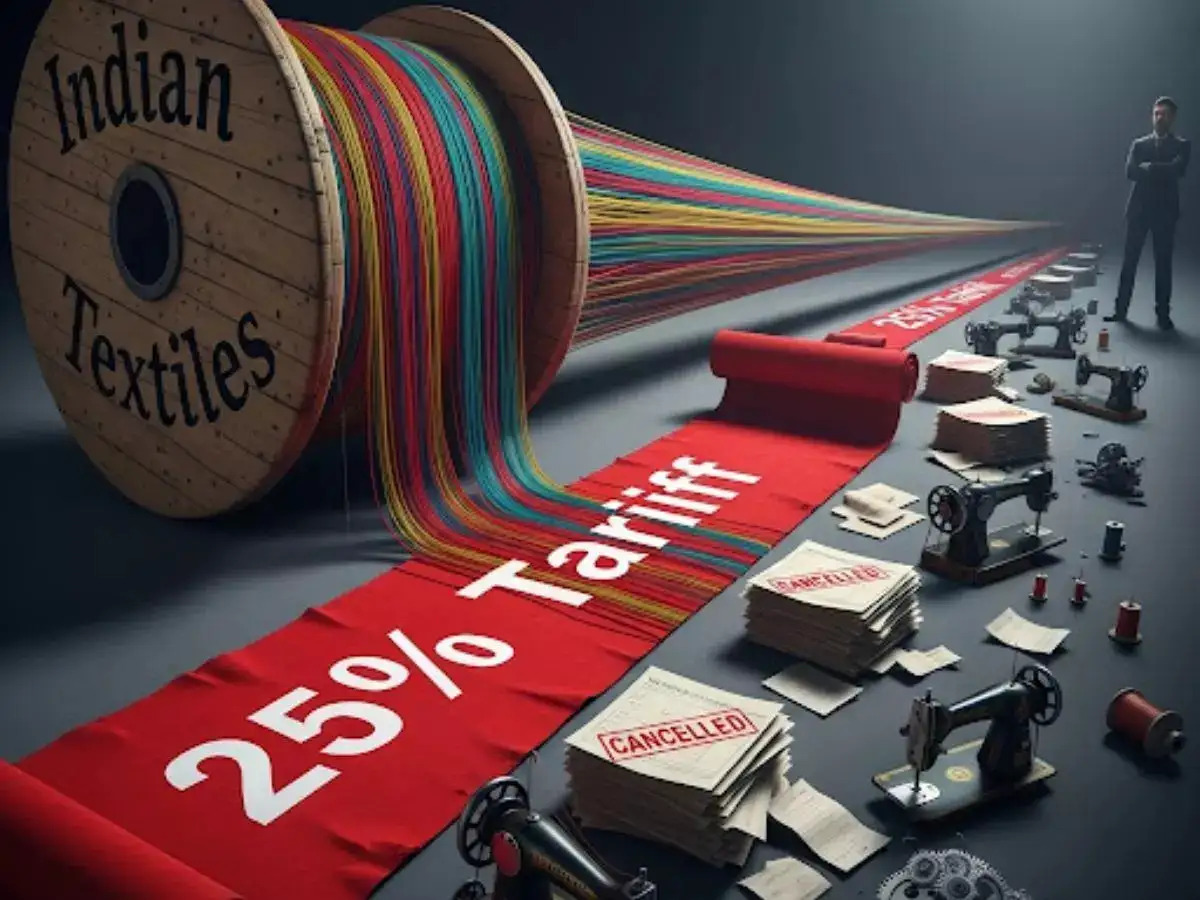
The industry wants a uniform textile policy across the country. This is seen as necessary since if one state offers subsidies, textile units in other parts shut down and shift to that state.
India aims at doubling the annual revenue of the textile industry in the country by 2025.
The Indian textile sector contributes 16 per cent to the country's GDP. But when only 16 per cent of the GDP comes from manufacturing, it is not enough for a sustainable economy. Thus it is necessary to scale up that contribution.
Foreign direct investment is being encouraged in the textile sector, which has the potential to create millions of jobs. The textile sector is capable of strengthening the rural economy and creating large-scale employment.
However the Indian textile industry is over-dependent on the European Union and the US for exports. But when the season goes away in those markets, there aren’t enough orders. The sector doesn't have markets in other parts of the world. So it is exploring new markets like Latin America and Australia for Indian fabrics, garments and apparels in order to boost exports.
Efforts are on to make khadi a globally accepted fabric and garment. During a survey in 21 overseas markets, khadi was the most recalled Indian brand, along with yoga.
UBC Okanagan, based in Canada, is working to solve the issue of wrinkling when it comes to making textile composites.
Researchers investigated several de-wrinkling methods and discovered they could improve their effectiveness by pulling the materials in two directions simultaneously during the manufacturing process. They did this by creating a custom-made biaxial fixture -- a clamp that stretches the textile taut and removes unwanted bumps and folds.
Textile composites are known for their strength and durability. But a simple wrinkle in the manufacturing process can significantly alter the end product -- sometimes diminishing its strength by 50 per cent.
Wrinkling is one of the most common flaws in textile composites, which are widely used for prototypes, as well as mass production within prominent aerospace, energy, automotive and marine applications.
The challenge was to avoid unwanted fiber misalignment or fiber rupture while capturing the out-of-plane wrinkles. Manufacturers who use these types of composites are looking for more information about their mechanical behavior, especially under combined loading scenarios.
The research included stretching the material and then using specialized image processing and 3D scanning to analyze the required forces and its impact on the wrinkling and de-wrinkling of the material.
Composite textiles are changing the way products are designed and built in advanced manufacturing sectors.
Shima Seiki has joined the Massachusetts Institute of Technology Media Lab as a Consortium Lab Member. Through its collaboration with the MIT Media Lab, Shima Seiki seeks to explore next-generation technologies that open up new opportunities for the garment sector.
At the MIT Media Lab, the fusion of art and science as well as engineering and design are the basis for state-of-the-art research that leads the world in various fields. Meanwhile the knit/apparel industry which Shima Seiki mainly serves is itself based on that very same synthesis of design and technology.
The fashion apparel industry is currently facing paradigm changes due to market trends that are no longer based on traditional values as well as uncertainties that reflect the rapidly changing global economy. Within such a market environment the need arises for providing consumers with a consistent supply of quality items at appropriate price points based on advanced trends.
Shima Seiki, based in Japan, is a leading computerised knitting machine manufacturer. Its seam-free wholegarment knitting technology offers an alternative to labor-intensive manufacturing.
The applications are not limited to knit fashion but include a wide range of new applications in knitting technology, including sports apparel, aerospace and the IT industry.
Textile mills in Pakistan want an increase in regulatory duty on the import of spun yarn and manmade fiber from five to ten per cent.
The justification is that import of raw material for yarn has become exorbitant due to higher duties as opposed to import of finished product. Pakistan imposes a 11 to 20 per cent duty on raw material for the textile sector. The duty on finished products stands at five per cent.
The cascading duties are being impacted by free trade agreements signed with regional countries.
Previously duties on raw material were lower compared to finished products and now raw materials are attracting more duty than the finished goods. The duty on raw material is higher and lower on intermediary finished goods imports.
Under the South Asian Free Trade Agreement, the import duty on yarn was reduced to five per cent. A ten per cent regulatory duty on import of spun yarn has been suggested by the industry. It wants the anomalies done away with.
Some 25 units have been closed down in Pakistan because of the negative impact of the tax and duty structure.
Duties are higher on raw material imports and lower on intermediary finished goods imports.
International Textile Machinery (ITM) exhibition was held in Turkey, April 14 to 17, 2018. The exhibition proved it has become a trusted place for launching new technologies and innovation in the industry.
This is a platform for textile machinery, textile fibers, and yarns. ITM 2018 attracted a record-breaking number of visitors and technology launches. Visitors and participants from Turkey and many other countries around the world, flocked to the exhibition. A good number of visitors came from Bangladesh. There were 58,942 visitors from 94 countries.
Over 1150 textile technology manufacturers and company representatives from 64 countries participated at the exhibition, which took place in eleven different halls, and exhibited their products and technologies that have been introduced to the industry for the first time.
ITM 2018 has significantly enlarged in both country diversity and visitor numbers compared to previous ITM exhibitions. It was an unprecedented success according to the very positive feedback received from companies and visitors. It offered incredible commercial opportunities for professionals who wanted to take the industry’s pulse and follow innovations.
Most textile machinery manufacturers in Turkey range from small to medium sized companies. The line of textile machinery products manufactured by Turkish companies varies substantially from highly automated equipment to basic models. They have competence in most machinery categories such as atmospheric jet dyeing or blow dyeing.
Carnegie Mellon University (CMU) has developed a system that can translate a wide variety of 3D shapes into stitch-by-stitch instructions that enable a computerised knitting machine to automatically produce those shapes.
This ability to generate knitting instructions without the need for human expertise could make on-demand machine knitting more available. It may be possible to use the industrial knitting machines to produce customised pieces one at a time or in small quantities, allowing to choose the desired color, pattern and fit.
Knitting machines could become as easy to use as 3D printers.
As of now a floor of knitting machines also needs a department of engineers. Garment designers rarely have the specialised expertise necessary to program the machines. This makes doing one-off customised pieces very difficult.
V-bed flat knitting machines are highly capable but have certain limitations in terms of flexibility. The CMU algorithm takes these constraints into account, producing instructions for patterns that work within the limits of the machine and reduce the risk of yarn breaks or jams.
A number of brands have experimented with the on-demand production concept. In 2017, Intel teamed up with women’s brand Eileen Fisher to experiment with 3D sweater knitting. Last year, Adidas carried out a project, where shoppers could design a sweater, have a body scan to determine fit and get it knitted by a state-of-the-art Stoll flat knitting machine within a couple of hours.