


FW
Vietnamese RMG makers under pressure from foreign brands
As per Vinatex’s (Vietnam Textile & Garment Group) current production capacity of the textile and garment industry has exceeded $35 billion per annum. Vinatex noted that 2016 was tough for the industry as demand from the largest export markets fell — exports to the US decreased 3.4 per cent, Japan 2.6 per cent and to South Korea by 2.1 per cent. Market analysis firm VIRAC notes the domestic garment market has small scale — when compared to other markets — because of low spending per capita in Vietnam.
Vietnamese garment companies will have to face two big problem: presence of counterfeit goods; and products imported across the border and low capability of enterprises in distribution, design and branding. A Vinatex report shows in rural areas, Vietnam’s textile and garment products have to compete with imported products with no clear origin, while in urban areas they have to compete with imports from the US, the UK and ASEAN.
While Vietnamese enterprises are reluctant to develop the domestic market, foreign retailers and fashion brands are having a field day. Maison, for example, has been bringing mid- and high-end fashion brands to Vietnam and distributing products of 21 brands, including Christian Louboutin, Karen Millen, Coast, Max&Co, Max Mara, Oasis, Charles & Keith and NYS and owns 44 shops in Vietnam.
Son Kim Fashion, following success with brands such as Jockey, Vera, Wow and J. Bus, has partnered with two Japanese investors Williamson-Dickie and Sumitex International to bring the US Dickies brand to Vietnam. Japanese Uniqlo with 2,000 shops worldwide is preparing to open two shops in Vietnam this year. Meanwhile, Forever 21 would come to Vietnam next year. While Vietnamese garment companies think the domestic market is too small, foreign investors consider Vietnam the new land to exploit with the garment market valued at $4.5 billion.
MSME minister for exempting khadi products from GST
The Micro, Small and Medium Enterprises (MSME) minister, Kalraj Mishra is hopeful that khadi products would be exempted from GST which came into effect from July 1. Various khadi and village industries products attract different rates of GST ranging from 5 to 12 per cent. Addressing a meeting of khadi institutions, Mishra said for the larger interest of weavers and spinners associated with the khadi industry, the GST panel had started analysing the pros and cons of the new tax on various products. He disclosed that the finance minister had promised he would give GST exemption to ensure financial development of the economically backward lot of weavers and spinners.
Expressing concern over decreasing number of artisans in the khadi sector, the Singh said all round development of the sector would remain a mirage if there was no provision for sustainable economic growth of artisans; and added that no one knows the reason that how the number of artisans fell from 11 lakh in 1950 to nearly 2 lakh at present.
MARC O'POLO launches Special 50th Anniversary sweatshirt
MARC O'POLOs Special 50th Anniversary Sweatshirt Edition was launched by Robbie & Ayda Williams in person. This special collaboration was timed to coincide with the 50th anniversary of the fashion label which was founded in 1967.
The brand had a surprise in store in the form of an eclectic panel discussion featuring Robbie, Ayda, Mads Mikkelsen and German MTV legend Marcus Kavka. A Facebook livestream broadcasted all the action inside before the event that culminated with Robbie and Ayda - appearing in front of their fans who had gathered in front of the store - unveiling shop windows specially decorated using design elements from their capsule collection.
This collection, designed in cooperation with Robbie & Ayda Williams, is now available exclusively in MARC O'POLOs stores and on http://www.marc-o-polo.com. Robbie’s is of the view that a confident man wears was pink«, and this was the stand-out colour shade from the colour palette that was used for the sweaters in their capsule collection. The pieces also carry Robbie's signature embroidered on the sleeve, and Ayda was even able to convince her husband to feature the song titles Love My Life and Come Undone on the women's sweatshirts. The accompanying campaign was shot by ace photographer Peter Lindbergh.
SVP Group to develop greenfield project on Oman’s Sohar Freezone
"Oman is gearing up to give a strong boost to its textile industry with a slew of projects. One such project is a greenfield textile industry at Sohar Freezone in the Sultanate replicating the success formula of India, Germany, China and Italy. The foundation was laid by India’s ShriVallabh Pittie Group (SVP), a global leader in the manufacturer of cotton yarn — the raw material for textiles. The Group’s Oman subsidiary, SV Pittie Sohar Textiles FZC LLC, is preparing to launch work on its $300 million cotton yarn project on a 27-hectare site at the free zone adjoining the Port of Sohar. "

Oman is gearing up to give a strong boost to its textile industry with a slew of projects. One such project is a greenfield textile industry at Sohar Freezone in the Sultanate replicating the success formula of India, Germany, China and Italy. The foundation was laid by India’s ShriVallabh Pittie Group (SVP), a global leader in the manufacturer of cotton yarn — the raw material for textiles. The Group’s Oman subsidiary, SV Pittie Sohar Textiles FZC LLC, is preparing to launch work on its $300 million cotton yarn project on a 27-hectare site at the free zone adjoining the Port of Sohar. Vinod Pittie, chairman, ShriVallabh Pittie Group, elaborated that the SVP Group is investing in the fundamental building block of what will inevitably evolve into a major textile hub in Sohar Freezone. With a cotton yarn plant in place, the potential for upstream, downstream, forward and backward integration is huge, and so is the opportunity for employment generation. Entire cities have sprung up in India, China, UK and the US, among other countries, on the back of textile industries.
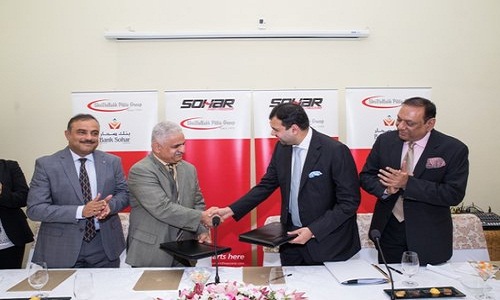
The Group operates a complex of state-of-the-art plants in Gujarat, as well as a trio of traditional spinning mills in the Southern India. Total capacity is projected to double with the installation of 300,000 spindles and 7000 rotors at its upcoming facility in Oman. The upcoming project is the Group’s first-ever investment outside India. This is probably the first project of its kind in the world to be set up in a location that neither offers the basic raw material nor is a destination for the end product. Usually, it is either one or both criteria that are a prerequisite. The decision has been taken on the back of logistical advantages that it offers as well as an appeal investment expanse. Additionally, Sohar Freezone has well-developed infrastructure and is located not far from Dubai as well.
Sourcing advantages
Technology-wise, the Sohar project is set to be high-tech. The company has just completed one of the world’s most modern compact yarn projects in India, but this new project in Sohar will be the world’s most modern automated plant. Full automation will contribute to the production of a finer count of yarn and cost savings in the form of reduced energy consumption and lower manpower requirements. Machinery and equipment will be primarily procured from Germany. Raw cotton as raw material for the project will be sourced from the United States, Australia and India depending upon the grades of yarn required to be produced and the targeted markets internationally.
Slated advantages
The upcoming spinning project augurs well for the entire value chain of the textile industry, be it weaving, garment-making, etc. According to Pittie, it won’t be surprising to see that in three to five years, investments of around $1 billion will materialise in the textile cluster at Sohar. Imports and exports linked to the project will generate in excess of 5,000 containers in annual traffic through the Container Terminal.
The global market for textile fibres is projected to reach around 124 million tons by 2022, driven by the development and launch of innovative blends of textile fibres and yarns, expanding applications and burgeoning demand in emerging countries. In value terms, this translates to $156 billion in 2022, up from $126 billion presently.
Azerbaijan set to accelerate sustainable cotton production
Because Cotton is a valuable money crop, Azerbaijan has recently set course on restoring its traditional industry of cotton cultivation and now the state is providing huge support to this industry. From 1970 to 1980, cotton production was of crucial importance for Azerbaijan’s economy accounting for approximately 25 per cent of agricultural revenue. At that time, the country harvested a million tons of cotton per year.
Until 2016, cotton production remained insignificant. But the measures taken last year permitted increasing sown area of cotton to 51.400 hectares and its production shot up to 89.4000 tons. In 2017, the sown area reached 136,000 hectares, and production is planned to touch around 2,60,000 to 2,70,000 tons.
The state program for 2017 to 2022 will further strengthen measures directed at developing this industry. The purpose of the program is to develop cotton growing in Azerbaijan, increase export potential in this sphere, ensure employment of their rural population and increase the production of cotton to 5,00,000 tons in 2022.
If in 2015, some 35,000 tons of cotton were procured, then last year this figure touched about 90,000 tons. If last year cotton was grown on 51,000 hectares, then this year it is grown on 1,36,000 hectares. President Aliyev disclosed that cotton was grown in 20+ regions of the country. Cotton is the most widely used fiber in the world today comprising half of all fiber production. Around 90 countries worldwide grow cotton which is used to make clothes and other textiles worldwide with a large portion of the rest comes from synthetic products.
Gartex India to showcase latest innovative in garment manufacturing
Gartex, India’s comprehensive exhibition on Garment and textile machinery, fabrics, accessories and allied industries, is set to showcase latest technological advancements in the Indian textile and garment manufacturing. The exclusive B2B exhibition is scheduled for July 29 to 31 July 2017 at Pragati Maidan, New Delhi. The show is determined to bring forth a complete value chain of garment and textile manufacturing solutions and technologies. Gartex has emerged as the definitive gateway to provide excellent quality and one-stop selling and sourcing platform. Top industry players such as Mehala, Durst, EFI Reggiani (Arrow Digital), Britomatics, Mimaki, Jaysynth, Colorjet, Negi Sign and many more are expected to be present.
Gartex serves as a one-stop-destination for latest innovations in textile and garment machinery and accessories market. The show this year would highlight latest developments in digital textile printing machinery, embroidery machines and garment and apparel machinery encompassing garmenting, digital textile printing technologies, fabrics and accessories.
Digitex will display the latest developments in digital textile printing technology encompassing machinery, inks, software and services. Visitors would get an opportunity to see digital printing for home furnishing and interior decoration, apparel and fashion, corporate interiors and other related segments.
One of the show’s central interests is garment and apparel machinery which includes pre and post process washing equipment, cloth inspection machine, cutting and laying machines, embroidery equipment, finishing machines, fusing machines, ironing and steaming equipment, knives/scissors grinding machines, quilting machines etc.
Clothing wholesalers reluctant to ‘Buy Zimbabwe’ concept
Clothing and textile wholesalers are reluctant to embrace the ‘Buy Zimbabwe’ concept meant to support the growth of local industries, as they prefer imported fabric to buying locally-produced ones. Zimbabwe Textile Manufacturers’ Association, secretary-general, Raymond Huni says wholesalers and retailers were reluctant to embrace the concept regardless of its nobleness.
Zimbabwe’s textiles and clothing industry is seriously weighed down by an influx of cheap imports from Asian countries and is operating under constrained capacity. Compounding the problem is the fact that despite the existence of legislation banning the importation of second-hand clothing, the practice has continued unabated because authorities have failed to enforce the ban.
At its peak, the clothing and textile industry in Zimbabwe used to employ as many as 35 000 people. The number has since whittled down to below 3 000. To promote local industry, government has been preaching the gospel of the Buy Zimbabwe concept.
Huni says that there are 52 companies in the textile industry, though only 15 employ more than 70 employees, while the smallest employs five or so employees. He also added that smaller companies are operating above 50 per cent, while at the same time big companies are operating below 40 per cent.
24th Hong Kong Fashion Week sees footfalls from across the world
"The 24th Hong Kong Fashion Week for Spring/Summer, organised by the Hong Kong Trade Development Council (HKTDC) received more than 12,000 buyers from 71 countries and regions. During the four-days (July 10-13) buyers from Japan, the Philippines, the US, Malaysia, Singapore and Russia recorded considerable growth. Twenty fashion events, including fashion shows, trend forecasting seminars, buyer forums and a networking reception were held, which explored the latest topics of interest in the fashion industry while generating more business opportunities for industry professionals."

The 24th Hong Kong Fashion Week for Spring/Summer, organised by the Hong Kong Trade Development Council (HKTDC) received more than 12,000 buyers from 71 countries and regions. During the four-days (July 10-13) buyers from Japan, the Philippines, the US, Malaysia, Singapore and Russia recorded considerable growth. Twenty fashion events, including fashion shows, trend forecasting seminars, buyer forums and a networking reception were held, which explored the latest topics of interest in the fashion industry while generating more business opportunities for industry professionals.
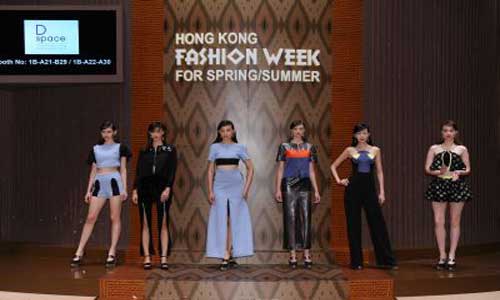
“In addition to being a premier sourcing platform for the industry, Hong Kong Fashion Week is also an important marketing channel for exhibitors promoting new products and fashion projects; and provides an opportunity for industry professionals to gather the latest market intelligence,” said Benjamin Chau, Deputy Executive Director, HKTDC. “Although the Internet and social media are gradually becoming mainstream promotion channels, fashion trade fairs are still a dominant platform for conducting face-to-face business negotiations, exchanging market intelligence and showcasing new collections. The HKTDC will continue to offer its unique 4-in-1 integrated marketplace, consisting of trade fairs, the HKTDC Online Marketplace (hktdc.com), product magazines, and mobile app, for promising fashion companies to reach global buyers anytime, anywhere.”
A promotional platform
With buyers coming from around the world, Hong Kong Fashion Week is a major platform for international corporations to promote fashion-related activities. During the fair, the Italian Trade Commission Hong Kong and Assocalzaturifici (Italian Footwear Manufacturers’ Association) jointly organised an exhibition titled ‘The seduction of footwear: Italian glamour,’ displaying 50 styles of classic Italian women’s shoes and leveraging Hong Kong Fashion Week to introduce visitors to the aesthetics of Italian footwear.
Annarita Pilotti, President, Assocalzaturifici, explained Hong Kong and the Chinese mainland together represent Italy’s fifth-largest export market in terms of value. Last year, Italian export volumes to the mainland rose 2.3 per cent; while the total value of exports to Hong Kong increased by 3.5 per cent. It was also found that the average export prices of the two markets were higher than other countries and still continues to rise. “It is because both Hong Kong and the Chinese mainland are such important markets for Italian-made goods that we are keen to stage our promotional road shows in Hong Kong, which allow us to bring the excellence and quality of Italian footwear to the attention of international buyers,” said Pilotti.
Spotlight on social causes
On the first day of the fair, international trend forecasting group Fashion Snoops presented ‘The Visionary Trends for Autumn/Winter 2018/19 for Women’s and Men’s Wear’. The group pointed out that fashion trends are often closely related to both society and everyday life issues, such as environment protection and immigration.
“The identity crisis brought on by the refugee crisis is a pressing global concern,” said Michael Leow, Asia/Pacific Sales & Marketing Head, Fashion Snoops. “Climate change and world trade have caused an influx of refugees. Although many may not want to approach this subject, we as fashion designers, should explore the issue, let our voices be heard, and galvanise people into action towards a brighter tomorrow.”
To embrace diversity, ‘Engineered Identity’ will be one of the major trends, Leow says. Each piece of clothing will integrate fashion elements from different countries, alongside sharply contrasting colours and conflicting elements, presenting a world of harmony and one without borders.
New launches
Apart from unveiling fashion trends, latest technologies were also discussed at various seminars. At the seminar ‘New Generation of Merino innovation–Wool Denim Wear & Wool Sneakers’, the Woolmark Company introduced its latest denim fabric and its related application techniques. Brenda Yang, Technical Manager-Dyeing and Finishing, the Woolmark Company, explained wool’s anti-perspiration, breathable, anti-odour and warmth-keeping qualities make the fabric ideal for use in sportswear. The high external wear-resistance of the wool also makes it suitable for sports shoes. “It is currently a trend to produce the vamp by weaving, thus many styles can be created,” said Yang. Some manufacturers have even incorporated far-infrared properties into the wool/nylon to relieve post-exercise muscle fatigue. She added that using wool as the principal material for shoes, such as adding it into the sole for warmth or stitching leather with it to create a thick wool-knitted leather or wool-blended fabric, are new trends in shoemaking.
The second edition of Centrestage, a platform for Asian fashion brands and designers specifically to promote their brands and launch their collections will be held from September 6 to 9.
VF Corp motivates staff through local volunteerism
VF Corp, the parent company of Wrangler and Lee, is encouraging employees worldwide to step out of the office and volunteer in local communities. The company launched initiatives that showcase its commitment to social responsibility, sustainability and environmental volunteerism.
In North Carolina, over 330 associates from VFs world headquarters and its jeans wear organisation gave over 830 volunteer hours working on 20 different projects, including improving facilities and grounds at the Glenwood Recreation Community Center and the Greensboro Science Center.
Wrangler and Lee partnered local organisations in Lumberton, North Carolina, to revitalize 200+ homes that were impacted in last year’s hurricane. Wrangler also donated a portion of its jean surplus to help the Girl Scouts of America to create 300+ dog beds for local animal shelters and associates also gathered animal food for donation to the shelters.
Thriving communities mean thriving associates, being an actively engaged local citizen is good for the community and business. The brand’s associates worldwide are making their communities stronger by living values of honesty, integrity and respect, and are giving back to the places where they live and work, said a spokesperson for the brand.
VF’s local volunteer projects complement many of the brand’s larger sustainable commitments, including its goal to use 100 per cent renewable energy at its owned and operated facilities by 2025 and its recent pilot program to increase the supply of sustainable cotton in the US.
Swim Week Colombo aspires to be the first eco-ethical fashion week
Swim Week Colombo concluded its 3rd edition which heralded Green Conscious and Earth Sensitivity. This set the pace for future direction of the fashion industry in Sri Lanka and in the region. The fashion industry platform focused on swimwear, resort wear and active wear. All participants had a green impact story and they were offered eco-sensitive manufacturing through their partners Linea Aqua.
Trendswim — an expert forum where thought leaders discussed topics of importance which impacted the global fashion industry — provided three meaningful sessions covering ‘global trends’, ‘good and sustainable fashion’ and a ‘textile forum’. Art Connect celebrated the collaboration between art and fashion where six important artists expressed their interpretation of Green Conscious and Earth Sensitivity under the theme of the exhibition ‘Revive’.
Fashion Films has become an important part of the fashion week where six young directors worked with designers to bring to life their ideation through one-minute films shot on smart phones. New trends in swimwear was shown by top internationals brands such as Heidi Klein and HAH (Hot-As-Hell), along with 11 Sri Lankan brands which included Buddhi, Meraki, Peronie, Maus, Conscience, Arugam Bay, Rachel Raj and Koca. There were also Indian brands such as Aviva and Ajay Kumar. Olu tropical water was the title partner; Linea Aqua was the main partner; American Express Nations Trust Bank was the official fashion card.











