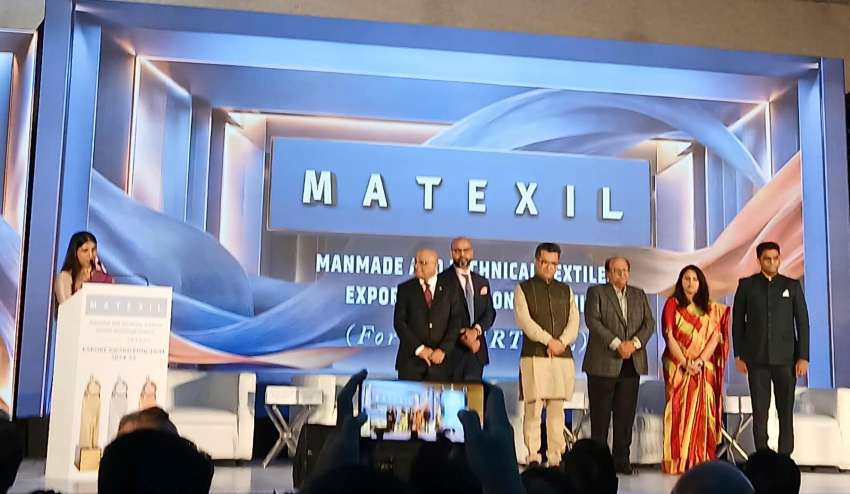

India’s textile exports have remained virtually flat at $15–16 billion for an entire decade, while competitors such as Bangladesh and Vietnam have surged past the $40-billion mark. Delivering a data-driven wake-up call to mill owners and policymakers, Prashant Agarwal, Managing Director of Wazir Advisors, stated that India’s growth engine cannot advance if the industry continues sinking capital into traditional spinning while ignoring the real global demand: automation, man-made fibres (MMF), technical fabrics, and agility. Presenting the flagship theme report at the 17th annual FICCI TAG 2026 conference in Mumbai, Agarwal challenged the industry’s long-standing playbook, warning that while the national target envisions expanding the textile sector to a $350-billion economy by 2030, anchored by $250 billion in domestic consumption and $100 billion in exports; the export leg demands an aggressive leap from a historical 1% compound annual growth rate (CAGR) to over 22%, requiring a coordinated 13% CAGR across the entire value chain.
The Spinning Trap vs. The $540-Billion garment reality
Agarwal stressed that despite recent global trade disruptions and geopolitical conflicts, world textile trade still exceeds $900 billion, of which $540 billion is driven strictly by garments. While China's market share in the US has contracted by 8%, it is Vietnam, Bangladesh, and Indonesia that have stepped in to capture that vacated space, while India’s share has remained stagnant. Agarwal cautioned against India's persistent tendency to pour fresh capital into spinning, emphasizing that global business models, retail inventories, and buyer demands have fundamentally transformed. Analyzing consumption trends in the United States, he pointed out that while retail sales indices reflect nominal dollar growth due to 3% to 4% inflation, actual import volumes are shrinking. With international retail brands managing lean inventories of around 2% to avoid post-pandemic overstocking, buyers are systematically destocking, curbing speculative forward orders, and executing aggressive vendor consolidation, demanding faster lead times, lower minimum order quantities, and agile regional networks.
The Critical Bottleneck: Quality filament and the MMF deficit
India's inability to capture high-margin global apparel orders stems directly from upstream deficits in the domestic man-made fibre ecosystem. Globally, the fibre mix has tilted decisively toward synthetic and technical textiles—projected at an 80:20 ratio compared to traditional cotton, yet Indian fabric makers remain hamstrung by severe quality constraints. Domestic wet processors continue to struggle to source high-grade, barré-free continuous filament yarn within the country, forcing domestic fabric manufacturers to import 70% to 80% of top-grade synthetic inputs directly from China. Consequently, massive global apparel categories such as knit sweaters and outerwear jackets remain negligible in India's export basket, being manufactured almost exclusively for low-value domestic consumption. Agarwal argued that while high-margin segments like technical textiles and home textiles will naturally attract private capital, policy interventions must decisively support mainstream apparel and synthetic weaving and knitting to unlock large-scale industrial employment.
Closing the floor-level efficiency chasm
Addressing the operational mechanics of Indian manufacturing, the presentation revealed that Indian garment facilities operate at an average efficiency of only 40% to 45%, lagging far behind Chinese factories operating between 60% and 70%. To close this gap, apparel plants must recruit industrial engineers capable of implementing time-and-motion studies, process de-skilling, and predictive shop-floor AI, rather than staffing plant operations purely from traditional merchandising backgrounds. Furthermore, just as synthetic plants run continuous lines, automated garment units must adopt two- to three-shift production cycles to lower amortized capital costs. Agarwal also warned that long-term industrial viability hinges on middle-management productivity rather than short-lived government incentives. With mega-infrastructure like PM MITRA parks set to create an estimated 7.5 lakh jobs, existing public training programs like the Samarth scheme leave a substantial skill deficit that private industry must fill through institutional training budgets. Domestic enterprises must also rethink vertical integration through cross-border manufacturing partnerships, citing recent models such as Arvind’s joint venture in Bangladesh with Simba to supply global buyers like Gap, where Indian fabric production paired with agile offshore assembly delivers required speed and price competitiveness.
Strategic Priorities: The six imperatives for India
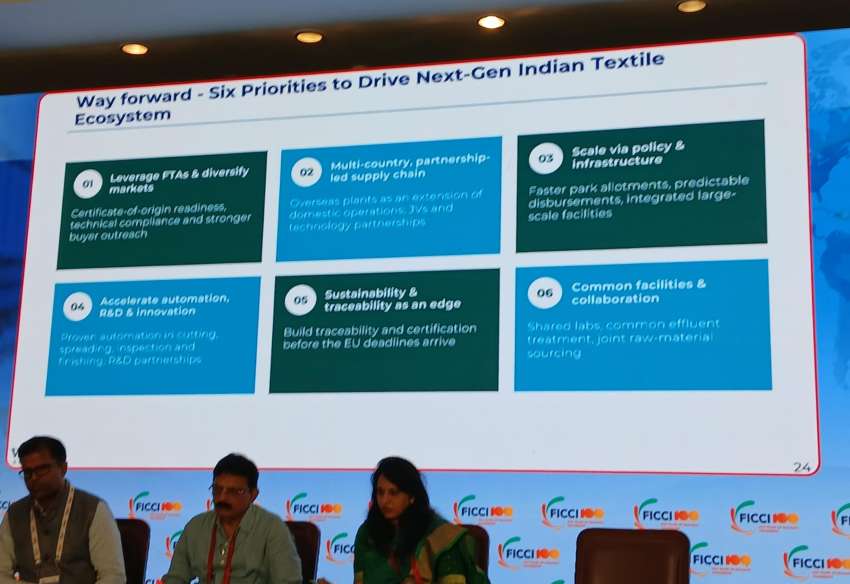
To capitalize on shifting trade corridors and newly signed trade agreements, Wazir Advisors outlined six structural imperatives to break the decade-long plateau. First, Indian mills must actively target fast-expanding FTA corridors in the UK, EU, and Japan with dedicated product categories rather than attempting to ship commodity cotton lines. Second, manufacturers must immediately establish environmental compliance frameworks, as non-tariff ESG regulations in Europe will quickly neutralize duty advantages if domestic wet processors fail sustainability audits. Third, Indian companies must establish multi-country footprints by setting up sourcing and production offices in Indonesia, Vietnam, and Bangladesh to maintain proximity to global retail buyers. Fourth, the government and industry must set up shared, world-class product development and testing centers in primary production hubs like Surat, Coimbatore, and Ludhiana, relieving MSMEs from heavy standalone R&D investments. Finally, Indian mills must build opportunity-led capacity in synthetic outerwear and activewear while dramatically reducing product development cycles to enable three-day sampling and quick-response turnaround.