
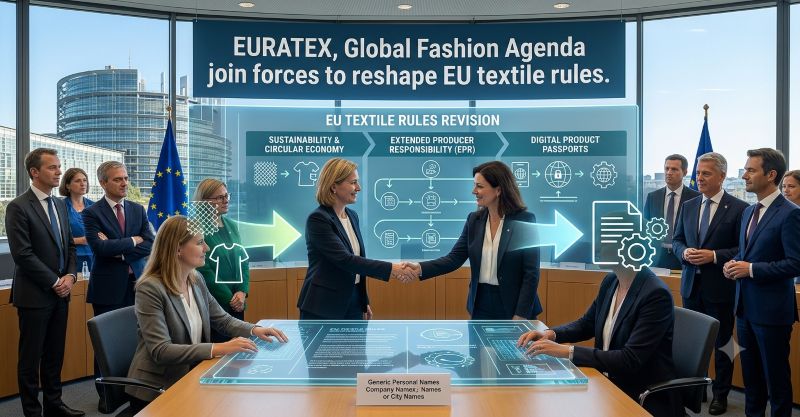
The European Apparel and Textile Confederation (EURATEX) and Global Fashion Agenda (GFA) have formed a strategic alliance to align European textile manufacturing with global fashion and retail priorities as the European Union tightens sustainability regulations. The partnership brings together manufacturers and fashion businesses to coordinate policy advocacy, increase circularity investments and protect Europe's industrial competitiveness. It comes as the sector faces higher production costs, low-priced cross-border e-commerce competition and stringent environmental compliance requirements.
The EU's regulatory agenda, led by the Ecodesign for Sustainable Products Regulation (ESPR), revised Waste Framework Directive and forthcoming Digital Product Passports (DPP), is reshaping sourcing, manufacturing and product design. The alliance will seek common industry positions in Brussels while using the annual Global Fashion Summit in Copenhagen to connect policy objectives with commercial implementation.
Aligning Industrcosts and competition from overseas producers have further constrained manufacturers' ability to invest in cleaner technologies and circular production. EURATEX Director General Dirk Vantyghem point out the transition to a sustainable textile industry depends on maintaining a strong and competitive European manufacturing base. GFA CEO Federica Marchionni highlighted the need to coordinate legislation with industry-wide implementation. The alliance aims to bridge these priorities through joint advocacy and closer engagement across the textile value chain.
Recycling needs capital
Scaling textile-to-textile recycling is a main priority. Europe generates approximately 5.8 million tonnes of textile waste annually, yet less than 1 per cent of discarded clothes are recycled into new garments. The ReHubs Techno-Economic Master Study estimates that recycling 2.5 million tonnes of textile waste annually by 2032 will require €5 billion-€6 billion in investment. Funding will be needed for automated sorting, fibre recovery and processing infrastructure. The proposed investment could generate up to €4.5 billion in socioeconomic value and create 15,000 regional manufacturing jobs.
However, infrastructure investment remains commercially difficult without predictable feedstock supplies and assured demand for recycled fibres. Long-term procurement agreements between recyclers, spinning mills and fashion groups will be critical to establishing viable recycling operations.
European recycler Reju's multi-year procurement agreements with six regional spinning and knitting mills illustrate how committed offtake can help de-risk investments in secondary fibre and yarn production.
Compliance reshapes supply chains
The EU's regulatory framework is progressively transferring responsibility for textile waste, product durability and traceability to brands and their supply chains. The resulting compliance requirements will influence material selection, product development, inventory management and supplier relationships.
The partnership addresses a longstanding disconnect between textile manufacturers and fashion brands. Retailers have committed to sustainability targets, but the financial and operational burden of meeting them often falls on upstream suppliers, including spinners, weavers and chemical processors.
Volatile energy prices, raw material
Table: Regulatory deadlines and market capital impact
|
Regulation |
Timeline |
Commercial implications |
|
Separate Textile Collection (WFD Article 11) |
Effective January 2025 |
Requires separate collection of post-consumer textiles, increasing the supply of feedstock for recyclers. |
|
Harmonised Textile EPR |
National implementation through 2028 |
Makes brands financially responsible for textile waste and encourages recyclable materials through eco-modulated fees. |
|
Ecodesign for Sustainable Products Regulation (ESPR) |
Phased implementation from 2026-27 |
Introduces product sustainability requirements and restrictions on the destruction of unsold apparel. |
|
Digital Product Passport (DPP) |
Phased deployment from 2026-28 |
Requires product-level information on fibre provenance, chemical inputs and material composition, increasing traceability and data-management requirements. |
For brands, the implications extend beyond environmental reporting. Product design, fibre blends, sourcing decisions and enterprise resource planning systems will need to adapt to new requirements. Manufacturers will also face greater pressure to disclose material and production data.
Protecting industrial margins
The alliance comes amid mounting pressure on Europe's textile and apparel industry. Retail employment in the EU apparel sector has reportedly declined by around 100,000 positions since 2018, reflecting changing consumer behaviour, cost pressures and competition from low-cost cross-border e-commerce. Manufacturers are simultaneously dealing with fluctuating natural and synthetic fibre prices, higher operating costs and tighter environmental controls.
A key objective will be to establish consistent eco-modulation criteria across national Extended Producer Responsibility (EPR) systems. Differences in national implementation could increase administrative costs, complicate cross-border trade and make investment decisions more difficult. The partnership will push for regulatory frameworks that reward durable products, recyclable material combinations and investment in domestic recycling capacity rather than imposing fragmented compliance costs.
Building a common industry voice
EURATEX represents approximately 192,000 enterprises across Europe's textile and clothing industry, generating €166 billion in annual turnover across apparel, home textiles and technical textiles.
The partnership with GFA brings manufacturing representation closer to global fashion brands and retail leadership. The combined effort seeks to ensure that sustainability regulation considers the economics of production alongside corporate environmental commitments.
The larger challenge is converting Europe's regulatory ambitions into commercially viable industrial infrastructure. Without capital investment, standardised rules and long-term demand for recycled fibres, circularity targets risk remaining compliance obligations rather than creating a competitive manufacturing ecosystem.