
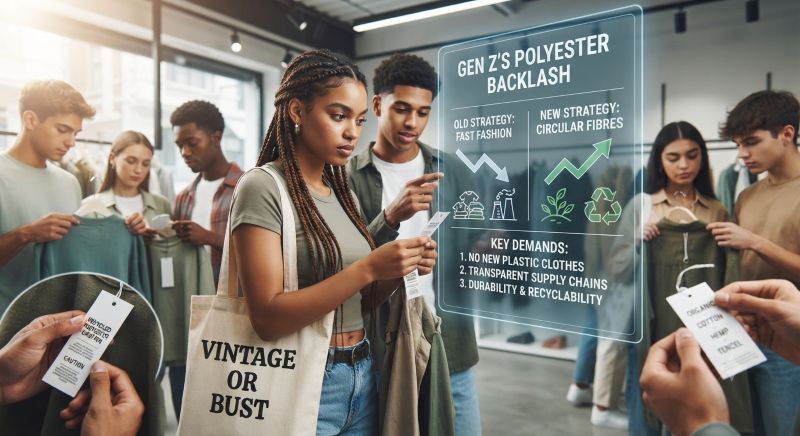
The wash-care label is emerging as a new consumer checkpoint, challenging the high-street economics of polyester-led sourcing and pushing brands towards natural and next-generation cellulosic fibres. Fashion retail is witnessing a shift in how younger consumers evaluate garments. Instead of looking first at brand names, design details or price tags, Gen Z shoppers are checking composition labels before making purchase decisions. The small care label stitched inside a garment has become an important indicator of perceived quality, authenticity and value.
A blend containing 56 per cent cotton and 44 per cent polyester, once promoted for its durability and wrinkle resistance, is increasingly facing consumer resistance. Across social media, fashion haul reviews and high-street changing rooms, polyester has acquired negative associations with cheapness, poor quality and environmental damage.
This shift challenges apparel brands that have relied on synthetic blends to control manufacturing costs and protect gross margins. For decades, polyester has been incorporated into knitwear, tailoring, denim and everyday fashion to reduce dependence on more expensive natural fibres. However, younger consumers are increasingly questioning whether garments marketed as premium or natural justify their prices when synthetic content accounts for a substantial proportion of the fabric. The composition label is consequently becoming a commercial consideration rather than merely a regulatory requirement.
Polyester's volume advantage
The consumer backlash contrasts sharply with the industry's dependence on synthetic fibres. As per Textile Exchange's Materials Market Report, global fibre production reached 139 million tonnes, with polyester accounting for approximately 59 per cent of the total, or more than 82.5 million tonnes. Cotton, the second-largest fibre category, contributed around 25.7 million tonnes, representing almost 18 per cent of production. All animal fibres combined, including wool, alpaca, mohair and cashmere, accounted for less than 1 per cent.
Polyester's dominance is rooted in manufacturing economics. Virgin polyester staple fibre generally costs substantially less than cotton and is considerably cheaper than premium natural fibres. Its strength, abrasion resistance, lightweight properties and dimensional stability have also made it attractive to spinning mills, fabric manufacturers and garment exporters.
For high-street retailers, blending polyester with cotton, wool and other natural fibres has been an established strategy for reducing bill-of-materials costs while maintaining accessible retail prices.
However, the commercial calculation is changing. When consumers begin associating synthetic content with inferior quality, the cost advantage at the procurement stage can translate into a reputational disadvantage at the retail counter.
Recycled polyester faces scrutiny
Retailers have attempted to address concerns about synthetic fibres through recycled polyester collections, often supported by sustainability labels and bottle-to-garment messaging. But the circularity credentials of this approach are increasingly being questioned. Studies show approximately 97 per cent of recycled polyester used in apparel originates from recycled PET beverage bottles rather than discarded textiles. Textile-to-textile recycling remains marginal, accounting for approximately 0.3 per cent of polyester production and around 1 per cent across all fibre categories.
The distinction matters because converting beverage bottles into apparel does not necessarily establish a closed-loop textile recycling system. Bottle-derived polyester still sheds synthetic microfibres during washing, while the material may eventually become difficult to recycle further. Concerns about microplastic pollution, combined with increasing scrutiny of environmental claims, are putting pressure on brands to show measurable circularity rather than rely on recycled-content marketing.
The European Union's Ecodesign for Sustainable Products Regulation (ESPR), Digital Product Passports (DPP) and Extended Producer Responsibility (EPR) frameworks are adding another dimension. Greater transparency around fibre composition, durability and recyclability will make it harder for brands to obscure synthetic-heavy blends behind premium positioning.
The margin dilemma
For apparel manufacturers and retailers, replacing polyester is not a straightforward procurement decision. Natural fibres offer consumer appeal but introduce substantial cost implications.
Table: Sustainable sourcing strategy & materials impact
|
Sourcing Strategy |
Operational implications |
Commercial impact |
|
Pure natural fibres |
Replace blends with cotton, linen or certified wool |
Raw material costs can rise 35-70%, putting pressure on margins |
|
Cellulosic alternatives |
Shift towards lyocell, modal and hemp-based fibres |
Better consumer acceptance, but processing capacity and costs remain constraints |
|
Functional synthetics |
Restrict polyester to rainwear, swimwear and compression garments |
Retains technical performance while reducing exposure in lifestyle categories |
A pure wool blazer or heavyweight linen coat can cost considerably more to manufacture than an equivalent acrylic-polyester-elastane alternative. Passing the increase to consumers risks pushing products beyond established high-street price thresholds. Absorbing it directly compresses operating margins. Brands must therefore rethink not just fibre selection but also product architecture, sourcing commitments and pricing strategies.
The overcoat experiment
A European mid-market fashion group is an example of how this shift can work commercially. After recording an 18 per cent increase in store returns and declining conversion among shoppers aged 18-28, the retailer identified synthetic content, static electricity and the plastic-like feel of coats priced at €120 as recurring customer complaints.
For its subsequent autumn collection, the company removed synthetic fibres from the shell fabrics of three flagship coats. It introduced 100 per cent recycled wool weaves with organic cotton linings, increasing production costs by 42 per cent. Rather than absorb the entire increase, the retailer simplified product design, reduced decorative hardware and cut colourways from eight to three to improve manufacturing efficiencies. Retail prices were increased to €165.
The company also made fibre composition a prominent part of the product communication, displaying detailed care and composition information on interior pocket facings. The results were significant: sell-through improved by 28 per cent, while clearance write-downs fell to almost zero.
The example suggests that younger consumers may accept higher prices when material quality is clearly revealed and the product delivers a credible value proposition. It also highlights the importance of communicating fibre composition as part of the product's commercial identity.
Cellulosics enter the competition
The longer-term fibre transition is unlikely to involve a complete return to conventional natural fibres. Cotton faces land, water and agricultural constraints, while wool production remains limited by livestock and grazing capacity.
Meanwhile, global fibre consumption has reached approximately 17 kg per capita. Business-as-usual projections indicate that production could rise to 172 million tonnes by 2030, with polyester expected to account for much of the additional volume. This creates an opportunity for manmade cellulosic fibres (MMCF), including lyocell, modal and viscose. These fibres reached approximately 9.1 million tonnes, which is around 7 per cent of global fibre production.
The next stage involves developing alternative cellulose sources, including agricultural residues, non-wood biomass and microbial cellulose produced through fermentation. These materials offer opportunities to combine the softness, drape and breathability associated with natural fibres with industrial-scale processing. However, their commercial expansion remains constrained by capital-intensive biorefineries, solvent recovery requirements and fragmented biomass collection systems.
Next-generation regenerative cellulosics still make up less than 1 per cent of the fibre market. Scaling them will require longer-term procurement commitments, investment in processing infrastructure and stronger collaboration between fibre producers, spinners and fashion brands. Without such commitments, these alternatives are likely to remain premium niche materials while conventional polyester continues to dominate industrial volumes.
Performance over perception
The future of synthetic fibres will depend increasingly on where and why they are used. Polyester retains clear advantages in technical rainwear, athletic base layers, compression garments and performance outerwear, where strength, low moisture absorption and abrasion resistance are essential.
Its position is more vulnerable in everyday lifestyle categories such as shirting, knitwear, dresses and tailoring, where consumers increasingly associate natural composition with comfort, quality and authenticity. For yarn spinners, fabric mills and garment manufacturers, this shift creates an opportunity to diversify fibre portfolios and invest in cellulosic alternatives, textile-to-textile recycling and traceable sourcing.
The industry is unlikely to abandon polyester, given its manufacturing economics and unmatched production scale. But its use may become more function-specific as consumer expectations and regulatory requirements converge. The high-street value proposition is therefore undergoing a fundamental change. Brand identity and marketing claims will no longer be sufficient to justify premium pricing. Increasingly, the evidence will be stitched inside the garment itself.