

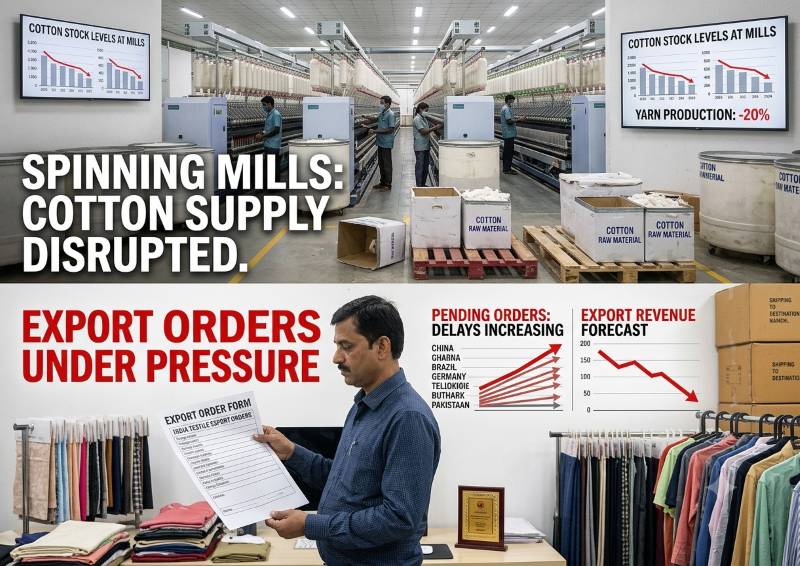
India’s textile industry faces deep cotton shortage just as new free trade agreements (FTAs) open fresh export opportunities in major markets. The growing gap between domestic cotton production and mill consumption threatens to undermine the competitiveness of Indian spinners and downstream manufacturers. The domestic cotton supply-demand deficit is projected to exceed 9 million bales in the 2026-27 marketing year, compared to 7 million bales in 2025-26. Production is expected to fall below 28 million bales of 170 kg each, while mill consumption could cross 36 million bales.
The imbalance reflects two simultaneous pressures: weather-related crop losses and rising industrial demand. The implementation of the India-UK FTA and the anticipated India-EU trade agreement are expected to generate additional demand for Indian cotton-based textiles and garments.
The immediate consequence is higher raw material costs. Gujarat Shankar-6 cotton (29 mm) prices have climbed to Rs 68,500 per candy, up Rs 4,500 in a month and over 7 per cent from the previous level. The rally is squeezing mill margins and increasing uncertainty across the textile value chain.
Numbers behind the crunch
The latest supply-demand estimates point to a steadily deteriorating domestic cotton balance.
Table: Cotton supply-demand projections
|
Supply-Demand Variable |
2024–25 Actual |
2025–26 Estimate |
2026–27 Forecast |
|
Domestic crop production |
32.50 mn bales |
29.80 mn bales |
Below 28 mn bales |
|
Mill consumption |
31.80 mn bales |
34 mn bales |
Above 36 mn bales |
|
Domestic supply-demand deficit |
4.80 mn bales |
7 mn bales |
Above 9 mn bales |
|
Raw cotton imports |
5.74 mn bales |
7.10 mn bales |
7.50–8.50 mn bales |
|
Shankar-6 price per candy |
Rs 57,000 |
Rs 64,000 |
Rs 68,500 |
|
National stock-to-use ratio |
42% |
36.50% |
31% |
The declining stock-to-use ratio underlines the growing vulnerability of domestic mills. With inventories tightening and imports becoming important, the industry has limited room to absorb further supply disruptions.
Weather hits production
The production shortfall is rooted in uneven monsoon distribution and adverse weather across major cotton-growing regions. Parts of Maharashtra's Vidarbha and Khandesh belts, northern Karnataka and Telangana have seen moisture stress during critical crop development stages. In Khandesh, inadequate rainfall during August and September affected boll development and per-hectare yields. Localised pest infestations have added to the damage.
Harvest arrivals are running three to four weeks behind schedule. Growers in Saurashtra and Jalgaon are also holding back stocks in anticipation of higher prices, further restricting immediate market availability. The price disconnect between cotton and downstream products is creating another problem for the supply chain. "Ginning has become challenging as yarn prices haven't increased in proportion to the increase in cotton prices," informs Pradip Jain, President, Khandesh Ginners’ Association. For ginners, higher procurement costs without corresponding improvements in selling realisations are weakening operating economics.
Spinners absorb the pressure
The cotton rally is transferring cost pressure directly to spinning and weaving clusters. In Coimbatore, Tirupur and Rajkot, raw cotton accounts for over 62 per cent of yarn manufacturing expenses. However, benchmark 30s combed cotton yarn prices have not kept pace with the Rs 4,500-per-candy increase in lint prices. Independent spinning mills are consequently facing negative operating margins.
The pressure is spreading to weaving and knitting centres, including Surat, Ichalkaranji and Bhiwandi. Fabric manufacturers are reducing forward purchases and avoiding inventory accumulation, preferring to procure yarn only against confirmed orders.
This shift towards hand-to-mouth procurement is forcing spinning units to reduce capacity utilisation to 70-75 per cent to contain working capital requirements and cash-flow exposure. The result is a chain reaction: expensive cotton raises yarn costs, cautious fabric procurement restricts mill sales, and manufacturers become increasingly reluctant to commit to large export orders without assured raw material supplies.
FTAs raise the stakes
The timing of the cotton shortage is particularly challenging because India's export opportunity is expanding. Preferential tariff access under the India-UK FTA has improved the commercial proposition for Indian textile and apparel exporters. Expectations surrounding the India-EU trade agreement, targeted for implementation in 2027, are adding to sourcing interest.
However, greater export demand will require reliable access to competitively priced cotton. K Selvaraju, Secretary General, The Southern India Mills’ Association (SIMA), said UK export demand had increased over the preceding months. He warned that cotton consumption in the forthcoming season could exceed 36 million bales, while production may fall below 28 million. The potential implementation of the EU FTA could further increase demand and intensify shortages of quality cotton.
India imported 7.1 million bales in 2025-26, compared with 5.74 million bales in the previous season. Imports are projected to rise to 7.5-8.5 million bales in 2026–27. The immediate policy concern is the expiry of the temporary exemption from the 11 per cent import duty on raw cotton on October 31, 2026.
Import duty becomes critical
SIMA and other textile industry bodies have approached Union Finance Minister Nirmala Sitharaman, seeking an extension of the duty-free import regime until at least March 2027. The industry argues that restoring the 11 per cent duty would raise landed cotton costs and push domestic fibre prices above international parity. This would place Indian spinning mills at a disadvantage against competitors in Bangladesh, Vietnam and Pakistan, whose export-oriented manufacturing sectors benefit from different sourcing and trade arrangements.
For mills already struggling with negative margins, the additional duty could make imported cotton commercially unviable even as domestic availability remains insufficient. The issue is therefore no longer simply about cotton imports. It concerns whether India's textile manufacturing sector can translate new trade access into export growth without losing its cost competitiveness.
Tirupur exposes the export risk
The situation in Tirupur, India's largest knitwear export cluster, illustrates the operational consequences. An export-oriented manufacturer operating 50,000 spindles alongside circular knitting capacity secured forward orders from British retail chains following tariff reductions under the India-UK FTA. Its cost assumptions were based on domestic cotton prices of approximately ₹63,000 per candy.
The subsequent increase to Rs 68,500, combined with delayed arrivals, forced the manufacturer to source imported Australian and American extra-long staple (ELS) cotton. With the 11 per cent import duty exemption approaching expiry and fixed-price export contracts limiting its ability to pass on higher costs, the unit reduced operating capacity to 68 per cent and sought delivery extensions. The case highlights the vulnerability of export commitments when raw material prices move sharply after orders have been contracted.
Competitiveness needs supply security
Established in 1933, SIMA represents organised spinning mills and has been involved in industry representation, operational issues and farm-level productivity initiatives. Its current challenge extends beyond securing temporary import relief. India needs a more dependable cotton supply framework that addresses agricultural productivity, crop quality, price volatility and import access.
The industry's export ambitions depend on more than tariff concessions. FTAs can improve market access, but they cannot compensate for an uncompetitive domestic fibre base. Unless cotton availability and pricing stabilise, India's expanding export opportunities could translate into higher procurement costs, weaker spinning margins and delayed deliveries rather than sustainable manufacturing growth.