
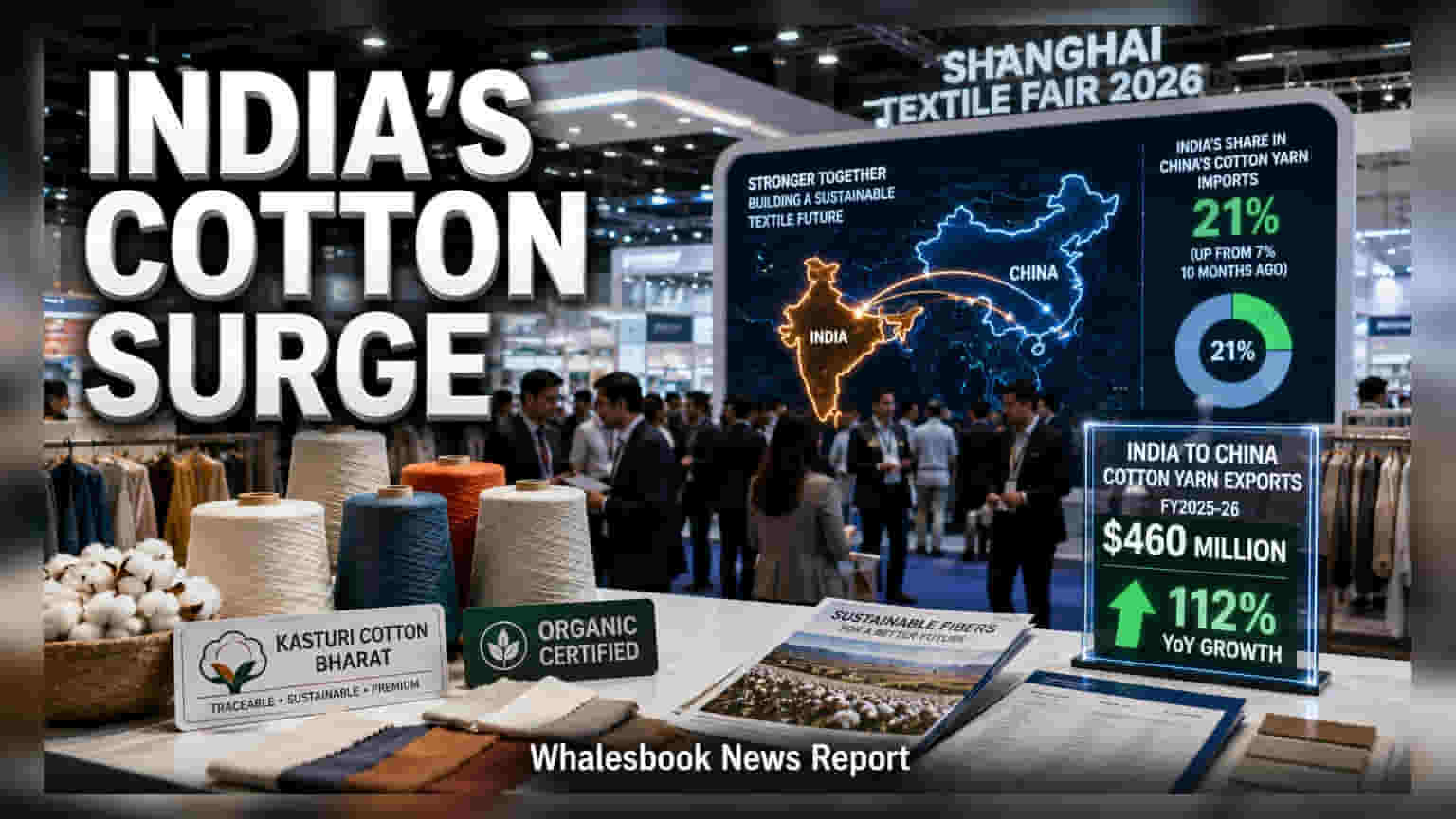
Indian cotton yarn manufacturers are regaining ground in China as changing fibre and currency economics restore competitiveness of domestic spinning mills. Cotton yarn shipments from India to China touched $460 million in FY2025-26, more than double from $217 million a year earlier, a 112 per cent increase.
The sharp recovery comes after a period in which Indian spinners struggled to compete in China because of higher raw cotton costs, weaker yarn realisations and subdued downstream demand. The latest reversal signals that price arbitrage is once again influencing sourcing decisions among Chinese fabric and garment manufacturers.
China has consequently become an important buffer for Indian spinning mills amid weaker demand in several other export markets. India's overall cotton yarn exports fell around 2 per cent to $2.857 billion in FY2025-26 from $2.915 billion in the previous fiscal year. Yet shipments to China grew rapidly, increasing the country's contribution to India's total yarn exports to 13.51 per cent.
Table: India-China cotton trade indices
|
Trade indicator |
FY2024-25 |
FY2025-26 |
Analysis |
|
India Cotton Yarn Exports to China |
$217 mn |
$460 mn |
+112 per cent value expansion |
|
China Share in India's Total Yarn Exports |
7.4 per cent |
13.51 per cent |
Expanded by ~6.1 percentage points |
|
Total Indian Cotton Yarn Exports |
$2,915 mn |
$2,857 mn |
Down ~2 per cent on sluggish Western/SE Asian demand |
|
India Share in China's Yarn Imports |
7.00 per cent |
21.00 per cent |
Tripled in first 10 months of marketing year |
|
Historical China Peak Share (Decade Ago) |
30.0-40.0 per cent |
13.51 per cent |
Significant runway remaining for volume recovery |
Rupee adds to the edge
The revival has been supported by a combination of lower Indian yarn realisations and currency movements. USDA assessments of the global cotton market indicate that Indian cotton yarn exports to China tripled during the first 10 months of the marketing year, taking India's share of Chinese yarn imports from 7 per cent to 21 per cent. The significance of the increase extends beyond India's own export performance. It indicates that Chinese buyers are reassessing sourcing economics across Asian origins.
A weaker Indian rupee improved exporters' price competitiveness, while relatively lower domestic yarn prices reduced the landed cost for Chinese buyers. Together, these factors narrowed the cost differential between Indian supplies and alternative sources, creating an opportunity for Indian mills to capture orders that had previously moved to competing origins. As Sharad Khemka, MD, SP Group and member of the Cotton Textiles Export Promotion Council (TEXPROCIL) Committee of Administration points out China remains a critical buyer and processing hub for global textile supply chains. The strong presence of Indian exporters underlines our competitive positioning as a reliable supplier of high-quality, traceable, and eco-friendly cotton yarns and textile inputs on the global stage.
Room to rebuild
Despite the latest increase, India's position in China remains well below its historical peak. Around a decade ago, China accounted for between 30 per cent and 40 per cent of India's cotton yarn exports. The subsequent rise in Indian minimum support prices, fluctuations in raw cotton availability and the development of competing spinning capacities in Vietnam and Pakistan reduced India's dominance.
The current recovery therefore is more than a cyclical improvement. It also highlights the possibility of a broader restructuring of sourcing patterns if Indian mills can sustain their cost advantage. Competition, however, remains intense. Vietnam continues to command significant volumes in China's blended and open-end yarn segments, while Indian exporters have found stronger traction in carded yarns in the 8s-25s range and combed single yarns in the 25s-47s range. This product segmentation could prove important as Chinese manufacturers increasingly balance cost with quality, consistency and compliance requirements.
Traceability becomes critical
The competitive equation is also being reshaped by stringent traceability expectations from global brands. Chinese fabric and garment manufacturers supplying Western markets face growing pressure to demonstrate the provenance of textile inputs and maintain chain-of-custody documentation.
That trend creates an opening for Indian suppliers offering certified, traceable and value-added yarns. Combed, compact and sustainably produced cotton yarns can command greater relevance in procurement programmes where compliance is becoming as important as price. For Indian mills, the opportunity is therefore not limited to supplying commodity yarn at the lowest possible cost. Building credentials around traceability, sustainability and product consistency could help convert the current China rebound into longer-term market share.
Mills move up the value chain
India's large spinning base offers the capacity to support this shift. The sector operates over 50 million spindles and around 750,000 open-end rotors, producing over 3,400 million kg of cotton yarn annually. Mills are adjusting products towards premium combed and compact yarns, organic-certified cotton and other value-added categories. Initiatives such as Kasturi Cotton Bharat are also aimed at strengthening the identity, quality assurance and traceability of Indian cotton.
And as Khemka explains a major emphasis is on sustainable, traceable, and value-added cotton solutions, including initiatives like Kasturi Cotton Bharat. The current year 2026-27, is expected to further boost Indian cotton yarn demand in China.
With Indian cotton consumption expected to remain above 26 million bales, the challenge will be to maintain sufficient raw-material competitiveness while expanding higher-value yarn output. The China rebound shows that Indian yarn can regain international market share when fibre costs, currency movements and product positioning align. The next test for spinners will be turning a price-led recovery into a durable competitive advantage built on quality, traceability and value addition.