

The global apparel industry’s 2026 earnings cycle has exposed a growing divide between retailers that convert sales into returns and those still struggling with inventory, overheads and unclear brand positioning. Across roughly $1.9 trillion global apparel market, scale alone is no longer sufficient. The strongest operators are combining disciplined inventory management, lean selling and administrative costs (SG&A), and sharply defined value propositions. Retailers carrying heavier stock and cost structures are increasingly relying on markdowns and turnaround programmes to defend margins. The contrast is visible across the latest trailing-twelve-month (TTM) financials.
Table: Global apparel retailer’s financial performance
|
Company |
Revenue ($bn) |
YoY growth in % |
Gross margin in % |
SG&A/ sales % |
EBIT margin % |
Inventory /sales in % |
Per cent online share |
ROIC in % |
|
Inditex |
47.1 |
+6.0 |
56.4 |
28 |
20.1 |
9.20 |
27 |
46.2 |
|
Fast Retailing |
24.4 |
+14.8 |
54.7 |
36.5 |
18.5 |
12.9 |
15-20* |
37.5 |
|
H&M Group |
22.3 |
-4.50 |
54.4 |
45.5 |
8.9 |
17.8 |
30 |
18 |
|
Gap Inc. |
15.3 |
+1.1 |
40.5 |
33.9 |
6.2 |
15 |
39 |
10.1 |
|
Next |
9.6 |
+4.4 |
44.1 |
25.3 |
18.6 |
15.1 |
68 |
28.6 |
|
LPP S.A. |
6.5 |
+15.2 |
57.5 |
40.1 |
12.8 |
21.4 |
28 |
17.6 |
*Estimated. Sources: group interim reports, TTM disclosures, StockAnalysis.com and CompaniesMarketCap.com.
Returns follow discipline
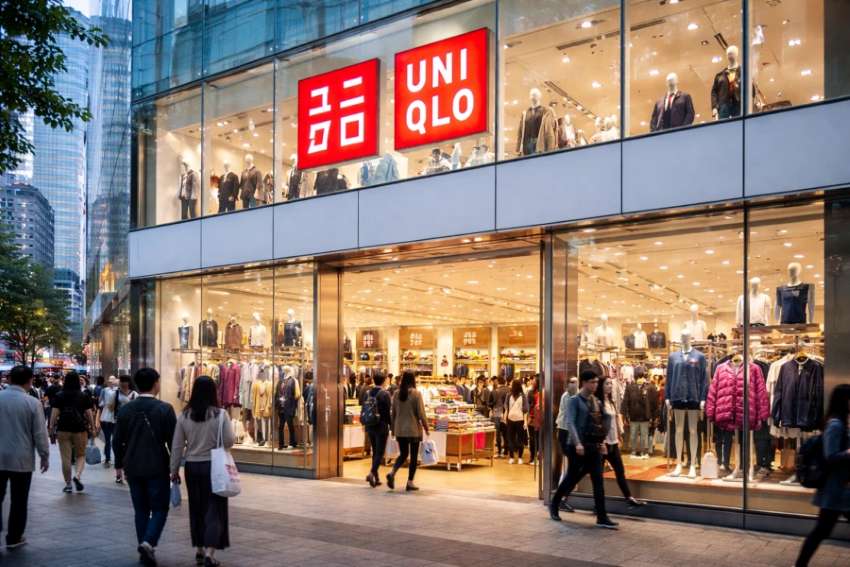
Inditex remains the benchmark for capital efficiency. Its $47.1 billion revenue base combines a 20.1 per cent EBIT margin with a 46.2 per cent ROIC. Its 9.2 per cent inventory-to-sales ratio also shows the financial benefit of a responsive supply chain. Fast Retailing is growing faster, with revenue up 14.8 per cent to $24.4 billion, while maintaining an 18.5 per cent EBIT margin and 37.5 per cent ROIC. Uniqlo LifeWear proposition gives the group a clear functional identity that travels across markets.
Next offers another model. Revenue reached $9.6 billion, but its 18.6 per cent EBIT margin is supported by an industry-leading 25.3 per cent SG&A ratio and a digital channel contributing 68 per cent of sales. Its technology and logistics platform allows it to extract greater productivity without relying exclusively on store expansion. LPP is the fastest-growing company in the peer group, with revenue up 15.2 per cent. But its 21.4 per cent inventory-to-sales ratio illustrates the working-capital cost of rapid physical expansion.
At the other end, H&M's 45.5 per cent SG&A burden leaves little room between gross margin and operating profit. Revenue declined 4.5 per cent, while EBIT margin fell to 8.9 per cent. Gap is more stable, but its 6.2 per cent EBIT margin and 15 per cent inventory ratio similarly demonstrate the challenge facing mature operators.
Overheads become the battleground
The numbers reveal that gross margin alone does not determine profits. Several European groups operate with gross margins above 54 per cent, yet their operating outcomes vary dramatically. Inditex and Next convert those margins into roughly 19-20 per cent EBIT because overhead remains tightly controlled. H&M, despite a comparable 54.4 per cent gross margin, converts it into less than 9 per cent operating profit. The difference is structural rather than cosmetic. Higher SG&A absorbs the benefit of full-price selling, while excess inventory forces additional markdowns and ties up capital.
This also highlights the vulnerability of ultra-fast digital models. SHEIN's estimated $41 billion revenue demonstrates extraordinary scale, but its roughly 2.7 per cent EBIT margin leaves limited protection against higher customs costs, regulatory scrutiny and rising digital customer-acquisition expenses.
Primark has the opposite equation. With approximately $12.9 billion in revenue and an 11 per cent EBIT margin, it continues to defend a sharply defined value proposition through physical retail while selectively testing digital capabilities.
Growth requires a clear proposition
The leading groups are also redirecting capital toward businesses with identifiable growth corridors. Inditex is looking beyond a mature Zara base by scaling Massimo Dutti, Bershka and Stradivarius. Its tightly integrated sourcing network enables smaller initial production runs and faster replenishment, helping minimise markdown exposure. The challenge is scaling secondary brands without weakening group-level economics.
Fast Retailing is taking a more functional route, using Uniqlo LifeWear as the driver for expansion across North America and Europe. The strategy benefits from demand for durable, everyday apparel, but Theory requires restructuring while GU faces the harder task of establishing itself outside Asian markets.
Next is pushing beyond conventional retail through its Total Platform, providing logistics, payments and e-commerce infrastructure to third-party brands. This creates a higher-margin services layer without proportionate store investment. LPP is pursuing a contrasting physical-growth strategy through Sinsay, its value-led concept. The approach is generating rapid growth but has increased inventory intensity and exposure to Central and Eastern European markets.
2027 tests the balance sheet
As retailers prepare 2027 budgets, capital allocation is shifting from indiscriminate store growth towards supply-chain flexibility, technology and working-capital productivity. Regulation will reinforce that shift. European requirements around unsold goods, product traceability and Digital Product Passports, alongside tighter customs scrutiny in major markets, will make slow-moving inventory increasingly expensive to hold.
The emerging lesson from 2026 earnings is therefore straightforward: growth without inventory discipline destroys returns; gross margin without overhead control does not translate into profit; and scale without a distinctive value proposition offers limited protection. The winners are increasingly those that can align product, supply chain, technology and capital with what the customer actually values.