
India is encouraging silk production in the Northeast. Projects worth Rs 690 crores are being implemented in the Northeastern states. Out of these, six are in Assam, one in Sikkim, two each in Meghalaya and Manipur and the rest in other states. The scheme is aimed at a holistic development of sericulture in all its spheres from plantation development to production of fabrics with value addition at every stage of the production chain.
The scheme is being implemented under two broad categories: Integrated Sericulture Development Project; and the Intensive Bivoltine Sericulture Development Project covering mulberry, eri and muga.
All four commercially exploited varieties of silk — mulberry, muga, eri and tasar — are produced in the north east and this region contributes about 21 per cent of the total silk production in the country. The mulberry farms in Meghalaya are almost a 100 years old, first set up by the British in 1925. Three districts in Meghalaya have been identified and an intensive awareness campaign will be launched to help draw back silkworm farmers to the trade. The British had identified Shillong as a center for rearing silkworms. So a Rs 29 crore project in mulberry production will be implemented.

- 1
- 2
- 3
- 4
- 5
- 6
- 7
- 8
- 9
- 10
Denim mills diversify into hemp blends to cut cotton dependence
Commercial textile mills are expanding hemp-cotton fabric portfolios beyond niche sustainable collections, developing blends for mainstream denim, stretch trousers, lightweight... Read more
Industrial Giants and Composite Specialists Sweep MATEXIL Export Awards: Driving…
Indian synthetic and technical textile exporters captured international market share across high-value fibre, filament, blended yarn, and engineered fabric categories,... Read more
Upstream Scale and Advanced Materials: Reliance Industries anchors India’s polye…
At a transformational moment when the Indian textile sector is targeting an aggressive expansion to 350 billion dollars in total... Read more
Resilience Under Pressure: Bhadresh Dodhia on how Indian textile exporters navig…
Global textile exporting is not an enterprise for the faint-hearted. Facing relentless volatility in raw material pricing, demands from international... Read more
Regulatory Modernization and Mandatory Digital Governance: Textile Commissioner …
India’s textile and apparel sector, an ecosystem sustaining more than 50 million livelihoods, stands at an operational turning point driven... Read more
Scaling India's Manmade Fibre Base to 18 Million Tonnes: MATEXIL outlines road t…
India stands before a decisive commercial inflection point in its global textile positioning, holding massive upstream manufacturing volumes while capturing... Read more
Global Economic Diplomacy and Relaxed PLI Thresholds: Minister Pabitra Margherit…
India’s textile sector is undergoing a structural repositioning on the world stage, combining bilateral free trade negotiations, aggressive economic diplomacy,... Read more
Export ambition and policy realignment anchor MATEXIL Export Awards in Mumbai
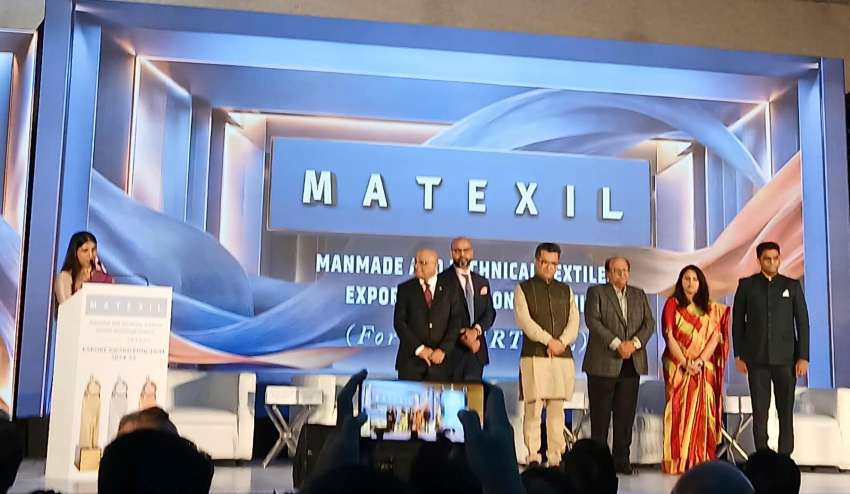
The Manmade and Technical Textiles Export Promotion Council convened the MATEXIL Export Award Function in Mumbai on 31 October 2026,... Read more
Sweat-masking yarns, circular fibres shape activewear’s next phase
The global activewear market, valued at almost $458 billion in 2026 and projected to be over $850 billion in the... Read more
Recycled Denim: The missing link between waste collection and yarn production
The Dutch Denim Deal’s industrial trials have highlighted a persistent challenge in textile circularity: mechanically recycled post-consumer cotton can be... Read more