The global textile industry is moving at breakneck speed, and the clearest sign of that acceleration came straight from the floors of Intertextile Shanghai Apparel Fabrics Autumn 2026. The next big shakeup in clothing is not some futuristic, niche category. Instead, it is the quiet, rapid transformation of everyday clothes into garments that handle sweat, heat, and movement just like high-end running gear.
Held at the National Exhibition and Convention Center in Shanghai, Intertextile stands as one of the largest and most influential sourcing platforms in the world. Each season, tens of thousands of global mills, yarn makers, designers, and brand buyers gather to negotiate deals and set the commercial direction for the seasons ahead. This autumn, the trade fair made one thing obvious: the athletic look might come and go, but athletic performance has officially moved into the everyday wardrobe.
Tearing down the sportswear boundary
For years, sportswear brands taught shoppers to appreciate a bit of stretch, quick-drying threads, and fabric that breathes on a hot day. Now, people want those exact perks in their office chinos, casual shirts, and weekend jackets. The old line separating specialist gear from daily clothing no longer makes sense. A commuter might not read the technical tag on a button-down shirt, but they certainly notice if it stays cool on a crowded train, shrugs off wrinkles, and holds its shape after dozens of trips through the laundry.
Because the technology is essentially invisible, it is finally ready for the mass market. At Intertextile, suppliers focused heavily on pairing soft, natural textures with serious technical chops. With warmer city summers and busy days on the move, climate adaptability is no longer just for trail runners or mountaineers. It is for anyone walking down the street, and shoppers do not need to understand polymer chemistry to enjoy the comfort.
The fair's Climate-adaptive Textiles programme put a sharper definition around this shift, grouping developments around thermal regulation, comfort and sustainability, and moisture management. HKRITA, for example, presented a passive-cooling textile approach designed to deliver eco-performance without relying on energy-intensive active cooling. Its workwear-oriented Multimode Anti-heating Green Uniforms also showed how heat-management technology is moving into everyday occupational clothing rather than remaining confined to sports.
Building function into the fibre
The race to upgrade basic clothing is happening right at the start of the production line. Over at the co-located Yarn Expo Autumn, more than 260 exhibitors filled the Chemical Fibre Zone to show off new synthetic, bio-based, and recycled materials.
Rather than relying on chemical coatings that wash out over time, manufacturers are building performance straight into the raw yarn. Toray put the spotlight on plant-based polyesters and synthetics that transition smoothly from outdoor trails to city streets. Huafeng rolled out versatile spandex options, offering stretch yarns that are bio-based, recycled, chlorine-resistant, and treated for daily hygiene. By tackling performance at the molecular level, these makers give clothing brands the freedom to add sweat-wicking or stretch without ruining the natural touch or drape of a classic cotton or wool blend.
A different route was visible in nylon. Prutex Nylon, working with INVISTA, used its 66 Inspiration Hub to bring together partners across the Nylon 6,6 chain, presenting functional yarns, sustainable solutions and finished fabric applications in one setting. Its PRUTAC high-performance Nylon 66 was positioned for premium activewear and next-to-skin applications, demonstrating how a yarn-level material decision can be carried directly into a fabric and end-use proposition.
That upstream-to-downstream connection is significant. The innovation is no longer simply “a better yarn”; it is a material platform that can be adjusted for a particular use, with the fabric application visible almost immediately to the buyer.
Why the entire supply chain moves faster in China
Speed is the main reason this transition is happening now rather than a decade down the road. China’s textile advantage goes well beyond sheer factory size; it lies in how close every link of the supply chain sits to the next. Fiber producers, spinning mills, weavers, dyers, and garment factories often operate just hours apart, allowing fresh ideas to jump from the lab to store shelves in record time.
“China serves as an ideal testing ground for fresh ideas”, echoed by many of the experts; with new product rollouts routinely finding their footing there first. The tight, agile network lets teams turn a brand-new fiber concept into a finished garment ready for retail in just a few months. When the goal is to make high-tech fabrics affordable for the masses, that kind of turnaround time is everything.
The Prutex–INVISTA 66 Inspiration Hub offered a practical demonstration of this network effect: instead of presenting Nylon 6,6 only as a fibre specification, the partners assembled yarn, fabric and application possibilities together for buyers. Similarly, the Yarn Expo programme placed fibre innovators close to downstream fabric and apparel businesses, while the four concurrent exhibitions—Yarn Expo, Intertextile, CHIC and PH Value—put fibre, yarn, fabric, apparel and knitwear sourcing under one roof.
That proximity matters particularly when a performance requirement needs several suppliers to adjust simultaneously. A fibre producer can modify the material, a yarn maker can adapt the construction and a fabric mill can test the resulting hand-feel and performance without sending the development process around the world.
The quiet advantage of ‘Everyday Clothes’
As functional fabrics become easier and cheaper to make, they stop being a luxury add-on. Just look at stretch denim: what was once an expensive novelty is now an absolute baseline. The exact same shift is happening right now with moisture control, stain resistance, and UV blocking.
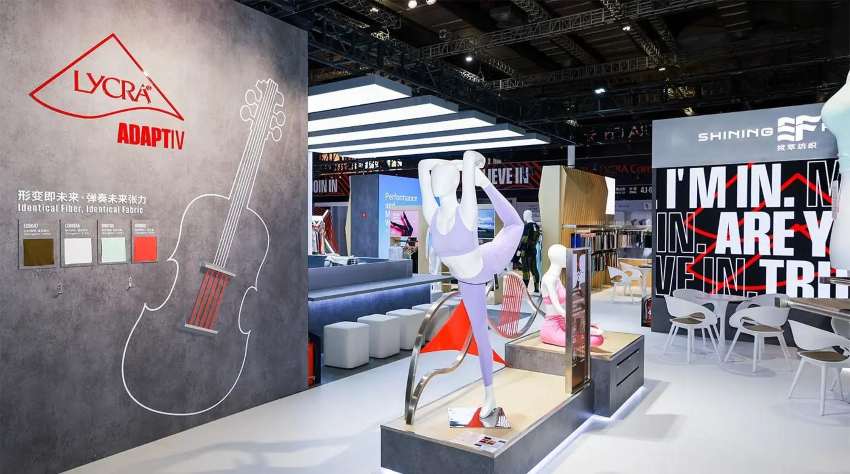
One of the clearest examples came from The LYCRA Company, which presented three technologies at Shanghai that deliberately blur the boundary between performance apparel and ordinary clothing. LYCRA FiT400 fibre offers stretch and cooling without conventional spandex; COOLMAX CloakFX, made from recycled polyester, is designed to manage moisture while reducing the visible appearance of sweat; and Renewable LYCRA fibre contains 70% plant-based content. The company showed these technologies across different garment types rather than restricting them to specialist sportswear.
The COOLMAX example is particularly telling because the consumer benefit is deliberately mundane: less visible sweat on a garment. It is not about looking like an athlete. It is about making an ordinary shirt or woven garment work better during an ordinary day. The technology is essentially hidden once it reaches the wardrobe.
The smartest brands are no longer trying to make clothing that screams "high-tech." The real winners will be the regular-looking cotton shirts that keep you dry, the tailored trousers that bend without bagging at the knees, and the light jackets that take the bite out of shifting weather. The shopper simply sees an easy, reliable piece of clothing; the mill sees a carefully engineered textile. Intertextile proved that performance is no longer an upgrade, it is simply how everyday clothes are going to be made from here on out.