India’s domestic retail landscape is experiencing an unprecedented boom. Fuelled by a massive consumer base, rising disposable incomes, and rapid retail expansion, the domestic textile and apparel market is rapidly surging toward $190 billion. Yet, behind this success lies a glaring structural contradiction.
Inside the strategy sessions at the Bharat Tex Roundtable, Giriraj Singh, Minister of Textiles and all trade stakeholders ; experts and government officials confronted a persistent paradox: while India's domestic consumption breaks records, its global textile export footprint remains largely stagnant. For many Indian textile majors, the booming domestic market has become a comfortable cushion, a "domestic comfort trap" that disincentivizes manufacturers from taking on the rigorous demands of global trade.
The Compliance-Free Luxury: Why domestic margins outshine exports
During the roundtable deliberations, speakers highlighted why so many domestic manufacturers prefer serving the local market over chasing international orders. Selling domestically offers solid profit margins without the intense friction, high overheads, and stringent audit standards associated with Western export markets.
Exporting to North America or Europe requires navigating complex regulatory frameworks—such as zero-liquid discharge requirements, strict chemical safety standards, carbon tracking, and full supply chain traceability. In contrast, domestic retail allows manufacturers to enjoy rapid scale without facing maritime container shortages, complex export logistics, or punitive buyer compliance audits.
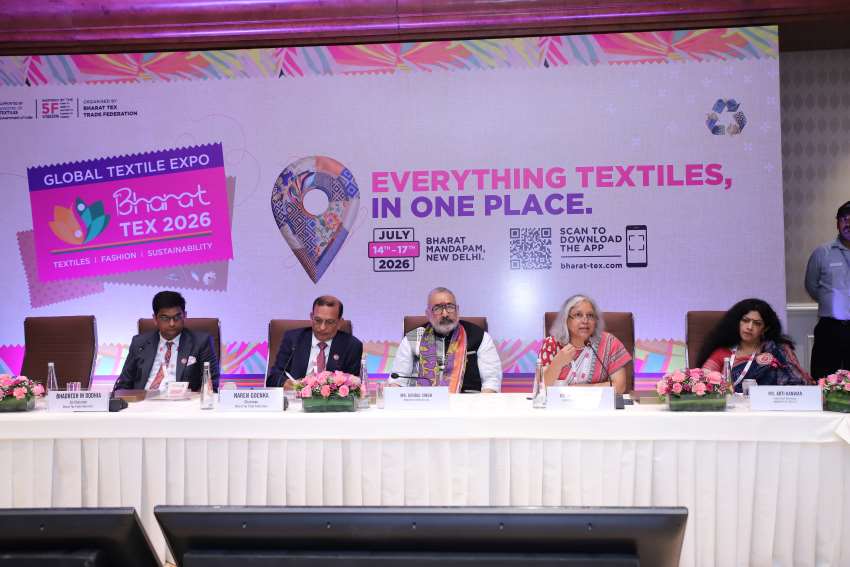
"Look at the domestic market, it used to be $138 billion, and today we are reaching nearly $190 billion. People think, 'Containers are not required here, compliance doesn't need to be met here, why get caught up in foreign buyers ?Forget it!'", Giriraj Singh, Minister of Textiles, Government of India said, quoting industry sentiment.
This reluctance to face export compliance has created a growth ceiling. While domestic demand provides immediate financial stability, relying on it exclusively prevents Indian companies from building the scale and operational discipline needed to dominate global supply chains.
The $300 Billion Opportunity: Unlocking the FTA advantage
While domestic manufacturers stay focused on local retail, India’s trade negotiators have been aggressively opening doors worldwide. The roundtable emphasized that India stands at the edge of a massive trade opportunity, backed by recently signed and upcoming Free Trade Agreements (FTAs) across major global economies.
Trade officials pointed out that opening preferential trade pathways with the UK, UAE, Australia, New Zealand, and ongoing negotiations with major Western markets unlocks a combined $300 billion market opportunity. This presents a 10x growth horizon compared to India's current export figures.
However, free trade deals do not guarantee automatic market share. As trade leaders noted during the session, FTAs merely provide a ticket to the game; capturing real market share requires Indian manufacturers to step up, diversify their product offerings into synthetic/MMF garments, and meet global compliance standards.
"If you put them all together, Europe alone is a $200 billion market across 27 countries. The UK... is a $20–25 billion market. If you add the UAE, Oman, New Zealand, Australia... put it all together, it becomes a $300 billion market opportunity; as somebody said, it is a free market, not a free pass. So we need to diversify.", elaborated, Anil Kumar Sagar, Special Secretary, Government of Uttar Pradesh
From Contract Fabrication to Global Brands: The ministerial mandate
Unlocking this global potential requires a fundamental shift in mindset. Closing the roundtable, Union Textile Minister Giriraj Singh delivered a clear mandate to industry leaders: Indian textile companies must graduate from being passive third-party contract manufacturers and start building homegrown, globally competitive fashion brands.
Relying solely on job-work garment fabrication for foreign labels leaves Indian suppliers vulnerable to global price wars and razor-thin margins. To capture true value, Indian majors must invest in original design, advanced technical innovation, and global distribution networks.
"Aggressively, you too will have to step up a bit, along with the government.Sure, you do fabrication, but we also have to build 'Brand India'. That is my request as well; if we are progressive and aggressive, no force in the world can stop us." says Giriraj Singh emphatically.
Escaping the cushion to lead global trade
The domestic market will always remain a vital pillar of strength for Indian textiles. However, treating it as a safe haven from global competition risks leaving India behind as international trade realigns. By pairing domestic strength with aggressive global ambition, advanced compliance, and homegrown brand building, Indian textile majors can break out of the comfort trap and claim their space as global industry leaders.