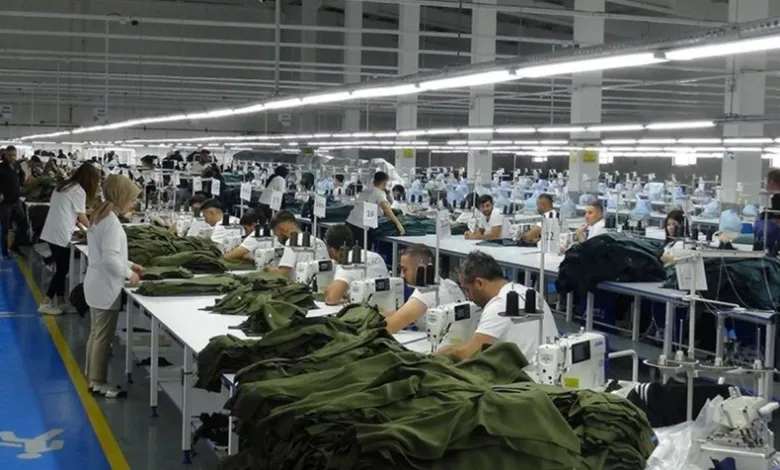
The suspension of production at Orta Anadolu’s spinning and weaving complex in Kayseri in mid-September, followed by its scheduled permanent closure by mid-October, is a stark signal of the pressure reshaping Turkiye’s textile industry. The 73-year-old manufacturer, once a technical backbone of Europe’s premium denim supply chain with customers including Levi Strauss and Inditex, is becoming emblematic of a broader industrial retreat.
More than 2,100 textile and apparel companies have reportedly closed in Turkiye over the past 18 months, while sector employment has fallen below 910,000. The pressure is structural rather than cyclical. Triple-digit inflation, repeated statutory minimum-wage increases and industrial electricity and natural-gas costs have pushed Turkish manufacturing overhead sharply above those of several competing Mediterranean and Asian locations.
With the Turkish lira no longer offering exporters with the same depreciation cushion against rising domestic costs, manufacturers are unable to absorb price reductions demanded by international buyers. The result is reworking of sourcing where European procurement teams are moving volume programmes offshore while retaining Turkiye for products where speed, technical capability and proximity justify a premium.
Cost gap widens
The emerging sourcing equation is defined by the gap between manufacturing cost and market access.
Table: Global textile & garment sourcing hub comparison
|
Sourcing hub |
Average monthly manufacturing wage |
Industrial energy cost index (Turkey = 100) |
Transit time to western Europe |
Leading segment gains |
Primary trade frameworks |
|
Turkiye |
$750-850 |
100 |
3-5 days (Road/Ro-Ro) |
High-end denim, technical textiles |
EU Customs Union |
|
Egypt |
$150-220 |
35-40 |
4-6 days (Sea) |
Denim, basic jersey, cotton yarn |
Agadir Agreement, US QIZ |
|
Morocco |
$280-340 |
75-80 |
2-4 days (Short-sea) |
Fast-fashion knits, tailored separates |
EU Association Agreement |
|
Pakistan |
$120-160 |
50-55 |
18-22 days (Sea) |
Terry towels, bed linen, carded yarn |
EU GSP+ Status |
|
Bangladesh |
$110-140 |
45-50 |
25-30 days (Sea) |
Mass-market knits, circular T-shirts |
EU EBA Scheme |
This difference explains why the disruption is spreading beyond premium denim into towels, bed linen, jersey, yarn and synthetic fabrics. In Denizli, Turkey’s home-textile centre, towel and bedding producers are reportedly operating looms below 65 per cent capacity as buyers redirect baseline programmes towards lower-cost suppliers in Pakistan and India.
Pakistan is gaining volume in sheets and bathrobes, supported by its low labour costs, domestic cotton availability and EU GSP+ access. Basic yarn shipments from distressed regional spinning facilities have surged, while Bangladesh is absorbing more long-lead basic knitwear and T-shirt programmes.
Egypt moves ahead
Egypt is emerging as the clearest beneficiary of Turkiye’s loss of cost competitiveness. Industrial energy costs are estimated at only 35-40 per cent of the Turkish index, while manufacturing wages remain a fraction of Turkish levels. Its Mediterranean location also gives European buyers a relatively short maritime connection.
Egypt’s appeal is strengthened by its trade pattern. The Agadir framework and QIZ arrangements gives preferential access to major markets, supporting an integrated proposition across spinning, weaving, garment manufacturing and finishing. The shift is already visible in trade flows. Turkish woven-fabric exports into Alexandria and Damietta have grown 68.5 per cent, indicating that the two countries are not simply competing for finished-goods orders. Turkish companies are supplying intermediate materials to production platforms in Egypt that can manufacture finished products more competitively.
Morocco and Tunisia are capturing another layer of the business: rapid fashion replenishment. Spanish and French brands seeking short production cycles are allocating capacity around Tangier and Casablanca, where proximity to European distribution networks remains a strategic advantage.
Capital follows the order book
The geographical shift is also visible in corporate investment decisions. Turkish manufacturing group Şık Makas, a major European denim supplier and operator of the Cross Jeans brand, has curtailed domestic shifts and reportedly cut nearly 1,000 jobs at its Tokat complex after margins turned negative. At the same time, the group has strengthened investments in Egypt, where it operates washing, cutting and stitching facilities.
Other Turkish groups, including Eroğlu Holding and Taypa, have followed similar strategies through integrated operations in Ismailia and 10th of Ramadan City. The objective is not necessarily to abandon Turkish manufacturing altogether, but to preserve relationships with global retail customers by moving cost-sensitive production closer to competitive manufacturing ecosystems.
Ramazan Kaya, President, Turkish Clothing Manufacturers’ Association, has said overseas brands are seeking discounts of 20-25 per cent, which most Turkish mills struggle to accommodate. The result is a striking form of capital shift: Turkish companies are investing in North African capacity to protect European customer relationships.
Speed still protects Turkiye
Turkiye retains one important advantage. Its clusters in Bursa, Çorlu and Kahramanmaraş combine spinning, weaving, dyeing, wet processing, product development and logistics within tightly connected industrial systems. Road and Ro-Ro links can put Turkish goods into Western Europe within three to five days, a proposition that remains difficult for South Asian suppliers to replicate. That advantage, however, is becoming concentrated in higher-value and time-sensitive categories. For basic commodities, the cost differential is increasingly too wide to ignore.
Egypt still depends on imported specialty yarns, elastanes and finishing chemicals, while customs clearance and maritime schedules can introduce variability. South Asian suppliers face even longer transit cycles. Yet European sourcing offices appear willing to manage this issue through dedicated quality, compliance and vendor-management teams.
The significance of Turkiye’s textile decline therefore extends beyond the closure of individual mills. It is leading to a re-segmentation of the Mediterranean-European supply chain. North Africa is gaining programmes that require competitive manufacturing combined with relatively short European transit times, while Pakistan and Bangladesh are capturing labour-intensive, volume-oriented categories. Turkiye, meanwhile, is being pushed towards segments where its technical expertise, integrated supply base and speed can command a premium.
For European buyers, the emerging strategy is less about replacing one country with another than building a multi-country sourcing. The Turkish shakeout is consequently turning Egypt, Morocco and South Asia from alternative suppliers into permanent components of the European textile and apparel supply chain.