FW
Indonesian batik clothing and fabrics on display at ATF 2019
The Apparel Textile and Footwear (ATF) 2019 trade exhibition featured several Indonesian batik clothing and fabrics. The exhibition was held from June 12-14, 2019 at the International Convention Center in Cape Town, South Africa.
The Indonesian Embassy in Pretoria, Indonesian Consulate General in Cape Town, and the Indonesian Trade Promotion Center (ITPC) in Johannesburg collaborated at the exhibition to popularise and market batik in a more systematic way in African markets.
The second day of the exhibited included a Wastra Nusantara” sequence at the fashion show which featured the latest collection of batik designers and entrepreneurs from Lampung, Pekalongan, and Bandung.
Batik Siger, a brand with experience in showcasing its collections in various countries, presented clothing lines for men and women, with a typical Siger style of Lampung Province, at this exhibition.
Lovely Zia from Bandung displayed contemporary batik clothing, including patchwork skirts, shirts, dresses, and outer wear for both genders. Aruni Batik Pekalongan showcased batik clothing for men and batik fabric, while Annie.B Cape Town featured Balinese fabrics, silver jewelry, accessories, and rattan bags.
ATF is the largest annual exhibition of textiles, apparel, and footwear in Africa, which annually attracts some two thousand visitors and at least 500 exhibitors from various countries.
Lifestyle International launches the tween lines in India
The Dubai-based business Landmark Group’s fashion arm Lifestyle International, recently introduced the tween lines at its stores in the country. The range includes clothing lines from international brands such as Kappa and Bossini that target a tween audience aged between nine and 15 years.
Lifestyle recently also held an interactive grooming workshop in Mumbai on June 15 with celebrity stylist Apeni George who gave a talk on fashion styling and the industry. The group also collaborated with George’s male grooming brand The Man Company for the event and held a special display of its products. As Virat Kohli’s hair stylist, George gave celebrity hair styling tips to the audience and promoted Lifestyle.
This year, Landmark Group celebrates its 20th anniversary in April 2019. The completed 20 years in the international clothing industry and celebrated this achievement on the social media.
Intertextile Shanghai Home Textiles to focus on finished products
Intertextile Shanghai Home Textiles – Autumn Edition will feature over 1,000 exhibitors of finished products from around 25 countries and regions. The exhibition will held from August 28-31, 2019 at Shanghai. It will be organised by Messe Frankfurt (HK); the Sub-Council of Textile Industry, CCPIT; and the China Home Textile Association (CHTA).
The finished product zone will feature more sourcing options in 2019, including a number of international suppliers including Fossflakes (Denmark), Fujishinkou (Japan), Jaspa Herington (Australia), and Naturtex (Hungary). Fossflakes’ product is composed of 100 per cent extended polyethylene polymers and is therefore naturally hypoallergenic, which makes it a suitable filling material for allergy and asthma sufferers. Fujishinkou, focuses on manufacturing down comforter, partner with farms in Hungary and Poland to use high quality down. Jaspa Herington’s product catalogue covers a large variety of pillows, quilts, protectors, and foam and wool underlays. They also provide products especially designed for allergy sufferers, and therapeutic use.
Solutions for the contract business and whole-home sectors will also be a major attraction at the fair. While Intertextile Shanghai’s product offerings cover all sourcing needs – bed and bath, decorative, upholstery and window treatment fabrics, carpet and rugs, wall and interior decorations, editors, whole-home solutions, design studios and digital printing technology – it is finished products that are seeing the most growth this year.
Luxury brands increase social media budgets
Luxury brands like Gucci, Louis Vuitton and Christian Dior are targeting social media platforms like Instagram for advertising their collections. Brands like LVMH and Kerings are increasing their advertising budgets for the social media. Kering spent almost half of its revenue on digital advertisement in 2018, a 20 per cent increase from that spent in the last three years.
Kering’s rival LVMH also increased its expenditure on marketing in 2018 to 5.6 billion euros, reaching 12 per cent of group revenues — more than most brands that disclose this budget and topped only by another big online trendsetter, privately-owned Chanel.
Louis Vuitton allocates half its marketing costs to digital media. Italian shoemaker Tod's is also among a clutch of brands that invests in social media in a bid to revive its sales. The brand including LVMH's Christian Dior, Marc Jacobs and Givenchy labels were among Tribe Dynamics' top 10 brands listed last year, with Kering's Saint Laurent and Balenciaga also featuring on the list. The list quantifies the total value of this social media buzz on a brand’s performance.
Inditex reports 10% increase in Q1 profit
Inditex recently reported a 10 per cent rise in its first-quarter profit, as foreign currency effects moved back in its favor after two years. The company is currently under pressure to deliver strong like-for-like sales without the margin dilution that has affected others in the apparel sector, plagued by out-of-season sales as shoppers wait for discounts or hunt for bargains online.
The world's biggest clothing retailer reported net profit of 734 million euros ($832 million) for the three months from February 1 to April 30, 2019. Its sales increased by 5 per cent to 5.93 billion euros. Sales at constant exchange rates for the first six weeks of the second quarter increased by 9.5 per cent as shoppers snapped up items like jewel-toned blazers and long printed dresses from Zara's spring collections. Its sales growth however, was lower than that expected by analysts due to adverse weather conditions in the latter part of the period when it was wet and cold across much of southern Europe.
Inditex maintained its full-year guidance of 4-6 per cent growth for like-for-like sales. RBC Capital Markets estimated it had booked like-for-like currencies of around 6.5 per cent during the first weeks of the second quarter, against around 2 per cent in the first quarter.
Inditex generates over half of its sales in other currencies that have to be converted back into euros for the financial report. Those currencies have strengthened slightly against the euro compared to a year ago, on average, helping reported sales.
Hanes tees feature US parks
HanesBrands has issued a line of T-shirts celebrating national parks in the US.
These are Acadia National Park, Blue Ridge Parkway, Grand Canyon National Park, Grand Teton National Park, Great Smoky Mountains National Park, Olympic National Park, Rocky Mountain National Park, Yosemite National Park and Zion National Park. These t-shirts will be sold at Walmart stores near nine of the country’s most beautiful and recognised landmarks. Each store will carry one design to promote its regional recreation area.
The crewneck T-shirts are made with 100 per cent American-grown, ring-spun cotton from US farms – among the most environmentally sustainable cotton grown in the world. The T-shirts are garment dyed, ultra soft and have a vintage, lived-in look.
HanesBrands is a socially responsible manufacturer and marketer of leading everyday basic apparel under some of the world’s strongest apparel brands in the Americas, Europe, Australia and the Asia-Pacific including Hanes, Champion, Bonds, Maidenform, DIM, Bali, Playtex, Bras N Things, Nur Die/Nur Der, Alternative, L’eggs, JMS/Just My Size, Lovable, Wonderbra, Berlei, and Gear for Sports. Hanes’ commitment to comfort goes far beyond clothing. It is committed to being an apparel industry leader in environmental stewardship and social responsibility. Through this partnership it is focused on inspiring more people to embrace, visit, support and protect national park treasures.
New process by Lectra wins Texprocess Innovation Award 2019
Lectra has been awarded by a jury of experts the Texprocess Innovation Award 2019 in the New Process category for its latest ground-breaking offer, Fashion On Demand by Lectra.
Fashion on Demand by Lectra automates the entire personalisation process, from order reception and product development to the final cutting stages. Resulting from a four-year research-and-development process, the digital solution for on-demand production was developed based on Industry 4.0 principles.
Companies can define their desired product personalisation criteria for each item depending on the package, and launch production processes right from the get-go, without interfering with their standard workflows.
This innovative cloud-based platform solution ensures efficient made-to-measure and customisation production processes and facilitates nearshoring for companies that offer individualised products. This technology can be used by the fashion industry on a plug-and-play basis.
Herrero joins G-III
Victor Herrero is on the board of directors of G-III.
Herrero’s expertise has been developed by his diversified apparel and accessory experience in North America, Europe and Asia. He was chief executive officer and a director of Guess. He has spent more than 12 years at Inditex in several senior executive roles and rose to become the head of Asia Pacific where he was responsible for all aspects of Inditex’s Asia business for all brands. He has also been a non-executive director of Coppel.
G-III is known for its global power brands, DKNY, Donna Karan, Calvin Klein, Tommy Hilfiger, Karl Lagerfeld, Kenneth Cole, Cole Haan, Guess, Vince Camuto, Levi’s and Dockers. The company has been seeking to diversify its sourcing network by arranging to move some production out of China and has also succeeded in obtaining price concessions from its Chinese vendors. In addition, it has obtained price increases from some of its customers in the US. G-III estimates that the incremental 15 per cent increase in tariffs for the remainder of fiscal 2020 will increase its cost by approximately six million dollars. However the company has not factored any future increases in tariffs on additional goods imported from China into the US in its fiscal 2020 guidance.
Denims jeans ready to make a comeback with new styles
"Denim is set to get a boost as demand for athleisure clothing seems to have peaked. Now, companies are looking for newer options and resurrection of the good old jeans is most likely."
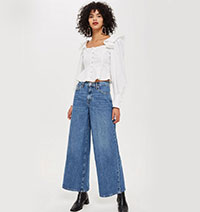 Denim is set to get a boost as demand for athleisure clothing seems to have peaked. Now, companies are looking for newer options and resurrection of the good old jeans is most likely.
Levi’s IPO marks a turnaround for jeans
For generations, no other clothing item represented the US better than jeans. However, the introduction of athleisure by Lululemon in 2007 turned the tide against denim as comfortable clothing gained popularity. Millennials, who became a bigger consumer force, emulated younger icons like Taylor Swift and Kim Kardashian by adopting the new athleisure look. During this period, sale of jeans in the US declined by 11 per cent while overall apparel sales rose 10 per cent.
However, now with the return of Levi Strauss to the public market, the tide seems to be turning in favour of denim again. Levi’s IPO launched in March 2019 was priced above expectations amid heavy demand. Even today, the brand’s market value is high and remains unlike other tech IPOs.
Global denim market to grow 11 per cent
Euromonitor projects US jeans revenue will grow by 5 per cent to $17.5 billion by 2023, with global market growing by 11 per cent to $111.6 billion. While there is a huge scope for the growth of athleisure, momentum may be shifting towards denim in the fashion industry. Denim brands Lee and Wrangler jeans are likely to make a comeback after their spinoff last month from VF Corp into the newly listed Kontoor Brands. The spinoff gives Kontoor a leadership team that's quicker to adapt to trends and more likely to experiment.
Emergence of new denim styles
As Robert Burke, CEO, Robert Burke Associations points out there are clear signs of a renewed for denim. However, consumers are not willing to wear the traditionally uncomfortable or restricting pair of jeans. They are adopting new dressing styles like pairing their denim with blazers.
The Euromonitor also predicts the US jeans revenue will grow by 5 per cent to $17.5 billion by 2023. Chip Bergh, CEO, Levi Strauss CEO terms the rise of athleisure in the fashion industry as being "throwdown moment," which inspired brands to make more comfortable jeans styles.
New fabrics being adopted
Their efforts are bearing fruit as after years of stagnation, denim brands are offering innovative fabrics that appeal more to shoppers used to the coziness of leggings. For instance, American Eagle is introducing more comfortable denim known as the American Eagle Ne(X)t level jeans, which provides a 360-degree stretch that lifts, shapes, supports and moves with you in every direction.
Besides natural, synthetic fibers like spandex adding to the comfort of the jeans making them more flexible, comfortable and durable American Eagle's online store even lets shoppers search for jeans by the level of stretch. Levi Strauss has attracted more women by investing in stretch fabrics as well. Ultimately, will established denim brands like Calvin Klein and Tommy Hilfiger survive the athleisure storm or will the skinny jeans go completely out of favor, remains to be seen.
Bliss Impex acquires four Durst Alpha systems
Bliss Impex, an international manufacturer of synthetic textiles, printing fabrics and apparel fabrics, has acquired four Durst Alpha systems – three Alpha 190 Reactive machines and one Durst Alpha 180 printer for polyester work.
These four Durst machines are a part of a €6 million investment in a temperature-controlled digital production center for the Bliss Impex Group, which employs 300 people and has a €17.5 million turnover.
Their cost-effective, proven digital technology enables industrial scale production of over 10,000,000 linear meters a month and is expected to replace Bliss Impex’s conventional textile printing set-up within three years. With virtually no wastage, no limitations to color configurations and GOTS-certified inks, Bliss Impex is confident of fast-tracking future growth through these machines. The Alphas use the Durst One-Step GOTS-certified reactive ink, which was specially developed for the Alpha Series of printers.
The Delhi-based company has pledged to invest in more systems from Durst, a manufacturer of advanced digital and production technology, in a seismic change to industrial digital textile production.
Durst is the first choice and a preferred partner for the transformation and digitisation of industrial production processes. Brand owners and designers are increasingly demanding that their orders be printed on the four Durst production systems to benefit from the fast turnaround requirements where orders can be processed and delivered within two days, instead of a previous typical 15-30 day cycle.