Global apparel trade is entering a more uneven recovery phase, with demand growth persisting but losing uniform momentum across major consumer markets. The latest ‘Monthly Global Apparel Consumption & Trade Update’ from Wazir Advisors shows cumulative monthly apparel imports across the US, UK and Japan rose 7 per cent year-on-year in February 2026, indicating resilience in consumption despite inflationary pressures.
Yet the data also signals fragmentation. The US has begun registering a marked pullback in apparel imports after an extended inventory restocking cycle, a warning for global sourcing markets given America’s central role in trade flows. In contrast, the UK and Japan are showing tentative recovery, though both remain vulnerable to cautious discretionary spending. This difference suggests the next growth phase will be less about synchronized demand rebounds and more about selective, market-led opportunities. For exporters, the implication is clear: growth may depend on positioning rather than volume increase.
India’s export recovery faces competition
Export indicators mirror this complexity. India’s apparel exports grew 4 per cent year-on-year in 2025, pointing to stabilization after prolonged volatility. But the number masks mounting competitive pressures. Increasing compliance costs, shifting buyer preferences and fluid sourcing decisions are reshaping supplier competitiveness. Buyers continue diversifying beyond concentrated sourcing models, but the benefits have not accrued evenly across production hubs.
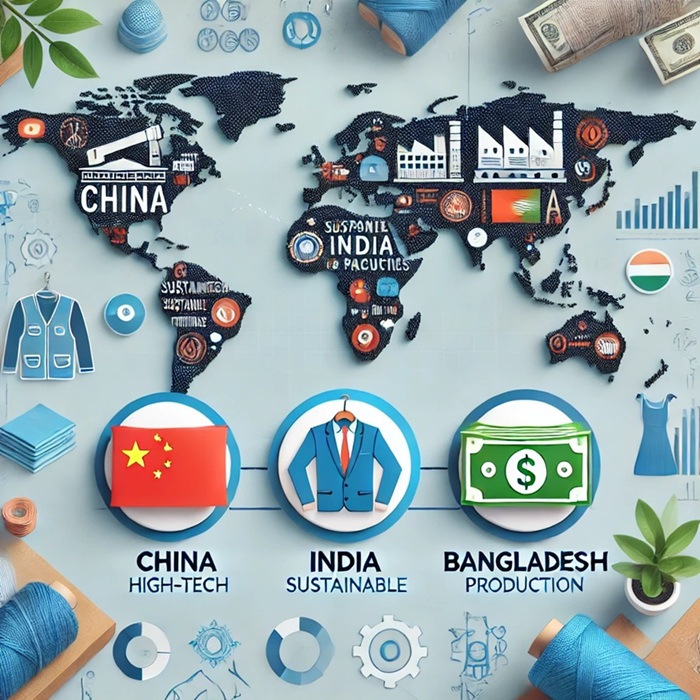
China’s apparel exports have weakened sharply amid shifting sourcing dynamics, yet the expected gains for India and Bangladesh have been moderated by lower order flows and margin pressures. This underscores that sourcing diversification is no longer a simple redistribution of volumes but a deeper structural contest built around agility, compliance and specialization. The 4 per cent export gain therefore, reflects resilience and reveals how difficult competitive gains have become in a slower-growth trade environment.
Contrasting patterns in UK’s apparel retail
One of the strongest indicators in the report is the 6 per cent increase in UK apparel store sales during January-December 2025, highlighting resilience in physical retail even as broader discretionary demand remains uneven. This reinforces a widening difference between channels. Brick-and-mortar apparel has benefited from experiential shopping and occasion-led demand, while e-commerce in several major markets remains under pressure from cautious consumer behavior and promotional intensity. That variance carries implications for sourcing and inventory planning. Categories linked to store-led growth may support shorter replenishment cycles, while weak digital demand may restrain broader volume commitments. Rather than a simple retail rebound, the 6 per cent growth points to a channel-specific recovery pattern now shaping demand signals globally.
Sourcing re-alignment redefines positioning
Supplier share trends point to a deeper sourcing reset. Post-tariff adjustments, geopolitical risk and resilience planning are boosting diversification strategies, but cost arbitrage alone is no longer enough. China’s export slowdown reflects both lower demand and shifts in sourcing. Yet alternative suppliers are not experiencing uniform windfalls. India and Bangladesh continue facing pressure from uneven order books and aggressive supplier competition.
This suggests sourcing re-alignment is becoming more sophisticated, rewarding suppliers that combine scale with flexibility, sustainability and speed rather than merely offering low costs. For exporters, competitive positioning is increasingly defined by response capability, not manufacturing volume alone.
Retail indicators reflect uneven recovery
The broader retail and macro indicators reinforce a selective recovery narrative. US and EU apparel e-commerce performance remains subdued, while business confidence signals across Europe continue to fluctuate. Similarly, lower US home furnishing sales, often a proxy for discretionary confidence indicate consumers remain cautious rather than expansionary. For apparel, that tends to favor value segments while keeping inventory commitments conservative.
Together, these indicators suggest uncertainty has not disappeared; it has become more fragmented. Recovery exists, but it is uneven across markets, channels and categories.
A shift from recovery to repositioning
The larger significance of the April market data lies in what it reveals about the next stage of global apparel trade. The 7 per cent import growth, 4 per cent increase in India’s exports and 6 per cent rise in UK store sales all signal resilience. But each also points to a deeper restructuring underway.
The market is moving beyond a straightforward recovery cycle into one defined by re-alignment. US demand moderation, selective resilience in the UK and Japan, and export pressures across major sourcing hubs all suggest competitive positioning will matter more than aggregate demand growth.
For manufacturers, the message is: capacity alone may no longer be sufficient. Agility, supply chain resilience and market responsiveness are becoming decisive competitive factors. For brands and retailers, the split between physical and digital performance reinforces the need for more standarized demand planning. What emerges is not a contraction story, but a transition from recovery to repositioning. In a more fragmented and competitive global apparel market, the winners may be determined less by scale and more by adaptability.