


FW
Shima Seiki to participate in Pitti Immagine Filati expo
Shima Seiki Italia S.p.A., Italian subsidiary of leading Japanese computerised knitting machine manufacturer Shima Seiki, is set to exhibit at the 84th edition of the Pitti Immagine Filati exhibition in Florence, Italy, in booth C18/19. The international event for the knitting yarn industry will be held from January 23-25, 2019, at Firenze, Italy.
The company will participate in the Fashion At Work section of the exhibition aimed at appealing to the technical and creative interests of visitors by providing hardware and software solutions for design, manufacturing, and processing of knitted goods, according to a media statement by Shima Seiki.
On display will be the SVR123SP computerised knitting machine that features a special loop presser bed, capable of producing hybrid inlay fabrics with both knit and weave characteristics. Demand for such novel fabrics are very high across a wide range of applications, from fashion apparel to sportswear, innerwear, outerwear, uniforms, and other functional clothing, as well as home furnishing and technical textiles. Knitted accessory items will also be presented to demonstrate the flexibility of knitting technology. SVR123SP at Pitti Filati furthermore features the new iPlating option, capable of alternating yarn colours in any pattern, producing jacquardlike designs using plain jersey stitch. Plating can be performed within the same course and for individual needles for even greater diversity in knit design.
The latest version of Shima Seiki’s 3D design system SDSONE APEX3 will also be exhibited at Pitti Filati. At the core of the company’s ‘Total Fashion System’ concept, APEX3 provides comprehensive support throughout the product supply chain, integrating production into one smooth and efficient workflow from yarn development, product planning and design to production and even sales promotion. Especially effective is the way APEX3 improves on the design evaluation process with its ultrarealistic simulation capability, whereby virtual samples minimise the need for actual sample-making. This realises significant savings in time, cost, and material, contributing to sustainable manufacturing.
Sensient Imaging launches digital dye sublimation inks
Sensient Imaging Technologies, a subsidiary of Sensient Technologies Corporation, has launched a new range of high performance digital dye sublimation inks for low-viscosity Epson printheads, ElvaJet Opal SB inks. Sensient Imaging Technologies is a leading supplier of inkjet inks for digital textile, industrial digital, and sublimation printing.
Following the extensive success of ElvaJet Opal SC inks for mid-viscosity printheads, ElvaJet Opal SB ink addresses the needs of low viscosity printheads, and allows customers of wide format printers to benefit from the revolutionary technology. ElvaJet Opal SB ink fulfils the need for a plug and print solution in this market. ElvaJet Opal SB ink is also certified for Eco Passport for Oeko-Tex, epitomising Sensient’s commitment to sustainability and responsible use of chemicals in the supply chain, according to a media statement by the company.
When Sensient launched ElvaJet Opal SC ink in January 2018, this pioneering ink gave users unparalleled benefits in terms of colour, sharpness, and superior release from coated and uncoated transfer papers as low as 18 grammes in weight. With ElvaJet Opal SB ink, Sensient resets the standard for sublimation printing in wide format systems. ElvaJet Opal SB ink defines ease of use with simple start-up, minimal maintenance, and maximised printing up time with further unique benefits for users.
“Users of wide format and industrial printers in the same print shop can now reproduce the same output on all machines because ElvaJet Opal SB and SC inks use the same colour reference. This standardisation offers unique options for production flexibility and a reduction of consumable costs. Early market tests show significant ink savings can be achieved by new customers switching to ElvaJetOpal SB ink,” Simon Daplyn, marketing manager of Sensient’s inks division said.
“By focusing on the needs of the market and our clients, ElvaJet Opal SB inks enhance the value of our offerings to print shops. Product that delivers peace of mind for our users is key. We are delivering reliable printing with outstanding results in terms of batch to batch colour consistency, sharpness of print detail, colour intensity, and high release from the paper, all with Eco Passport status providing further reassurance of brand compliance and sustainability in the supply chain,” Mike Geraghty, president of Sensient’s Color Group said.
The digital sublimation inks developed under the ElvaJet Opal platform are designed and manufactured in Morges, Switzerland, and have been formulated for use in Piezo-based printers for applications such as fashion, sports apparel, home textiles, and sign & display. Successfully printed on a range of wide format digital printers, these inks show exceptional print and colour performance.
Durst Strengthens Large Format Printing Division With New Dual Leadership And Central Management
BRIXEN, Italy – January 15, 2019 – Durst, manufacturer of advanced digital printing and production technologies, is expanding its high-revenue Large Format Printing (LFP) segment with a new leadership. Previously, the segment was divided into the areas of web-fed printing in Brixen and flatbed printing at the Lienz production site. With the introduction of the P5 technology platform and the future development of hybrid printing systems, the historically grown structure will be dissolved in favor of better efficiency in the daily dealings with Durst customers and the business unit will be controlled from the Durst headquarters in Brixen, northern Italy.
The new dual leadership will be formed by experienced Durst managers Christian Harder and Andrea Riccardi. Both employees have been with the company for more than 20 years and have helped shape the evolutionary stages of Durst inkjet technology in all its facets. As the new global sales director, Harder has cross-segment know-how and has been responsible for successful worldwide sales management for Ceramics Printing in recent years. Prior to that, he was responsible for sales in Eastern Europe and Latin America in the LFP segment. Riccardi, as the new head of Product Management, worked for many years in direct sales in the important LFP market Italy and since the end of 2016 has been responsible for the product portfolio in LFP web printing and the further development in Soft Signage/Fabrics Printing.
“The reorganization in the LFP segment brings together the building blocks we set in 2017 with the introduction of the P5 technology platform, the expansion of the Lienz and Brixen customer centers and the new headquarter in Brixen,” said Christoph Gamper, CEO of the Durst Group. “The new dual leadership has my fullest confidence and the best prerequisites for further developing the segment and consolidating our position as market leader. By concentrating the management function in the Group, we are also paving the way for optimal networking and integration with the relevant areas in development, software and services. The Lienz location will also benefit from the cross-segment technology transfer.”
Roland DG unveils new direct-to-garment desktop printer
Roland DG Corporation has launched a new desktop direct-to-garment printer which makes it possible to print personalised messages directly on cotton-based products.
The company says the Versastudio BT-12 is designed for on-demand personalisation and could be a good option for businesses looking for new revenue opportunities by offering in-store experiences for customers.
Etsuo Harada, division president of Coto Business Division for Roland DG, says since the 2003 introduction of the Versacamm SP-300, the company’s inkjet printers have been increasingly used for custom made apparel and other printed fabric goods.
“More recently in-store personalisation services for printing customer designs have grown rapidly. To meet this demand, the COTO Business Division developed the new DTG printer,” Harada says.
The fabric needs to contain between 50 to 100 per cent cotton to be used on the A4 size printer. Full colour graphics including photos, logos and text are possible to be printed on a variety of items including t-shirts, bags and interior decorations.
The B12’s compact 399mm wide × 760mm deep size and price point make it an affordable option for businesses keen to offer a more personalised service from locations short on space, such as shopping malls, kiosks, hotel gift shops and tourist destinations, Harada says.
“Consumer behaviour has been shifting from consumption to experience due to the diversification of consumer values,” Harada says.
“As a result, businesses have an opportunity to offer high-value merchandise such as personalised products to meet customer needs and desires.
“Our goal is to provide our users with tools that help deliver a unique experience and quality time for their customers and to transform their imagination into reality.”
Roland DG says when combined with cotodesign print management and design software, the B12 can offer a complete design, order and print management solution.
Kornit launches new Atlas direct-to-garment printer
Digital textile printing manufacturer Kornit Digital's all-new ‘super-industrial’ Kornit Atlas has been radically designed for high-volume production.
The new Kornit Digital Atlas
“This is a huge leap forward, not only for Kornit, but also for the direct-to-garment industry as a whole,” said Omer Kulka, Kornit’s VP of Marketing and Product Strategy. “We have delivered the Atlas on the collective feedback of thousands of Kornit systems’ operators and on the experience collected from hundreds of millions of printed garments – simply put, the Atlas is the best and most cost-efficient direct-to-garment printing technology for high-quantity and high-quality production requirements.
“On top of that, the Atlas has been designed in a modular and future-ready way, driving quick and easy implementation of new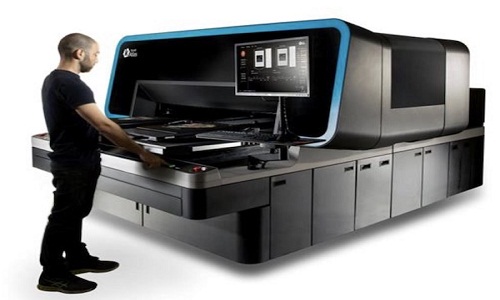 developments in the future. At Kornit, we remain focused on constantly introducing technology that allows the industry’s leading brands to better connect with their customers and to adapt to the rapid changes in consumer preferences, impacting the fashion and apparel industry and is driven by the talent in our global research and development division.”
The Kornit Atlas is a heavy-duty system created for super-industrial garment decoration businesses. It was designed to deliver a typical annual production capacity of up to 350,000 impressions, optimizing production efficiency and cost of ownership. The Kornit Atlas is aimed at highly productive garment decorators, mid to large size screen printers and businesses looking to combine state-of-the art technology with lowest cost of ownership. Its printing area is up to 23.5 x 35 in / 60 x 90 cm.
A press release says: The system is equipped with new recirculating print heads and comes with a newly developed ink, NeoPigmentTM Eco-Rapid. The Kornit Atlas is also equipped with a unique printing engine, featuring an enhanced version of Kornit’s HD technology, complemented by a professional RIP (raster image processing) software solution and produces prints that meet the highest standards of retail quality and durability.
A revolution in textile printing
When the SureColor Fabric series was first launched it represented a revolution in textile printing. The equipment was designed from the ground up to provide a complete single-vendor solution with simpler operation, higher durability, and superior imaging.
The F2160 is Epson’s latest generation Direct To Garment (DTG) printer. It features enhanced production flexibility, higher productivity, reduced maintenance, and a lower running cost.
Optimised for customisation and value-adding on cotton based garments such as T-shirts, Polo tops, jeans and sweats, it will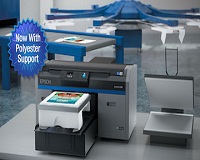 image onto a range of polyester sports and leisure wear, and can also be used for promotional and décor items including tote bags, tea towels and cushions. Prints can be made on pre-cut fabric or directly to finished garments with a heat press used to ‘fix’ the dye.
The printer can be ordered in a 4-colour configuration for high speed volume production as well as a 5-colour configuration for flexible CYMK + white work. Hardware is covered by a comprehensive on-site warranty with service cover extendable up to three years.
SureColor F2160 at a glance:
Direct to garment low-cost customisation of shirts, caps, bags, and more Epson UltraChrome® DG ink delivers crisp and bright images with a low tack finish, high stretchability and good wash/UV durability
Improved performance and enhanced image quality with smoother gradation, an expanded gamut and Dmax New platen grip pads enable faster loading and setting
Upgraded self-cleaning print head and new auto cap washing system for enhanced reliability, reduced maintenance and wastage
Supplied with enhanced Epson Garment Creator application software
Diethlene glycol free ensures for a safer work environment with Oeko-Tex certification so garments can be worn by adults, children and infants
Available in high speed 4 colour and flexible 5 colour with White configurations
Comprehensive warranty with service cover extendable up to 3 YEARS
Supports a wide range of garments with natural and man-made
Epson UltraChrome DG Ink was developed to support fabric with a 50% or greater cotton content. It adheres well and fixes easily for images with a low tack finish that have good UV/wash durability. Both the ink and Pre-Treatment liquid when applied to cotton fabrics conform to the latest Oeko-Tex Eco Passport standard with garments safe for use by adults, children and babies.
Truetzschler technology makes life comfortable – Gupta Spinning Mills
“Truetzschler technology has made my life more comfortable,” says Rajiv Garg, Managing Director of Gupta Spinning Mills, Panipat, India. He was referring to the transformation experienced by Gupta Spinning Mills after installing the latest technology Truetzschler machines.
Gupta Spinning Mills had more than 150 old generation cards. The performance of these cards was erratic due to various technical problems. Getting the required production was a major pain area and the maintenance costs were sky high due to breakdowns. This impacted the efficiency of the entire mill.
In the year 2012, when Mr Garg thought of modernising the mill, the launch of Truetzschler’s TC series card – with its 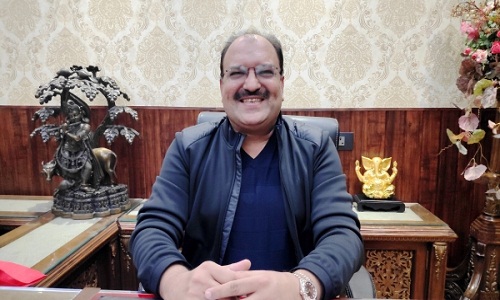 advanced features and excellent price performance ratio – came at the right time. Mr Garg modernised a section of the mill immediately. Replacement of old cards with the TC series Truetzschler cards soon changed the trajectory of the mill with increased production and better quality output. It also resulted in saving a lot of space with the reduction in the number of cards. Soon, Mr Garg started replacing all the mills’ old cards with TC series cards, until today he has a total of 58 Truetzschler cards that include TC 5, TC 8 and TC 10 cards, running on an average Ne 8’s count, feeding 12,000 rotors and producing 125 tons of yarn per day. “No other cards can run at a production rate of 135 kg/hour. My life has become more comfortable after installing Truetzschler machines in my mill”, says Mr Garg with a great sense of satisfaction.
The mill workers are also happy as the new Truetzschler cards need less maintenance. They appreciate the innovative features of the Truetzschler cards such as the precision mote knife setting PMS in licker-in zone, precision flat setting PFS and T Con, to name just a few. The working environment in the mill has also become cleaner as the waste collection system of the Truetzschler cards is very effective. Overall there is now a pleasant ambience in the carding department as the workers daily job has also become easier.
Adds Mr Garg: “With the launch of each new card model, Truetzschler raises its own technological bar and we are looking forward to ITMA, Barcelona, for the new model launch from Truetzschler, which I am sure, will offer even more user benefits”.
Group of 39 Brazilian textile and machinery companies participate in Colombiatex 2019
Latin America’s most important textile show, Colombiatex de las Americas, is being held from January 22 to 24. During the event, recent innovations in the Brazilian textile industry are announced through launches by 39 companies. In addition to offering apparel fabrics and inputs, companies introduce technological developments in machinery for faster productive processes in cutting and apparel-making, automation, design and energy efficient equipment.
The 39 Brazilian companies are members of the Texbrasil and Brazil Machinery Solutions Programs, partnerships between Abit (Brazilian Textile and Apparel Industry Association) and ABIMAQ (Brazilian Machinery Builders’ Association), with the support of Apex-Brasil (Brazilian Trade and Investment Promotion Agency).
Among Texbrasil companies are Cataguases; Covolan Têxtil; Rosset, Sancris Linhas, fios, zíperes; Santanense, Cedro Têxtil, Malhas RVB, SantaConstancia, La Estampa Tecidos & Artes, Linhas Trichê, Hudtelfa, Santista, Paramount, Indústria Denim Canatiba, Manequins Expor, Vicunha Têxtil, Nicoletti Têxtil, Incotex, Salotex, Têxtil J. Serrano, Dalila Têxtil, Creora, MPRO, Lunelli Têxtil, Innovativ, Berlan, Estrela Aviamentos, Latina, Eberle-Mundial and Pelican Têxtil.
While Brazil Machinery Solutions companies include Audaces; Orizio, Castilho; Censi; Comelato Roncato; Delta; Inarmeg;  SocioTec and Weko.
At this new edition of the textile show, the Brazilian delegation is showing visitors trends for 2019 and new developments, using fashion shows held in the Brazil space. The collection brings together inputs from member companies, which were transformed into single items, filled with colors and design, representing the charm and evolution of Brazilian fashion.
One of the main Brazil attractions will be the virtual expo on Brazil’s Industry 4.0 and a virtual reality experience of a model Industry 4.0 plant, highlighting the country and the importance of its industry. This experience is developed by ABIT and ABIMAQ in partnership with Brazil’s National Service for Industrial Training (SENAI).
During this visit, which will be led by Brazilian specialists, visitors can also access a virtual mirror. The device uses a camera to take body measurements, with the person then choosing the model and print.
“Colombia is the best scenario to show Latin America the advances and technologies in Brazil in textile and apparel production. Colombiatex is a commercial showcase par excellence that lets every visitor learn close-up about what our industries offer,” says Rafael Cervone, CEO of the Texbrasil Program. He adds that “even this year, we are very excited about our alliance with Senai, making it possible to share Brazil’s advanced manufacturing in Colombia.”
According to Patricia Gomes, Executive Director for Foreign Markets at Abimaq and the manager of the BMS program, Brazil is a reference in the machinery and equipment sector for the textile industry in Latin America in terms of quality, technology and competitiveness. “From January to November of 2018, industry exports to Latin American countries reached USD 24.3 million, which represents a 10% increase in relation to 2017, when they were at USD 22 million,” she points out.
About Texbrasil
The Brazilian Textile and Fashion Industry Internationalization Program (Texbrasil) works with textile and apparel industry companies to develop strategies for success in the global market. Over nearly 20 years, it has helped around 1500 brands to enter the export market, bringing in USD 3.6 billion in business. The Program is conducted by Abit in partnership with the Brazilian Trade and Investment Promotion Agency (Apex-Brasil).
About the Brazil Machinery Solutions Program – The result of a partnership between the Brazilian Investment and Trade Promotion Agency (Apex-Brasil) and the Brazilian Machinery Builders’ Association, the Program is aimed at promoting Brazilian machinery and equipment exports, while strengthening Brazil’s image as a manufacturer of technological and competitive mechanical capital goods. The BMS Program currently has 400 members, including industries in various sectors, such as agriculture, textile, mining, plastics, packaging and others.
About ABIMAQ
The Brazilian Machinery Builder’s Association (ABIMAQ) was founded in 1937, with the goal of working to strengthen the national industry, mobilizing the sector, carrying out initiatives in conjunction with political and economic authorities, fostering trade and international cooperation and contributing to enhancing performance in terms of technology, training of human resources and managerial modernization.
About Abit
Founded in 1957, the Brazilian Association of the Textile and Apparel Industry (Abit) is one of the most important organizations within the country’s economic sectors. It represents the productive force of 33,000 companies nationwide of every size, employing over 1.6 million workers and together generating annual revenues of US$ 36.2 billion.
JASMA registers major textile companies for JIAM 2020
The Japan Sewing Machinery Manufacturers Association (JASMA), has announced that it has been accepting exhibitor applications from major textile machinery manufacturers for the Japan International Apparel Machinery (JIAM) 2020 OSAKA since May 2018. The leading textile machinery exhibition will be held from May 20-23, 2020, at Intex in Osaka, Japan.
The show has set its exhibition theme as ‘the forefront of the future technology and master craftsmanship collaboration’, with many major manufacturers and organisations expressing their intent to participate as exhibitors, according to a press release on the show.
Since exhibitor registration opened in May 2018, the show has received many inquiries from companies and organisations in Japan and overseas. JASMA has actively promoted JIAM 2020 OSAKA to the industry stakeholders at related trade shows held in Japan, as well as at sewing-related trade shows held across Asia in 2018 (including Taiwan, Dongguan, and Korea).
JASMA has also solicited groups in Europe, such as with the VDMA German garment and leather technology association and its members, for participation in JIAM 2020 OSAKA as exhibitors and visitors.
Consequently, companies from Germany and other countries in Europe have also announced their participation at the show’s overseas pavilions. Organisers plan to engage in a wide range of promotional activities to attract exhibitors and potential visitors, in addition to conducting a publicity campaign at industry-related trade shows in Japan.
A press conference for JIAM 2020 OSAKA and the exhibition overview will also take place at DTC 2019 Dongguan, China in March; as well as at Texprocess 2019 Frankfurt, Germany in May, and at CISMA 2019 Shanghai, China in September. The events will provide specific information on topics related to JIAM 2020 OSAKA accordingly.
EU moves closer to imposing sanctions on Cambodia
The EU is about to impose trade sanctions against Cambodia as a result of alleged human rights violations in the country. That means, Cambodia won’t be allowed to export goods duty-free and quota-free to the EU. Sanctions will damage Cambodia’s economy, where a $5 billion garment industry employs 7,50,000 people and is the biggest exporter.
In addition, the EU is mulling imposing tariffs on Cambodian rice for three years as a result of a surge in imports deemed to have hurt European rice producers. Progress on workers' rights in Cambodia has slowed significantly. While the government still allows some independent unions and workers'-rights organisations to operate, the space for them to advocate effectively is shrinking.
A number of labor union and human rights leaders have been targeted for official harassment, and some have been arrested or criminally charged. In several high-profile cases, labor leaders who were charged with baseless crimes in 2013 still have those charges pending against them. A law restricting freedom of association, adopted in 2015, restricts the activities of a wide range of non-governmental organisations, including those advocating on behalf of workers. Another law adopted in 2016 places onerous constraints on those who wish to form new unions.











