FW

Avery Baker will step down from her role as chief brand officer for Tommy Hilfiger from June 2019. She led the launch of “The Hilfigers” Family communications platform, the modern revival of the brand's Tommy Jeans logo collection, as well as the relaunch of Tommy Hilfiger's global women's business with brand ambassador Gigi Hadid. - Via Tommy Hilfiger She is currently responsible for overseeing brand strategy, creative direction for product design, global marketing and communications, global licensing and creative services, in addition to leading brand-building initiatives.
Baker joined the company in 1998. Prior to her current position, she served in a variety of leadership roles at the company, including chief marketing officer. During her tenure, Baker led key transformational programs such as the launch of “The Hilfigers” Family communications platform, the modern revival of the brand's Tommy Jeans logo collection, and, most recently, the relaunch of Tommy Hilfiger's global women's business with brand ambassador Gigi Hadid. In addition, she also managed TommyNow, the brand’s “see now, buy now” fashion show, an initiative that sought to boost the brand's image as a leader in fashion's future.
A national conclave on technical textiles will be held in Mumbai on January 29, 2019. The release of HSN codes for technical textiles will be one of the major highlights of the conclave. Several panel discussions will be held on subjects like administrative consolidation of technical textiles, manufacturing possibilities and import substitution, benefits of standardization and global best practices, technical textile codes for New India, investment opportunity in technical textiles and research and development in technical textiles.
Technical textiles are textile material and products manufactured primarily for technical performance and functional properties rather than aesthetic and decorative characteristics. They find application not only in clothing but also in areas like agriculture, medical, infrastructure, automotive, aerospace, sports, defence and packaging.
The technical textile sector is the sunshine sector for the textile industry and is one of the fastest growing segments of the Indian economy. This sector is expected to see a double digit growth in coming years. There are around 2100 units manufacturing technical textiles in the country and most of them are concentrated in Gujarat followed by Maharashtra and Tamil Nadu.
Technical textiles constitute 12 to 15 per cent of the total textile value chain in India, whereas in some European countries technical textiles constitute 50 per cent of the total textile value chain.
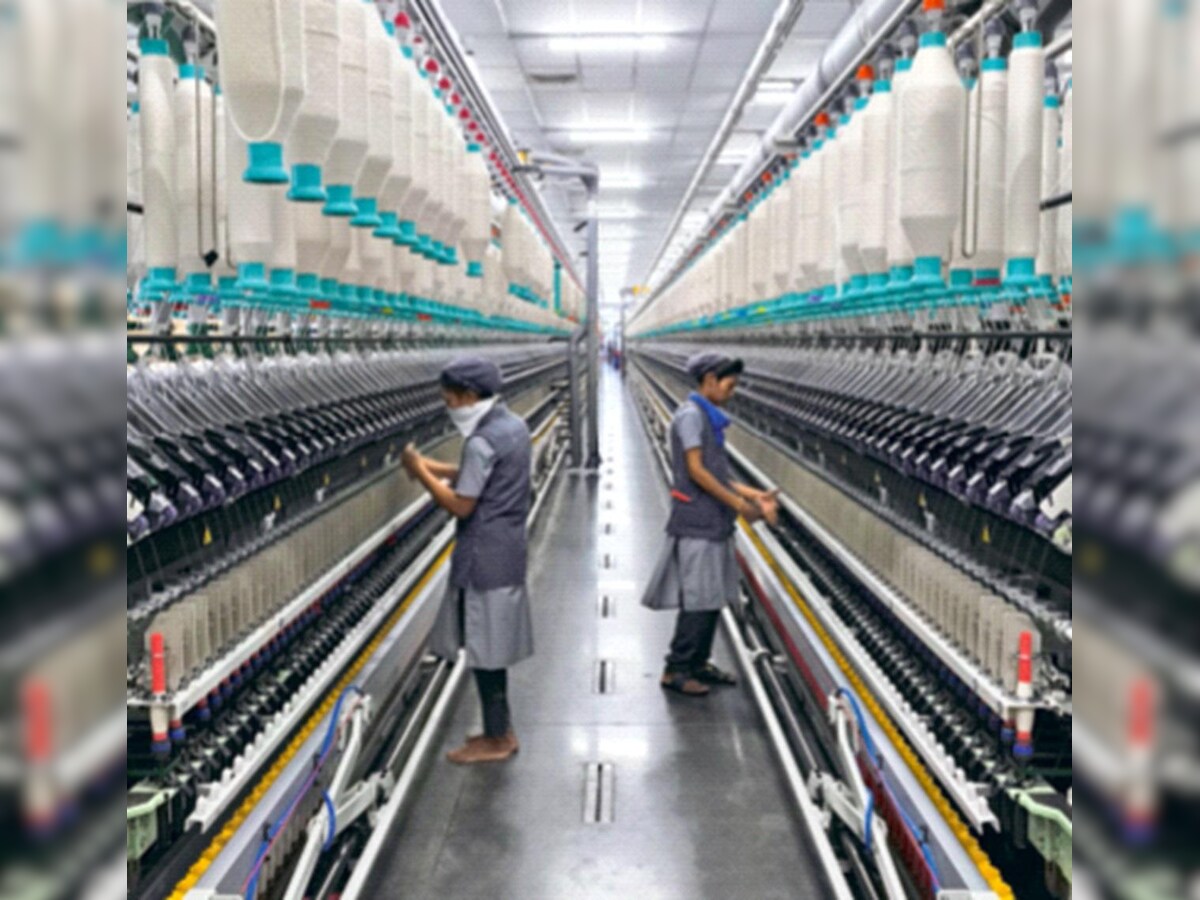
Small and medium units find it difficult to enter the textile sector in Gujarat. The main problem is: increasing cost of machinery in the textile value chain. Manufacturing of yarn, weaving, processing and garment manufacturing require sizeable investments.
In case of power looms, entrepreneurs earlier were able to start a business by spending a few lakhs on three to four traditional machines. However, today a single power loom costs up to Rs 50 lakh. Hence, it would be out of reach for micro and small businesses. Even medium size businesses are feeling the pinch. Setting up a textile unit earlier used to cost around Rs 12 crores but now with cutting edge technology, the cost would easily cross Rs 100 crores.
In Gujarat, garment manufacturing is limited to a handful of big players. But unless micro and small units become part of the textile value chain, the textile industry cannot generate adequate jobs. Unlike Tirupur, where small and medium units thrive in ready-made cloths, Gujarat lacks a proper ecosystem. Expensive textile machinery and equipment has made the entry of new entrants in the segment more difficult. A sizeable capital subsidy on machinery would be required in order to make a new unit affordable.
In the past six months, Pakistan’s knitwear exports grew 10.5 per cent. This was possible following the receipt of outstanding tax refunds and uninterrupted gas and electricity supply. Exporters want the option of being provided refund bonds (promissory notes) with an annual profit of 10 per cent and maturity of three years, which would ensure liquidity for their businesses. Now the knitwear garment sector hopes to be able to raise its exports by 20 per cent in the next six months.
Import duties on hundreds of raw materials used for manufacturing export products have been withdrawn. Pakistan’s knitwear industry plays a vital role in value addition of the textile sector. There is a great potential of further development in this industry as there is substantial value addition in the form of knitwear apparel, sportswear, socks, gloves etc. The knitwear sector is the largest foreign exchange earner as well the largest contributor in textile exports and total exports of the country. Pakistan is diversifying knitwear products to bring more innovations and incentives to boost its exports. This sector has export potential despite remaining under pressure from its competitors mainly Bangladesh, India and the Far Eastern nations. The knitwear sector in Pakistan enjoys top ranking in the textile group and other sectors.
As per Morgan Stanley analysts, Adidas AG and Nike Inc. are currently at crossroads, with Adidas continuing to slowdown and Nike starting to regain market share. The research group’s analysts issued separate company reports that together show how one company’s market share loss is expected to result in the other brand’s gain.
Analyst Elena Mariani in the UK has downgraded Adidas to “Underweight,” noting that the market is underestimating both the cyclicality of the company’s business model and stronger competition from peers. And while the company is better now than it was five years ago, Adidas’ topline profile is more exposed to fashion risks given what has been a stronger push into lifestyle products.
With growth normalising over the last two quarters and growth in footwear down to the single digits after three years of double-digit growth, the analyst believes the current product cycle might be coming to an end for the company. And with the current sport-inspired styles contributing almost 50 percent of sales versus just 20 percent 10 years ago, The company might find it hard to replace the brand’s most successful styles.
In contrast, any market share loss from Adidas is likely to benefit Nike, according to analyst Lauren Cassel in New York. Her thesis is that Nike’s new product pipeline continues to resonate with consumers, and a Nike bull case can be made via its capture of Adidas’ lost share through Nike’s direct-to-consumer channel.
Unifi’s Repreve recycled nylon staple fiber is a more eco-friendly option for spun yarns, and it can be used to improve the hand feel and strength of fabrics and add natural heather or cooling effects. Repreve is one of the most trusted and certified earth-friendly fibers in the world.
Truclean is chemical-free fiber that permanently inhibit static and cling to keep fabrics looking newer. Truflexx is a new engineered stretch fiber made with Repreve and is 100 per cent polyester. Engineered stretch can replace spandex in the five to per cent content range for comfort-stretch knits, creating the possibility of a 100 per cent closed-loop recyclable stretch polyester fabric.
Unifi is a synthetic yarn provider which believes that true innovation starts in the fiber. Its goal is to provide even more options to inspire customers to innovate at the fiber level to achieve sustainable, high-performing products.
The company collaborates with brand and textile partners to create unique performance technologies that are embedded in the fiber. By offering a wide range of products focused on benefits, Unifi helps customers create innovative fabrics that solve everyday problems and meet and exceed their consumers’ expectations.
Unifi is a textile solutions provider and a leading innovator in manufacturing synthetic and recycled performance fibers.
Jeanologia has developed a new production model that integrates hardware and software to reduce time-to-market and put the emphasis back on the product being developed. The production model will focus on authentic results. It will digitize the garment finishing processes and allow designers to focus on the product itself as the production model helps to improve synchronization between development and production. The model’s purpose will be to simplify and standardize things like fabric selection and it can even measure the environmental impact of various finishes before a single stitch is made.
Four new capsules have been designed and produced with the new process, each featuring different finishes to demonstrate its adaptability to different styles. Each of the new capsules was made with Jeanologia’s 5.Zero techniques, which promise zero discharge, zero manual scrapping and grinding, zero PP spray, zero stone and zero bleach.
The digital model equips designers with tools that make it possible to design in a more intuitive, fast and dynamic way, optimizing the creative process through the use of technology.
Jeanologia has clients on five continents in 61 countries. Its technology is used on more than 35 per cent of the five billion pairs of jeans produced every year.
Jordan’s garment exports are expected to grow by at least eight per cent this year. The US is Jordan’s number one export market. The country’s garment exports to the European Union are also expected to increase, in light of the simplified rules of origin agreement. These allow for Jordanian manufacturers to export local products to the EU with up to 70 per cent of the product’s make-up comprising imported materials.
Still, the sector faces several challenges. They include the absence of trained and qualified local labor, high borrowing costs and lack of experience among leaders of the sector’s small and medium sub segment.
Of these challenges, the percentage of foreign labor in the sector is the most pressing issue. About 75 per cent workers in the sector are foreign laborers. Factory owners feel hiring foreign labor is cheaper. Many Jordanian youths think they are overqualified to be working in factories. Jordanians who hold degrees tend to not only avoid working in garment factories, but in any job that includes physical labor. They prefer to find a job that society deems prestigious. Jordanian workers are not inclined to work overtime, which is another reason the sector leans towards employing a foreign workforce.
Indorama Ventures is taking steps to effectively reduce emissions. The company has developed a policy and strategic framework within which to take action and reduce negative climate change impacts. It is fully committed to finding pathways to develop effective low-carbon strategies that alleviate climate change. Its aspiration is to be a world-class chemical company making great products for society, growth resting on positive environmental and social continuity as well as ethical performance.
Chemical producer IVL now operates on a global scale of an integrated polyester value chain and HVA platform, with a more resilient product and geographic mix. Indorama’s fiber portfolio includes polyester fibers and yarns, polyolefin fibers and bicomponent fibers for various applications, including apparel.
The company will continue to pursue value accretive opportunities in its key segments to further strengthen the foundations of sustainable performance. The strategy to drive sustainable and profitable growth in both high-volume necessities and the stable but high margin and high value-added HVA business continues. The company further upgraded its portfolio through organic growth, operational excellence initiatives, value accretive acquisitions and strategic integrations.
Indorama joins companies that are making efforts to prevent dangerous climate change and environmental damage. Industry fundamentals continue to be positive, led by strong demand growth for 100 per cent recyclable PET, supply balance and on-going improvements seen in the PET industry.
Several local fabric manufacturers are participating in Dhaka International Trade Fair (DITF) to market their products amongst both local and foreign clients. Bexi Fabrics is displaying hundreds of items for men, women and children. Visitors prefer Brexi products due to their quality and competitive prices. The manufacturer is selling its products at wholesale prices on the occasion of the fair.
Classical Hometex aims to attract the attention of foreign buyers. The brand is exhibiting over 500 categories of bed sheets with hundreds of color combinations. Customers can buy a standard bed sheet at Tk 700 to Tk 1,500 and high-end bed sheet for Tk 2,000 to Tk 4,500.
Father Textile Mills, a concern of Asian Group, is displaying suiting and shirting fabrics of more than 700 types of designs. Most of the company’s fabrics are supplied to local readymade garment sector.
Bangladesh exports home textile products, including bed sheets, bedspreads, pillows, pillow covers, cotton table napkins, furnishing fabrics, curtains, window and door curtains, cushions, cushion covers, carpets, table covers, kitchen accessories, mattress covers and bath linens.