FW

Cotton Council International (CCI), in collaboration with the Indonesian Textile Association (API), CCI presented a seminar titled: Advantages of US Cotton Textiles Products and Future Fashion Trends in the Global Market. The seminar attended by Jane Singer, Director & Head-Market Intelligence, Inside Fashion Group stated that 2019 fashion trends cover everything from coral to tie-dyed denim. Singer shared the results of his observations about the main changes that occurred in the retail market and changes in consumer attitudes.
He underlined the important role of the quality of materials used by factories to produce clothing, in order to validate brand or brand quality claims. He further emphasised that role of good quality products in determining the brand value. According to him, American cotton is the right choice for entrepreneurs as a basic material for textile production and materials for fashion creations that will be created this year.
COTTON USA ™ technology innovation is very useful for fashion production according to this year's fashion trends. Then, customers today tend to be willing to pay extra for functional clothing.
While in his presentation, Andy Do, Representative of CCI Indonesia's Program said that COTTON USA ™ is always committed to assisting manufacturing industries in understanding fashion trends. Another concern is the use of the latest technology, and the advantages of using American cotton to create new opportunities and other benefits for entrepreneurs and more broadly, for the Indonesian textile industry.
A yarn and fabric show will be held in Bangladesh from January 23 to 25, 2019. The aim is to introduce latest sophisticated yarn, fabrics, accessories and emerging technologies to the textile and garment industry. Over 370 exhibitors from 22 countries will showcase textile products that include the latest trends and technologies in fabrics, accessories, ready-to-wear and industrial fabrics, innovative and smart fabrics and many more.
The exhibition will enable textile and apparel industry buyers to meet local and overseas textile and yarn manufacturers face to face for the best qualities and reasonable prices. There are seven garment factories in Bangladesh that are among the top 10 environmentally-compliant readymade garment factories around the world. The country has a target of reaching $50 billion in textile exports by 2021.
Currently Bangladesh imports viscose worth billions a year which can be easily saved by producing it in the country. Production of viscose fiber has proved more profitable than production of readymade garments. Bangladesh has made a deal with China for building a plant to make viscose fiber from jute using Chinese technology and finance.
China is the top exporter of apparel products in the world while Bangladesh stands second.
Bangladesh may fail to meet readymade garment export targets. Reasons include: rising cost of doing business and mounting conflict between workers and owners on wages. Workers’ protests have sparked clashes between police and workers and killed at least one worker and wounded dozens more.
The country’s readymade garment industry accounts for 80 per cent of Bangladesh’s merchandise export earnings and serves some of the biggest brands in the world. Bangladesh raised the minimum monthly wage for the garment sector’s four million workers by 51 per cent from December. But workers say their raise was less than this and unions, which warn the strikes may spread, say the hike fails to compensate for price rises in recent years.
Wages were hiked after five years. But in five years the cost of living has increased more than the wage hike. However, rising trade disputes between the US and China have opened the window of opportunity for Bangladesh to increase exports. China, the world’s largest exporter of apparel, is seeing its apparel companies migrate to countries with cheaper labor costs. US sanctions on Chinese technology companies are expected to accelerate the trend. Another advantage Bangladesh has is cheap labor costs.
MODA, to be held from February 17-19, 2019 in Birmingham, NEC will attract an array of sought-after footwear and accessories brands. It will include the UK launch of the AW19 Alexa Chung collection for Superga. The new collection will be launched in collaboration with Alexa Chung, as well as a host of new colors, animal prints, fluoro colourways, sport luxe trainers for women, and corduroy and military styles for men.
Superga launched the Classic Superga 2750 style in 1911in Italy. The 2750 became established as “the People's Shoe of Italy”, and Superga increased its product line with technical sport shoes, rubber rain boots and a growing range of colours and styles.
Delivering a high quality and cost-effective platform for mid-market brands and a commercially viable and convenient buying environment for retailers across the UK and Ireland, MODA will bring together over 1,200 collections under one roof at the NEC Birmingham from brands including: Geox, Loake, Birkenstock, Chatham, Fly London, Steptronic, Rieker, Hotter, Bugatti, Lunar, Alpe, Suzie Blue, Zohara (bags), Gabys, Tilley & Grace, Suzanne Bettley, Max & Ellie, Tempest Designs, Whiteley Fischer Hats, and Pineapple Island.
Bangladesh’s apparel exports to India grew 143 per cent in December. The value of Bangladesh’s knitwear exports rose 107 per cent in July to December 2018 compared to July to December 2017. The value of woven exports rose 161 per cent.
India has been grown into a big market for Bangladesh’s apparel exporters. Last fiscal, Bangladesh’s apparel exports witnessed 100 per cent gain in India – a trend which is continuing this year and expected to rise. India recently introduced a uniform taxing policy across its states – lifting a major trade barrier and proving a boon for business. Also, international brands and stores are opening up in India, which demand more apparel products from Bangladesh.
Also, many renowned fashion brands are exploring Indian market now – opening up outlets across its states. These fashion brands and outlets are demanding apparel items from Bangladesh. Since giant business groups such as Reliance and Tata have opened up retail chains across India, this is an opportunity for Bangladesh to act as a prominent supplier to them.
Another fact is that the Indian domestic market has grown and the number of fashion conscious consumers has increased. This is a win-win situation for both countries since Bangladesh imports readymade garment raw materials such as cotton and machinery from India.
"There is positivity in the entire textile value chain thanks to the pragmatic approach adopted by the government, says Confederation of Indian Textile Industry (CITI) has said. However, rising imports of textile products remains a key area of worry. As per Sanjay Jain, Chairman, CITI, the RBI Financial Stability Report for December 2018, stressed advance ratio of textile sub-sector has declined to 18.70 per cent in September 2018 from 23.70 per cent in September 2017."
 There is positivity in the entire textile value chain thanks to the pragmatic approach adopted by the government, says Confederation of Indian Textile Industry (CITI) has said. However, rising imports of textile products remains a key area of worry. As per Sanjay Jain, Chairman, CITI, the RBI Financial Stability Report for December 2018, stressed advance ratio of textile sub-sector has declined to 18.70 per cent in September 2018 from 23.70 per cent in September 2017.
Robust growth noted for textile and apparels
Jain points out as per Ministry of Commerce & Industry, DGCI&S, Quick Estimates data for November ’18, textiles and apparel exports in November 2018 grew 14 per cent to Rs 18,965 crore (US$ 2.69 bn) as compared to Rs 16,707 crore(US$ 2.37 bn) in November 2017. Apparel exports over the same period grew 21 per cent. The IIP production data for T&C also witnessed a robust year-on-year growth during October 2018 as compared to October 2017. Textiles and apparel sectors registered a growth of 6.2 per cent and 28 per cent, respectively during October 2018.
Government support boosts growth
Jain believes, this positive trend in the entire textile value chain is the result of the pragmatic approach shown by the Union 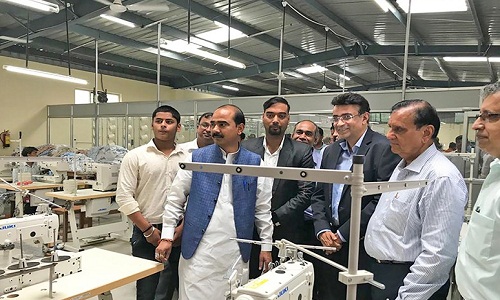 Minister of Finance, Minister of Commerce and Industry and Civil Aviation and Minister of Textiles, on the issues of T&C industry. The government too has supported the industry by disbursing Rs 1,300 crore (US$ 1.84 bn) funds for the Samarth Scheme, Rs 6000 crore (US$ .85 bn) Apparel & Made-ups Package along with various state incentives; resolution of GST related issues, increase in import duty of various textile and apparel commodities, etc. Jain expressed his deep gratitude to the ministers for their timely policy support and intervention to boost the industry which was under severe stress especially after the implementation of GST.
Imports needs attention
Jain also highlights some of the other prominent schemes that Ministry of Textiles has introduced for the development of entire textile value chain. These include: Scheme for Integrated Textile Park (SITP) and Integrated Processing Development Scheme (IPDS) which have been extended and notified from 2017 to 2020 and Technology Upgradation Fund Scheme (TUFS) under which A-TUFS has been launched for 2016-2022.
However, one key area of concern today is continuously rising textile imports which needs immediate attention and government support. All the categories across value chain have seen a drastic rise in imports during Jan-Oct 2018 vis-à-vis same period last year.
"Year 2019 promises to be that of change in the world of men’s fashion. Events like high-profile label hookups, industry shakeups, and a focus on sustainability will rattle the Richter scale for menswear for the next 12 months with several brands igniting trends, change and quite probably a purchase or two."
 Year 2019 promises to be that of change in the world of men’s fashion. Events like high-profile label hookups, industry shakeups, and a focus on sustainability will rattle the Richter scale for menswear for the next 12 months with several brands igniting trends, change and quite probably a purchase or two.
Timberland
Christopher Raeburn plans to take over the reins of American lifestyle brand Timberland. The designer, with a strong focus on eco-friendly production and purposeful design, will incorporate bleeding edge materials and a utilitarian design that has a streetwear tinge into the brand’s offerings to offer wearable clothes.
Louis Vuitton
Marking the dawn of a new era in menswear, Louis Vuitton appointed Off-White founder Virgil Abloh as its art director last year. Abloh’s debut collection shook up the fashion status quo, not just in terms of design but also with its efforts to normalise diversity within the industry. This year promises to be a defining one for two of these biggest names in the fashion world.
Fila
The sneaker, introduced by Fila last summer, appealed to both sexes and was easily picked up on the high street. Its success was the centerpiece for the retro Italian sportswear label, which is now based in the South Korea. The brand formed several collaborations in 2018, from Fendi to Weekday via Liam Hodges. It now plans to form associations with MVP sportswear, Killer, Champion or Kappa, etc.
Nike
The release of the Yeezy Boost 350 back in 2015 gave rise to a new era of sneaker design at Adidas and other brands. It popularised the use of oversized sole units, knitted uppers, sock-like fits and uncaged lacing systems. In 2019 Nike’s Air Fear Of God 1 collection will introduce new silhouettes from the Swoosh.
Stella McCartney
Designer Stella McCartney, was once ostracised by her contemporaries for her unfaltering commitment to sustainable fashion. She recently introduced a vegan Stan Smith sneaker in collaboration with Adidas. Now, the same people who once scoffed are being forced to follow suit, making McCartney look like one of the most important designers of 2019 and beyond.
Serac
Serac is set to shake up outerwear in 2019. The label will bridge the gap between fashion and functionality by utilising a British Millerain shell fabric, which is the world’s first fully-washable and waterproof 3L waxed cotton. This groundbreaking material is highly technical, yet ages and weathers like leather, making each garment unique to its wearer.
Zara
In 2018, Spanish retail juggernaut Zara came under scrutiny, for contributing to world textile pollution through its fast-fashion offerings. The brand has now pledged to stop sending all of its unused textiles to landfill by 2020. Its market-leading position enables it to introduce world-changing reforms in fashion and retail.
Calvin Klein
After two years of launching a new luxury line, Raf Simons quit as the chief creative officer at Calvin Klein in late December 2018. Questions like who like replace him and future of the brand’s 205W39NYC collection continues to haunt the brand and the industry.
Perry Ellis
Miami-based Americana brand Perry Ellis went private in 2018.The brand recently launched the revamped collection of streetwear-inflected staples, courtesy of the brand’s ‘America Perry Ellis’ line.
Barbour
Kicking off with a stellar presentation at London Fashion Week Men’s, Barbour recently introduced a limited edition line of hero jackets inspired by its extensive archives, alongside a collaboration – the Director’s jacket – with fellow north-east legend Sir Ridley Scott.
Labor unrest has gripped Bangladesh’s garment sector. In September last year, the minimum monthly wage for readymade garment workers was raised by around 51 per cent. The new wage took effect in December. But when workers drew their pay in January, they found a huge disparity, triggering the agitation.
The protest began on January 6. The sector is the country's largest forex-earning sector. Revised wage structure is expected to be devised for apparel workers of grades 3, 4 and 5. The tripartite committee formed to resolve the labor unrest in the garment industry has found disparity in three grades of the workers' pay structure, and has started working to minimise the wage gap that sparked the protests.
Bangladesh has emerged as a key hub for garment manufacturing, as prices in China have increased dramatically in recent years. As of now, Bangladesh is the world’s second largest exporter of garments, following China, but it also holds the title of one of the lowest cost centers for manufacturing.
Employing an estimated four million people, 80 per cent of whom are women, Bangladesh apparel industry falls behind other centers not only in terms of wages but also worker well-being. A wage hike disturbs factory owners too. In the past few years, a number of garment manufacturers had to shut their factories as they could not cover their costs.
The 2018 Apparel & Accessories Market, held from October 24-27, 2018 at the Market Center, Texas, strongly indicated regional variations in consumer tastes with many brands adapting their offerings to local tastes. There was a lot of demand for waffle knits by Vining at the event. Its popcorn sweaters – the pullovers as well as the cardigans – were also popular. Women’s casualwear brand Fiore witnessed a lot of popularity for its fuzzy sweaters besides velvet tube tops, teddy coats and flared pants.
Be Stage, a Los Angeles-based label specialising in US-made fashions for the larger ladies, offers striped shirts with added details like pockets and sparkles. It shirts are available in big floral prints in plus as well as regular sizes. Regional differences in size and fit were also seen as factors to bear in mind, with Sam Um, a Sales manager with Entro, an LA-based wholesaler of contemporary women's clothing, noting that the biggest difference is in sizing. While Southern people really love flowy, comfortable styles, New York customers like more fitted, business-like stuff; things that are not as colorful, nor as bright.
While views on regional variations differed and many had conflicting opinions on coming trends, majority of exhibitors reported that sales were sluggish at best. Indeed, the event was seen by many as a particularly low watermark for the sector, a situation exacerbated by the fact that its scheduling makes it rather too late for autumn/winter styles and too early for spring/summer collections.
The Synthetic & Rayon Textiles Export Promotion Council (SRTEPC) has welcomed the new duty drawback rates announced by the government. The increased rates will provide relief to exporters, says Narain Aggarwal, Chairman SRTEPC. The drawback rates declared now need to be enhanced at least up to 6 per cent to 7 per cent. The Goods and Services Tax (GST) Council has decided to raise Composition Scheme Limit and Exemption Threshold to benefit small and medium enterprises (SMEs).The threshold has been doubled for people living in the hilly states and those in the North East region to Rs 20 lakh from the earlier Rs 10 lakh. The GST Council has comforted the tax exemption limit to Rs 40 lakh of annual turnover from the earlier cap of Rs 20 lakh and increasing the composition scheme (without input tax credit and no recovery of taxes on output liability) limit to Rs 1.5 crores from present Rs 1 crore.
The GST Council will also provide composition scheme to those providing services or mixed supplies (goods and services) with a turnover up to Rs 50 lakh. Secondly, service providers and those who render mixed supplies of goods and services with a turnover of up to Rs 50 lakh in the informal sector will be entitled to the composition scheme under the GST regime. The composition rate for services has been put at 6 per cent. Moreover, composition taxpayers will pay tax quarterly, but file returns annually.