FW
Western German textile, clothing industry settle on wage rates
Workers at the West German textile and clothing industry will get 4.9 per cent in wages and salaries and a one-off payment of €340 over the next two years. This is what employers and IG Metall have agreed after a 14-hour negotiation. The company is planning security in a highly unstable economic situation. This difficult situation has determined the negotiations until the last minute.”
Under the agreement, workers will first get a one-time payment of €340. From August 1, 2019, the wages and salaries increase by 2.6 per cent; from September 1, 2020 by 2.3 per cent. There will also be improvements in semi-retirement; the trainees' and the holiday pay. The conclusion has a term of 24 months.
Digital textile printing saves 40 billion liters of water in 2018
Digital textile printing saved over 40 billion liters of water worldwide in 2018. It offered g an efficient solution compared to traditional water usage for rotary screen printing which is in the region of 50-60 liters of water per meter. Digital textile printing uses smaller quantities of color, typically 10 per cent of the volume used when compared to screen printing. Using pigment inks as an example, and its requirement for fixation only finishing (no washing) uses less than 10 liters of water per meter.
Digitally printed cotton virtually eliminates the consumption of water and the discharge of noxious effluents. It uses low volumes of liquid dispersions of pigment colors, therefore offering a positive environmental impact. Digital Textile Printing using Pigments also removes the need for water and energy greedy post processing, since color fastness is achieved by heat fixation alone as opposed to lengthy steam fixation and washing off procedures.
Viscose poses threat to habitats globally
Poor waste management of viscose factories not only pollutes nearby waters and air but causes widespread illnesses. Viscose is found in a huge variety of clothes and used by almost every major fashion brand today.
Although not inherently unsustainable, it is the production process of viscose that presents a problematic story. Wood pulp is extracted, then turned into viscose staple fiber and filament yarn through a highly chemical process using carbon disulphide. With demand for dissolving pulp projected to increase 122 per cent in the next 40 years, the viscose industry is a growing threat to vulnerable habitats around the world.
With growing use of textile blends among fashion retailers, viscose is now the third most commonly used fiber in the world. As a biodegradable fiber, it has the potential to be a sustainable alternative to oil-derived synthetic fabrics and water-hungry cotton.
Many of the world’s largest viscose manufacturers have not yet adopted responsible production methods and sustainable wood sourcing practices. China accounts for 63 per cent of global viscose production. Several large Chinese viscose producers dump toxic wastewater into waterways and fisheries, or allow it to seep onto nearby agricultural land.
Kering Q4 revenue up 29 per cent
For 2018 Kering’s consolidated revenue was up 29.4 per cent on a comparable basis. All regions reported strong growth, with comparable revenue up 37.8 per cent in North America, 33.8 per cent in Asia-Pacific, 23.9 per cent in Japan, and 23.7 per cent in Western Europe.
Gross margin was up 28.8 per cent on the previous year. Recurring operating income was up a record 46.6 per cent year on year. Consolidated recurring operating margin advanced 400 basis points year on year to 28.9 per cent. Consolidated ebitda climbed 42 per cent while the ebitda margin widened by 360 basis points to 32.5 per cent. Net income group share rose 108.1 per cent.
Recurring operating income was up 46.6 per cent year on year. Consolidated recurring operating margin was 28.9 per cent. Kering’s houses delivered exceptional 29.1 per cent comparable revenue growth in 2018. This brisk growth was fueled by a 31 per cent increase in sales through directly operated stores, which account for over 77 per cent of revenue. Online sales surged by 71.3 per cent. Wholesale revenue from the group’s houses rose 24.1 per cent on a comparable basis.
All regions contributed to the strong revenue growth momentum, with Asia-Pacific up 34.1 per cent, North America up 37.3 per cent, Japan up 23.7 per cent and Western Europe up 23 per cent.
US registers double digit import growth in blue denim apparel
Latest data from the US Commerce Department’s Office of Textiles & Apparel (OTEXA), reveals Asian sourcing powerhouses Bangladesh, Vietnam, Cambodia and India posted double-digit percentage gains for import of blue denim apparel to US in uptill November 2018.
The report revealed imports in the category– 95 per cent of which are jeans–from China increased 1.4 per cent in value to $871.97 million in the first 11 months of 2018. This keeps China in the top supplier slot, but leaves many countries quickly gaining ground.
In the same period, denim apparel imports from Vietnam jumped 44.53 per cent to $277.37 million, while Bangladesh’s shipments rose 12.34 per cent to $536.54 million. Imports from Pakistan gained 12.18 per cent to $227.6 million, Cambodia’s shipments increased by 23.65 per cent and imports from India rose by 45.58 per cent to $34.01 million. Imports from high-end supplier Japan were up 13.16 per cent for a value of $18.66 million.
While the mill’s European customers are still buying textiles from China, prices for packaging and manufacturing in China are getting too high for most, so House of Gold is looking outside of China for large-scale production in countries like Pakistan, Bangladesh, Vietnam and Mauritius.
Ralph Lauren net revenues up five per cent
Ralph Lauren’s net revenues have grown five per cent. The American fashion retail giant also saw a respectable growth in underlying comparable sales. Bottom line of the brand boosted its operating income by 12.9 per cent over last year. A lot of this is attributed to lower discount rates offered by the company mainly in wholesale channel.
A more focused and disciplined approach in producing new collections over the last few months has helped in not only enhancing its sales but also in building connectivity with consumers. The last few years have been about cutting costs. Ralph Lauren is on the right track. What it needs now is a focused business strategy.
Ralph Lauren has ambitious plans to increase sales by a billion dollars by 2023. Marketing spend will go up by a $100 million over the next five years. The goal is to woo the next generation of consumers and increase gross margins by improving the core product (which makes up 60 per cent of overall revenue), amplifying under-penetrated categories (including women’s, outerwear and denim) and operating with discipline, which constitutes being more careful about discounts and promotions, more strategic when it comes to price, and cutting costs in creative-but-impactful ways.
Huntsman enhances footwear services
Huntsman has invested in equipment to boost the research and development services it offers to footwear producers and their manufacturing partners. To enrich its work across the entire footwear value chain and create fully equipped testing and prototyping environments, Huntsman recently purchased machines that give it extra technical support capabilities in the field of polyurethane casting; direct-on production; multi-section injection molding; and TPU injection molding.
Global chemical company Huntsman is a leading developer of innovative polyurethane and thermoplastic polyurethane materials for the footwear industry. Throughout Asia, the Americas and Europe, the business has a number of technical centers that provide specialist support to the footwear industry. Part of a much larger global network of Huntsman innovation and customer care centers, these footwear hubs offer design, prototyping, testing and technical support services to some of the world’s most well-known footwear brands.
Many of the footwear companies Huntsman works with are big global brands. These companies want their material suppliers to have a similar geographic footprint – not just in terms of people, production and supply, but also for the delivery of innovation services and technical support. The recent investments have been made with the needs of these customers in mind.
Abuse of women rampant in apparel supply chains
How committed apparel companies are to fighting harassment and discrimination in their supply chains is uncertain. The $2.4-trillion global apparel industry employs millions of workers globally, mostly women. But women experience specific challenges at work because of gender, including pregnancy-based discrimination and sexual harassment.
There is a desperate need for a binding convention because 59 countries do not even have any specific legal remedies against sexual harassment at work. Even where legal remedies exist, they are often poorly enforced.Social audits are one of the primary tools apparel brands use to monitor conditions in factories across global supply chains, to check gender-based violence or harassment at work.
But social audits are not designed to elicit information about gender-based violence or harassment at work. They are not designed to overcome the specific barriers to reporting such harassment. They do not sufficiently create a safe space for workers who experience such harassment.
Violence against women is one of the most prevalent human rights violations. Gender-based violence makes women all around the world suffer daily and undermines their health, dignity and security. Pressure to meet fast fashion deadlines is leading to women working in factories across Asia being sexually and physically abused.
ITMA 2019 FORUMS draw strong industry support
The world’s leading textile and garment technology exhibition, ITMA 2019, will be complemented by several key forums when it is held in Barcelona in June, two of which are the ITMA-EDANA Nonwovens Forum and Textile Colourant and Chemical Leaders Forum.
Nonwovens, and chemical and colourant forums unveil key speakers
Mr Fritz Mayer, President of CEMATEX, said: “As technological developments are happening at breakneck speed, and collaboration is becoming increasingly necessary in a globalised economy, the industry has to stay abreast of the latest developments and trends. Hence, ITMA will be staging several forums to help participants be ahead of the competition curve.
“The forums also offer a valuable platform for various associations and professionals to connect and network with the right players. This is especially important as collaboration and partnerships from research institutions to technology, chemical and raw material providers and users are increasingly more critical to business success.”
ITMA-EDANA Nonwovens Forum
The Nonwovens Forum is jointly organised by ITMA and EDANA. To be held on 21 June 2019, it will highlight the latest innovations in nonwovens. The theme of the forum is ‘Nonwovens Manufacturing Processes for the 21st Century: More Flexible, More Efficient, More Sustainable’.
Mr Pierre Wiertz, EDANA’s General Manager said: “The nonwovens industry is a bright spark in the textile world. We are glad to be able to collaborate with ITMA to bring these exciting opportunities to visitors who are involved in or have the intention to move into nonwovens manufacturing.”
Providing the latest industry insights will be keynote speaker Mr David Allan, Editor, Nonwovens, RISI (United States). His presentation is titled ‘Global Trends in Nonwoven Processes under Economic and Sustainability Constraints’.
The forum will feature three sessions:
Circular economy/challenges & opportunities for processing bio-based & recycled materials on nonwovens machinery
Latest trends and innovation in nonwoven processes – including hybrids and composites
Innovations in nonwovens technology
In addition, there will be a panel discussion with experts from leading centres of excellence in nonwovens who will exchange their views on the nonwoven processes of the 2030s.
Textile Colourant and Chemical Leaders Forum
The 3rd Textile Colourant and Chemical Leaders Forum @ ITMA 2019 on 23 June will focus on the circular economy and resource sustainability strategy and how innovation will drive future industry success. Launched at ITMA 2011, the forum, is an industry initiative that draws lively participation from dyestuff, colour and chemical professionals from around the world.
Themed ‘Meeting Resource Challenges in the Circular Economy’, the 2019 forum explores how textile chemicals and innovative and cleaner technologies can help create a more sustainable future for the textile and garment industry.
Presentations at the forum are clustered into three sessions:
Resource management and Industry 4.0
Responding to sustainability challenges with innovation
Envisioning the future of the colourant and chemical industry
Chairing the forum is Mr Andrew Filarowski, Technical Director of Society of Dyers and Colourists. He said: “The forum has been an eagerly-awaited event at each ITMA edition as it is an inclusive industry platform that takes in perspectives from all stakeholders of the textile and garment supply chain. Organised by the industry, it allows like-minded industry players to exchange knowledge on the latest innovations and solutions, understand current issues and trends in a global context.”
Speakers confirmed for the forum include Ms Christina Raab, Global Implementation Director of The ZDHC Foundation. She will speak on the role of chemistry for circularity in textile, leather and fibre production. She will also elaborate on ZDHC’s approach and tools to drive the transition and uptake of safer and more circular chemistry, as well as the current state and findings of circular implementation projects from the sector.
Another speaker is Ms Dunja Drmač, Sustainability Officer of the European Apparel and Textile Confederation (EURATEX). Her presentation will enlighten participants on resource sustainability and relevant strategies in the journey towards a circular economy.
In addition to the forums, other knowledge sharing activities include the ITMA Innovation Lab. An important element of the lab is the ITMA Speakers Platform where all ITMA exhibitors have been invited to participate. The Platform will be complemented by a video showcase. A new highlight, the ITMA Innovation Video Showcase will provide a new channel for visitors to learn more about innovative exhibits at ITMA 2019.
Registration for both forums is open at http://www.itma.com. Details of other co-located events at ITMA 2019 can also be found on the website.
ITMA 2019 will be held from 20 to 26 June at Fira de Barcelona, Gran Via venue. The exhibition will feature over 1,600 exhibitors who will be showcasing their latest technologies and sustainable solutions for the entire textile and garment manufacturing value chain, as well as fibres, yarns and fabrics
KARL MAYER’s new warp knitting machine TM WEFT launched in China
KARL MAYER has developed a new warp knitting machine with the weft insertion, the TM WEFT, and has successfully launched it at an in-house show held at its Chinese subsidiary in Changzhou. Representatives from more than 10 companies came every day during January 15-18 to attend the machine presentation. These included knitters and weavers as well as finishers interested in moving into textile production. They travelled from all over China, mainly from Jiangsu and Zheijiang, as well as from Shandong and Hebei. They were all impressed by the cost:benefit ratio of the machines on show.
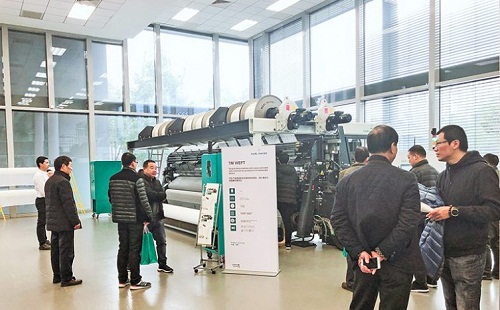 Two models of the TM WEFT, 247”, E 24, were being demonstrated, both producing an interlining, i.e., a traditional fabric with one guide bar and a version having a higher drapabiity for special applications with two guide bars.
Both machines were running at an impressive level of stability and at a high speed of 1,500 min-1. The entire concept was well received. The feedback according to Hagen Lotzmann was that “Our customers were impressed by our focus on the functions, easy operation and reliability of the TM WEFT.”
Together with Steffen Trabers from ILLIES China, the company’s agent in the region, the Sales Manager of KARL MAYER Technische Textilien had detailed conversations relating to specific projects. The first machines have already been sold and further orders are expected over the next few months.
With its features and conceptual direction, the TM WEFT, as a basic model, is designed to complement the existing WEFTTRONIC II HKS, which will continue to be available for the high-end market.
KARL MAYER is thus extending its tried-and-tested two product line strategy in its technical textiles business unit.