FW
December denim show in London
Denim Première Vision will be held in London on December 5 and 6, 2018. The show will welcome 89 exhibitors, compared to 80 a year ago. Among the companies present will be:, Advance Denim, Albiate 1830, Artistic Denim Mills, Artistic Fabrics and Garment Industries, Artistic Milliners, Arvind, Berto, Bossa Denim, Calik Denim, Kurabo, Kuroki and Raymond UCO Denim.
The spring/summer 2020 season will be divided into four fashion themes, discover, care and share, performance perspective and personalization. The first day will be dedicated to conferences on topics related to fashion, while the second will focus on eco-responsible denim. In addition to round tables on respectful denim, a smart library will show samples and innovations of selected exhibitors and a smart wardrobe will present finished products conceived thanks to eco-responsible materials and production processes.
Following the launch of the Première Vision Marketplace, its market space for fabric samples, in the latest edition of Première Vision Paris in September, the team responsible for this pole will be available to give information to exhibitors and buyers about the tool. This marketplace will welcome the suppliers of the leather sector next February and the exhibitors of the denim sector in June. Manufacturers of textile accessories will join them in September.
Pakistan opens door to Afghan cotton
Pakistan has allowed the import of cotton from Afghanistan/ Central Asian states via the land route. The objective is to bridge the demand and supply gap in the textile sector. The textile industry of Pakistan consumes around 12 to 15 million bales of cotton per annum.
The cotton imports will be subject to all sanitary and phytosanitary regulations. A permanent quarantine facility will be set up for cotton imported through the land route. Cotton is a sensitive crop. It attracts a variety of pests and a fumigation process is a must to counter such threats.
Meanwhile Pakistan will withdraw sales tax and customs duty on imports of cotton. This is to encourage value addition, reduce the cost of doing business and bridge the gap between production and consumption.
Pakistan has been a net cotton importer since 2001. The country produces short to medium staple length cotton which implies that long and extra long staple cotton has to be imported for production of finer yarn counts for subsequent transformation into high value added finished products. Import of cotton remained duty free till zero per cent slab was abolished in 2014-15 and customs duty of one per cent was imposed along with a five per cent sales tax.
Bulgarian textile industry looks at ways to improve labour rights
Bulgarian textile mills, unions and brands including H&M, Inditex and ASOS met recently to look at ways to improve wages and labor rights in the country’s garment and footwear sectors. The groups met as a part of an EU-supported project targeting the textile sectors of seven countries in the region, namely Albania, Bulgaria, Croatia, Macedonia, Montenegro, Romania and Serbia. All face challenges in improving employer-employee relations and labor rights in their respective textile sectors, with these issues hampering growth and competitiveness.
In Bulgaria, there are around 1,00,000 workers in the textile, garment, leather and footwear industries. The sector is characterised by low wages and poor image, which has led to labor shortages. Bulgaria has the lowest minimum wage in the European Union. There are very few collective bargaining agreements.
Industriall Global Union has introduced the cooperation between brands and unions which started with the Bangladesh Accord, and continued with global framework agreements (GFAs) and the ACT initiative which is intended to achieve living wages through industry-wide collective bargaining linked to the brands’ purchasing practices. A training session was carried out for national, regional and local level union representatives on how to use GFAs for organising workers into unions.
Representatives from GFA partner brands H&M, Inditex and ASOS, also members of ACT, explained how they in cooperation with unions solve problems when they occur and promote social dialogue and collective bargaining.
ATUFS may become simpler
Norms under the Amended Technology Funds Scheme (ATUFS) may be simplified for players in textile and intermediaries across the value chain. Textile players face severe difficulties while availing benefits under the ATUFS due to its complicated structure.
The complicated structure of ATUFS has made it one of India’s least preferred subsidy schemes. For example, overseas machinery suppliers have to be enlisted in suppliers’ list for which the government asks for documents like the ISO (International Organization for Standardization), a certificate which machinery suppliers are reluctant to show. Secondly, the government has introduced joint inspection by textile experts in financial institutions or industry associations.
Apart from the allocation of 16-digit machine identification code number engraved on imported machinery, the government has included approval for all individual machinery mandatory for the plant. The total fund allocation under ATUFS has been low since its launch in January 2016.
Meanwhile, India’s textile and apparel exports jumped by a staggering 38 per cent in October due to growing demand from overseas. The boom has been triggered by a recovery in the global economy. The depreciating rupee helped boost realisations of textile and apparel exporters. While overall textile exports posted a jump of 28 per cent, shipment of apparel from the country shot up by 54 per cent in the month under consideration.
Fashion accessories face supply chain issues with ongoing tariff wars
"In recent years, these companies have been facing many challenges from the Chinese markets. Prices are increasing, minimum units required are rising, there are worker shortages, late shipments and factories are closing. Although some large companies have begun shifting production elsewhere to find cheaper labor costs and factories that could meet their needs, many companies that had well established supply chains, have not established back-up plans or searched for new countries for sourcing."
 For long, fashion accessories companies have relied on Chinese factories to make their products. Twenty-five years ago, fashion jewelry shifted production from the US to Asia and as other categories, such as handbags, grew in importance, the factories overseas became the go-to places to manufacture.
In recent years, these companies have been facing many challenges from the Chinese markets. Prices are increasing, minimum units required are rising, there are worker shortages, late shipments and factories are closing. Although some large companies have begun shifting production elsewhere to find cheaper labor costs and factories that could meet their needs, many companies that had well established supply chains, have not established back-up plans or searched for new countries for sourcing.
Chinese companies face staggering taxes
Chinese companies making luggage, handbags, backpacks, wallets, purses, hats, belts and similar items are suddenly facing staggering duties as a side effect of the tariff war. With purchase orders shipping between September 24, 2018, and January 1, 2019, they will now pay an additional 10 per cent duty, and goods shipping after January 1, 2019, will be subject to an additional 15 per cent tariff —making for an additional 25 per cent total.
The majority of goods imported by these Chinese companies were already taxed at tariff rates ranging from 16 to 20 per cent of the imported value. The addition of another tariff has created cumulative tariff rates that exceed 30 per cent and go as high as 45 per cent. This subjects handbags and luggage items to the highest tariff rates of any product imported into the United States. In fact, these rates are on par, or higher than, goods from countries that do not have normal trade relation, such as Cuba and North Korea.
Decreased margins for US retail companies
The US retail industry for accessories is already under financial stress as sales have been down over the past two years and many of the larger retailers have consolidated or closed retail locations. In the short term, these companies will have decreased margins, but in the long term, the cost increase will be passed along to consumers.
While there are many categories that are not currently impacted by these tariffs, such as footwear, jewelry and apparel, they will be included in future tariff announcements. There is no timeframe, no schedule and no assurances of a new trade agreement with China in the near future.
India emerges an alternative to China
India will become an alternative to China for production of these categories of goods. There are a few US-based resources that are likely to expand but in order to mitigate the long-term effects of tariffs, the US is aggressively exploring other options for its members and associated companies.
Indian factories are continuing to expand their capabilities and quality, with many becoming increasingly design focused. And in many Indian factories founded in the late 80s and 90s, second generation leaders are taking the helm, bringing with them a global perspective, innovative ideas and an understanding of how their businesses must change to provide solutions for brands and thrive in this ever-changing market.
The tariffs have highlighted lack of diversity in the US supply chain. The lesson that US must learn is that in order to be successful the US companies, alongwith a healthy stock portfolio, also need to have a healthy sourcing portfolio.
EPCH holds expo in Sweden
 A Buyer-Seller Meet is being held in Sweden, November 22 to 23, 2018, by the Export Promotion Council for Handicrafts (EPCH).
EPCH is the nodal agency for the promotion and development of handicrafts exports from India to various destinations of the world.
More than 25 Indian exporters are participating in this BSM and displaying a wide range of Indian handicrafts, home furnishings, floorings and textiles, houseware and decoratives, fashion accessories, shawls, scarves, bags, fashion garments from India. The Buyer Seller Meet is a B2B exhibition for booking orders for future sourcing of foreign buyers in Sweden.
With premium products to suit contemporary demands, manufacturers in India focus on freshness and new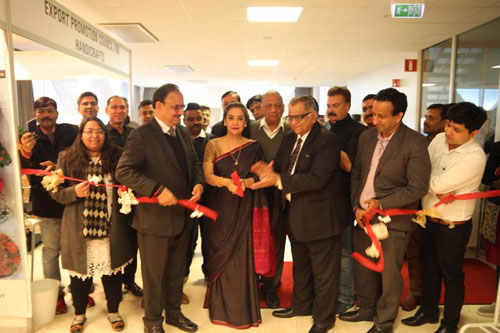 thinking. India’s exports to the Scandinavian region have seen a healthy and consistent growth with Indian manufacturers and exporters growing knowledge of market trends and consumer preferences.
The main export markets for Indian handicrafts are the US followed by the EU, Middle East and the Far East. However, Scandinavian countries are emerging as a new potential destination for exports of handicrafts. Indian craftsmanship, ethnic designs and colors are unique and have no comparison with products from other countries. The range produced in India is very large and wide and the quality and price structure varies from high-end market to middle end market.
Todd Dalhausser appointed President of VF Corps brand Altra
VF Corporation, a global leader in branded lifestyle apparel, footwear and accessories has appointed Todd Dalhausser, Brand President, Altra®, effective immediately. He will report to Steve Murray, Vice President, Strategic Products.
Dalhausser was earlier employed with Wolverine Worldwide, where he served as Senior Vice President of Sales for Saucony North America, one of the leading brands in the Running Specialty sector. He managed Saucony/Hind’s apparel business, where he oversaw design, development and product merchandising. He also held similar positions for both Vans® and Reebok.
The appointment of Dalhausser as President of the Altra® brand provides an opportunity for Brian Beckstead, co-founder of Altra®, to assume a new role as Founder and Chief Marketing Officer. In this role, Beckstead will be responsible for all Product and Marketing for the brand. Beckstead will report to Dalhausser.
Applied DNA Sciences develops denim tags that survive harsh processing
The tags of Applied DNA Sciences (APDN) can be used to authenticate denim products, even when subjected to harsh processing. The tags added to the denim material prior to stone and bleach washings used in the production of finished garments are still detectable afterwards. They remain intact and are suitable for high quality forensic scale analysis after processing.
Denim undergoes the harshest treatment among apparel products. APDN provides its tags to companies in the textiles industry. This technology enables brands and manufacturers to track their fibers from the farm through to the finished product, allowing for a more transparent supply chain.
Traceability can also help verify certain sustainability claims about commodities and products, helping ensure good practices and respect for people and the environment in supply chains. In future, Applied DNA Sciences will tag cotton intended for denim use, as well as other premium fibers such as wool, cashmere, manmade fibers like viscose, nylon, and recycled polyester, and bio-based fibers. The company has a defined goal of having 3,00,000,000 sq. ft. of DNA-tagged leather under contract over the next five years.
There has been a lack of commercially available test methods to determine where denim fibers are grown, and this is a concern to manufacturers, as global counterfeiting continues to escalate.
VTG 2018 and VitaTex organised in HCM City
The 18th Vietnam International Textile & Garment Industry Exhibition (VTG 2018) and the Vietnam International Textile and Apparel Accessories Exhibition (VitaTex) were organised on November 21, 2018 in HCM City. The events featured over 500 exhibitors including 100 brands from 13 countries and territories: Bangladesh, mainland China, Germany, Hong Kong, India, Indonesia, Japan, South Korea, Malaysia, Singapore, Taiwan, Turkey and Việt Nam.
Many sewing machines brands from mainland China and Hong Kong such as Adler, Leman, Siruba and others were also present at the expo. The events will include a number of seminars on issues like: the US-China trade war, a study of effective competitive strategy of garment company in Việt Nam, solutions for saving energy in the textile industry, automation, digitalisation, and challenges facing the Việt Nam textile and garment industry.
The expos are organised by Vinexad National Trade Fair & Advertising JSC, Yorkers Trade & Marketing Service Co Ltd, Guangdong Sewing Equipment Chamber Commerce and Paper Communication Exhibition Services, and the Hong Kong Apparel Machinery Association.
Nigeria to revive country’s textile industry
The Nigerian government vows to revive the country’s textile sector. Textile Company, the Vlisco Group will invest US $ 200 million in a textile factory in Nigeria. The President plans to encourage the cultivation of cotton in the country as it would offer jobs to thousands of people thereby keeping farmers busy as well as enhancing the economy of the nation.
Further, the government also plans to change the supply chain from Asia to Nigeria. It wants to promote the use of Nigerian cotton and also encourage the creative industries in the country to find a voice.