FW
Pure London show begins July 22
Pure London will be held from July 22 to 24. The message this season is all about the future, making a better future for all, discussing relevant and pertinent issues facing the industry.
With a host of other informative talks confirmed, styling seminars, regular WGSN trend briefings and live catwalk shows, Pure London will deliver an insightful and thoughtful fashion experience. Pure London is the UK’s leading trade fashion buying event, representing women’s wear, men’s wear, footwear, accessories and young fashion. The show offers buyers from UK and around the world an opportunity to discover collections launched for the season, attend catwalk shows and hear from their peers and other industry experts in valuable seminars and workshops.
As sustainability shifts to being an integral part of the entire fashion value chain, Pure London is keen to take the lead as a disruptor in the industry, to probe key issues and offer visitors an inspiring and educational content program that helps guide brands and retailers towards alternative business models and new concepts centered around sustainability.
Pure will have an exciting mix of brands and some of leading champions driving a better future for fashion. Visitors can learn about new technologies making this new era possible.
Isko organises fifth edition of educational project
Isko held the fifth edition of its educational project, Isko Iskool Denim Award, in Milan’s BASE. This year’s theme was ‘UnDocumented’ which tried to imagine the future of denim from the point of view of newly graduated students from around 30 international fashion schools. It involved them in projects interpreting values of sustainability and respect for the environment.
Around 216 contestants participated in the event which included students from highly qualified fashion schools and young creatives. The 32 chosen finalists included 20 students who participated in the Denim Design Award and 12 others who participated in the Marketing Award, all supervised by Isko’s marketing team and Creative Room - the company’s creative studio based in Castelfranco Veneto, Italy.
The shortlisted participants were voted by two distinct juries of experts, partners and insiders and were awarded at the special final event and party held in Milan.
Bangladesh refuses to extend the tenure of Accord and Alliance
The Bangladesh State Minister for Labour and Employment has said the government will not extend the tenure of Accord and Alliance as the Remediation Coordination Cell (RCC) is capable of running inspection and monitoring of workplace safety in garment factories. RCC was set up in May last year through the collaboration of the Bangladesh government, the Bangladesh Garment Manufacturers and Exporters Association, and the Bangladesh Knitwear Manufacturers and Exporters Association, with technical support from International Labour Organisation. The government has already recruited 130 inspectors to run the cell, which will work as the permanent body for the inspection of workplace safety.
The government has extended the tenure of the Accord and the Alliance for Bangladesh Worker Safety for six months so that they can take preparations for departure from the country. As per the decision, the buyer-driven groups will run their operations upto December 31, 2018.
Chargeurs Fashion to acquire PCC’s interlining biz
Chargeurs Fashion Technologies, the world's second-largest apparel interlinings manufacturer, is acquiring Precision Custom Coating's interlinings business. The acquisition consisting of a share deal of PCC Asia and an asset deal of the PCC USA interlinings business carveout, is expected to result in no redundancies and be completed by the end of 2018. The acquisition will expand Chargeurs Fashion Technologies’ global footprint and propel the business into new technical performance wear categories, such as outerwear, performance apparel and athleisure, as well as intimate apparel.
Chargeurs Fashion Technologies currently works with luxury, ready-to-wear and fast-fashion brands that include Chanel, Gucci, Hermès and Uniqlo. The company, since 2015, has been executing a strategy that involves a more selective marketing approach. It has been systematically upscaling its offerings, showcasing them in new showrooms in Paris, New York and Milan.
Angela Chan, managing director and president of Chargeurs Fashion Technologies, will oversee the company’s worldwide expansion. Chan is an industry leader with expertise across sourcing, business development, merchandising, product development and multichannel retail in North America and Asia. Also, current the CEO of PCC, Scott Tesser will join Chargeurs Fashion Technologies as Chief Sales Officer and will be responsible for the combined entity’s global sales strategy.
PCA closes two Bangladesh Accord arbitration cases
The Permanent Court of Arbitration (PCA) has closed two landmark cases against multinational fashion brands brought under the Bangladesh Accord on Fire and Building Safety. The brands met all terms of the settlements, including paying more than $2.3 million towards remediating unsafe conditions in Bangladesh ready-made garment factories. The Accord will distribute the money to eligible factories.
The arbitrations were filed in July 2016 and October 2016 to bring recalcitrant brands into compliance with the terms of the Accord. The brands did not require the contracted factories to remedy hazards in a timely manner—leaving thousands of workers in dangerous conditions. The unions also charged that the brands did not ensure that contracted factories had the financial resources to fix ongoing safety issues.
Africa’s apparel exports to the US on the rise
African countries posted solid growth in apparel exports to the US during the first five months of 2018. Kenya remained the largest exporter from the continent followed by Lesotho, Madagascar, Mauritius, Morocco, Ethiopia and Tanzania.
Kenya’s apparel exports to the US grew 11.57 per cent year on year. Lesotho’s apparel exports to the US noted a decent growth of 9.27 per cent. Madagascar too showed impressive growth of 28.16 per cent on a year on year basis. Mauritius and Morocco were also up by 5.64 per cent and 9.96 per cent in their respective exports. Ethiopia’s exports to the US grew 106.55 per cent.
One major reason for booming garment exports from African nations to the US is investments by giant Bangladeshi garment groups to avail of duty privileges under AGOA. African countries enjoy duty-free and quota-free access for certain goods, including garments, to the US.
As China transitions towards higher value-addition in manufacturing and services, the African textile industry has a chance to take a share. Fashion products from Africa benefit from a tariff free access to the UK market as part of the EU trade policy, which makes them significantly cheaper than products imported from Asia.
Cotton import export to see a sudden shift amid US-China trade war
"Amid retaliatory tariff measures, tension between the US and China seem to be increasing and the substantial impact would be on cotton imports and exports. As highlighted by Jon Devine, Senior Economist, Cotton Incorporated, China’s cotton imports have been on the rise and are expected to continue climbing over the next several years now that its government-controlled cotton stockpile has dwindled and because it can’t meet demand with its domestic cotton supply. Devine says, China traditionally has a production deficit between 10-15 million bales. That deficit had been filled by reserves in recent years, but with reserves now lower, that gap should be increasingly filled by imports."
 Amid retaliatory tariff measures, tension between the US and China seem to be increasing and the substantial impact would be on cotton imports and exports. As highlighted by Jon Devine, Senior Economist, Cotton Incorporated, China’s cotton imports have been on the rise and are expected to continue climbing over the next several years now that its government-controlled cotton stockpile has dwindled and because it can’t meet demand with its domestic cotton supply. Devine says, China traditionally has a production deficit between 10-15 million bales. That deficit had been filled by reserves in recent years, but with reserves now lower, that gap should be increasingly filled by imports.
Cotton faces tariff barriers
With growing tension between the two economies, it remains to be seen how China will satiate its supply of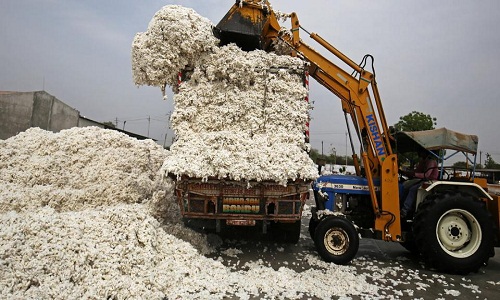 cotton. In the 2017-18 crop year, the US should export 16.2 million bales. In comparison, the next largest exporter is India at 5.0 million bales. It would take the sum of India, plus the next six largest shippers to equal the volume that the US ships.
In that regard, if China increases its imports by 5-10 million bales over the next several years, it is hard to see how that would not benefit the US because the pool of exportable supply is limited once you move beyond the US. If the US does prove to be unaffordable for Chinese mills with the tariffs, the cotton that is redirected to China from other sources (e.g., India, Brazil) should open up demand for US cotton in other import markets (e.g., Vietnam, Bangladesh) where cotton from non-US exports could have otherwise gone, stated Devine.
As per figures, over the 2012-13 to 2017-18 period, China’s share of US exports dropped from roughly 40 per cent to between 10 per cent and 15 per cent. The implied tightness in exportable supply suggests upward pressure on prices. Collective stocks for the world outside the US are forecast to reach a record this summer, and collective volume will serve as a buffer against a rising tide of Chinese import demand. In terms of supply chain reactions, if the tariffs do remain in place, the flow of cotton through Vietnam could be expected to continue to be profitable.
Considerable gains
Vietnam has seen significant growth in cotton mill use of late. Devine points out, Chinese government controls on cotton fibre imports has fuelled much of that growth. Because there are no quantitative limits on cotton yarn imports (there are limits on the tonnage of cotton fibre) and because duties are either low (5 per cent for India and Pakistan, countries without FTAs with China) or non-existent (countries with FTAs with China, like Vietnam), it was cheaper for Chinese fabric mills to import yarn. A lot of that yarn came from Vietnam, and over half of all the fibre spun into yarn has gone to China for the past several years.
The possibility that the tariffs could result in an economic downturn is a concern. Tariffs can lead to higher consumer prices which means the Federal Reserve may look to more increases in interest rates. Higher interest rates can slow economic growth, and there is a concern that overly aggressive increases in interest rates could be a factor contributing to the next US recession, cautioned Devine.
Vietnam, India to jointly develop textile industry
The governments of Vietnam and India have prioritised development in garment-textiles industry to enhance bilateral trade and build a supply chain for the sector in the future. Currently, India owns a strong fiber and yarn production industry that produces all kinds of fabric and supporting materials available in the market. India also produces and exports textile products from synthetic yarn, a material fabric that is being used widely in the world garment industry with high expansion prospects in the future.
Meanwhile, Vietnam is in the top five garment exporters in the world with export turnover reaching $ 31 billion in 2017. However, Vietnam has had to import a large volume of materials for the sector, with US$ 19 billion in import value in 2017. India and Vietnam can thus supplement each other in the supply chain of the garment sector, the two-way trade in the area remains modest. In order to promote cooperation and improve trade in the sector, India has set a target of exporting $1 billion in materials to Vietnam in the coming time.
This cooperation in the garment and textile sector between Vietnam and India will pave the way for enterprises of both sides to optimise their strengths and advantages. Vietnam will benefit from more materials, technology and equipment for production, while India can expand its markets.
UN proposes to shift textile production to biogradable textiles
A new United Nations initiative that aims to make forests more fashionable has proposed that textile production should be shifted from fossil fuel-based synthetic fibers to renewable, biodegradable textiles, made from wood.
The fashion industry is responsible for producing 20 per cent of global waste water and 10 per cent of the global carbon emissions – more than the emissions of all international flights and maritime shipping combined. In addition, the textiles industry has recently been identified as a major polluter, with estimates of around half a million tonnes of plastic microfibers ending up in the world’s oceans as polyester, nylon or acrylics are washed each year.
Although the 2030 Agenda for Sustainable Development and the Sustainable Development Goals (SDGs) are an ambitious blueprint for governments, everyone must make a conscious choice to change habits and plan for the future. Moreover, forests can create productive ecosystems, to support local and rural communities. to the UNDP envoy forest.
Tirupur exporters welcome duty hike
Tirupur garment exporters are happy about the increase in basic customs duty from 10 to 20 per cent on specified garments. Duty hike on import of 23 knitted garment items and one knitted fabric is expected to help protect the domestic textile industry.
Knitwear exporters had been appealing for swift action in this regard as textile imports from countries such as China, Bangladesh, Vietnam and Cambodia have increased significantly. Textile imports grew at a CAGR of 17 per cent in the last five years and last year readymade garment imports increased by almost Rs 1,000 crores to Rs 4,983 crores in 2017-18 from Rs 3,994 crores in 2016-17.
Exporters say there is a need to restrict import of textile products. They have prepared a white paper detailing the threat from China, with Chinese companies setting up factories in countries bordering India to take advantage of labor, low wages and customs exemption available to these countries in EU and Canada.
Under the South Asian Free Trade Area (SAFTA) agreement, specified garment items imported into India from Bangladesh are also exempted. Exports of Tirupur in the last financial year have gone down by 5.6 per cent from the previous year.