FW

Clean Clothes Campaign is dedicating this year’s International Labor Day to the hundreds of thousands of workers who produce garments for H&M. They are waiting for the brand to stop turning its back on the commitment that living wages would become a reality by 2018. Starting on May 1 and continuing throughout 2018, Clean Clothes Campaign (CCC) is placing the spotlight on H&M.
The brand’s public commitment to ensure workers receive living wages, and the associated roadmap, received a lot of positive media coverage in 2013, along with cheers from countless consumers who care about sustainable fashion.
However, the roadmap failed to state a living wage benchmark, among other issues. More than four years after H&M published the roadmap, hundreds of thousands of workers producing H&M’s garments are still not receiving living wages. Together with the International Labor Rights Forum and other international partners, Clean Clothes Campaign will be making sure throughout the year that consumers are aware of H&M’s 2013 living wage commitment, of the brand’s ability to fulfill it, and of the current practice: stocking shelves on the backs of workers who have to constantly worry about how they will feed their families, keep a roof over their head, send their children to school, pay for doctors' visits and cover other basic needs.
As per Pew Research Center study, Bangladesh, Cambodia, Sri Lanka, Pakistan, Vietnam, and other such nations pay highest import duties in the US market, due to their substantial trade in clothing and footwear. Amongst them Bangladesh paid the highest tariff of 15.2 per cent of the value of its shipments. In 2017, Bangladesh’s exports to the US totaled $5.7 billion; 95 per cent of these included clothes, shoes, headgear, and related items.
As the US is Bangladesh’s single largest export destination, about 20 per cent of country’s export receipts come from the US. ITC database shows, the reason for such high tariffs is protectionism. The average American tariff for knitwear or crocheted clothing is 18.7 per cent and 15.8 per cent for non-knitted clothing, the two highest average rates out of 98 broad import categories. Footwear is close behind with the average tariff rate of 11.9 per cent.
 The ongoing tiff between US-China trade will have significant impact on global economic landscape. How things pan out is still not known, yet going by the present picture, things don’t look too bright between the two countries with severe allegations made by the US government on China. President Trump on April 3 released a long-winding list of Chinese imports that his administration intended to target as part of a crackdown on what he believed to be unfair trade practices. The sectors covered by the proposed tariffs included products used for robotics, IT, communication technology and aerospace. The US Trade Representative (USTR), said it was targeting products that benefit China's industrial plans while minimising the impact on the US economy.
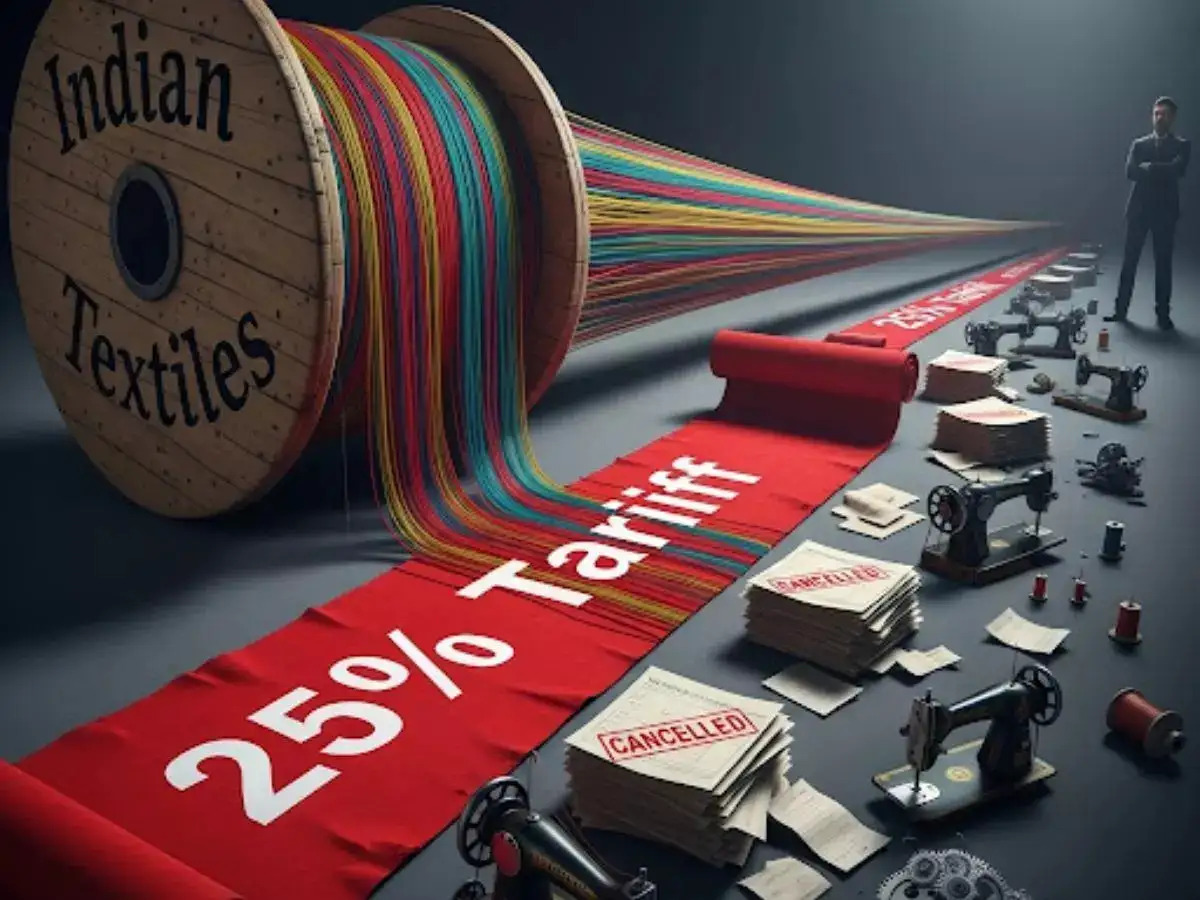
The US was expected to levy tariffs on $50 billion to $60 billion of Chinese imports annually. The official announcement underlined that the total value of imports subject to the tariff increase would be equal to ‘the harm caused by China’s unreasonable technology transfer policies.’ The official note remarked that the Trade Representative proposes an additional duty of 25 per cent on a list of products from China. The American list included over 1,300 imported products. The Chinese reaction was immediate. The next day, it announced additional tariffs on 106 US products. This was in addition to 128 other US export products that had been listed earlier by China. The effective start date for the new tariffs has not been announced, though China’s ministry of commerce made it clear that the tariffs were designed to target up to $50 billion of US products annually.
On the ongoing situation, Rick Helfenbein, President & CEO, American Apparel and Footwear Association, stated the industry is pleased with the administration’s decision to avoid adding tariffs to US imports of apparel, footwear, and travel goods from China. At the same time, they showed their concerned towards the list that includes tariffs on machinery used in their domestic manufacturing process. This would directly raise costs on domestic manufacturers and impact their ability to grow Made in USA. Speculations are rife that the cost of doing business would go up, and even though the US President harped on the job protection string, many believed that the additional tariffs would only push up costs of apparel for the average American customer. American companies have already scouting for alternative sourcing hubs, since domestic apparel manufacturing would become more expensive with the additional duties on machineries.
Stats and the impact
As a retaliatory measure, apart from cotton, China proposed additional tariffs on soybeans and pork. The National Cotton Council averred that China is the second largest export market with purchases of approximately 2.5 million bales of US cotton. Ron Croft, chairman of the Council, said that no one can overstate the importance of China’s market to the US cotton farmers and the importance of US cotton in meeting the needs of China’s textiles industry. The cotton industries of the US and China enjoy a healthy, mutually beneficial relationship. In lieu to this, the NCC encouraged the two governments to engage in immediate discussions that can resolve trade tensions and preserve this long-term collaborative relationship. The US cotton industry stands ready to assist the US Government and its trading partners in China to find a resolution to this damaging trade dispute. The high-profile United States Fashion Industry Association (USFIA) had, even reiterated over an earlier statement that while they support efforts to protect the intellectual property of brands and retailers, they will never support punitive tariffs based on the fiction that imports harm domestic jobs and growth. These new tariffs will not create more jobs in the United States, but instead, will harm the companies that already create thousands upon thousands of high-quality jobs in design, in marketing, in retail, in logistics, in compliance, right here in the US.
The way ahead
China produces about 32 million bales of cotton but needs roughly 45 million bales; the shortfall is met by imports. China’s cotton stockpile is expected to come down to around 15 million bales by the end of this year; much of that is reckoned to be of poor quality. Among the initial reactions after the conflagration broke out were those from the cotton sector in India. Early speculations hovered over the possibility of India trebling its cotton exports to China. Atul Ganatra, president, Cotton Association of India, stated that India was looking to sell between 2.5 million and 3 million bales, each of 170 kg, to China in the next marketing season beginning October, up from around 800,000 bales of expected exports in the 2017-18 marketing year. This year China is scheduled to import 2.5 million bales of cotton from the US, with the other major suppliers being Brazil and Australia. But for India to replace Australia, to start with, as the second largest exporter of cotton to China, Indian cotton will need to match that of the Australian variety.
Thanks to the rise of fast fashion, textiles waste in the UK has been sharply increasing in recent years.
But now high street names like M&S, Tesco and Sainsbury’s have set ambitious sustainable cotton targets.
Retailers and brands are focusing on a number of priority garments which have been identified as having the highest environmental costs in terms of manufacture and which sell in the largest numbers.
Top of the list are women’s dresses, jumpers and jeans, followed by men’s T-shirts and jumpers. Women’s jeans have been singled out in terms of the amount of water used during their production while dresses and jumpers and men’s T-shirts are similarly high volume products which require work to tackle their carbon footprint and supply chain waste.
The amount of clothing in household residual waste has decreased since 2012, falling by 50,000 tons in the household waste stream. This is a fall of 14 per cent and represents the equivalent weight of more than 300 jumbo jets.
Reuse and recycling signatories are helping divert an increasing amount of clothing away from landfill at end of life.
But though fewer clothes are ending up in residual waste, clothing purchases have risen over the last five years. This is due to relatively low prices and the increased population.
Asos, Wrangler and Primark are among the major fashion brands that are becoming more transparent about their supply chains.
The 3rd annual Fashion Transparency Index, which ranked 150 major global brands according to how much they are willing to reveal about their social and environmental practices, shows that the industry has a long way to go before it can confidently tell us
Many online and high street favourites scored less than 10 per cent. The report found that things are slowly moving in the right direction. More brands have published a list of where their clothes are cut, sewn and completed and 62 per cent of brands are disclosing their process for fixing problems when violations are found in a supplier factory.
However, with none of the brands scoring more than 60per cent there is still a lot of room for improvement.
The Fashion Revolution campaign believes that although change is slowly happening, many companies are still operating in broadly the same way that enabled the RanaPlaza disaster to occur.
According to the an ambassador for Adidas there are people working on sustainability within these companies every day, but it’s not easy to track every cotton farm and everyone involved, as there are thousands of locations around the world. Fashion Revolution co-founder, Carry Somers, agreed that the fight for sustainability is not an easy one, but how brands are responding to the report by upping their game proves that improvements can be made.
The textile industry was one of the booming sub-sectors of the Nigerian economy in the post independence years.
Driven by locally grown cotton and with a huge demand for clothing by a fast growing population, it provided direct and indirect employment to hundreds of thousands of Nigerians for several decades.
Between 1985 and 1991, Nigeria’s textile industry recorded an annual growth of 67 per cent. In that period textile companies numbered around 180, employing about a million people, and accounting for over 60 per cent of the textile industry capacity in West Africa.
The story, however, changed in the early nineties when the sector took a massive dive. From about 180 thriving textile companies, the number came down to almost zero.
Over the years, there has been a steady decline in the operations of textile firms and then an eventual collapse of the industry, which has led to a loss of jobs, dearth of skilled manpower, low capacity utilization and drop in revenue due to lack of excise duties.
The dip in the fortunes of the industry was due to the influx of cheap textiles and fabrics into the country from all over the world and mainly from China.
Now the country is trying to attract the necessary investments into cotton farming and textile manufacturing and so become a major producer and exporter of textiles in the world.
Japan textile industry have expressed willingness to invest for a number of unique fabrics of their innovation to Indonesia.
Director General of Small and Medium Industries (IKM) of Ministry of Industry, Gati Wibawanings says that several Japanese textile industries have come to him and expressed his desire to invest in Indonesian sector.
He further added that a message from a Japanese company from Usawa was received that expressed their desire to build a cotton textile industry with silk quality.
They claim to want to produce fiber (fiber), yarn as well as fabric made from cotton. The technology they found with merebushancurkan cotton was able to produce fiber and yarn and even fabric with silk-like quality when made from cotton.
Usawa company representatives view Indonesia as very suitable for cotton plants because it only has 2 seasons. At present they are ready to build the innovative textile industry to Indonesia.
Gati mentioned that, other companies interested in developing fabric / textiles made from hemp. They are planting hemp on 2 hectares of land in Malang, and if successful, they declare will build fabric fabrics factory in Indonesia.
Indonesia hopes to triple textile and textile product exports in the next five years.
If this happens, this sector will be Indonesia’s largest non-oil export contributor and create jobs for six million people.
Indonesia’s exports in 2017 went up six per cent compared to exports in 2016. Apparel exports rose from 7.21 billion dollars in 2016 to 7.93 billion dollars last year, while textile exports stagnated at 4.66 billion dollars.
In 2016, apparel exports from this southeast Asian nation decreased 3.2 per cent due to several challenges including high logistics costs and gas and power tariffs being higher than other competitor countries.
At present, the US is the largest clothing importer from Indonesia. If the country were to lobby with the US to expand its Generalised System of Preferences to include more Indonesian apparel and accessories, this would facilitate the entry of more Indonesian products into the US at lower tariffs.
A small 0.62 per cent year on year growth was detected in Indonesia’s textile exports in the first half of 2017. This modest growth was supported by a 20.4 per cent year on year rise in knitwear exports.
Indonesia is one of the world’s largest textile manufacturers and exporters (although trailing far behind China).
Gifts and Premium Fair has just concluded on at Hong Kong, held between April 27 to 30.
More than 4300 exhibitors from 33 countries and regions are participating in the fair including group pavilions from China, Italy, Korea, Macau, Taiwan, Thailand and India displaying a wide range of corporate gifts, fashion accessories, green gifts, picture and photo frames, toys and sporting goods, beauty, health and wellness, watches and clocks, luxury gifts, premium gifts etc.
The fair is the largest fair of its kind in the world and an effective platform for designers, manufacturers and wholesalers to make new business opportunities.
Hong Kong is emerging as an important destination for aggressive marketing through the medium of trade fairs.
Indian exhibitors had showcased a wide range of products, which include handcrafted and decorated premium gifts, souvenirs, lifestyle accessories, cotton scarves, necklaces, picture frames, boxes, pen stands, note books, shawls and stoles, handmade paper products, jute, cotton, canvas bags, women’s hand bags, leather hand bags, Christmas decoratives, wooden decorative art ware, stationery, table tops, grocery bags, and decorative journals etc.
Handicrafts occupy an important place in the Indian economy and society. This product group is a large foreign exchange earner, an employment generator for economically and socially backward classes and a promoter of Indian ethnic, cultural heritage worldwide.
Demonetization and GST have hit hard textile businesses in Surat. Production of fabrics has dropped from about four crore meters a day before demonetization to about 2.5 crore meters a day. The number of working embroidery machines has fallen and the demand for new shops has also dropped.
Exports of garments have dropped drastically. Fabric traders are not getting payment on time. Traders are facing a shortage of working capital. Institutional loans are not available and private lending has also stopped after GST.
Sales of local textile traders have dropped by about 30 per cent to 40 per cent. Falling earnings have resulted in traders’ shifting to low rent shops and demand for new shops has dropped. Those who had availed of loans are finding it difficult to honor their EMIs.
The number of embroidery machines has dropped by 1.25 lakh, 89,000- odd power looms have been sold at the price of scrap, exports are on a continuous decline and women working in embroidery are becoming jobless.
The withdrawal of high-value banknotes put sudden brakes on the disposable income of consumers. Many power loom weavers shut down their units and more than a lakh conventional power loom machines were sold in scrap.
Where till recently Surat produced 40 million meters of polyester a day, the figure now stands at only 25 million meters.