FW

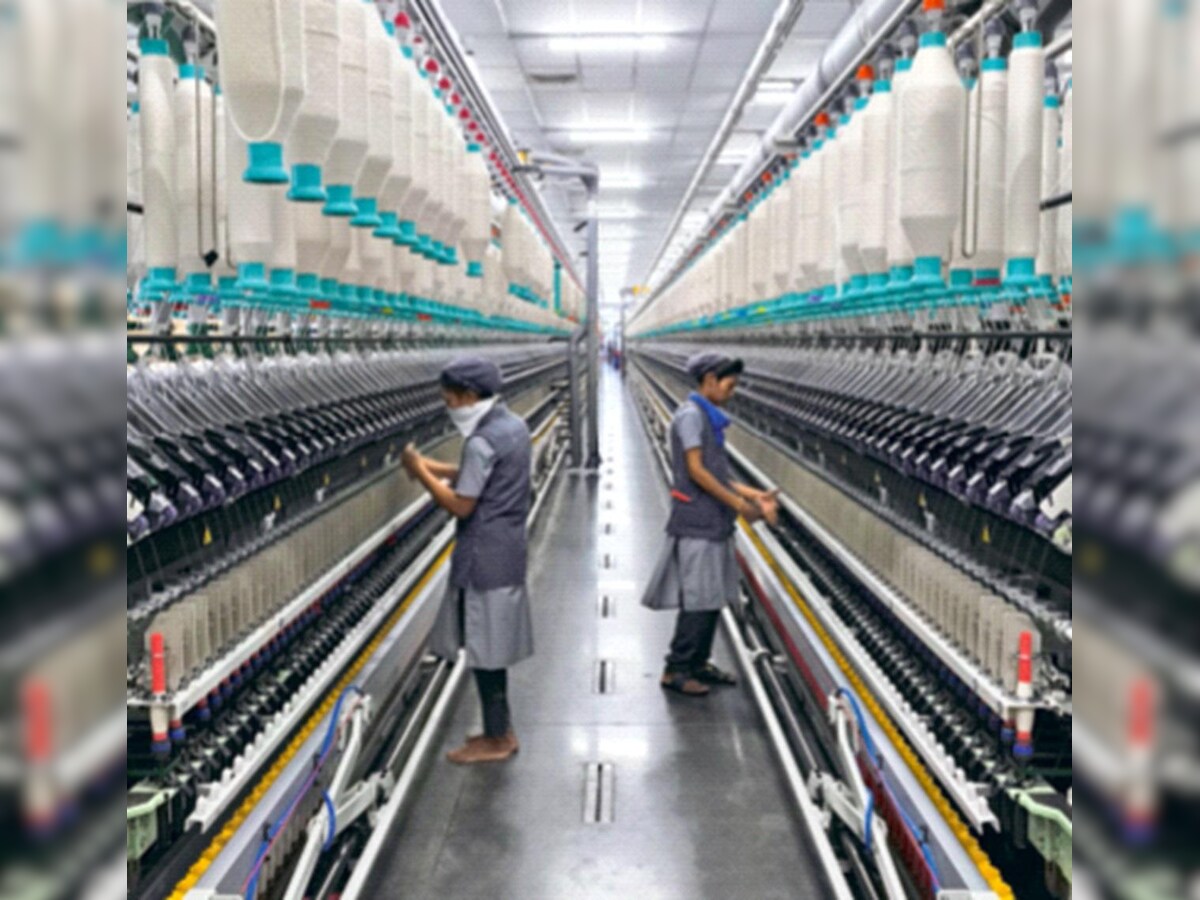
World Bank President Jim Yong Kim said recently that automation could render about two thirds of jobs in the developing world redundant. An ILO report on Textile and Clothing Sector in ASEAN states the textile, clothing and footwear (TCF) sector is at the highest risk of losing jobs to automation. Reports suggest Raymond will be firing 10,000 workers across its 16 manufacturing units in India. These workers will be replaced by robots in around three years
Adidas, in 2016, successfully tested an automated shoe factory, ‘Speedfactory’, using 3D technology and robotics. Under consideration is another automated plant in the US as well as its newest factory in 2018 in Arkansas which will house autonomous robots — and their human supervisors— will be able to daily manufacture 8,00,000 sports shirts.
Texprocess, a major trade fair for the international garment-manufacturing and textile processing industry, put on display a Digital Textile Micro Factory at its May 2017 show in Frankfurt, Germany. It was a live demonstration of an integrated production chain for apparel right from the design stage to digital printing to automated cutting to sewing.
The threat from automation is real and developing countries such as Bangladesh cannot escape this threat as “we service the same brands that will demand higher productivity, lower cost, lower carbon footprint, better working condition, quicker turnaround time, and flexibility” said an industry expert.
In Bangladesh, over four million workers in the garment industry are earning over 82 per cent of the nation's overall export income. The main ‘product’ of Bangladesh is the labour of the millions who take raw textiles and turn them into finished garments, however, much of this labour is concentrated in the final phase of production before shipping known as ‘Cut and Sew — the same process that Western innovation is working to automate. The question now is for how long Bangladesh can sustain production on the ‘low labour cost” advantage? A fiscal rethink may soon be necessary if the wave of automation causes large numbers of job losses. Then making the robot pay tax and using the money to retrain humans may be a solution to a problem.
Eco Fashion Week, a Vancouver-founded, not-for-profit event that highlights environmentally friendly designers and garments, has canceled its 13th edition for 2018 and will not move forward with additional shows. Following eight years and 12 editions, the fashion event dedicated to showcasing and promoting sustainable practices in the fashion industry, has canceled its 13th edition indefinitely.
Organizers of the Vancouver and Seattle-based non-profit event noted a lack of support, which made it increasingly hard to produce a sustainable event that its volunteers could properly organize. Founded in 2010, EFW offered a platform for 160-plus environmentally minded designers and labels from over 15 countries, including Vancouver’s own Mishel Bouillet, Obakki, and Bianca Bellatoni. It brought together 100 speakers and 80 vendors as part of its panel discussions, which saw figures like Esther Speck, vice president of global sustainability at Lululemon; local designers John Fluevog and Nicole Bridger; and Tony Shumpert, vice president of reuse and recycling at Value Village, converging in Vancouver to address how we can more sustainably produce, reuse, and dispose of clothing.
Although EFW is bowing out of Vancouver’s fashion circuit, Laroche hopes that designers, retailers, and consumers alike will continue to re-evaluate their own manufacturing and consumption habits.
Comfort, performance and luxury are key elements for Trident’s new sheet launches at Heimtextil this week. Trident’s new generation wrinkle-free finishing, creating a super soft sheet combined with comfort features such as moisture management and breathability. Air Rich yarn makes the sheeting soft and smooth. The collection was developed using a special technology that adds to the strength and the luxurious look also provide a smooth drape that lasts through multiple washings.
The Tetra Fine ultimate performance sheet provides an all-in-one offering of four key attributes: Moisture management, quick dry comfort, anti-pilling and wrinkle resistance.
NectarSoft is finished with a unique yarn and fabric treatment that helps remove weak cotton tendrils. The result is a lustrous, internally smooth and ultra-soft sheet with a graceful drape.
Hyde Park is a pure luxury collection made of 100 per cent Egyptian cotton. High 500-count construction provides strength and lustrous sateen weave. The brand is introducing products that enhance one’s bath experience with premium blends and innovation in yarn construction in their towel range.
The company in a statement said, “Today, the definition of luxury is focused more on our personal quality of life. Luxury, in its new context, is the enjoyment of the best in life.” Durasoft employs a unique innovation in spinning to create a luxuriously soft, absorbent towel with high resilience and minimal linting. Plush and thick from the start, the towels get softer and better with time. Their Tender Touch collection is crafted from a plush blend of luxury cotton, silk and Lenzing Tencel. The towels are breathable and more absorbent than a typical luxury towel as well as lustrous and silky soft. Using the mill’s Twist Management technology, the Feather Touch collection offers an extremely subtle feel as well as its eco-friendly attributes. This super thick and thirsty three-ply construction “takes our technology to the next level of luxury and sophistication,” the company said.
For the Stellar collection, Cashmere is intimately blended with cotton to produce a yarn that's naturally strong and traps moisture with a uniquely soft hand and luxurious appearance.
The North American market remains Trident’s largest trade area and it is expanding in Canada and Latin America. In addition, the company is putting a major focus on warehousing and drop ship this year as well as enhancing its design, product development and sales team in the US.
Target’s new denim collection, Universal Thread, is working towards becoming a one-stop shop for jeans with over 100 pieces from sizes 00 to 26W under $40. The collection is part of Target’s portfolio building initiative to roll out over 12 new, Target-only brands with unique points of view.
Universal Thread provides solution for a number of women’s fit problems with contoured waistbands, added back-rise coverage and slimming fabrics, while tackling the challenge of creating sustainable yet affordable denim. Select styles are made from recycled cotton. Jeggings are finished using Kitotex, a technology that uses Chitosan in the dyeing process to help reduce water, chemicals and energy consumption. A portion of the jeans have pockets made with Repreve polyester made from recycled plastic bottles.
The brand’s tagline is ‘the denim collection that’s true to you.’ Universal Thread uses a youthful and minimalistic aesthetic based on classics. Denim is coupled with baseball caps, silk kerchiefs, tees and natural leather handbags—similar to the accessible yet stylised looks that helped Madewell come to the fore.
The collection offers an encyclopedia of cuts including: skinny bootcut, mid-rise deconstructed skinny, mid-rise curvy skinny, mid-rise roll cuff boyfriend, high-rise skinny, high-rise jegging, high-rise wide leg, high-rise kick bootcut crop and high-rise wide leg crop. Universal Thread’s adaptive collection offers medium and dark wash bootcut jeans with a high-rise back, wider leg construction and flattened seams to help reduce pressure points.
Washes in the collection encompass light, medium and dark indigo, to white, grey and black. Floral embroidery and pops of coloured denim, like red, green and pale pink, add a summery feel to the line. The brand pays special attention to hems, offering released, split and raw hem finishes. Blouse options include off-the-shoulder tops and button-down denim shirts. Railroad jackets and embroidered Trucker jackets. Midi and mini-skirts, denim apron dresses and shirt dresses round out the collection. Universal Thread launches February 4 and will be available in Target stores and on Target.com.
Russia has guaranteed Bangladesh to provide duty-free and quota-free market access for Ready Made Garments (RMG) products soon. According to the discussion of World Tread Centre (WTO) Bangladesh gets duty-free and quota-free market access to Russia on 71 products but RMG was still not in the list due to some complications. To remove complications, Bangladesh has signed an agreement with Eurasian Economic Commission to be its member.
Soon Bangladesh will become its member and then RMG will get the duty-free and quota-free market access to the country. Meanwhile Russia wants to organise the next World Expo in 2025 and has asked Bangladesh to support them as it is one of members of World Expo who will elect the organiser through voting.
The New Year is looking good for Vietnam’s garment-textile industry, with exports estimated to fetch around $33.5 to $34 billion, up by 10 per cent year-on-year. Chairman of Hung Yen Garment Company (HUGACO) assesses the achievements recorded in 2017, thorough preparations of businesses and the government’s plan to support industry development will go a long way in helping the industry achieve strong growth.
The Vietnam Textile and Apparel Association (VTAA), noted at the beginning of last year, the sector overcome various challenges caused by the pending Comprehensive and Progressive Agreement for Trans-Pacific Partnership (CPTPP) and the falling international demand for apparel. Vietnam’s industry reversed the trend from the second quarter of the year and ultimately managed an export turnover of $31 billion, a rise of 10.23 per cent as against 2016.
In the year, Vietnam’s garment-textile exports to major markets such as the US, the EU, Japan, the Republic of Korea and Russia went up by 7.2 per cent, 9.23 per cent, 6.1 per cent, 11.8 per cent and 56 per cent, respectively. The growth of the Vietnamese garment-textile sector is rated the highest as against that of other garment-textile exporters such as China, India, Bangladesh, Turkey and Indonesia.
Vietnamese garment manufacturers’ are expected to get more orders in 2018, but face many issues including that caused by falling garment prices in many markets. Truong Van Cam, VTAA Vice Chairman, noted the domestic garment enterprises will have to compete with their rivals from Myanmar, Cambodia and Bangladesh in terms of insurance, land, tax, transportation and customs procedure costs.
Le Tien Truong, General Director of the Vietnam Textile and Garment Group (Vinatex), suggested local garment-textile businesses focus on technological applications, investment attraction and the building of connectivity chains of the VTTA. Besides spending more investments in design, original design manufacturing (ODM) should be increased to 10 per cent to raise added values of products. To achieve the two-digit growth target in 2018, VTAA advises businesses to adapt to market changes, expand the domestic market and diversify products, while forming effective production chains.
A comprehensive trade show and conference, the Apparel Textile Sourcing Miami (ATS-M) trade show will take place from May 21 to 23, 2018, at the Mana Wynwood Convention Center in Miami. The event will bring to Florida hundreds of international apparel and textile manufacturers from countries worldwide including, China, India, Bangladesh, the US, Turkey, Pakistan and Mexico. And as Moishe Mana, Miami-based billionaire developer and CEO of Mana Group says, “We are committed to making Miami the nexus for commerce between Asia, North America, and Latin America.
We’re excited to have ATS Miami join this initiative as the fashion and apparel industry is one of our core verticals.” The ATS brand has established itself internationally with Apparel Textile Sourcing Canada, held every August in Toronto. In 2017 the event grew by over 50 per cent in attendees and international exhibits. The same formula of success is the basis for ATS-Miami. “The expansion of the ATS Brand to Miami is a direct response to the market demand and fills a significant gap for the US-&-Latin American markets,” said Jason Prescott, CEO of JP Communications, organiser of the event and parent company to TopTenWholesale.com and Manufacturer.com, the most expansive network of business-to-business sourcing platforms in the US. Millions of international members use these brands to locate wholesalers and manufacturers. ATS-Miami provides a unique opportunity for apparel and textile importers and retailers to intersect and access the most current importing information from the top industry insiders. The producers are coming from Asia to Miami.
ATS-M will feature three days-worth of seminars, panels and runway shows featuring acclaimed industry and government experts, covering topics from trade agreements to best practices with an eye on the changing Latin American market, as well as tips on how to choose overseas producers, plus new approaches on succeeding in the US market.
The 4th edition of the Morocco International Fashion, Textile and Accessories Fair will open doors on March 28, 2018 at the Casablanca International Fairground, Morocco. The Morocco Style is becoming trendy following collaboration with Pyramids International and AMITH, Morocco's only textile Federation. Thousands of buyers from each region of Morocco and over 400 exhibitors will be part of Morocco Style to display their products for the African market.
Morocco, which has an FTAs with the EU and the US, provides many advantages to textile exporters. The country’s economy is growing every year following International trade and textile products are among the largest import items. Morocco Style is the best platform to enter into this market and participants will be able to take an advantage of all these opportunities with the buyer delegations and professional visitors from over 18 countries; mainly from neighbouring countries such as, Tunisia, Algeria, Portugal and Spain.
Casablanca, being the biggest city and port of Morocco, holds 80 per cent of Moroccan Trade in terms of volume. Morocco’s — whose fabric import is exempt from tax — imports high volume of fabrics which accelerates the export of ready-to-wear. This platform allowed national and international companies of different industry sectors to show and promote their skills, meet partners and find international brands from several countries. Thus ‘Morocco Style’ contributed to the consolidation of the Moroccan expertise in this area, consolidating the competitiveness of the Kingdom and making it an international reference hub.
At the 3rd edition over 312 exhibitors from 11 countries such as, Morocco, Turkey, Spain, France, Portugal, France, China, India, Italy, Pakistan, Tunisia along with 12,443 professional visitors from Morocco and 37 foreign countries from West and South Africa, North Africa, Middle East and Gulf countries, European countries such as Italy, Germany, Spain, Portugal, France, Belgium, Greece, Netherlands, England and America contributed the success of the expo.
The date released by Iran’s customs administration reveal, Iran exported over 3,000 tons of apparel worth $39 million in the first nine months of the current fiscal year (started March 20, 2017. Afghanistan, Iraq, Turkmenistan, Tajikistan, Kyrgyzstan, Pakistan, United Arab Emirates, Turkey, Oman, Azerbaijan, Kuwait, Armenia, Georgia, Yemen, Germany, Netherlands, Canada, United Kingdom, Lebanon, India, Norway, Japan, Spain and Australia were among the destinations of the country’s apparel exports.
Officials put the value of Iran’s apparel market at $11 billion. The Islamic Republic exported 3,800 tons of apparel worth $46.2 million in the last fiscal year (ended March 2017), up 2.6 per cent in volume and 3.9 per cent in value when compared to the previous year. Almost 1,500 industrial units with 30,000 employees are active in clothing sector, with 340,000 tons of producing capacity. The output currently reaches 300,000 tons of clothing items per year.
According to Iranian officials, only 10 per cent of Iran’s clothing import is legal, while 90 per cent of it is smuggled. Some experts believe that the abundance of foreign brands, which flaunt cheaper price tags, has eroded the competitiveness of domestic producers, as renowned foreign brands employ strong advertisement campaigns worldwide.
Unreliable Bt cotton seeds, perennially low cotton prices, a political regime that does not seem to care and of late the pink bollworm pest. A cotton farmer dejectedly says “Before the pink bollworm fiasco, we used to produce 800 kg per bigha (2.5 bigha is equal to 1 acre), now we produce only 500-600 kg. Now I am experimenting with chickpeas.” Other farmers are experimenting with onion. A team of cotton researchers admit that the pink bollworm is now resistant to genetically engineered Bt cotton. It is partly because farmers do not follow the advisories, they add. “We prescribe a number of measures to tackle the pink bollworm. But farmers in Saurashtra have become too casual,” says Dr Dhaduk of the Cotton Research Station housed inside the state-run Junagadh Agriculture University. “We prescribe measures to tackle pink bollworm. But farmers in Saurashtra have become casual. Research by government and private companies is on to discover BT with new genes. Maybe, that will tackle this pest,” the good doctor added.
Most farmers in Saurashtra, like in other cotton growing states, fear the pink pest may eventually slash cotton production in India. With 351 lakh bales per year (1 bale is equal to 170 kg). 2016-17 data of the Rajkot-headquartered Saurashtra Ginners Association reports that India is at the world’s leading cotton producing nations; Gujarat, with 95-100 lakh bales, is the leading state in India. Saurashtra accounts for nearly 70 per cent of Gujarat’s total production, besides housing 625 ginning mills handling 65 lakh bales of cotton.
The Indian Council of Agricultural Research (ICAR) met last month to find a solution to the pink menace. The issue resurfaced when Germany’s Bayer recently bought Monsanto. Radha Mohan Singh, Union Minister of Agriculture and Farmers Welfare admitted, during the past 2-3 years, resistance of BT cotton to fight pink bollworm has broken down. And farmers have been advised to follow certain steps. Reports say spurious seeds and pesticides are affecting farmers as well as the price of cotton has remained very low for the last two years. Not many farmers can afford to stock cotton and wait for a higher price. Brokers, traders and those who have the capacity to do so are making money in Saurashtra. The cotton bonanza in this district in the last 15 years has seen many exporters began growing to millionaires — that was till the little wiggly pink bollworms ‘Frankenstein’ emerged from their eggs and munched through the lovely cotton lint and chewed on the seeds.