FW

The upcoming Bangladesh Garment Manufacturers and Exporters Association (BGMEA) election took a dramatic twist after a new platform emerged to contest in the poll to ensure that leaders of the trade body are not selected arbitrarily. The platform, Swadhinata Parishad, unveiled its nine members at a press briefing in Dhaka. The garment sector's apex trade body was all set to get a new set of leaders through favouritism and not by ballot.
Shahidul Islam, Managing Director, Rupa Group and a former Vice-President of the BGMEA, was set to be formally announced on March 7 as the new president for the next two years. The convener of Swadhinata Parishad is Md Jahangir Alam, MD of Design and Source.
The other members are: Md Aminul Islam of Venix Bangladesh; Shahidur Rahman of Nova Apparels; Golam Mowla Chowdhury of Parents Sweater; Omar Faruk of Alliance Apparels; Ayesha Akhtar of Way Mart Apparels; Mahmud Hossain of DK Global Fashion; Ansarul Alam Lincon of Azra Enterprise; and Humayun Rashid Jony of Olira Fashion.
In a statement, the platform said the BGMEA has become an ineffective organisation as the leadership of the association has not been decided by ballot for a long time. “As a result, general members are being deprived of proper services and are facing harassment and negligence in some cases,” it noted. Swadhinata Parishad has decided participate in the election to choose leaders through direct member votes.
The Karnataka government has given the green signal to Kerala-based Kitex Garments to invest Rs 493 crore for a ready-made garments unit for infants in Hassan, Karnataka. The chairman and Managing Director of Kitex Garments, Sabu M Jacob, disclosed, “The government of Karnataka has given approval to the project. Now depending on how fast the government clearances comes through, the project will start.
Our plan is to start commercial production by March 2019.”At a recent meeting, Karnataka’s State Level Single Window Clearance Committee cleared 52 new projects valued at Rs 5,233.82 crore. Of this, investments valued at Rs 2,369.56 crore are approved for Bengaluru.
A release from the State Information Department noted, “An investment of Rs 2,864.26 crore has been approved for places outside Bengaluru. This reiterates the constant endeavour of the government to have overall industrial development of the State.” Jacob said the garments unit would be located in a steel building which would be imported from the Gulf — most likely Saudi Arabia. It will be nut-and-bolts job and would be set up very fast.
“Initially, the unit will have capacity of 1,500 to 2,000 people. In Phase 1, it will produce up to 2-lakh pieces of infant garments. After that, we will expand every six months. We intend to complete the expansion by 2021,” he disclosed. Andhra Pradesh is also luring Kitex Garments to take the company’s investment to that State by offering various sops to the company. The Andhra Pradesh government has given some very compelling proposals to invest in that State. For instance, it has offered free land, support in setting up the building, power at Rs 1 per unit and salary for the staff for three years, he informed.
Trident which has over 300 MBOs in India, is one of the largest exporters of home textile products from India. Trident exports to over 100 countries across six continents with clients like Target, Ralph Lauren, JC Penney, IKEA, Wal-Mart, Macy’s, Kohl’s, Sears, Sam’s Club, Taj, Oberoi Hotels, Sheraton Hotels, ITC Hotels and DMart. In FY17, 55 per cent of the brands net revenue was contributed by exports. In the bath and bed linen segment, 89 per cent of net revenue was accounted for by exports, primarily to the US as the domestic market is led by unorganised players.
The brand held 13 per cent share (of India’s 40 per cent share in CY16) in international towel exports to the US, while its share in Indian towel exports to that country was 32 per cent. As bed linen capacity is speeded up, the company aims to gain share in the US bed linen market by leveraging its existing client base from the terry towels segment.
Trident is focussed at achieving Rs 1,000-crore sales from the home textiles business in the domestic market by 2020 and double the segment’s contribution by up to 20 per cent. The company is considering adding new products, including rugs and pillows as it aims to be a complete home textile brand, besides expanding the retail network here.
The brand is set to achieve these by adding new categories and enhancing brand presence. The company gets 70 per cent of its sales from the US market, 20 per cent from the rest of the world and 10 per cent from the domestic market in the bed and bath linen segment.
Gradually as they will increase market share in India the shift will then be 60-65 per cent from the US market, 20- 25 per cent from Europe and the rest of the world and around 15-20 per cent from the domestic market in the next 2-3 years.
Sweden-based H&M has apologized for what many said was an insensitive association between the young model and a hateful slur against black people. It stated it had removed it from all its marketing. The advertisement was widely criticised for being racist, including by Canadian pop star The Weekend, who collaborated with H&M, the world's second-largest clothing group, on two collections in 2017. The company would not again after seeing the advertisement.
The word 'monkey' has long been used by some as a racial slur. Models for Diversity, a British-based organization advocating for more inclusion in the fashion industry, was one of many groups questioning how the photo made it through marketing teams and out into the world.
An official delegation from South Korea and the Gujarat Chamber of Commerce and Industry (GCCI) signed a MoU for co-operation between industries in Gujarat and the East Asian country, with a key focus on the automobile, defence and textiles sectors. The South Korean delegation was led by the country's Consul General in Mumbai, Kim Soungeun.
The key objective of the MoU is to help Gujarat-based small and medium enterprises (SMEs) explore opportunities through joint ventures with South Korean firms, mainly in areas of automobile, defence and textiles, said GCCI president Shailesh Patwari. "We import lubricants and auto parts for industry. Now that Gujarat is becoming an auto hub, JVs with Korean companies will help our SMEs. Our intention is also to support our SMEs in manufacture of defence equipment with the help of Korean companies," Patwari noted.
Korean companies are offering technical help to the textile industry in Gujarat to reduce costs and help them compete with Bangladesh and China and improve the ready-made apparel trade, he added.
Bangladesh has the potential to spiral up its annual garment export to $5 billion to China, says analysts. The country’s RMG sector is pampered with duty-free export facilities to China. Siddiqur Rahman, President, BGMEA says they are trying to grab a huge share of China’s local market. China has a population of 1.35 billion, including an increasing middle-class income people, who can be the best buyers of Bangladeshi products. Siddiqur also said his association has not yet drawn up strategies but has made a plan to enhance annual garment export to China to touch $5 billion over the next three to five years. Currently, the country’s RMG export to China is small. In fiscal 2016-17, the country notched $391.59 million from apparel export to China, which is 14.77 per cent year-on-year rise, as per data from the Export Promotion Bureau.
The export to China in FY 2015-16 was $341.22 million and $304.94 million in the previous fiscal. Mirza Azizul Islam, Finance Adviser of the former caretaker government, says China is the best destination but Bangladesh should also take steps to expand its market to the US and Europe. Bangladesh is now getting duty-free privilege in Chinese market and a sound G2G policy. Now, the exporters should focus on the market demand and boost the supply.
As per a recent study conducted by Switzerland-based International Textile Manufacturers Federation (ITMF), by end 2020, China would produce $750 billion worth of garments against $300 billion produced now, half for exports and the remaining for domestic consumption.
Currently, China is exporting 20 per cent of the garments it produces after meeting 80 per cent of the local demand. Statistics reveal that the remaining 20 per cent will be valued at around $200 billion by the end of 2020, as the country will have more than half a billion middle-class consumers. Seeing the huge potential market, the BGMEA has decided to enter the Chinese local market.
To promote apparel clusters and enhance exports, the Ludhiana-based apparel industry will seek the Centre’s assistance in setting up a Common Facility Centre (CFC). The facility will house state-of-the-art machinery such as a design studio, quality control facility etc, which member units cannot afford to acquire individually. The proposed CFC would be promoted through a special purpose vehicle.
SS Bedi, Cluster Development Manager, Ludhiana Apparel Cluster says, Ludhiana is one of the prominent hubs for the apparel sector in the country. The city has over 12,000 units manufacturing knitwear, winter wear and shirts but these clusters do not have any CFC to address the issues confronting the apparel industry. The industry is beset with issues such as obsolete technology and quality. To give a boost to this sector we will propose to the Ministry of MSME to grant a CFC. Under the Micro and Small Enterprises Cluster Development Programme, the Ministry can support the entrepreneurs with a grant from 70 to 90 per cent of the cost for setting up the CFC.
The CFC will be managed by a special purpose vehicle (SPV). About 25 members have been identified for the SPV. After the formation of SPV, detailed diagnostic study report (DSR) will be submitted to the Ministry for the financial assistance to be sanctioned under the cluster development programme.
Most of the manufacturing processes of member units would be completed at the cluster. The cluster would take care of manufacturing using latest machines, designing and product testing. Under the scheme, member units would be given an opportunity to exit their unit if they learn the processes and manage to set up the required machinery.
Ludhiana-based garment manufacturers are already facing a stiff competition from imported garments, especially from Bangladesh where production cost is lower. In such a scenario, the setting up of the CFC will assist them in acquiring cost-effective products and new designs of superior quality.
Building upon the successful launch of footwear and apparel made from recycled ocean plastic, Adidas Outdoor has launched an expanded Parley for the Oceans apparel line with performance outerwear for men and women. The brand will also introduce next generation design and innovation with variations on traditional baffles for increased warmth and protection and pair unlikely textiles and styles for that hybrid looks. The line will be on display at Outdoor Retailer Snow Show 2018, from January25 to 28, in Denver, USA.
Greg Thomsen, MD Adidas Outdoor says expansion to performance outerwear with Parley for the Oceans is a natural progression. They have seen global success with apparel launched last spring not only because of the sustainability story but also, the fashion forward design, incredible hand feel, and quick drying, water wicking capabilities. This initiative has been embraced by consumers and retailers alike that are paying more attention to the supply chain. The Parley styles blend well with the rest of the collection, as the lines between fashion and function continue to blur. Consumers want apparel that not only functions, but looks great.
Parley jackets and parkas feature recycled polyester fibre made from reclaimed ocean plastic and Climaproof, Adidas’ proprietary waterproof breathable technology providing protection and comfort in wind, rain, or snow. Styles include men and women’s Parley 3-layer jacket and Swift Parley 2-layer; and the women’s only style, the Clima Parley Parka.
Adidas entered a partnership with Parley for the Oceans in 2015, an environmental organisation and collaboration network that raises awareness for the beauty and fragility of the oceans, and implements comprehensive strategies to end ocean plastic pollution.
Nearly 44 more readymade garment factories which manufacture products for North American retailers and buyers have completed full safety remediation in December in 2017. The Alliance for Bangladesh Worker Safety (AFBWS), said in a statement. Including the 44 new RMG factories, the total number of remediated factories affiliated with the AFBWS, a platform of North American buyers and retailers, reached 301.
Jim Moriarty, the Alliance Executive Director exults, “Each of these factories deserves our commendation for working hard to achieve the Alliance’s strict safety standards. Their progress sets the tone for 2018 and furthers our mission of ushering in a culture of safety in Bangladesh garment industry,” he added. Across all Alliance factories, 87 per cent of all required factory remediation has been completed, the Alliance statement noted.
The total number of suspended factories stands at 164, however, no factories were suspended for failing to make adequate remediation progress in December, this only goes to show that a combined effort by Alliance factories to take appropriate measures to provide safer working conditions for their employees.
The Alliance has so far inspected over 700 RMG factories and currently the number of active factories under the platform is 658. After the Rana Plaza building collapse in April 24, 2013, that killed more than 1,100 people, mostly garments workers, North American retailers including Walmart and Gap formed the Alliance undertaking a five-year plan, which set timeframes and accountability for inspections and training and workers empowerment programmes. EU retailers formed the Accord on Fire and Building Safety to improve safety in around 1500 factories in Bangladesh.
"The 26th edition of Garment Technology Expo (GTE) ’18 will be held from January 19-22, 2018 in New Delhi’s NSIC Exhibition Complex. In the sidelines of GTE, on January 20, FashionatingWorld/DFU Publications and GTE 2018 are organizing a global summit ‘Apparel 4.0: Shaping the future with Smart Factories’. Apparel 4.0 is the buzzword in apparel manufacturing and apparel technology industry today. It is an interpretation and application of Industry Revolution 4.0 in apparel technology and apparel manufacturing sectors across supply chain."
The 26th edition of Garment Technology Expo (GTE) ’18 will be held from January 19-22, 2018 in New Delhi’s NSIC Exhibition Complex. In the sidelines of GTE, on January 20, FashionatingWorld/DFU Publications and GTE 2018 are organizing a global summit ‘Apparel 4.0: Shaping the future with Smart Factories’.
Apparel 4.0 is the buzzword in apparel manufacturing and apparel technology industry today. It is an interpretation and application of Industry Revolution 4.0 in apparel technology and apparel manufacturing sectors across supply chain. The primary focus of Industry 4.0 is on increasing productivity, flexibility and efficiency in order to create smart factories.
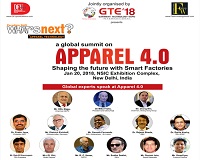
The summit aims to educate how Apparel 4.0 is shaping and transforming the global fashion and apparel business and the opportunities it offers for Indian industry. It will bring together apparel manufacturers, apparel technology solution providers and stakeholders who will discuss the major challenges apparel businesses are facing in today's digital marketplace, and identify practical steps companies can take to digitalise their value chain.
Insightful sessions at summit
The sessions will deliberate on the topic, ‘What exactly is Apparel 4.0, and the concept of Smart Factories? Are these factories already operational?’ How is digitalisation of apparel manufacturing processes, from design/creation to production, Apparel 4.0 is creating a new organisation of factory ecosystem. The summit shall also address opportunities and challenges of implementation for India; is India ready for such a transformation?
Global industry experts at Apparel 4.0
The conference has an impressive line of experts speakers led by theme presentation by Dr Mike Fralix, President and CEO [TC]2, USA. Dr Fralix, a PhD in technology management, is an globally acclaimed speaker on technology and automation. He also serves on the Board of Directors of the AAFA (American Apparel and Footwear Association) and active in several industry organizations including the IAF, where he serves as a member of the Board and Chairman of the Technical Committee.
Dr Prabir Jana, NIFT, while introducing the subject, will give the keynote presentation. Dr Jana, Head of Research at NIFT, is a visionary in technology development and management in apparel manufacturing. CEO & chairman Dürkopp Adler, Dietrich Eickhoff, would highlight opportunities Apparel 4.0 brings in the global scenario, as a technology providerl; Samath Fernando, CIO, Hirdaramani Group of Companies, Sri Lanka will share his expertise as users’ perspective. Hirdaramani, a pioneer in the Sri Lankan apparel industry, has already implemented Industry 4.0 and the company is a one-stop shop for global brands with 38 manufacturing facilities across Sri Lanka, Bangladesh, Vietnam & Ethiopia.
Representing Indian perspective in terms of opportunities and challenges, Dr Rajesh Bheda, RBC will conduct a panel discussion with industry stalwarts H K L Magu, Chairman AEPC, Dr Darlie Koshy, ATDC, J D Giri, Shahi Exports, R C Kesar, OGTC, Sudhir Sekhri, GEA, Gunish Jain, Royal Datamatic and Vinod Aiyer, Fortuna Colours.
Zhang Min, Chairman, ShangGong Group would be the Guest of Honor at Apparel 4.0. The conference is supported by all leading textile trade bodies like AEPC, OGTC, CMAI, IKF,GEA, NAEC and GEAR
The Organisers
GTE 2018
The annual Garment Technology Expo’s is the flagship event of GTE New Delhi held in spring. This is Indian subcontinent’s largest show for apparel technology; the 2017 New Delhi edition attracted 350 participants, from over 800 companies and brands from 18 countries. This hugely popular show was attended by over 21,700 trade visitors.
FashionatingWorld/DFU Publications
FashionatingWorld is a global web platform for news and insights on Fashion, Apparel and Textiles, reaching out to more than 4,00,000 industry professionals across the world every day. FashionatingWorld is promoted and steered by DFU Publications, India’s pioneer publication company for over 28 years.