FW
Customs duty on fabric imports hiked
Customs duty on imports of synthetic woven fabrics of various qualities, other woven fabrics, synthetic filament fabrics, artificial filament fabrics and artificial woven fabrics has been increased from the existing ten per cent to 25 per cent.
Customs duty on imports of synthetic texturized yarn, artificial texturized yarn, synthetic yarn, PSF, VSF and artificial yarn has been increased from the existing ten per cent to 20 per cent. Similarly customs duty on imports of comber waste has been hiked from the existing 15 per cent to 25 per cent whereas that of cotton fiber has been revised to 25 per cent from the existing ten per cent.
It is still to be seen what impact the latest duty revision will have on the ailing textile industry as the finance ministry while increasing the import duties on fabrics has also increased the import duties on yarn. The industry however, is upbeat and hopes the revision will be a breather in the present scenario.
It is expected that the hike in the import duty of synthetic and cotton fabrics will protect the interests of weavers and help domestic textile manufacturers. Textile manufacturers have demanded anti-dumping duties on imports of fabrics from countries like China, Malaysia, Indonesia and SAARC.
AEPC to probe spike in exports to the UAE
The United Arab Emirates (UAE) has suddenly become the biggest destination for readymade garment exports from India. India’s readymade garment exports to the UAE shot up 17.8 per cent for the first four months of this financial year. Comparatively, top export destination till now, United States, saw only a 1.5 per cent growth in Indian shipments. In fact, none of the other top 27 large apparel exporting countries saw any significant jump in shipment.
The Apparel Export Promotion Council has launched a fact finding mission. In fact, over the same period, RMG exports from India to the UK, Germany and France too saw a fall. Exports to the UK fell 0.8 per cent from a year ago; Germany and France saw a larger fall of 2.6 per cent and 14 per cent. The trend of the UAE outperforming these destinations defies logic.
These figures apart, the Indian apparel industry has been under stress for varied reasons. Most neighboring countries have FTA with Europe and so, Indian exporters are outpriced. Second, the currency has strengthened, while competing currencies have weakened. In addition, the duty drawback and the rebate on state levies schemes have stopped since October.
Against this background there has been another puzzling trend. September’s readymade garment exports grew 25 per cent as against a declining trend in the previous months. Almost no large apparel exporter has seen any substantial rise in their exports.
Milano Unica brings planet essential theme based on Water, Air & Earth
"The 26th edition of Milano Unica began with the presentation of the S/S 2019 trends at the Teatro Vetra in Milan. The three themes that inspire the international global trends focus on three elements that are essential to our life on the planet - Water, Air and Earth - and its payoff is projected towards the future: ‘Milano Unica: Save the Planet’. Myths, heroes, legends, novels, comics, movies, songs, opera, ballets, scientific studies, theories and calculations act as ‘testimonials’."

The 26th edition of Milano Unica began with the presentation of the S/S 2019 trends at the Teatro Vetra in Milan. The three themes that inspire the international global trends focus on three elements that are essential to our life on the planet - Water, Air and Earth - and its payoff is projected towards the future: ‘Milano Unica: Save the Planet’. Myths, heroes, legends, novels, comics, movies, songs, opera, ballets, scientific studies, theories and calculations act as ‘testimonials’. Identified by Stefano Fadda and a panel of Italian national and international industry specialists, they send out an important and incisive message, which Milano Unica, along with many other fashion players, embraces and intends to promote: love for life, nature and ourselves.

With a view to fulfilling this social need and in addition to the analysis of new technology and research, the dialogue among all the players of the supply chain will play a key role in the identification of new solutions to protect our unique, amazing but also fragile planet. The presentation, which has now become a ‘must’ event, will stimulate discussion about an increasingly sensitive and transparent fashion system, thanks to the reduced consumption of water and energy and fashion items increasingly devoid of harmful substances.
“The dialogue must extend more and more, and also include end users, as was the case with the recent ‘Apriti Moda’ initiative (in which Milano Unica participated as the partner depositary of the upstream art), an event that opened the doors of fashion houses that, till date, had always remained concealed inside their creative cocoons. All fashion players today agree on the fact that fashion must remain ‘exclusive’ but not be ‘excluding’, becoming a platform to share confrontation strategies. A shared industry vision is critical to boosting creativity based on exchange and unity of intents,” said Ercole Botto Poala, president, Milano Unica.
Students, an inclusive part
Exhibitors, fashion houses, designers, style offices and for the first time fashion students get a preview in the exhibition dedicated to the suggestions for materials and the inspiration behind the creative and productive path. Massimo Mosiello, General Director of Milano Unica, added, “We should not neglect the dialogue with fashion students, they are the craftspeople of the future. Talking with them, involving them in the creative process will give strength to the message that Milano Unica also intends to promote to start the engine at the system’s core. Textiles and fashion together represent a sounding board with immense potential for reaching out to everyone, even those holding the reins of international politics.”
Designer’s campaign against AIDS
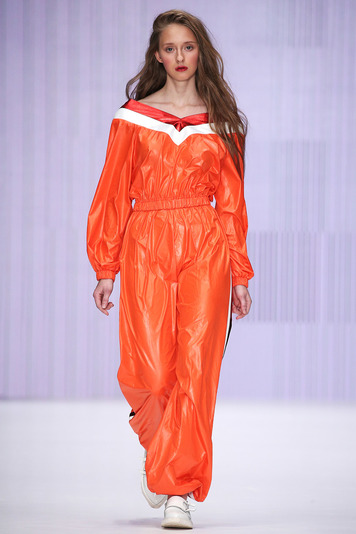
From October 21 to 26 Moscow hosted the Mercedes-Benz Fashion Week.
More than 80 designers from Russia, Georgia, Kazakhstan and other countries showcased their spring/summer 2018 collections.
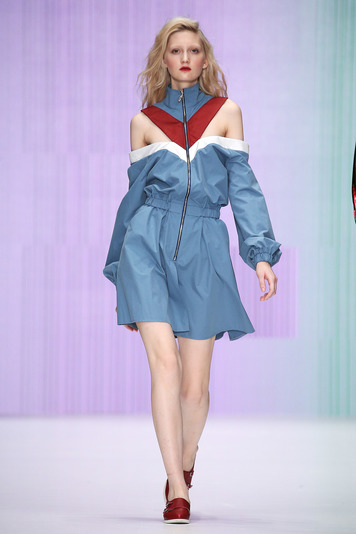
Ten established and emerging Russian designers united at Mercedes-Benz Fashion Week Russia for a mass media campaign against HIV/AIDS supported by the Ministry of Health of the Russian Federation. The involvement of popular fashion designers was expected to deliver the message about the risks of contracting HIV to various age groups.
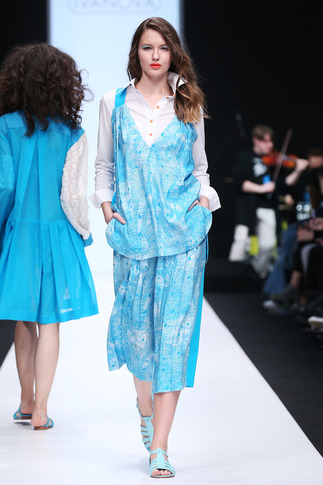
The population of Russia exceeds 146 million people. Nine lakhs are currently HIV-positive.
The Museum of Moscow and Moscow Museum of Fashion featured a display and presentation of 20 emerging Moscow designers and artists. The presentation of young designers at Mercedes-Benz Fashion Week has become the starting point in the long-term development program of the project.
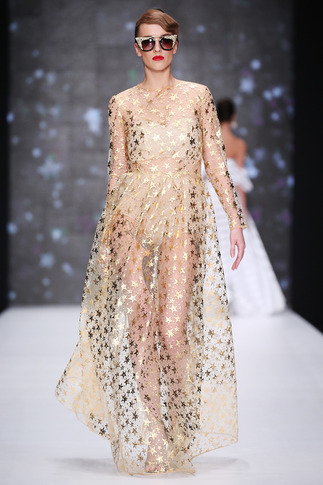
Mercedes-Benz Fashion Week Russia, the biggest and most widely media-covered fashion event in Russia and Eastern Europe, is run by the Russian Fashion Council. The fashion week takes place in Moscow twice a year, in March and October, since 2000, showcasing over 70 designers. Each season, MBFW Russia is attended by over 55,000 guests, including thousands of buyers, journalists, and industry experts. More than 1,000,000 viewers follow live streaming videos of fashion shows from Moscow on the internet through hundreds of web-sites and media channels.
Vietnam showcases product at HKs fashion show
Twenty Seven leading Vietnamese manufacturers of quality garments, textiles, fashion accessories and garment-related industries are showcasing their products at the Global Sources Fashion Show, in Hong Hong, which will run until the end of the month. Speaking on the occasion of the business-to-business fashion trade show which opened on October 27 in Hong Kong, Phạm Thiết Hòa, Director, HCM City Investment and Trade Promotion Centre (ITPC), said, “Việt Nam has become a more attractive complementary garment sourcing destination for overseas buyers.
We’re seeing an increasing number of multinational firms from Taiwan, Hong Kong and Singapore making not only completed finished clothes, but also buying fabrics, textiles, yarns, plastics, printing and other accessories, they’re looking to expand their production capacity in Vietnam and are shifting their production bases to Vietnam to enjoy tax incentives and other advantages.”
Vũ Ngọc Khiêm, chief representative of Global Sources, said: “In collaboration with ITPC, we have created a one-stop shop sourcing platform, for yarns and fabrics to completed clothes, from labels and tags and interlining fabrics to textiles and fashion bags, hats, caps and jewellery, so that buyers can meet businesses offline. We’ve seen a trend where many export orders are shifting to Vietnam not only because China is heading toward more sophisticated higher-value manufacturing industries but also because Vietnamese makers have stepped up to a new level of FOB export capabilities, and are more ready to compete with rivals via differentiation and excellent services, not just cost advantages anymore.”
The four-day tradeshow hosts 1,800 booths of accessories, fabrics and apparel from Vietnam, China, South Korea, India and the Philippines. The event is expected to see a footfall of 12,000+ buyers from 150 countries and territories, including the US, the EU, Hong Kong and Japan.
The on-site Fashion Parade features many products made in Vietnam, including totes, bags and jewellery. The show offers a unique one-stop shop theme where buyers can discover Vietnamese manufacturers offering all kinds of garments, textiles, labels, bra cups and fashion accessories. Other highlights include conference programmes, fashion parades and the Trends Forum, presented by Fashion Snoops and Pantone.
International cotton stocks set to rise exponentially
The International Cotton Advisory Committee (ICAC) and UK-based private consultancy Cotlook have raised estimates of world production of cotton during the 2017-18 period, based August-to-July. The ICAC raised its forecast by 1,90,000 tonnes (8,73,000 bales) to 25.57 million tonnes. Cotlook enhanced its prediction by 1,68,000 tonnes to 26.03 million tonnes. “A considerable reduction for Pakistan is more than offset by an expectation of increased output in several major producing countries, including India, China and Brazil,” reported Cotlook.
ICAC enhanced its estimate for world cotton inventories at the close of the season to 18.89 million tonnes, a growth of 3,43,000 tonnes year on year while Cotlook predicts significant growth in stocks to 8,41,000 tonnes; however, The US Department of Agriculture (USDA) holds a middle ground with a forecast of growth to touch 2.81 million bales (6,11,800 tonnes).
There is a discrepancy in India’s production forecast which the ICAC sees at 6.03 million tonnes; the ICAC at 6.63m tonnes and The USDA is at 30 million bales (6.53 million tonnes). Regarding Chinese cotton consumption, ICAC sees it at 8.12 million tonnes, Cotlook at 8.36 million tonnes and the USDA at 38.5 million bales (8.38 million tonnes).
It looks like an extra reason why cotton investors have a keen eye on the prospects of the growing supply of cotton, however, they are watching India as the possibility of an enhanced MSP would decrease the competitiveness of its cotton exports.
Tommy Hilfiger banks on sourcing apparels from outside the US
Thomas Jacob the principal designer at Tommy Hilfiger, feels 'Made in America' is very important. He says he would love to make everything in America if he could find the factories but they don't exist in America. And it's his duty to bring the consumer the best product at very best price.
More than 40 per cent of clothing shipped to the US is made in China and seven of the top 10 importers are in Asia. The apparel and footwear industry is of the view that making more of its products in the US would push up prices.
‘Controversy’ is Jacob’s middle name. Earlier this year, models for his brand wore white bandanas around their wrists to protest The US President’s immigration ban, however, he had also criticised designers who were against creating outfits for Melania Trump. He felt they can dress the first lady and Ivanka Trump without getting delving into politics about it.
Hilfiger's brand, owned by PVH Corp, has had to cope with the industry's shift to e-commerce. Relying on social-media influencers and other online channels is key to staying relevant, he said. One has to reach consumers in many different ways. If people aren't with the program now, catching up is going to be very difficult.
GST continues to dog MSMEs, says AEPC
As per Ashok Rajani, Chairman, Apparel Export Promotion Council (AEPC) the positive impact of GST is yet to be felt by the garment industry as input costs have fallen. Sharing concerns of the textile industry comprising largely of micro, small and medium enterprises (MSMEs) an AEPC delegation met the Parliamentary Standing Committee to discuss the implications and impact of GST on apparel exports. The exporters’ body was unhappy that the sector, especially the MSMEs, does not have necessary resources to ensure GST compliance.
Commenting on the impact of GST on MSMEs, Rajani said due to a significant increase in working capital and higher transaction cost MSMEs have to hire services of CAs to effectively manage GST payments/refunds which is an added burden on the sector. Due to these issues exports are likely to fall drastically in coming months.
Further the sector is already facing tough times due to competition from rival counties and the complications of GST is further harming the industry. The Council through its presentation also drew attention on the issue of extension of exemption of IGST on import under EPCG or Advance Authorisation from 31st March, 2018 to December, 2018 to provide a longer window for investment decisions and enhancement of MEIS to 5 per cent for reimbursing increase in cost of working capital and higher transaction cost.
Chic 2017 Autumn: Reflects the future of Chinese fashion business

Close to 65,722 professional visitors attended at the recently concluded Chic 2017 Autumn edition in Shanghai. Special focus was placed on new and innovative collections as retailers look for high quality and debut luxury collections. In addition, China’s intensive endeavour for a clean planet plays an important role in the fashion business. A ‘Green Thread’ was prominent across the three-day event. Exhibitors presented technological, ecological and contemporary novelties at the fair. In his keynote address, Sun Ruizhe, President, China National Textile and Apparel Council, underlined the importance of sustainability in today´s economy and called it a ‘must’. The initiative ‘One belt, One Road’ also supports the fashion business on the stage of the global fashion industry. Talking about the positive response, Chen Dapeng, Head of Chic and Executive Vice President of CNGA said, “We are never subject to conventions and never stick to past achievements.”
Exhibiting innovations
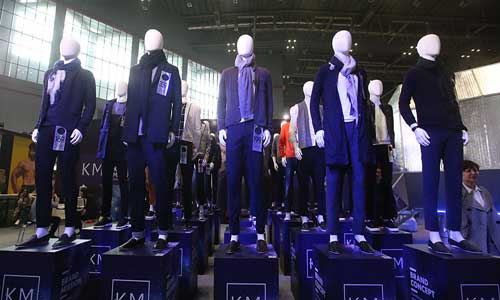
Around 783 exhibitors from 16 countries and regions presented 815 fashion brands at Chic. Most of exhibitors were from China but many other nations including Denmark, France, Great Britain, India, Pakistan, South Korea, et al, benefitted from this fashion business platform. The event was structured into nine sectors: Urban View, New Look, Kids Paradise, Fashion Journey, Heritage, Impulses, Secret Stars, Superior factory, The Unit. Integrated as Shows-in-show: Chic Young Blood, Shanghai Bag Expo and Preview China from South Korea.
And Andrea Fessura, CEO, Fessura, said, “We are satisfied with our participation within the Italian pavilion. We had many contacts, which are certainly more selected then those we made joining the show outside the Italian pavilion in the past as individual exhibitor. We will definitely join the next show in spring again. Gionata Funari, Sales Manager, Giovanni Fabiani, said, “We never had as many contacts as this edition. Chic is one of the best platforms for us to position our brand successfully in the Chinese market.” Jin, Team leader, Kofoti, South Korea was satisfied with the participation. This time, they were focussed on designer brands. The visitor number at their pavilion was not as high as in March but the results were good. The got good orders.
Novelties on display
Among the innovative offerings, Shaoxing pavilion offered an emphasis to smart casualwear. Among the exhibitors were 13 formalwear enterprises, next to ‘bespoke’ exact measuring manufacturers presenting their collect ions. Bespoke menswear was one of the leading topics at Chic Autumn with Cezon, Aspop, Taizhou Goldjitai Garment, Long-Sailing and Jinyuanyang, being specialists in this field. The popularity of bespoke services is a direct reflection of the market´s need for individuality and customisation. Even jeanswear brand In Cell introduced its bespoke services at Chic.
Within Kids Paradise, school uniform brands Eton Kidd And Yuanlou displayed innovations such as garments with anti-bacteria, waterproof, anti-fouling and anti-allergic effects. Yuanlou presented its wearable position function that allows locating the child. Eton Kidd held a seminar on the importance of social responsibility in the field of school uniforms, realised by the use of environmental as well as health friendly materials.
Country pavilions
Elegant womenswear, menswear, shoes and fashion accessories were showcased at the Italian Pavilion as well as the French pavilion ‘Paris Forever’ in the international area Fashion Journey. The Korean participation, Preview in China, focussed on designer brands this time and received a lot of attention. Individual exhibitors from Canada, Denmark, and Greece showed their latest collections of cashmere womenswear, hats and jewellery.
Eco-emphasis
The Sustainability Zone, premiering at Chic and organised by the China National Textil and Apparel Council, wa attended by numerous visitors. Next to fashion manufacturers presenting their latest innovation on environmental friendly production methods and social responsibility initiatives, it hosted the China Fashion Forum, which was focussed on CSR. Environmental-friendly initiatives were launched by many companies, such as Fruit Dye from Foshan City, Guangdong Province, dying textiles 100 per cent without chemical additives, or the development of a coffee carbon fibre produced from coffee residues by Shanghai Different Chemical Fibre belonging to Shangtex Group Shanghai. This idea will be taken ahead in the upcoming event to be held in March with the introduction of the area Chic Green presenting eco-friendly fashion.
The next edition of Chic Shanghai March will take place from March 14 – 16, 2018. Its focus will be directed at the upgrading and evolution of creative, design-oriented fashion, at the same time, increasing intelligent service and support to meet all needs of the new retailing modes.
Global Sources Fashion being hosted in Hong Kong from October 27
Global Sources Fashion is being held in Hong Kong from October 27 to 30. This is a fashion sourcing event and has 1,800 booths of apparel, fashion jewelry, underwear, swimwear, bags, luggage, scarves, footwear and fabrics. It has exhibitors from Greater China, South Korea, Bangladesh, India, Indonesia, Kenya, Vietnam and the Philippines.
Exhibitors include OEM, ODM and OBM suppliers, plus emerging designers and fashion technology practitioners. The show allows thousands of international buyers to discover a large variety of in-trend fashion items to drive sales for upcoming seasons.
Global Sources Fashion hosts the largest collections of bags and luggage, footwear, and sports fashion in Hong Kong. It also features 400 brand new exhibitors and more than 450 exhibitors who promote their own designs and brands. The app enables buyers to shortlist exhibitors, find booths, take pictures and then follow exhibitors after the show. A newsletter provides daily reports and live videos on the hottest products.
Models will showcase designs from rising designers and exhibitors. There will be forums on color trends for autumn/winter 2018-19 and women’s fashion and accessories forecasts for spring/summer 2018. Sourcing experts will cover new technologies along with sourcing tips. The Fashion Tech Zone will showcase smart, eco-friendly and innovative designs. There will be a display of unique products from emerging markets including Vietnam, Indonesia, India, the Philippines, Laos and Cambodia.