FW
India, Egypt keen to enhance bilateral cooperation in textile sector
Egypt’s minister of trade and industry Tarek Kabil sees tremendous potential to enhance bilateral cooperation with India in textile, leather and automobile sector. He said this at a meeting with Tamil Nadu's Minister of Rural Industries P Benjamin who led the Indian delegation that participated in the recently concluded MACTECH Fair at the Cairo International Convention Centre.
India is Egypt's 10th largest export hub and the 10th largest import source. Hence, Egypt is keen to enhance economic cooperation with India in the SME sector. India's Ambassador to Egypt Sanjay Bhattacharyya disclosed both the sides discussed the possibilities of technology and investment cooperation in textiles and leather segment. India's participation with 50 companies at MACTECH Fair was to showcase the country’s strengths by delivering high quality, affordable prices and efficient utilisation of labour. Both sided also lok to increase exports and are looking at opportunities for joint ventures.
The delegation from the Engineering Export Promotion Council of India (EEPC India) comprised 50 leading Indian machine tools and technology organisations. The Indian Pavilion was organised by the EEPC, the premier trade and investment promotion group in engineering sector sponsored by the Ministry of Commerce and Industry, in association with the Embassy of India in Cairo.
Invista to invest $30-million for expansion its South Carolina plant
Invista is going for a major expansion at its fiber manufacturing plant in South Carolina. A $30-million expansion of the plant will enable the company to rapidly respond to demands of small-lot carpet fiber. The investment represents the industry’s first-ever offering of one-step, small-lot capability, specifically for solution-dyed nylon 6,6. Invista developed this innovative, proprietary small-lot technology by working closely with equipment manufacturer Truetzschler.
According to Dirk Burger, CEO of the Truetzschler Group, his team was challenged and inspired to create enhanced products as a part of a long-term collaboration in research and development. He thanked Invista for its confidence on his company. The variety of small-lot nylon 6,6 fibers will initially be offered under Invista’s ‘Antron Lumena’ brand to serve the globally growing solution-dyed nylon BCF markets. Invista is one of world’s largest integrated producers of chemical intermediates, polymers and fibers. The company’s advantaged technologies for nylon, spandex and polyester are used to produce clothing, carpet, car parts and countless other everyday products.
Headquartered in the US, Invista operates in more than 20 countries and has about 10,000 employees. With about 3,000 employees worldwide and 150 employees in Charlotte NC, Trützschler is one of the world’s leading textile machinery manufacturers.
Gap Inc.’s September same store sales miss analysts’ expectations
Same-store sales of Gap fell 4 per cent in September. Thus, the company missed analysts’ estimates of a 3.6 per cent year-over-year decline in sales. Gap’s shares dropped by 6.3 per cent in the first full-day of trading following the news. A number of analysts have weighed in on the stock. Jefferies Group reissued a buy rating on shares of Gap in a report of August 29. In a research report, Stifel Nicolaus gave a hold rating on shares of the company.
On the other hand, Vetr upgraded shares of Gap from a “sell rating to a hold rating and set a $25.65 target price on the stock in its research report. Credit Suisse Group AG restated a sell rating and set a $21.00 target price on shares of Gap in its research report. And finally, Canaccord Genuity restated a buy rating on shares of Gap.
Seven equities research analysts have rated the stock of Gap with a sell rating, twenty-six have assigned a hold rating, five have issued a buy rating and one has issued a strong buy rating to the company’s stock. The stock currently has an average rating of “Hold” and an average price target of $24.94.
A number of hedge funds have recently added to or reduced their stakes in GPS. Tobam raised its stake in Gap by 76.2 per cent in the first quarter. It now owns 1,348,416 shares of the apparel retailer’s stock valued at $39,644,000 after buying an additional 583,342 shares during the last quarter. Franklin Resources Inc. raised its stake in Gap by 1.8 per cent in the first quarter. Franklin Resources Inc. now owns 5,238,420 shares of the apparel retailer’s stock valued at $154,010,000 after buying an additional 94,400 shares during the last quarter. FDO Partners LLC bought a new stake in Gap during the first quarter valued at about $330,000.
Pakistan’s cotton yields set to soar as farmers show confidence
With rising cotton prices, farmers are encouraged to increase inputs, therefore, production is expected to soar in Pakistan this year, US officials claim. Despite trimming its estimate of harvested area to the lowest level in three decades, the US Department of Agriculture (USDA)'s bureau in Islamabad upped its forecast for production of cotton.
According to the bureau rising cotton prices are prompting farmers to more actively manage insects, resulting in higher expected yields compared to a year ago when low cotton prices prompted farmers to curb input costs despite reduced planted area. The bureau has forecast cotton production in Pakistan would be at 8.25m 480 lb bales, up 250,000 bales from the earlier estimate and up 18 per cent year-on-year. Prices remained low at the time of planting this season, between May and July, prompted farmers to cut sown acres to their lowest levels since 1985.
The bureau saw harvested area this year at just 2.40m hectares, down from an official USDA estimate of 2.50 m hectares, and well below the 2.80 harvested last year. But cotton prices have been rising with the bureau reporting that seed cotton prices now stand at 37 cents a pound up some 48 per cent year-on-year. Thus where last year farmers cut costs by reducing pesticide application that resulted in tanking yields of the commodity, now there is a strong incentive to grow cotton.
Based on updated figures, the bureau has forecast cotton yields at 3.4 bales per hectare compared to 2.5 bales per hectare in 2015-16, an increase of 36 per cent. But despite the stronger production, with consumption remaining essentially flat at 10.33m bales, the bureau actually upgraded its forecast for imports by some 200,000 bales.
Brexit to hit UK clothing suppliers the most
Suppliers of clothing who benefit from duty-free access to the UK might suffer due to Brexit unless special terms of access are negotiated, says a Textiles Intelligence report. It said suppliers in major clothing exporting countries like Bangladesh could be excluded from preferential access to the UK market when Britain leaves the European Union (EU).
After the historical poll that chose Brexit by 52 per cent to 48 per cent, UK has decided to come out from European Union. The exit process would take approximately two years as per a EU law mentioned in Article 50. In 2015, the UK was the EU's second largest clothing import market in value terms after Germany with a 17.7 per cent share of EU clothing imports into all member states. Bangladesh exported more than $3.5 billion to UK in 2015, and of the total export to UK, RMG goods accounted for over 50 per cent share ($1.62 billion)
Because the UK is a member of the EU, exporters in many developing countries including Bangladesh, Cambodia, Myanmar, Pakistan and Peru, enjoy duty-free access to the UK textile and clothing market under arrangements of the EU's Generalised Scheme of Preferences (GSP). But if and when the UK leaves the EU, imports into the UK from countries such as Bangladesh and Cambodia will, by default, be subject to a common external tariff as declared to the World Trade Organization (WTO).
Super show at Milan receives positive feedback
The eighth edition of women’s accessory and prêt-à-porter show, Super organized by Pitti Immagine was very successful. The show held from September 24 to 26 at the Mall in Porta Nuova, Milan received a positive feedback for the new course taken by the event. Super exhibited S/S 2017 collections by 142 brands of which 50 per cent were Italian and the rest were from across the globe. The show saw 5,100 buyers including 20 per cent from 50 countries worldwide.
Among the foreign buyers who visited the show were those from Japan, Spain, France, Russia, Switzerland, China, Greece, Germany, UK, South Korea, USA and Belgium. The interesting brands on display were: Studswar, contemporary sneaker brand, Tuba Ergin, Turkish brand focused on sustainability and street wear and Don’t Believe The Hype, an ethnic inspired denim brand.
Mercedes-Benz Fashion Week Russia in Moscow from October 13 to 17
The Mercedes-Benz Fashion Week Russia (MBFW) will take place at the Manege Central Exhibition Hall, Moscow from October 13 to 17. Over 70 fashion designers from Russia, Georgia, Ukraine and other countries will present their S/S collections. Some will showcase their current season or mixed collections.
The Fashion week will be inaugurated by Slava Zaitsev. Shows by Alena Akhmadullina, Viva Vox, Yasya Minochkina (Ukraine), Yulia Nikolaeva, DashaGauser, Julia Dalakian, Igor Gulyaev, GogaNikabadze (Georgia) and Dimaneu, Saint-Tokyo and others will be showcased over two days.
The Fashion Week will support talented debutants. In the new season for the first time in their careers, designers like Mach &Mach, Julia Dilua, Anastasia Kondakova, ZA_ZA, Anika, Naidal, Turbo Yulia, Nikolay Legenda as well as National Fashion Council grants awardees ArtemShumov, Chasto and Lime Blossom among others will showcase their work. Some designers will show their collections in a new dynamic apparel presentation format.
At the Children Fashion Festival, Russia Walt Disney Company in association with Children’s World store chain will present a collection inspired by characters from the film The Beauty and the Beast. For the third time, MBFW Russia will present collections, designed specifically for people with special needs and limited mobility. And for the first time, all the shows of the MBFW will be broadcast in the 3600 format.
An interesting addition to the new season of MBFW Russia will be the Festival of Russian Folk Artistic Crafts – ‘Russian Art Legacy’. For these three days a dedicated area of the exhibition centre will turn into a styled art-space; it will become a huge artistic workshop for folk craftsmen.
Textile industry in Pakistan expecting revival package soon
The textile industry in Pakistan is waiting for the announcement of a revival package from the government sooner than later. This was delayed because the Prime Minister was away from the country. During his last visit to Karachi, the PM had met a textile industry delegation when he issued directions to concerned ministries to uphold dwindling textile exports. The delegation had apprised the PM about the issues confronting growth. It was followed by the constitution of a committee by the PM to work out remedial measures to reduce the cost of doing business and restore export competitiveness.
The PM had also directed the finance minister to withdraw all levies on import of five million bales of cotton. It is likely that the government will announce a rebate of six per cent in the shape of Drawback of Local Taxes and Levy (DLTL), Long-Term Financing (LTF) facility on the import of machinery for five export-oriented sectors and sales tax refund of packing material for zero-rated sectors.
Vietnam targets sustainable trade deficit reduction with China
Reducing trade deficit with China is a good sign for Vietnam, says an official of the Ministry of Industry and Trade MoIT, Vietnam. The country’s trade deficit with China fell by 13.3 per cent to $9 billion in the first eight months of 2016 thus ending the rising trade deficit faced from 2001, according to the General Statistics Office (GSO). Deputy Director of the MoIT’s Industry and Trade Information Center Le Quoc Phuong blamed the global economic downturn that caused a reduction in demand in almost all markets including Vietnam. Furthermore, domestic businesses are striving to intensify their import markets to lessen dependence on the traditional ones, he said. He added saying that that they are actively importing commodities from other markets such as the Republic of Korea (RoK).
The GSO said Vietnam imported goods worth $20.3 billion from RoK in the last eight months of this year showing a year-on-year rise of 9.3 per cent mainly computers, electronic products and spare parts, he cited. However, the declining trade deficit with China at present is just temporary, he said, noting that made-in-China commodities still remain the first choice of Vietnamese businesses due to the proximity between the two countries and highly competitive prices. When economic growth bounces back, Vietnam needs more measures to reduce imports from China to reach a trade balance in a sustainable manner, he recommended.
Workers slave for European fashion brands
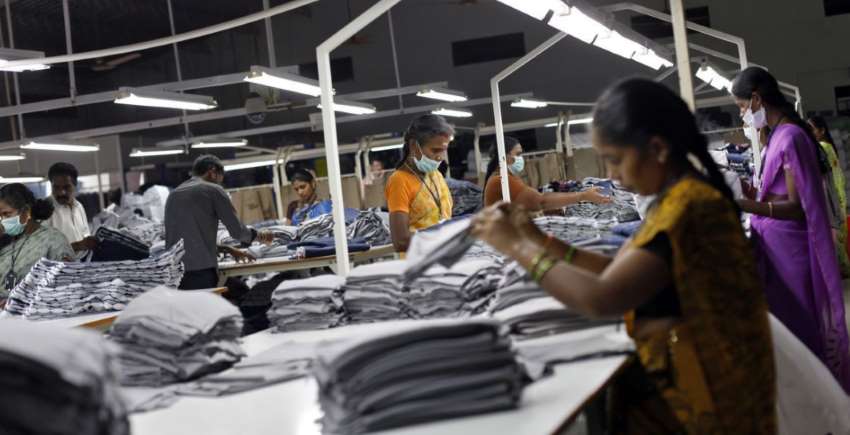
The garment and shoe industry throughout eastern and south-eastern Europe pays poverty wages. Despite working overtime, many workers in the Ukraine for example draw a salary that’s at least five times less than a living wage. Among their customers are fashion brands like Benetton, Esprit, GEOX, Triumph and Vera Moda.
Many of the 1.7 million garment workers in the region live in poverty, face perilous work conditions, including forced overtime, and have accumulated significant debts.
These European sweatshops offer cheap, yet experienced and qualified workers. Far too often the monthly wages earned by the mostly women workforce only just meet the legal minimum monthly wages. The legal minimum wages in the region are below the respective official poverty lines and subsistence levels for these countries. The consequences are brutal. Sometimes, workers simply have nothing to eat. Their wages are just enough to pay for energy, water and heating bills.
Many of the workers are exposed to heat and toxic chemicals, unhygienic conditions, unpaid and illegal forced overtime, and abusive treatment by management. Workers are intimidated and are under constant threat of termination or relocation. Many are forced to work overtime just to reach their production targets. Major international fashion brands profit substantially from these low wage system.