FW
Vietnam wins, US lag as American retail rewire global apparel supply chains

For years, global retailers expected tariffs, geopolitical tensions and supply chain disruptions to spark a manufacturing renaissance across North and Central America. The assumption was that apparel production would come closer to US consumers as brands sought to reduce risk and shorten lead times. Instead, the latest sourcing data suggests a different outcome. Rather than leading to large-scale nearshoring, US apparel buyers are simply replacing one set of Asian suppliers with another. The Western Hemisphere remains largely on the sidelines as procurement teams diversify sourcing across Southeast Asia and emerging manufacturing hubs in North Africa.
The latest figures from the Office of Textiles and Apparel (OTEXA) shows, suppliers operating under the United States-Mexico-Canada Agreement (USMCA) accounted for only 3.4 per cent of total US apparel imports during the first four months of 2026, up only marginally from 3.2 per cent a year earlier. Meanwhile, traditional sourcing leaders saw sharp decline. China's share nearly halved while India also lost significant ground. The beneficiaries have largely been Vietnam, Cambodia, Indonesia, Egypt and Turkey rather than neighboring manufacturing economies.
Table: Comparison of US apparel imports
|
Exporter |
Share of US apparel imports (early 2025) |
Share of US apparel imports (early 2026) |
Year-on-year import growth |
|
Vietnam |
18.10% |
22.50% |
+14.2% |
|
USMCA (Mexico/Canada) |
3.20% |
3.40% |
+0.2% |
|
China |
24.80% |
12.30% |
-50.20% |
|
India |
7.50% |
5.40% |
-28.00% |
Vietnam has emerged as the biggest winner, increasing its market share to 22.5 per cent as retailers deepen investments in its well-developed manufacturing ecosystem.
Missing links in the Americas
The muted growth across the Western Hemisphere highlights a weakness rather than a temporary slowdown. While Mexico has attracted incremental apparel assembly work, the region lacks the vertically integrated supply chain needed to compete with Asia's manufacturing clusters. An important trend is reshaping regional trade dynamics. Mexican apparel producers are sourcing an increasing share of their yarns and fabrics from China instead of the US. As China's textile exports to Mexico continue growing, the traditional North American textile value chain is becoming progressively less integrated.
This shift also carries implications for US agriculture. The U.S. Department of Agriculture projects cotton exports of 12.3 million bales during the 2026-27 marketing year. However, achieving that target depends on stronger global textile demand rather than the expected boost from regional manufacturing. As Robert Antoshak, Managing Partner, Gherzi Americas, points out current sourcing patterns reflect diversification instead of regional concentration. “US apparel sourcing is becoming highly diversified rather than concentrated in the Western Hemisphere. Tariffs are changing the flow of goods, but driving stronger cotton demand will require a broader recovery in global textile consumption, not a rapid return of manufacturing infrastructure to North America."
His assessment reinforces that tariff policies alone are insufficient to rebuild manufacturing ecosystems without parallel investments in textile production, raw material integration and industrial capacity.
Synthetic advantage widens the gap
Another factor limiting nearshoring is the growing dominance of man-made fibres (MMF) in global apparel sourcing. Demand has steadily shifted toward performance apparel made from polyester, nylon and other synthetic fibres. Southeast Asia has built extensive vertically integrated MMF supply chains capable of producing high-value technical garments at scale.
Vietnam exemplifies this competitive advantage. During the opening months of 2026, synthetic apparel shipments from Vietnam to the US were nearly ten times larger than comparable exports from India. Vietnam's production ecosystem enables manufacturers to move efficiently from fibre production to finished garments, allowing retailers to consolidate sourcing.
In contrast, India continues to rely heavily on cotton-based apparel exports, while Mexico and Central America remain concentrated in Cut-Make-Trim (CMT) operations for basic garments. Without substantial investments in synthetic fibre manufacturing and textile processing, these regions face difficulty competing in faster-growing product categories. The challenge is compounded by cautious retail spending. Persistent inflation and weak consumer demand have prompted brands to prioritize inventory discipline over aggressive purchasing.
Table: Sourcing performance breakdown
The 11.6 per cent decline in overall US apparel import reflects retailers' continued focus on preserving margins amid uncertain consumer spending.
USMCA faces a critical test
Despite limited gains in sourcing volumes, USMCA continues to deliver meaningful commercial benefits. Nearly 94 per cent of Mexican apparel exports entered the US duty-free under USMCA provisions this year, significantly higher than historical utilisation rates of around 80 to 83 per cent. This shows that the agreement remains commercially valuable for manufacturers serving established product categories.
However, the framework now faces an important inflection point as policymakers prepare for the mandatory review of USMCA. Stakeholders warn any weakening of yarn-forward rules or further dependence on Asian textile inputs could reduce the competitiveness of regional supply chains even further. For North American manufacturers, long-term competitiveness is likely to depend less on growing basic apparel assembly and more on developing vertically integrated synthetic fibre production, advanced textile processing and automated garment manufacturing.
Strategy over geography
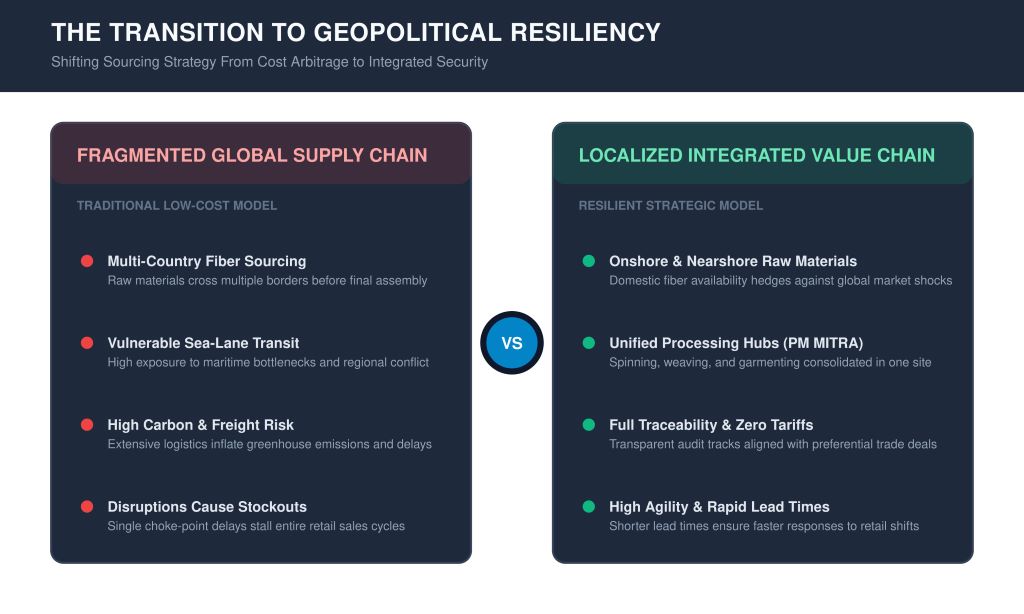
The latest sourcing patterns suggest that global apparel brands are prioritising capability over proximity. Rather than relocating production to nearby markets, retailers are now favouring countries that offer integrated supply chains, material innovation, competitive costs and manufacturing scale. Vietnam's continued rise shows that industrial depth has become a more decisive sourcing factor than geographic distance.
That leaves the Western Hemisphere with a narrowing window to reposition itself. Without significant investments in synthetic textile infrastructure, automation and regional material ecosystems, the long-anticipated nearshoring wave may remain more aspiration than reality even as global supply chains continue to diversify beyond China. For retailers, the message is clear: resilience today is being built through diversified global sourcing networks, not simply by moving production closer to home.
Consumer demand, rising costs drive brands to focus on physical expansion
Global fashion brands are reallocating capital toward physical store expansion, driven by consumer demand for tangible brand encounters and rising digital customer acquisition costs. Recent retail survey findings from media brand Monocle show, flagship stores in major metropolitan corridors are outperforming pure-play digital channels in customer retention and basket value. Rather than treating physical locations as transactional distribution points, apparel and lifestyle houses are designing immersive flagships that combine regional architecture, bespoke tailoring services, and hospitality components.
Strategic consolidation elevates per-square-meter yields
This revival centers on store optimization rather than indiscriminate real estate expansion. Leading apparel conglomerates like Inditex have streamlined store networks - reducing global door counts while enlarging footprint size in high-footfall city centers - resulting in in-store sales growth above pre-pandemic benchmarks. Retailers face operational headwinds from escalating commercial rents in prime districts and persistent supply chain inflation. However, physical spaces offer superior inventory productivity by serving as fulfillment hubs for omni-channel returns and localized click-and-collect orders. Contemporary consumers view store visits as social experiences rather than simple transactions, making physical space essential for brand equity, notes Andrew Tuck, Editor-in-Chief at Monocle.
Global media platform champions premium lifestyle and retail innovation
Launched in 2007, London-headquartered Monocle operates as a global media company covering international affairs, design, urbanism, and retail. Publishing monthly print issues, digital broadcasts, and books across European, North American, and Asian markets, the brand expands its commercial footprint via physical cafes and newsstands while maintaining profitable subscription revenues.
Monocle retail survey, physical store expansion, flagship stores, store optimization, Inditex store strategy, Andrew Tuck, omni-channel fulfillment, brick and mortar retail, retail estate yields, retail customer acquisition costs
Monocle retail survey, physical store expansion, flagship stores, store optimization, Inditex store strategy, Andrew Tuck, omni-channel fulfillment, brick and mortar retail, retail estate yields, retail customer acquisition costs
Monocle retail survey, physical store expansion, flagship stores, store optimization, Inditex store strategy, Andrew Tuck, omni-channel fulfillment, brick and mortar retail, retail estate yields, retail customer acquisition costs
Eastman targets west coast apparel hubs to scale bio-based cellulosic fibers
Global textile mills are expanding their use of circular man-made cellulosic fibers to satisfy stringent brand sustainability mandates and combat volatile natural fiber prices. Showcasing its Naia filament yarn and staple fiber portfolio at the Preface LA sourcing summit in Los Angeles, specialty materials producer Eastman is targeting West Coast denim and contemporary apparel manufacturers with high-performance bio-based alternatives.
By integrating Naia Renew - comprising 60 per cent sustainably sourced wood pulp and 40 per cent GRS-certified recycled material via molecular recycling - into cotton, polyester, and lyocell blends, weavers achieve enhanced fabric softness, rapid moisture management, and reduced carbon footprints without sacrificing structural durability. At the event, an interactive fabric installation based on the ‘Seeds’ design theme demonstrated the commercial versatility of these sustainable yarns across structured denim, activewear, and casual fashion separates.
Circular molecular sourcing mitigates raw material volatility
As apparel brands face mounting regulatory pressure regarding circularity and waste reduction, cellulosic fiber adoption offers a critical strategic buffer against traditional cotton yield instability. Integrating molecularly recycled cellulosics into fabric wefts enables mills to elevate wearing comfort while establishing traceable, closed-loop supply chains, states Chad Doub, Global Market Segment Manager - Casual Wear, Eastman. While higher processing technology costs remain an operational constraint for low-margin commodity garment suppliers, rising demand for traceable, skin-friendly textiles positions Eastman's closed-loop fiber platform for sustained volume growth across North American and European retail markets.
Specialty materials leader advances circular fiber portfolio
Founded in 1920, Kingsport-headquartered Eastman produces specialty materials, chemical additives, and cellulosic fibers for global apparel, medical, and industrial markets. Leveraging proprietary molecular recycling technologies, Eastman advances circularity across its Naia™ brand portfolio, projecting sustained revenues from eco-conscious yarn solutions across North American, European, and Asian textile sectors.
Adidas reports highest-ever sales of €6.7 billion in Q2.FY26
Global sportswear giant Adidas reported its highest quarterly sales in company history of €6.7 billion in in Q2. FY 26. This marks a 14 per cent Y-o-Y currency-neutral increase.
Strong momentum across licensed replica jerseys and technical sportswear drove a 35 per cent growth in overall apparel sales. Fueled by the 2026 FIFA World Cup, where Adidas outfitted 14 national teams and sold over 17 million jerseys, performance categories expanded by 39 per cent. Direct-to-consumer (DTC) channels outpaced traditional wholesale, jumping 25 per cent globally as retail flagships and digital platforms captured elevated consumer engagement. Supported by this top-line expansion, management raised its full-year 2026 revenue forecast to 9 per cent – 10 per cent currency-neutral growth.
High marketing outlays compress short-term operating margins
Despite top-line strength, heavy marketing expenditures - up 30 per cent Y-o-Y to support tournament activations - weighed on short-term earnings. Second-quarter operating profit grew by 5 per cent to €574 million, while gross margin expanded by 80 basis points to 52.5 per cent. Retailers faced localized freight surcharges and rising operating costs, though strong sell-through rates prevented severe promotional discounting. Addressing the performance, Bjørn Gulden, CEO, Adidas, states, the brand’s products across jerseys, culture wear, and footwear showcased what Adidas football should look like, delivering record commercial volume across key markets.
Sportswear icon builds on century-old athletic heritage
Founded in 1949 in Herzogenaurach, Germany, Adidas manufactures performance athletic footwear, lifestyle apparel, and equipment across global markets. Generating €13.3 billion in revenue during H1, FY26, the company plans to achieve €2.3 billion in full-year operating profit by scaling high-margin DTC channels and expanding core footwear and apparel categories.
Resale and value platforms reshape Western Europe’s fashion e-commerce
Western Europe’s fashion e-commerce sector has hit a structural turning point. Recent industry data indicates, while apparel accounts for nearly 20 per cent of total online consumer spending in the region, annual growth in online fashion slowed to 3 per cent, trailing the broader 5 per cent expansion seen across overall European e-commerce.
Dual drivers of circularity and affordability
This deceleration reflects shifting consumer behaviors, led predominantly by Generation Z shoppers aged 18 to 29. Rather than driving volume in primary retail channels, younger cohorts are allocating capital toward circular business models and ultra-value marketplaces. Pre-owned platforms like Vinted, alongside fast-fashion operators such as Shein and Temu, are capturing a growing portion of consumer wallets.
Fragmentation forces strategic realignment
As the competitive landscape fragments, traditional e-commerce specialists like Zalando face margin pressures. The next phase of fashion e-commerce growth in Western Europe will be driven by shifting consumer attention and wallet share, with Gen Z shoppers and the rise of resale reshaping the market, noted Ismail El Ouardirhi, Sales Director-Omnicommerce Solutions, NIQ. To protect margins, brands are forced to integrate peer-to-peer resale features and optimize digital discovery channels to stay relevant.
Digital marketplace ecosystems
Digital platforms facilitating online fashion transactions across Western Europe, offering primary apparel, off-price goods, and peer-to-peer resale services.
Core regional markets and growth outlook
Operating across major European economies—including Germany, the UK, France, and Spain—these platforms target digitally native consumers. Focus has pivoted toward circular integration and social commerce. With category-wide growth moderating to 3 per cent, operators are relying on resale channels to drive incremental user engagement and sustain long-term transaction volumes.
Digital Exchange accelerates sustainable fiber traceability and sourcing compliance
As global apparel regulations intensify around eco-design and supply chain transparency, textile mills and garment brands face rising compliance hurdles. To streamline raw material validation, functional textile platform Performance Days is launching its Sustainability Exchange. The digital hub connects fiber producers, yarn spinners, and fabric weavers directly with brand sourcing teams, centralizing validated compliance data across Scope 1 to 3 emissions, circularity metrics, and third-party standards such as GOTS, GRS, and Bluesign. By integrating technical datasheets covering over 23,000 functional fabrics, the exchange enables product developers to verify material claims prior to sampling, reducing commercial sourcing cycles by up to 30 per cent.
Standardized metrics tackle verification costs for textile mills
Navigating fragmented environmental standards remains a costly operational barrier for mid-sized yarn and fabric manufacturers across European and Asian textile clusters. The Sustainability Exchange addresses this friction by establishing a unified verification framework, allowing suppliers to upload authenticated life-cycle assessments once and share them across multiple retail buyers. Centralizing sustainability criteria into a single digital exchange eliminates redundant auditing costs while accelerating the commercial adoption of certified recycled and bio-based fibers, notes Marco Weichert, Founder, Performance Days. With European Union regulations mandating digital product passports, the platform positions functional fabric suppliers to preserve access to high-margin retail markets.
Global functional textile sourcing ecosystem
Founded in 2008 in Munich, Performance Days operates as a semi-annual sourcing platform for high-performance functional fabrics, yarns, and accessories. Serving activewear, outdoor, and workwear sectors across European and North American markets, the brand expands its digital ecosystem, supporting trade flows across more than 580 international textile manufacturers.
Gas shortage threatens Bangladesh textile export targets
An acute natural gas shortage across primary industrial belts - including Savar, Gazipur, and Narayanganj - has forced Bangladeshi spinning, weaving, and dyeing mills to cut production by up to 50 per cent. Triggered by an offshore LNG regasification outage alongside long-term grid deficits, gas line pressure in key hubs has fallen from 15 PSI to near-zero levels, preventing boilers and captive generators from operating. To honor tight autumn supply schedules for Western retail buyers, mills are resorting to expensive diesel generators, quadrupling daily energy costs and eroding operational margins across the $25 billion primary textile sector.
Policy interventions aeek emergency energy prioritization
The supply crunch threatens lead times for finished readymade garments, risking order cancellations and financial penalties from global fashion retailers. Factories continue paying full wages despite running at halved capacity, severely draining working capital, states Showkat Aziz Russell, President, Bangladesh Textile Mills Association (BTMA). Following emergency consultations between millers and government officials, interim measures have been authorized to divert CNG supplies directly to garment units while the state accelerates infrastructure repairs to restore industrial fuel lines.
Maintaining competitiveness across international fashion markets
Established in 1983, Dhaka-headquartered Bangladesh Textile Mills Association (BTMA) represents over 1,700 private spinning, weaving, and textile processing units nationwide. Driving raw yarn and fabric supply for the country’s apparel export engine, BTMA works with government authorities to secure energy allocations, optimize trade tariffs, and maintain competitiveness across international fashion markets.
Pakistani textile exporters target US retail sourcing growth at Texworld NYC
Pakistani textile and apparel manufacturers are aggressively pursuing direct vendor partnerships with North American fashion brands to expand export share beyond traditional commodity cotton. Organised by the Trade Development Authority of Pakistan (TDAP), the Pakistan Pavilion at Texworld New York City 2026 brought together specialized exporters—including A1 Infinity, MRI Group, Hometex Corporation, Ruqi Sports, and Niza Sports—at the Jacob K. Javits Convention Center. Showcasing value-added categories across activewear, technical leather garments, structured sportswear, and luxury home textiles, exporters aimed to capture higher-margin order books from US fashion retailers seeking reliable sourcing diversification.
Bilateral engagement supports export diversification drive
Expanding trade links with major American apparel groups remains vital to mitigating regional energy cost spikes and stabilizing foreign exchange earnings. Texworld New York City offers an essential platform for Pakistani manufacturers to establish direct buyer connections, demonstrate manufacturing compliance, and expand our commercial footprint across the American market, states Adnan Mahmood Awan, Trade & Investment Counsellor, Consulate General of Pakistan in New York. By leveraging integrated vertical supply chains and competitive labor costs, Pakistani apparel vendors are scaling technical garment capabilities to capture growing US demand for performance activewear and premium home textiles.
Export facilitation agency strengthens global trade infrastructure
Established in 2006 as the successor to the Export Promotion Bureau, the Karachi-headquartered Trade Development Authority of Pakistan (TDAP) orchestrates national export promotion across international textiles, leather, and consumer goods markets. Driving government-to-business trade initiatives across North America, Europe, and Asia, TDAP targets sustained export revenue growth by upgrading domestic value-added manufacturing standards.
Cost, climate and scale push polyester ahead in the global fiber race

The global textile industry is entering a decade where commercial economics, rather than fiber heritage, dictates sourcing decisions. The latest joint report by Organisation for Economic Co-operation and Development (OECD) and the UN Food and Agriculture Organization (FAO) highlights, polyester is expected to remain cotton's strongest competitor through 2035, supported by its lower cost base, expanding manufacturing capacity and broad industrial applications.
For apparel manufacturers operating under persistent margin pressure, fiber procurement is becoming a financial exercise. Polyester's cost advantage, combined with predictable chemical feedstocks and scalable production, is encouraging mills and brands to reduce their dependence on natural fibers. While cotton demand is projected to keep growing, its pace is unlikely to match the rapid increase of synthetic fiber consumption, particularly in mass-market fashion, sportswear and everyday apparel.
Price gap reshapes procurement
The growing cost differential between cotton and polyester has become one of the biggest drivers behind sourcing decisions. So far, cotton has traded at an average premium of around 77 per cent over polyester, with the gap periodically exceeding 100 per cent. Although petrochemical inputs such as Purified Terephthalic Acid (PTA) and Monoethylene Glycol (MEG) have seen temporary price volatility due to energy costs and shipping disruptions, synthetic fiber production has remained considerably more buoyant than agricultural supply chains.
As a result, mills continue increasing synthetic production, with polyester filament utilisation rates steadily rising beyond 60 per cent. Predictable raw material availability offers manufacturers greater production planning certainty than weather-dependent cotton crops. The long-term sourcing outlook show why synthetic fibers continue gaining ground.
Table: Fiber sourcing outlook
|
Market category |
Core target |
Sourcing impact |
|
Global Raw Cotton Growth |
1.2% CAGR |
Outpaced by synthetic filament adoption rates |
|
Total Production Target |
29.5 mn tonnes by 2034 |
Driven by yield gains over acreage expansion |
|
Global Cotton Trade Growth |
1.6% annual trade volume expansion |
Driven by raw shipments to low-cost Asian mills |
|
Export Consolidation Share |
66% (Two-thirds) global total |
Controlled strictly by Brazil and the United States |
|
Nominal Fiber Price Gap |
77% to 100%+ margin variance |
Favors synthetic procurement for volume retail lines |
The data suggests that even as cotton consumption grows gradually, polyester will continue strengthening its position across global sourcing strategies.
Climate adds pressure
Beyond pricing, climate variability is becoming another disadvantage for cotton. The OECD-FAO outlook projects modest downward pressure on real cotton prices over the coming decade despite mounting production risks. Prolonged drought conditions across the US cotton belt, erratic monsoons in India and broader climate-related disruptions are making cotton yields less predictable. These uncertainties are encouraging mills to diversify fiber compositions rather than rely solely on natural fibers.
Polyester-cotton blends have consequently become a preferred solution for manufacturers seeking to balance durability, affordability and stable raw material availability. Such blends are being adopted across casualwear, denim and athleisure categories where consumers remain highly price sensitive.
Meanwhile, the concentration of global cotton exports is an additional supply risk. Brazil and the US are expected to account for nearly two-thirds of global raw cotton exports by 2035, increasing sourcing dependence on a relatively small group of exporters. Processing activity, however, will continue shifting toward Asia, with India, Bangladesh and Vietnam expected to strengthen their roles as major textile manufacturing hubs owing to competitive labour costs and expanding industrial capacity.
Sustainability raises polyester's value
Polyester's commercial advantage is happening concurrently with a parallel sustainability shift. Many global fashion companies are replacing virgin polyester with recycled Polyester Staple Fiber (rPSF) to meet environmental commitments and prepare for stricter regulations governing plastics and carbon emissions. Unlike virgin polyester, however, recycled polyester commands a premium.
Limited feedstock availability, expensive collection systems and processing bottlenecks mean that high-quality rPSF produced from recycled PET bottles typically costs between 10 and 15 per cent more than virgin polyester. Despite the premium, many global apparel companies are absorbing the additional material costs. The investment is being viewed as strategic rather than discretionary, particularly as brands prepare for tightening sustainability regulations and rising consumer demand for lower-impact products across Europe and North America.
Blended the new standard
Recent sourcing decisions by a leading European fast-fashion retailer show the industry's broader change. Facing higher cotton prices during early 2026, some retailers revised specifications for several denim and knitwear collections, replacing 100 per cent combed cotton with a 60:40 poly-cotton blend incorporating mechanically recycled polyester.
The material substitution delivered measurable operational benefits within a single quarter. Yarn procurement costs declined by 14 per cent, while fabric tear strength improved by 22 per cent, reducing manufacturing defects and improving production efficiency. At the same time, partnerships with chemical recycling suppliers enabled the company to retain its sustainability positioning while protecting retail prices from agricultural supply volatility.
This reflects a broader sourcing strategy emerging across the global apparel industry, one that combines cost optimisation with environmental compliance.
Thus the OECD-FAO outlook indicates that polyester's leadership is no longer simply the result of lower prices. Instead, it reflects a transformation across global textile supply chains where procurement priorities revolve around predictable costs, supply reliability, manufacturing scalability and sustainability compliance.
Cotton is expected to remain an essential natural fiber, particularly for premium products and markets that value natural materials. However, growing climate uncertainty, concentrated export supply and persistent price premiums are likely to reinforce polyester's dominance in mainstream apparel production through 2035. For textile manufacturers and retailers alike, future competitiveness will depend less on choosing between natural and synthetic fibers than on optimising the balance between performance, affordability and environmental responsibility.
Fabric companies stitch together growth despite margin pressures in Q1 FY27

India's pure-play fabric segment entered FY27 with renewed operational confidence as easing raw material costs and stronger domestic demand lifted revenues across most leading manufacturers. Yet, beneath the encouraging top-line growth, the first quarter highlighted a reality: while integrated manufacturers translated operating force into healthier margins, consumer-facing fabric brands grappled with higher retail expansion costs that diluted profitability.
The June 1, 2026 removal of 11 per cent import duty on cotton proved to be the quarter's defining catalyst. Combined with stabilizing ocean freight rates and improving demand for premium suitings, shirtings and performance fabrics, the policy eased the raw material pressure that had constrained manufacturers throughout FY26. However, the benefits were distributed unevenly, depending on each company's fiber mix, level of vertical integration and capital allocation strategy.
Scale rewarded integrated players
The earnings season revealed that integrated manufacturing continues to offe the strongest defence against market volatility. Companies with large-scale weaving, processing and finishing capabilities captured the benefits of lower cotton costs while maintaining healthy utilization levels.
Table: Consolidated financial performance Q1 FY27 overview
|
Company |
Q1 FY27 Revenue |
YoY growth |
EBITDA margin (Q1 FY27) |
Growth driver |
|
Vardhman Textiles (Fabric & Processing) |
Rs 2,466 cr |
11.50% |
14.8% |
Cotton duty relief and synthetic fabric capacity expansion |
|
Arvind Ltd (Fabric Business) |
Rs 1,279 cr |
15.50% |
12.50% |
Strong institutional demand and reduced discounting |
|
Raymond Lifestyle (Branded Fabrics) |
Rs 780 cr |
8.90% |
16.2% |
Premium suiting and shirting demand |
|
Siyaram Silk Mills |
Rs 400 cr |
21.10% |
8.20% |
Premium fabric growth offset by retail investments |
|
Donear Industries |
Rs 197-239 cr |
Stable to 21.3% |
4.5% |
Stable synthetic volumes amid cost pressures |
Vardhman Textiles emerged as one of the strongest performers riding on lower cotton costs and the ramp-up of its 18 million metre annual synthetic fabric line. EBITDA margin grew nearly 15 per cent, reflecting the advantage of operating at scale while diversifying beyond conventional cotton fabrics.
Arvind delivered a similar quarter. The company benefited from higher full-price realization, stronger institutional demand and disciplined inventory management, allowing margins to improve despite a competitive retail environment. Raymond Lifestyle also maintained healthy profit as premium wool-blend suitings continued to attract domestic consumers, demonstrating that premiumization remains an effective hedge against broader pricing pressures.
Revenue growth masked profit spread
Although revenue growth was widespread across the sector, profit conversion varied. Siyaram Silk Mills shows this clearly. The company posted the highest revenue growth among major fabric players, with income rising 21.1 per cent year-on-year to Rs 400 crore. Yet its EBITDA margin declined from 10.3 per cent to 8.2 per cent, while net profit fell sharply from Rs 12 crore to Rs 5 crore.
The reason was less about weak demand and more about investment timing. Siyaram accelerated the rollout of its ZECODE and DEVO retail formats, increasing lease expenses, employee costs and promotional spending. Early monsoon conditions further softened discretionary retail purchases, limiting the immediate return on these investments. The quarter reinforced a broader lesson for India's branded fabric companies: expanding direct retail ownership strengthens long-term market positioning but temporarily depresses profitability during the gestation phase.
Synthetic specialists faced a different battle
For manufacturers with greater exposure to polyester, viscose and nylon blends, raw material dynamics remained more complicated. Donear Industries continued to maintain stable business volumes through institutional customers and wholesale dealer networks. However, profitability remained constrained by elevated energy costs, freight expenses and fluctuations in petrochemical derivatives such as PTA and MEG, which underpin synthetic yarn production.
Its EBITDA margin remained around 4.5 per cent, highlighting that while synthetic fabrics reduce dependence on cotton volatility, they introduce exposure to energy-linked cost structures. This contrast shows that fiber diversification alone is insufficient. Manufacturers must also manage procurement efficiency and production scale to preserve margins.
A shift from FY26
Compared with FY26, the industry's operating environment improved considerably. Last year was characterized by domestic cotton prices trading at premiums of 8-12 per cent above international Cotlook A benchmarks, increased freight costs and widespread inventory correction across apparel retail. Those conditions squeezed gross margins and forced companies to prioritize cost control over expansion.
Q1 FY27 marked the beginning of a different cycle. The cotton duty exemption immediately narrowed raw material costs, synthetic capacity additions started contributing commercially, and freight normalization improved export competitiveness.
At the same time, investment priorities evolved. Whereas FY26 capital expenditure focused primarily on modernizing processing facilities and manufacturing assets, the current fiscal has seen several companies redirect capital toward branded retail expansion and channel ownership. While strategically important, this transition has introduced short-term pressure on earnings before these investments mature.
Flexibility the new competitive edge
Perhaps the clearest lesson from the quarter is that profit depends on operational flexibility rather than production volume alone. Integrated manufacturers capable of processing multiple fibers including cotton, polyester, viscose, linen and wool blends were better positioned to respond to changing raw material economics. Likewise, companies with extensive processing infrastructure absorbed fixed costs more efficiently than fragmented manufacturers operating with thinner asset bases.
The quarter also showed that disciplined pricing and reduced promotional activity generated stronger operating leverage than aggressive discount-led volume growth. In effect, India's leading fabric producers are gradually shifting from competing primarily on manufacturing capacity toward competing on supply chain agility, product mix and capital efficiency.
Outlook brightens for the second half
Looking ahead, industry sentiment remains cautiously optimistic. The festive and wedding seasons are expected to stimulate demand for higher-margin suitings, shirtings and premium fabric collections, particularly for companies such as Raymond Lifestyle, Siyaram Silk Mills and Donear that maintain strong domestic distribution networks.
Meanwhile, export-oriented manufacturers stand to benefit from improving inventory replenishment across North America and Europe as global buyers resume sourcing after prolonged destocking. Stabilized freight rates and lower cotton input costs should further strengthen India's competitiveness in international fabric markets.
However, the next phase of growth will likely depend less on favorable raw material cycles and more on execution. Companies that combine fiber flexibility, integrated manufacturing and disciplined retail expansion appear best positioned to convert improving market conditions into sustainable earnings growth.
For India's fabric industry, Q1 FY27 was not simply a quarter of recovery it marked the emergence of a more resilient operating model where strategic investment, supply chain integration and capital discipline increasingly define competitive advantage.