FW
Year 2019 will be India’s ascent in global fashion industry: McKinsey study
"As per data from McKinsey’s FashionScope, India’s apparel market will be worth $59.3 billion in 2022, making it the sixth largest in the world, comparable to the United Kingdom’s ($65 billion) and Germany’s ($63.1 billion). The aggregate income of the addressable population is expected to triple between now and 2025. According to Sanjay Kapoor, Founder of Genesis Luxury, a luxury retail conglomerate, higher incomes are likely to create a whole new class of consumer: Retailers are moving on toward the ‘gold collar’ worker, term that defines the highly paid professionals."
 Though economic expansion is happening across Asia, 2019 will be the year when India will take center stage. As highlighted in McKinsey’s latest ‘State of Fashion report written in partnership with the Business of Fashion, India’s ascent is one of 10 trends the fashion industry needs to watch out for in 2019.
Retailers leverage technology
As per data from McKinsey’s FashionScope, India’s apparel market will be worth $59.3 billion in 2022, making it the sixth largest in the world, comparable to the United Kingdom’s ($65 billion) and Germany’s ($63.1 billion). The aggregate income of the addressable population is expected to triple between now and 2025. According to Sanjay Kapoor, Founder of Genesis Luxury, a luxury retail conglomerate, higher incomes are likely to create a whole new class of consumer: Retailers are moving on toward the ‘gold collar’ worker, term that defines the highly paid professionals.
Over 300 international fashion brands are expected to open stores in India in the next two years. To build momentum around conventional stores, Indian players are innovating: retailers are leveraging technology to enhance the in-store experience with digital marketing displays and improved checkout. For instance, Madura Fashion & Lifestyle launched the Van Heusen Style Studio, which uses augmented reality to display outfits on customers. Malls have also increased their share of space devoted to food service and entertainment.
Growth in the apparel sector is also being driven by increasing tech savviness among consumers. Ten years ago, technology was for the few, with just five million smartphones in a country of 1.2 billion people and only 45 million Internet users. These figures have since increased to 355 million and 460 million, respectively, in 2018, and they are expected to double by 2021, when more than 900 million Indian consumers will be online. E-commerce leaders are moving to solutions based on artificial intelligence.
Consumption patterns, preferences in focus
Successful brands have studied the consumption patterns of their consumers, their preferred colors, designs and touchpoints.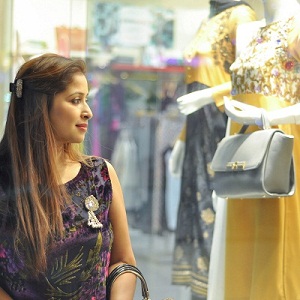 Indian women have beautifully amalagated the Indian and Western sensibilities across the spectrum. Traditional clothing made up almost 70 per cent of women’s apparel sales in 2017. It is expected to account for a 65 per cent market share by 2023.
With nearly 40 per cent of the Indian network unpaved till 2016, India’s infrastructure too continues to lag behind that of many other Asian countries. In addition, retail stock is often below expectations. However, there are signs of improvement. Reliance Brands, which operates over 500 stores for International brands is developing two fantastic luxury malls in Mumbai along with the convention center.
Offering a great promise
Many brands are determined to take advantage of India’s blossoming growth. The majority are likely to choose one of the three routes. First, players can partner with existing e-commerce platforms. This is most suitable for players with low brand awareness and relatively little capital to invest; it also offers a good way to test demand and customer preferences. Second, brands that have little local knowledge and are looking to enter the market quickly can do so with a franchise model, developing brick-and-mortar retail spaces. Finally, players that have significant local knowledge and capital resources can create fully owned and operated stores.
In short, the Indian market offers great promise. Despite structural challenges that include inequality, infrastructure, and market fragmentation, strong economic growth, scale and rising tech savviness will combine to make India the next destination for global fashion and apparel business.
US retail sector faces troubled times
Dark clouds hang over the US retail sector as a survey by the Institute for Supply Management shows retail is the only sector witnessing declining sales this year. The National Retail Federation had already forecasted in February 2019 that sales growth in US will slow this year as tax cut benefits fade and the trade war with China threatens to erode Americans’ appetite for shopping. The world’s biggest retailer, Walmart, will release its results next week as will Macy’s.
 Dark clouds hang over the US retail sector as a survey by the Institute for Supply Management shows retail is the only sector witnessing declining sales this year. The National Retail Federation had already forecasted in February 2019 that sales growth in US will slow this year as tax cut benefits fade and the trade war with China threatens to erode Americans’ appetite for shopping. The world’s biggest retailer, Walmart, will release its results next week as will Macy’s. The results of home home-improvement stores like Home Depot and Lowe’s big-box stores Target and Best Buy, and apparel mainstays Kohl, J.C. Penney Co. and Nordstrom Inc., will be released in the following week.
Tariffs rise to impact retailer’s margins
Around 20 per cent of US retailers import their goods from China. President Trump’s decision to raise tariffs on around $200 billion worth of Chinese imports could completely wipe out earnings growth across the sector. Though these higher tariffs will not affect the first quarter results of these companies, their ability to raise prices or shift manufacturing to other regions may be severely impacted.
The ability of these retailers to raise their prices varies according to their categories. For instance home improvement and auto-supply retailers are in a better position to raise their prices than the fast-fashion sellers. Some home improvement retailers most exposed to higher Chinese tariffs include Best Buy, since many electronics are sourced in China with long lead times and few other options. Target, due to the increasing number of private-brand goods made abroad; and Bed Bath & Beyond Inc. and other sellers of home goods with minimal ability to boost prices. Generally speaking, the more food a retailer sells, the more insulated it is, but that doesn’t mean big grocers like Walmart and Kroger Co. are totally immune.
Other costs impacting profits
Besides tariffs, retailers also have to deal with increasing transportation and labor costs. They are currently making huge investments in order to serve their growing number of online orders and ward off competition from Amazon.com Inc. One of their major initiatives includes increasing the minimum wages to their laborers. Target for instance plans to boosts its minimum wages $13 an hour in June and $15 next year. Walmart and Costco Wholesale Corp. have also improved employee wages and other benefits. To offset additional expenses, retailers have started cutting down on employee sizes. Weather also plays a pivotal role in determining the sales of these retailers. In the first quarter of last year, Walmart’s sales were badly affected due to unexpected rains. Its second quarter is also off to a bad start weather-wise, and companies are lap the warmest May on record in 2018.
Bad weather is likely to hurt results at department stores like Kohl’s, Macy’s, J.C. Penney and Nordstrom, which rely more heavily on seasonal apparel. Floods in the Midwestern regions since mid-March will not only boost second quarter results of home-improvement retailers, but it will also put a cap on their discretionary spending.
Fast fashion leaders feel the heat globally as new trends emerge
"It’s more than just conjecture that many mall stalwart brands have suffered due to the rise of fast fashion giants H&M and Zara, whose ability to significantly reduce time to market and undercut pricing of once iconic brands, have added to the woes fashion’s specialty retailers. Now, unexpectedly, H&M the world’s second largest clothing manufacturer behind Inditex’s Zara, decided to close down 160 stores. The fashion giant, in mid-2018, accumulated over $4 billion in unsold inventory, forcing significant discounting to clear out the goods."
 It’s more than just conjecture that many mall stalwart brands have suffered due to the rise of fast fashion giants H&M and Zara, whose ability to significantly reduce time to market and undercut pricing of once iconic brands, have added to the woes fashion’s specialty retailers. Now, unexpectedly, H&M the world’s second largest clothing manufacturer behind Inditex’s Zara, decided to close down 160 stores. The fashion giant, in mid-2018, accumulated over $4 billion in unsold inventory, forcing significant discounting to clear out the goods. This resulted in unexpected reductions in profits for the 6th straight quarter.
Martino Pessina, President of H&M's of North American operations, revealed the brand has already begun scaling back on the heavy discounting in its North American locations. It’s unclear how a company that has hooked customers on fast and cheap can simply flip the switch, without repercussions.
H&M isn’t the only fast fashion player that is feeling some pain. More recently, fast-fashion retailer Charlotte Russe filed for chapter 11 bankruptcy. It initially planning on only closing about 20 per cent stores but could end up liquidating if it is not able to find an investor to keep the business going.
Emergence of online players
Another cause of concern for the two fast giants is the emergence of a whole new breed of online-centric players. These upstarts include brands like ASOS, Boohoo and Misguided in the UK, who are building followings by cutting down supply chains to bring out offerings in as little as a week. Another major disruptor, Fashion Nova is supercharging its digital-first brand utilising a social strategy, powered by Instagram. They have managed to build more than 14 million social media followers; and in 2017 Fashion Nova became one of the most Googled brands in the world. The company has been able to introduce anywhere between 600 and 900 new pieces per week.
Seeking transparency around brand’s eco footprint
It’s no secret that fast fashion has been responsible for a catastrophic level of environmental pollution. The trifecta of overt use of raw materials, water pollution and greenhouse gas emotions are only a part of the story. Not only is this circular buy, wear and toss behavior impacting landfills, and becoming a major carbon contributor, that may not be the worst of it. Fast fashion has played a very dark role in contributing to black-market trafficking of forced labor, as evidenced in the New York Times documentary, Invisible Hands, by journalist Shraysi Tandon.
Additionally, hundreds of lobbying groups are raising awareness and influencing demand for drastic industry change. This has led to growing evidence that both millennial and gen Z’s are pushing for a new level of transparency around the ecological footprint and entire life cycle all products. And according to a recent Nielsen survey, 73 per cent millennials have demonstrated a willingness to pay more for products that are sustainable.
Trending driven by personal fashion expression
Trending appears to be evolving from a top-down fashion evolution, to a bottom-up percolation, driven by social media and personal fashion expression. The effect has both given permission and encouragement to throngs of consumers to cultivate their own, unique personal styles.
Contrary to the forces behind fast fashion, consumers of all ages and demographics are investing in fewer, but higher quality basics that can be mixed, matched and re-worn; even with the addition of some great vintage accessories.
UK February retail sales fall
Uncertainty around the UK’s imminent exit from the European Union has hit consumer spending.
In February, UK retail sales decreased by 0.1 per cent on a like-for-like basis from February 2018, when it had increased 0.6 per cent from the preceding year.
On a total basis, sales increased by 0.5 per cent in February 2019 compared to 1.6 per cent in February 2018. This is below both the three-month and 12-month averages of 0.9 per cent and 1.2 per cent respectively.
Over the three months to February, in-store sales of non-food items declined 2.8 per cent on a total basis and 3.1 per cent on a like-for-like basis. This is below the 12-month total average decline of 2.4 per cent.
Over the three months to February, non-food retail sales in the UK decreased 0.6 per cent on a like-for-like basis and 0.4 per cent on a total basis. This is below the 12-month total average decrease of 0.2 per cent.
Online sales of non-food products grew 5.4 per cent in February, against a growth of 6.4 per cent in February 2018. This is below the three-month average of 5.6 per cent and pulls down the 12-month average to 6.9 per cent.
USA to scrap GSP benefits for India
USA plans to scrap the generalised system of preferences (GSP) benefits for India within the next two months. GSP allows India to export up to $5.6 billion worth of products to America duty-free. It will not have significant impact on its shipment to the US.
Farm, marine and handicraft products are among India's exports most likely to be hit, Indian tariffs are within the bound rates under the World Trade Organisation's commitments and are on an average well below these bound rates.
The US had initiated the review of the GSP status to India on the basis of representations by the US medical devices and dairy industries but it subsequently included numerous other issues on a self-initiated basis.
These included issues related to market access for various agriculture and animal husbandry products, easing of procedures related to issues like telecom testing, conformity assessment and tariff reduction on ICT products.
India's top GSP exports to the US in 2017 included motor vehicle parts, ferro alloys, precious metal jewelry, building stone, insulated cables and wires.
Trade war can enhance Bangladesh exports
The US-China trade war can help enhance Bangladesh’s exports especially of garment, textile, IT and agricultural products.
The country can receive a lot of work orders, mainly shifted from China—the largest apparel supplier worldwide—because of the tariff war. Also, a higher domestic demand has propelled Bangladesh’s miraculous and extremely robust economic growth. At the end of the year, GDP growth is expected to hit 7.5 per cent.
But much depends on the continuation of trade privileges when the United Kingdom comes out of the European bloc. England is not only Bangladesh’s third largest export destination but also the hub for Bangladesh to reach other European countries. Both the European Union and the United Kingdom have promised to continue providing the generalised system of preferences facility after Bangladesh graduates in status from least developed to developing country. However, it is still a matter of concern how the Rules of Origin will be determined.
Bangladesh needs more entrepreneurs for new job creation and to reduce income inequality as the country is now on a development trajectory. Investing in good infrastructure, providing good logistics and easy facilitation can help develop an efficient global value chain, and thereby attract global companies to move their production centers to Bangladesh.
Surge in Chinese demand for Indian cotton
There has been a spurt in demand from China for Indian cotton. Five lakh bales will be shipped to China in the next two months.
It is to be noted Indian standard unit of 10 lakh equals 1 million.
The Cotton Association of India had estimated exports for the 2018-19 season to decline by 27 per cent to 50 lakh bales compared with exports of 69 lakh bales last year. India’s total cotton export shipment is around 32 lakh bales up to February 2019.
There has been uncertainty in the global cotton trade due to the ongoing trade war between the US and China. Though there will be no trade now with Pakistan for a few months, there’s good export demand for Indian cotton from many other countries like Bangladesh, China, Vietnam, Indonesia and many more. During the past couple of weeks, around four lakh to five lakh bales of cotton have been sold by Indian exporters to China for March-April shipments. Pakistan accounts for ten per cent of India’s cotton exports. India has already exported 6.5 lakh bales of cotton to Pakistan. Increase in export demand from other countries is likely to compensate for the loss of trade with Pakistan.
Prices of raw cotton are ruling below the minimum support price levels. The decline in the domestic prices has brought export parity.
Sports retailers differentiate with different looks
Sports retailers are differentiating themselves from their competitors in order to offer customers an unique shopping experience.
In the past, brands could dictate what sports collections had to look like, but the conservative sports looks won’t work in future.
A number of interesting small brands are delivering something special. These brands come from the fashion, luxury and sustainability segments. They are presenting themselves in a new way and with different approaches.
Tentree, based in Canada, has one goal: to plant one billion trees by 2030. Ten trees are planted per product sold. What started with one T-shirt has become an impressive collection and 58,230 trees have been planted in the European business alone and 25 million worldwide.
Templa, based in Australia, presents a young, very contemporary ski collection in the luxury segment. All materials and their processing are highly functional. Only the look is strikingly different: calf-length down coats, sack-like parkas, wide cargo pants.
With its strikingly colorful women’s collections, Blutsgeschwister serves around 350 fashion locations in Germany. The brand is known for parkas, hoodies and hooded jackets. Jackets and parkas are equipped with a water column and are therefore ideal for urban environments. In addition, the brand attaches great importance to sustainable production.
Pakistan raises credit limit
Pakistan is extending subsidised loan credit to the textile sector.
The Export Financing Scheme (EFS) has increased the credit limit for textile exports. The Long Term Financing Facility (LTFF) for investment in the textile sector has been enhanced. The loan credit under the EFS will be available at a subsidised mark-up of three per cent and under LTFF at five per cent.
In addition, the project financing limit will be raised. This will not only help cover the financing cost but also encourage large scale plants having an edge in economies of scale.
Textile exporters in Pakistan were facing difficulties as the share of the subsidised credit limit had dwindled to 27 per cent from 41 per cent in a year. The sector has been relying heavily on commercial loans. The discount rate was raised to 10.25 per cent from 5.75 per cent during the same period. More importantly, during the last year, the currency had devalued 35 per cent against the dollar. The cost of financing for textile projects has substantially increased along with the requirements of working capital and in the last five years imports of textile machinery have remained almost stagnant.
Textile exports make up around 60 per cent of the country’s total exports.
Polyester represents 55% of the world's fiber consumption
Polyester has grown to represent 55 percent of the world’s fiber consumption, and acts as a staple of our industry. The polyester industry in India is currently valued at $1.3 trillion (US).
Polyester is a synthetic polymer made of purified terephthalic acid (PTA) or its dimethyl ester dimethyl terephthalate (DMT) and monoethylene glycol (MEG), all derived during the refining and distillation of crude oil.
Originating from research headed by W.H. Carothers and working for DuPont on the development of synthetic fibers, British scientists Whinfield and Dickson took up the research in the late 1930s and eventually patented PET or PETE in 1941. Polyethylene terephthalate forms the basis for synthetic fibers like Dacron, Terylene and Polyester.