FW

Latest innovations in screen and digital printing, consumables, workflow and color management will be displayed at the upcoming FESPA Global Print Expo, Amsterdam. To be held from October 12-15, 2021, at the RAI exhibition centre in Amsterdam, the exhibition will display management solutions from over 300 industry suppliers.
The trade show will also focus on hardware solutions from confirmed gold sponsors Brother and Mimaki, as well as suppliers including Agfa, Canon, Durst, Fujifilm, Han Glory, and Roland DG; substrates from 3A, Ahlstrom Munksjö, Avery Dennison, Hexis and Re-board Technology AB; automation, workflow and colour management solutions from Barbieri Electronic, Inedit, OneVision, ONYX Graphics and Print Factory; and consumables from CHT Germany, Easy Inks, and Sun Chemical.
It will be co-located with the European Sign expo, the leading European exhibition for non-printed signage. The European Sign Expo will connect signage professionals with companies specialising in channel lettering, digital signage, dimensional signage, engraving and etching, illuminated displays, out of home media, LED and sign tools. The event is supported by the European Sign Federation, and gold sponsors Efka and Ledit Yaki.
American denim brand Lee has introduced a new water-saving dyeing technology that reduces the number of chemicals needed to manufacture a pair of jeans. As per Textile Today, the technology also enables the brand to recycle water at the dyeing stage. Called Crystal Clear, the technology uses indeterminate organic ingredients in dye baths to reduce the amount of water and energy needed to make a pair of jeans. Meanwhile, Lee has also collaborated with Los Angeles-based streetwear brand Hundreds to launch a workwear-inspired collection, featuring denim jeans and jackets, plus t-shirts and sweatshirts.
The aim is to use 100 per cent laser dyeing methods by 2023 besides partnership with companies engaged in upcyling garments.
An iconic American denim and casual lifestyle apparel brand founded by HD Lee, it has 130 years of experience in denim design and craftsmanship. Lee launched various denim styles for men, women, girls and boys during these years.
The government plans to launch a new policy on cotton solvent to encourage ginning mills in the state. Agriculture Minister Niranjan Reddy says the government aims to encourage ginning mills to manufacture cotton by products such as oil, cake and solvents. These byproducts command a good price at the international level and the ministry plans to give more incentives to the mills to manufacture them.
According to the minister, earlier, the Cotton Corporation of India and traders used to take the cotton purchased here to Maharashtra and Andhra Pradesh but now there was no such need. The government has set up ginning mills in rural areas to provide direct employment to 100 people in each mill and indirect employment to another 500, he added.
Data released by the Ministry of Commerce and Industry shows, India’s kids wear exports declined 6.11 per cent during Q1 FY21 to $436.59 million compared to Q1 ’20. Knitwear exports grew 14.58 per cent to hit $ 243.72 million export revenues, while the shipment of woven kids wear sunk drastically by 23.55 per cent to $192.87 million.
In March ’21, growth in both knit and woven kids wear segment remained positive with collective exports growing by 18.06 per cent on Y-o-Y basis to $142.95 million. Amongst top five export destinations for Indian kids wear the US, UAE and France grew during Q1 ’21, while exports to UK and Germany declined. Exports to the US grew 58.60 per cent in March ’21 to reach $22.41 million from $14.13 million in March’20.
Retail footfalls in major European countries declined in the range of 26 per cent to 40 per cent in 2020 on account of recurrent national and regional lockdowns, says a study by retail intelligence specialist TC Group. Based on data gathered between 9 a.m. and 9.30 p.m. daily on passers-by taller than 120 cm, the study showed a degree of disparity between countries.
For instance, consumer footfalls in UK’s main commercial high streets declined just 26.4 per cent or 3,225 people per day. The UK managed to stem the decrease in footfall by easing lockdown restrictions roughly in parallel with periods when footfall normally tends to increase, such as June-July and October-December. The worst result was recorded by Portugal, which witnessed a 40 per cent slump in footfall, equivalent to 2,245 people per day. Germany too was badly affected with footfalls on commercial streets falling by 38 per cent and in-store visits declining by 46.8 per cent, on average 217 people per day.
In Italy, high-street footfall fell by 31 per cent with the number of in-store visits decreasing by 40 per cent. In Portugal, pedestrian traffic fell by 30 per cent while in-store visits decreased by 41.3 per cent. France managed to limit its footfall decrease to 28.2 per cent while the number of in-store visits in the country plummeted, by 49.1 per cent, on average 334 people per day in the year.
Spain fared a little better, with high-street footfall falling by only 27.9 per cent while the number of in-store visits fell by 37.5 per cent at peak times.
For its upcoming edition of S/S’22 from August 10-13, Copenhagen Fashion Week aims to feature a strong line-up of labels. The event will feature 38 labels including established names and new talent. Some big brands participating in the event include Nordic brands such as Ganno, Stine Goya, Holzweiler, Saks Potts and Marimekko. The event will also feature returning brands such as Han Kjøbenhavn, Helmstedt, Brøgger and Hope.
Around 30 of the 38 brands will host physical shows which will be live-streamed on the fashion week’s website along with remaining digital shows. The event will also focus on menswear with a curated selection of brands, including, Schnayderman's, (di)vision, Berner Kühl and Nikolaj Storm Copenhagen. Established names such as Henrik Vibskov, Souland and Samsøe Samsøe will present both womenswear and menswear.
This year’s inaugural Talent Slot will be held by A Roege Hove, who will explore knitwear to indicate future Nordic design dexterity. Louise Lyngh Bjerregaard, will also debut at the event and The Royal Danish Academy will present a selection of its MA students' graduate collections.
Bangladesh Garment Manufacturers and Exporters Association (BGMEA) has urged Bangladesh Bank to support the RMG sector struggling to overcome the impacts of COVID-19 and retaining competitiveness in global market. Faruque Hasan, President, BGMEA thanked the Bangladesh Bank for coming forward with policy support for the garment industry when fell into deep trouble following the pandemic.
The bank’s support in simplification and relaxation of financial policies pertaining to the RMG industry would help the sector to address the challenges and turn around, he says. Earlier, Bangladesh Bank had extended the loan limit of garment and textile factories from the export development fund (EDF) to $30 million from $25 million. Hassan urged the bank to extend the time limit for the enhanced EDF by six months.
He requested BB to extend the payback period of the loans under the COVID response stimulus package from two years to five years as the sector is going through a rough patch. He also urged the central bank to write off all debts, interest, and cost of fund charges for the 133 sick RMG factories, taking them into special consideration.
For its upcoming edition of SS22 from August 10-13, Copenhagen Fashion Week aims to feature a strong line-up of labels. As per Fashion Network, the event will feature 38 labels including established names and new talent.
Some of the big brands to participate in the event include Nordic brands such as Ganno, Stine Goya, Holzweiler, Saks Potts and Marimekko. The event will also feature returning brands such as Han Kjøbenhavn, Helmstedt, Brøgger and Hope.
Around 30 of the 38 brands will host physical shows which will live-streamed on the fashion week’s website alongwith the remaining digital shows. The event will also focus on menswear with a curated selection of brands, including, Schnayderman's, (di)vision, BernerKühl and Nikolaj Storm Copenhagen. Established names such as HenrikVibskov, Souland and SamsøeSamsøe will present both womenswear and menswear.
This year’s inaugural Talent Slot will be held by A Roege Hove, who will explore knitwear to indicate future Nordic design dexterity. Louise LynghBjerregaard, will also debut at the event and The Royal Danish Academy will present a selection of its MA students' graduate collections.
adidas Golf has launched a new apparel and footwear collection made from recycled technical material Primeblue. The collection features polos, layering pieces and shorts, along with the new CODECHAOS21 footwear. It is made from the company’s high-performance recycled material made in part with Parley Ocean Plastic. The material meets a minimum standard of 40 per cent recycled content overall.
adidas Golf has also launched a new CODECHAOS21 range of footwear. This range is made from Primeblue recycled yarns that contain more than 50 per cent Parley Ocean Plastic. It is waterproof and includes overlapping microfiber panels on both the lateral and medial side of the shoe to give golfers more stability and protection when they play. It will be offered in multiple colourways, including a special scarlet and white colourway beginning today.
The shoes also have a spikeless outsole featuring Twistgrip technology where adidas Golf used heat-map studies to determine the most optimal location for the lugs, providing all players with the best grip possible. Other features found in CODECHAOS21 include full-length boost cushioning for added comfort and torsion X stability bar for added stability throughout the swing.
 The Vietnam National Textile and Garment Group (Vinatex) has set an ambitious target of achieving $39 billion in export revenue this year, equal to that of 2019. Last year, the group could achieve exports worth only $35 billion due to the pandemic, US-China trade tensions and Brexit. However, Vietnam was the only country among the world’s top five garment-textile exporters that did not cease production during the pandemic. According to Vietnam Times, the country was able to achieve export revenues worth VND 15.5 trillion last year and a profit of 628.9 billion.
In the first four months of the current financial year, Vietnam’s textile and garment exports increased 13.33 per cent to $11.747 billion compared to the same period last year, reveals Vietnam Textile and Apparel Association (VITAS).
Exports dominate with $8,766 bn revenues
Garment exports dominated during the year with revenues worth $8,766 billion. This was followed by fiber exports worth $1,638 billion, and fabric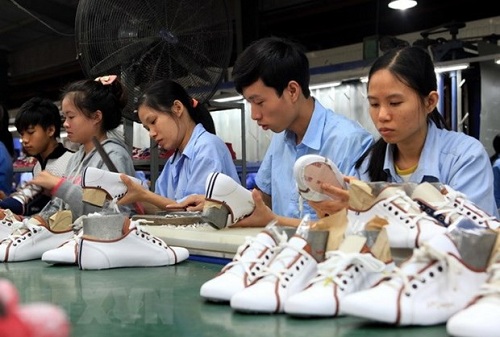 exports amounting to $740 million. Most exports were to the US, Europe and Japan during the year.
Experts attribute this vigorous growth in exports to the gradual recovery in several of its key markets and opportunities being offered by new free trade agreements. Vietnam’s local textile sector index during the period increased 8.1 per cent year-on–year, while clothing industry index increased 9.1 per cent. The combined turnover of the garment and textile industry during the year increased 15 per cent while that of all kinds of fibers and yarns increased 60 per cent.
Vietnam’s garments and textiles are known to enjoy a competitive advantage in several markets like the EU and the US. According to Le Tien Troung, Chairman, Vinatex, the country’s garments and textiles enjoy a competitive advantage in several major markets, including the EU and the US. The sector is known for its sustainable and clean production techniques.
Introduce export-oriented policies
However, a representative of Hue Textile and Garment Joint Stock Company believes, impacted by the pandemic, Vietnam’s garment sector may face a difficult period in the second quarter of this year. He along with a VITAS representative advise local businesses to keep a close tab on market changes and adjust production strategies accordingly. They also recommend incorporation of green solutions in their textile and garment products and seeking new orders.
Truong advises the government to cut of long-term interest rates as the textile and garment firms may find it difficult to repay loans due to declining businesses. The government also needs to adopt specific policies to support growth in the sector, he adds.
Though textile and garment production in Vietnam has revived, it is yet to achieve previous growth levels. The Ministry of Industry and Trade will continue to promote exports by exploring new FTAs, diversifying export and import markets, making exports more competitive and developing new trademarks.