FW
Shima Seiki’s Total Fashion System takes centre stage in Shanghai
Leading Japanese flat knitting machinery manufacturer Shima Seiki, showcased its latest innovative technologies at last month’s ITMA Asia + CITME 2018 in Shanghai, just as China’s domestic knitwear manufacturing industry prepares for digitalisation and automation.
Digitalisation and automation
Digitalisation and automation were key messages at ITMA Asia + CITME, which was held at the National Exhibition and Convention Centre (NECC) in Shanghai from 15-19 October 2018. Until fairly recently China was at the centre of the world’s knitwear exporting industry with its huge labour pool and low labour costs. Now with rising labour costs and labour shortages, things have slowed down a little and although China is still a very significant exporter of knitwear, it is smaller than it once was, with much production moving to Vietnam and Bangladesh.
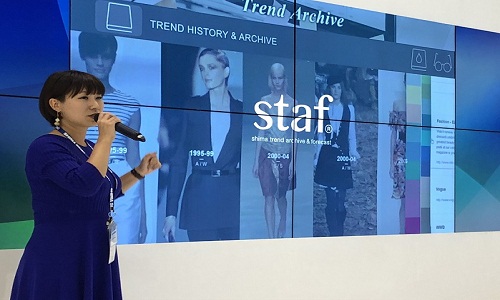
The situation in China’s domestic manufacturing industry is quite different however, with consumers wielding real spending power with the country’s domestic fashion brands. Speaking to Knitting Industry in Shanghai, Mr Ikuto Umeda, Director of Sales Headquarters, the man responsible for sales of Shima Seiki machines in China, explained: “With rising living standards and booming demand, China’s domestic needs in terms of knitwear and other apparel cannot be met conventionally. Production needs to change, and China has to deal with it. China has to adopt Industry 4.0.”
Total Fashion System
Accordingly, Shima’s Total Fashion System took centre stage in Shanghai. The Wakayama headquartered company’s solution is a complete digital system which aims to maximise profits while achieving zero inventory loss, zero leftover stock, zero lost sales opportunity and most importantly zero waste through smart, speedy and sustainable production.
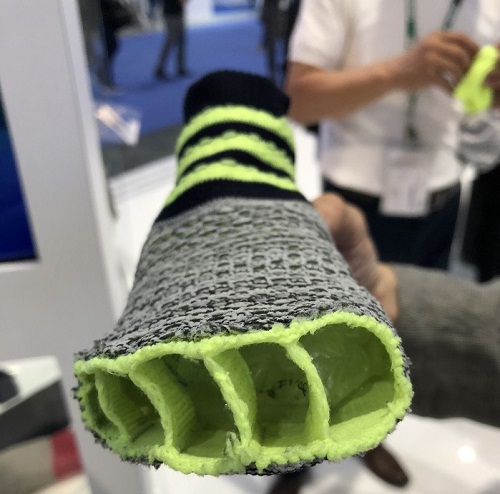
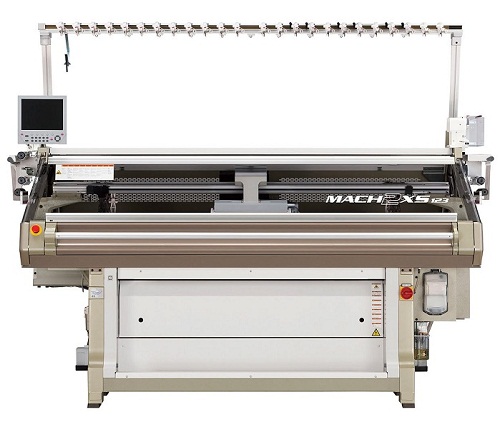
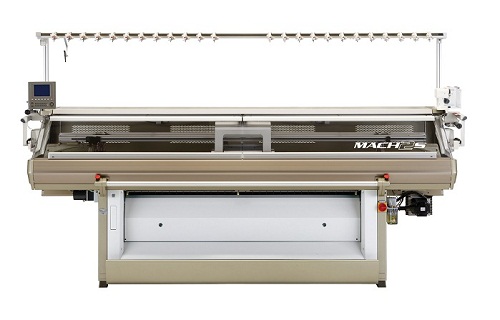
The automation part comes in the shape of the company’s WHOLEGARMENT knitting technology, a pioneering seam free knitting solution, which is now gaining real traction in the Chinese domestic market. Shima has been selling its flagship MACH2XS and MACH2S machines in significant numbers over the past three years, and a range of machines was on show in Shanghai, including a MACH2XS123 in gauge 15L and a MACH2S in 8 gauge.
Virtual sampling
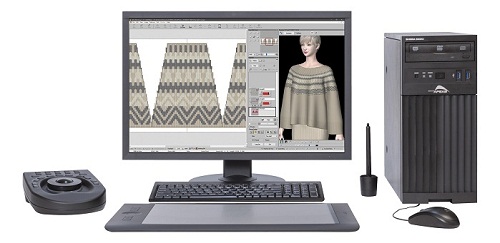
Also starring in Shanghai was the company's SDS-ONE APEX3 3D design system which sits at the core of the Total Fashion System concept. Highly realistic simulation capability on APEX3 allows virtual sampling which minimises the impact the sample-making process has on manufacturing, both in terms of time and cost.
With Shima’s new manufacturing model, the production cycle can be shortened to such an extent, that on-demand production is possible avoiding the limitations of seasonal cycles. This allows the product planning stage to be extended to allow more accurate analysis of consumer demand.
“Recent consumer trends, such as increased online shopping activity have changed supply chain requirements in China, with growing interest in on-demand production both in terms of time-compression and mass-customisation,” explained Masaki Karasuno, Head of Corporate Communications at Shima Seiki.DS-ONE APEX3 3D design system. © Shima Seiki
“The combination of Shima Seiki's pioneering Wholegarment knitting technology that allows a garment to be produced in its entirety without the need for linking or sewing afterward, along with the SDS-ONE APEX3 3D design system yields revolutionary game-changing flexibility in the knit supply chain to support such trends.”
Maximising profit
Virtual samples can also be used at retail level to gauge consumer acceptance of upcoming products, data for which can be used for forecasting demand.
“Such feedback can be used to adjust production and optimise inventory in order to prevent leftover stock that would otherwise go to waste. If stock runs out mid-season, on-demand production capability of Wholegarment knitting can furthermore replenish inventory to prevent lost opportunity,” Mr Karasuno said.
“In such a way, the Total Fashion System maximises profit while achieving zero inventory loss, zero leftover stock, zero lost sales opportunity and most importantly zero waste through smart, speedy and sustainable production.”
Virtual yarns
Shima showcased two collaborative projects which involve the generation and development of virtual yarns using the SDS ONE APEX3 Design System – the first with Italian spinner Tollegno and the second with Hong Kong’s UPW.
Readers familiar with SDS ONE APEX3 will know of its capability in producing hyper-realistic digital simulations of knit structures – the software also allows users to scan lengths of yarn to use in knit simulations. UPW has made its entire collection available digitally on its website, which means that any designer or factory that uses the APEX3 is now able to download UPW shade cards directly into their design system and design with UPW yarns.
First PLM solution for knitwear production
As part of its Total Fashion System and to further support knit manufacturing in the 21st century, Shima has developed the world's first PLM (Product Lifecycle Management) system dedicated to flat knitting as a powerful implementation of IoT for realizing factory automation and this was in evidence in Shanghai.
With Shima KnitPLM, the entire manufacturing process of knitwear from planning to production can be visualized to support efforts in maximizing production efficiency.
“The fashion industry is undergoing rapid change in globalization and diversification, requiring even more variety, higher speeds and shorter cycles. In such an environment, in order to perceive consumer needs and realize sustainable growth, the capability to perform the process from marketing and product planning to production and sales, quickly and without waste, becomes very important,” Masaki Karasuno explained.
Shima KnitPLM applies the latest IoT technology to join Shima Seiki products with its customers' ERP and SCM core systems, offering high levels of traceability and higher productivity throughout all stages in the value chain. With seamless linking of data between systems, workflow can be automated and labour can be reduced while reducing workload associated with data input required for each work stage.
WHOLEGARMENT knitting
Shima exhibited a number of computerised flat knitting machines, the production tools of its Total Fashion System, each with distinct solutions for current and future needs of the Chinese and Asian markets. WHOLEGARMENT knitting technology was represented by three machines.
The flagship MACH2XS WHOLEGARMENT machine has 4 needlebeds and Shima’s original SlideNeedle, which makes it ideal for producing WHOLEGARMENT knitwear in all needles. MACH2XS also features patented spring-type sinkers, which permits high quality knitting of complex fabrics – for example flechage is now easier to knit, allowing more control over neck drop.
As the ‘MACH’ name suggests, speed and productivity are high, with MACH2XS achieving a maximum knitting speed of 1.6 metres per second. Additionally, the machine’s R2CARRIAGE system permits quick carriage returns for high efficiency per knitted course. Split Stitch technique also allows efficient production by eliminating empty courses and quality is assured with i-DSCS+DTC Digital Stitch Control System with Intelligence and Dynamic Tension Control. MACH2XS is designed to offer flexibility for knitting beautiful and sophisticated, high-quality WHOLEGARMENT products in all needles, with a wide variety of knit patterns at very high speed and efficiency. MACH2XS was on show in gauge 15L.
MACH2S
MACH2S is a versatile V-bed machine that supports production ranging from conventional shaped knitting in all needles to WHOLEGARMENT knitting using every other needle. At ITMA Asia + CITME, the MACH2S was shown in 8 gauge for coarse gauge applications.
Shima is currently experiencing a spike in demand for its flagship MACH2XS machine, especially in China, which is affecting delivery times. The company is now offering MACH2S as an alternative for Chinese and other manufacturers.
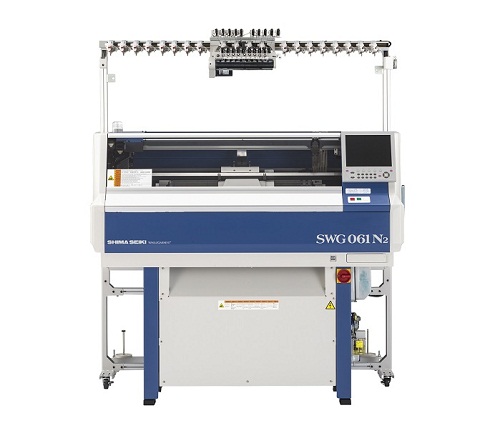
The third category of WHOLEGARMENT machine on display was the machine range known as ‘Mini’. The SWG061N2 compact or ‘Mini’ WHOLEGARMENT knitting machine is capable of producing a wide variety of knit accessories for fashion as well as technical textile applications. The SWG061N2 on show in Shanghai was producing novel 3D shoes in 15 gauge and an extensive range of samples was also exhibited.
Hybrid inlay fabrics
SVR series
For more conventional solutions, Shima’s SVR series is a very popular choice for shaped knitting. On show was the company’s SVR123SP computerised knitting machine in 14 gauge, featuring a special loop presser bed, capable of producing hybrid inlay fabrics that feature both knit and weave characteristics.
Demand for such unique fabrics are reported to be very high across a wide range of applications - from fashion to sportswear, innerwear, outerwear, uniforms and other functional clothing, as well as wearable technology and technical textiles.
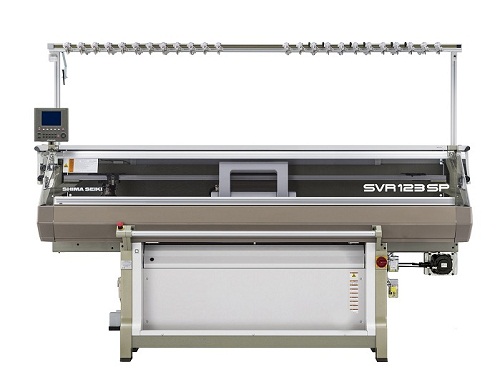
The SVR123SP shown in Shanghai also featured Shima’s i-Plating option for expanded capability in inverse plating technique where complex jacquard-like patterns can be knitted in plain jersey stitch. Knitted accessory items were also shown to demonstrate the flexibility of the technology.
ITMA ASIA + CITME was deemed a very successful show for Shima, who reported high visitor numbers and strong sales at the event. The exhibition hosted over 1,600 exhibitors and attracted around 100,000 visitors.
Kornit Storm II helps ‘Create Apparel’ enhance business

Create Apparel, Australian-based sports apparel manufacturer, has seen its business growing ever since the company started using Kornit Storm II direct to garment (DTG) printer.
Elaborating on this, Mark Yammin, Owner, Create Apparel, said that the Israel-made DTG printer has increased the business of its custom t-shirts without taking away any extra time of their staff.
After purchasing Kornit Storm II from Kissel & Wolf – the Australian distributor – the printer was installed by Create Apparel in March 2018.
Along with Kornit Storm II, the company also installed Adelco industrial textile dryer, which helped the company not only take larger orders of custom t-shirts but also supply better quality products to customers on time.
Mark said that the company was always looking to invest on a printer, which would not require more than a single person to run it and they were happy with their decision to buy the DTG printer.
Kornit Storm II makes 35 to 45 custom t-shirts every hour and only one person does the printing at a high rate. Also, its feature of printing on fabrics other than cotton make it unique.
Tomas Lorenc, Sales Manager, digital equipment at Kissel and Wolf, said though the initial investment is huge, but the volume and the cost per print is less.
Ricoh sets out ambitious growth plan
These must be interesting times for everyone who works at, or with, Ricoh.
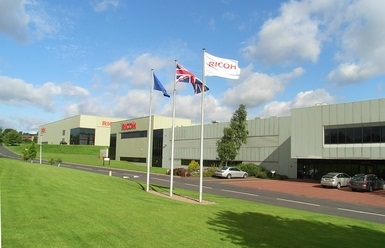
Not too long ago if the name Ricoh was mentioned to a printing industry professional, the products that would probably come immediately to mind would have been the Pro-series of electrophotographic sheetfed digital presses – also sold under the Versafire brand by Heidelberg – and Ricoh’s range of high-speed continuous feed inkjet printers under the InfoPrint and Pro VC60000 marques.
In the decade that has passed since Ricoh entered the production printing market at Drupa 2008, a lot has changed. And, specifically, a lot more has changed since fresh chief executive Yoshinori Yamashita took the helm of the business 19 months ago.
During his first financial year (ending March 2018) Yamashita rolled out his ‘Ricoh Resurgent’ strategy aimed at getting the business in the right shape to deliver growth.
Now, the group has entered the ‘Ricoh Ignite’ phase that will run to the end of the 2020 financial year, to be followed by ‘Take Off’ through to 2023, which includes some pretty peppy sales and profitability targets.
Yamashita wants to grow Ricoh’s commercial and industrial printing ops (including its thermal media business) from 12% of sales to 20% of the group by March 2023, backed with a ¥100bn (£688m)investment in mergers and acquisitions specifically in this part of the business.
He expects overall group sales including office printing, consumer products and healthcare, to grow from ¥2.03bn to ¥2.3bn; and perhaps more importantly, has set an operating margin goal of 8%, a substantial increase on the 1.7% margin achieved in 2017.
Developments, and M&A activity, on the print side have certainly moved on apace this year (see boxout). At Fespa in May, Ricoh showcased the many and various different products that could now be printed using Ricoh technology. It showed its first flatbed wide-format printer and previewed a new latex roll-to-roll printer that was officially launched last month. Also on the booth was a direct-to-garment printer developed following its acquisition of AnaJet.
Since then, Ricoh has moved into other new areas, including printing onto large, three-dimensional objects with the acquisition of LAC Corporation. LAC’s systems can print directly onto cars, trucks, aircraft, tyres and glass bottles. The vast majority of sales are currently in Japan, and Ricoh insiders see a great opportunity to expand that to other markets using Ricoh’s network.
The same thing applies for colour measurement firm ColorGate, Ricoh’s most recent buy. It is strong in Europe and is now expected to grow in Asia Pacific and the US on the back of Ricoh’s presence there.
Ricoh is also making it easier for developers to use its inkjet know-how, with the recent Coloreel partnership a perfect example.
“In the industrial area the supply chain is very fragmented, and you need a myriad of relationships for heads, inks, drives, software and ink delivery,” explains head of commercial inkjet business Graham Kennedy. “The fewer relationships a developer can have, the more they can accelerate time to market. We’ve done that to great effect with Coloreel.”
Ricoh corporate vice-president Peter Williams believes the business is well-placed to capitalise on its expanding reach. “We’re probably in a unique position, because we can go to not only traditional manufacturers such as Heidelberg, where we’re partnering with someone who’s recognised as the best in their chosen analogue field and then work with them to leverage their brand and customer base. We can also do the same in wallpaper, or textiles,” he says.
Indeed, Yamashita has highlighted those two markets as examples of where Ricoh could grow its business while also fulfilling its corporate goal to benefit society by driving sustainability: reducing the huge amount of polluted waste water created by conventional textile printing methods; and using a digital print-on-demand model to dramatically reduce inventory waste in wallcoverings.
Ricoh has come a long way in 10 years, but over the coming five it intends to go further still.
Santoni takes part in Textile Evolution
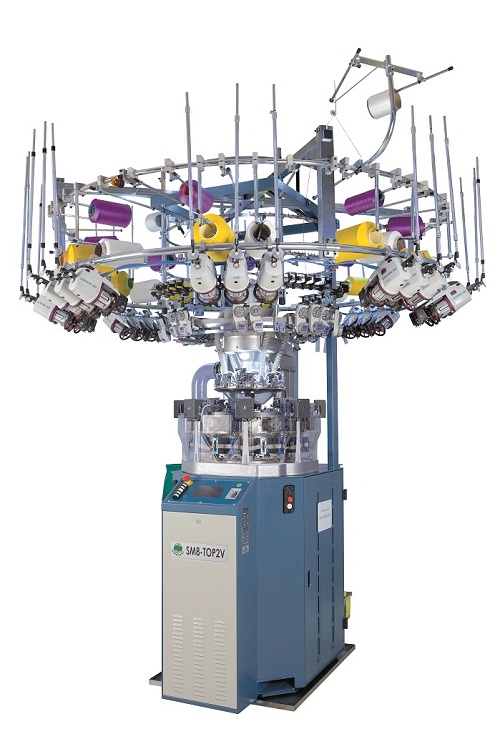
Santoni, a leading Italian socks machine manufacturer, is taking part in the Textile Evolution – Made in Italy 4.0 exhibition, which runs this month at the Steam Factory in Milan. The event aims to promote various Italian production processes for technical and innovative textiles.
The exhibition focuses on technologies and collaborations for the textiles of the future and showcases the products made by the leading Italian companies operating in all the textiles sectors involved, from the transformation of intermediate products, to clothing, to protective fabrics, through applications and textiles machines.
The company is exhibiting some products obtained with its own technology in collaboration with other leaders in the textiles sector. “The products exhibited for the footwear and accessories sector are a selection of excellence in terms of creativity, technology and sustainability, fields that guide the technological development of Santoni,” the company says.
Santoni was founded in 1919 as the first Italian socks machine manufacturer and in 1988 it became part of the Lonati group, a world leader in the production of sock and pantyhose machines. Since then, the company has lent its name to the Seamless phenomenon, becoming a leader in the production of electronic machines for garments without seams.
The textile printer that became a system supplier
The Heinrich Mayer GmbH textile printing plant offers a range of products that the company’s name does not make immediately apparent.
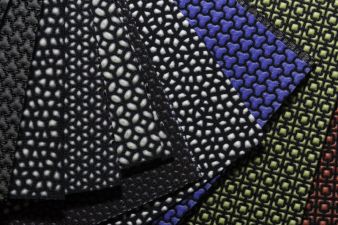 Hybrid textiles, for example. That is what managing director Michael Steidle calls his ceramic-coated high-tech fabrics. Patented as CERAPUR, these smart textiles are used inter alia in the automobile and furniture industries. Do they feel like fabric? Well, not entirely. But Steidle is not a “dyed-in-the-wool” textiles man himself – which is not to say that he has turned his back on classical printed textiles. Technical textiles may now account for the lion’s share of the company’s sales revenue, but with a range that extends from screen and rotary to roller printing, Heinrich Mayer GmbH is one of the few remaining German textile printing companies with such a wide-ranging product portfolio.
“Wait-and-see is no help whatever!”
 “It was already clear about 20 years ago that changes were under way in our line of business,” says Michael Steidle, managing director of the Mayer textile printing company in Meßstetten-Unterdigisheim. He and his wife Claudia took over the company in 2002 from his father-in-law Heinrich Mayer, who founded it in 1974. Back then textiles were still a mainstay of industry and employment in Germany’s Swabian Alb region. By the 1990s, however, the industry’s eastward relocation was gaining momentum as more and more production stages were transferred to lower-cost locations in other countries. “It hurt,” Steidle recalls, when customers who used to deliver tons of material a week for printing came round just to get samples.
Steidle himself is not a textiles man. He came to the industry by coincidence, as it were, via his wife. He trained as an electronics engineer, learning the trade at the weighing instrument manufacturer Bizerba in Balingen. That, he says, was a defining experience: “For one, there were so many new opportunities in electronics at that time; for another, at the firm where I learnt my trade it was always a matter of putting them to good use to set the company apart from the competition.”
The world of textile printing with which he then became acquainted had by contrast changed little over the decades. So Steidle, the firm’s junior boss at the time, was sure that “wait and see and carry on as before” would not be enough to ensure the textile printing company’s long-term survival: “Just as in other industries we as suppliers had to come up with something new to offer our customers. We had to develop products and create added value of our own”
Cerapur: Perseverance and inventive flair create a unique selling proposition
So in addition to high-quality textile printing the focus was from the outset on opportunities that textile surfaces offered in areas other than fashion and clothing. Instead of printing in colour on fabric, other materials could be printed; that was the approach.
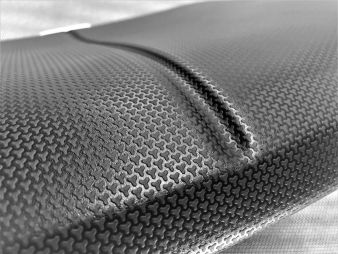
“A textile surface can be the basis for all manner of composites. It is an incredibly versatile carrier material,” says Michael Steidle, presenting a fabric pattern that is easily assigned to sportswear. It is the substrate for Cerapur, a 3D hard ceramic coating that the company has patented. The coating is applied in small burls, large triangles or flat rectangles, depending on the properties the customer requires of the end product. It can also be flame-retardant, anti-bacterial or luminous in the dark – all entirely individual. A lowermost rubberised layer completes the three-surface composite.
Preferred solution: individual
The Swabian family firm’s resourcefulness and ingenuity have become known in the industry. “Customers frequently come to us with their requirements and ask us to develop a suitable solution,” Steidle says. “One order, for example, was for a seat surface for a work chair that was to be low-wear and comfortable and, above all, prevented electrical discharges, which can quickly lead to damage in electronics manufacturing.” The result was ESD fibreX, a patented conductive ceramic composite applied to matching textile carrier materials such as ESD coateX.
For each new order and each new idea the ceramic coating with the required properties must first be developed. In a second step the Mayer textile printing company takes care to ensure a harmonious interplay between carrier and coating material. Trials are always needed in order to achieve the optimal result. Steidle is satisfied with nothing less than optimum. So it is hardly surprising that every machine in the spotlessly clean production hall is a one-off, designed to apply the tough ceramic coating or to achieve the matt effect that is a must in the automobile industry.
… and complete
Supplying smart textiles also means incorporating external processes. In some cases special yarns are required that must be knitted and equipped accordingly. “We prefer to work with regional partners and, fortunately, we have innovative enterprises on our doorstep,” Steidle says, given that he not infrequently needs to do his own sourcing for a customised product.
“Our customers greatly appreciate the fact that we deliver a smart complete solution and they do not need to deal with details such as finding the right supplier,” Steidle says. Behind that lies a great deal of trust that the company has worked hard to earn. Certifications like ISO 9001 testify to the company’s high quality commitment. The GOTS and Ökotex seals of approval stand for sustainability, and they apply to both technical textiles and classical textile printing.
The company has never abandoned textile printing, by the way; quite the opposite. In order to continue to supply longstanding customers Heinrich Mayer GmbH even relocated to Greece. Today the company has a branch operation in Bulgaria. And in Unterdigisheim it still prints in colour on jersey fabrics – even roller printing. “We are one of the last companies in Germany that print tubular fabric,” Steidle says. His customers appreciate that. Most of them come from the surrounding area and are themselves champions in their respective fields.
FESPA Mexico 2018 exceeds expectations
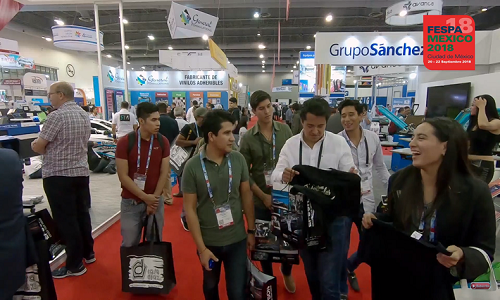
FESPA Mexico 2018 was held from the 21st – 23rd September. It is the most significant annual exhibition for large format digital printing, screen printing, textile printing, sublimation, garment decoration and signage.
For 3 days, approximately 12,343 visitors attended the CitiBanamex Center in Mexico City. Most visitors were professionals from the graphic arts industry. The event was attended by 150 international leading brands who showcased their products and services. The event also featured live demonstrations, conferences and workshops.
FESPA Mexico 2018 saw a considerable increase in the number of participating distributors from numerous renowned brands. A majority of visitors attended the event with the aim of learning about new trends and products by attending workshops and lectures that were led by well-known figures in the industry.
FESPA’s vehicle wrapping competition the World Wrap Masters Mexico showcased the local talent. The knowledge, ingenuity, creativity and capacity of vehicle wrappers were put to test.
If you could not join us this year, make sure not to miss out next year in 2019. We are certain attending or exhibiting at FESPA Mexico 2019 will exceed your expectations.
We look forward to seeing you in 2019!
Tengiva’s web platform helps improve textile industry efficiency
Tengiva has developed a web platform that enables buyers to acquire left-over, in-stock textiles worldwide. This allows buyers to acquire textiles in smaller quantities that help support specific stages or needs within the creative process: sampling, sizing sets, small productions or even custom orders.
Tengiva connects buyers and sellers, helping manufacturers improve their bottom line and efficiently distribute textile, while giving buyers increased access to great products, without having to overspend. It’s textile industry matchmaking and circular economics for better resource distribution and use. Additionally, the company educates buyers on textile types, advantages, features, limitations and much more.
Selected, pre-screened manufacturers feature their inventory on a micro-store that’s designed to showcase their excess stock. Each supplier has his own store, under the Tengiva umbrella. Direct contact information is published, so future production orders can be processed directly with a supplier. The platform was designed specifically with industry insider knowledge, so it’s easy to use and features relevant and necessary information that helps buyers make sound decisions. It will have simple dropdown menus and a user-friendly glossary. Buyers can browse by textile type, and also consult educational content that will further their knowledge of the available products and make buying smarter. The company is currently adding textile suppliers to the platform. Fabric will be available for purchasing before the new year.
Poland plans textile ventures with Uzbekistan
Uzbekistan and Poland plan cooperation in the textile industry and research and development The two countries celebrated the 25th anniversary of the establishment of diplomatic relations in 2017.
Poland exports live animals and animal products (about a third of total exports), chemical products (24 per cent), various machinery, equipment, and motor vehicles (more than 20 per cent) to Uzbekistan. Poland imports mainly cotton and its products (more than 45 per cent), mineral products (25 per cent), chemical products (20 per cent) from Uzbekistan. Currently, 25 enterprises with Polish capital are operating in Uzbekistan. They operate in the fields of energy, textiles, pharmaceuticals and solid waste.
Currently Uzbekistan is the world’s sixth largest cotton producer among 90 cotton growing countries. It produces about 1.1 million tons of cotton fiber annually, which accounts for about six per cent of global cotton production. The country exports cotton mainly to China, Bangladesh, Korea and Russia.
One policy priority of Uzbekistan is further development of its textile industry. The Central Asian country offers investment opportunities. Incentives are being offered to industry in the form of tax holidays, free land for joint ventures with Uzbek counterparts and a cheap and skilled workforce.
Growing use of viscose and brand’s commitment to sustainability
Many of the world’s largest viscose manufacturers have not yet adopted responsible production methods and sustainable wood sourcing practices. Companies like Next, Esprit and Inditex are said to have allowed their manufacturers to deliver viscose-based products with little information on their origin or environmental impact. These manufacturers are generally based in China, which accounts for 63 per cent of global viscose production.
Several large Chinese viscose producers dump toxic wastewater into waterways and fisheries, or allow it to seep onto nearby agricultural land. Some big-name brands have collectively funded the development of a new online tool that allows businesses, investors and customers to track the origin of paper, wood and viscose sourced by corporates.
Lenzing and Aditya Birla, two of the world’s largest viscose producers, have committed all their sites to meeting EU ecolabel requirements for viscose production by 2022. With demand for dissolving pulp projected to increase by 122 per cent in the next 40 years, the viscose industry is a growing threat to vulnerable habitats around the world.
Due to the rising use of textile blends among fashion retailers, viscose is now the third most commonly used fiber in the world. As a biodegradable fiber, it has the potential to be a sustainable alternative to oil-derived synthetic fabrics and water-hungry cotton.
Japantex 2018 concludes in Japan
Japantex 2018, also known as JTEX, concluded at the Tokyo International Exhibition Centre, Japan. The three-day event, organised by Nippon Interior Fabrics Association, is the largest interior fabrics exhibition in Japan. Over 300 companies from all over the world participated in the event, where they showcased the best of latest trends and innovation pertaining to the textiles and home textile sector.Collections of textiles, fabrics, yarns, sewing machines, bed linen and carpets among others, were also displayed.
The 37th edition also became a common ground to meet old and new customers looking for new suppliers. Besides, it also helped them learn and assess the best happening in the industry. Around 40,000 visitors visited the fair over the course of three days.